
The Hidden Costs of Managing a Monterey Home From Out of State
Most out-of-state landlords do the math on their Monterey property and it looks fine on paper. Monthly rent coming in, mortgage going out, something left over. But that math almost always leaves out the costs that don't show up until something goes wrong — and something always goes wrong eventually.
Monterey County is one of the most expensive rental markets on the Central Coast. Rents are strong, but so are the stakes. A missed maintenance call, a compliance misstep, or a bad tenant situation can turn a profitable rental into a money-losing headache fast — especially when you're managing it from Denver or Dallas.
This article breaks down the real costs of remote self-management — not the obvious ones, but the ones that quietly chip away at what you thought you were earning.
The Emergency Trip You Didn't Budget For
When a water heater fails at a rental in Monterey and you're sitting in Phoenix, you have two choices: find a local vendor you trust to handle it without supervision, or get on a plane. Most first-time remote landlords don't have that vendor network yet, so they fly.
A last-minute round-trip to Monterey Regional Airport from most major out-of-state cities runs $400 to $900. Add a rental car, two nights at a hotel near the peninsula, and your time — and a water heater replacement that should have cost $1,200 suddenly costs you $2,500 or more out of pocket.
This isn't an edge case. It's one of the most common hidden costs remote landlords describe after their first year. And it's rarely a one-time thing. Properties generate emergencies on their own schedule, not yours.
Even when you skip the trip and try to coordinate remotely, unmanaged repairs often take longer, and California law requires landlords to address habitability issues promptly. Delayed repairs in Monterey can expose you to rent withholding claims under California Civil Code 1942 — which is a much bigger problem than the repair itself.
If you want to understand what happens to a property when you're not nearby to catch problems early, what happens to your Monterey property when you're 500 miles away goes deeper on exactly that.

California Compliance Costs That Catch Out-of-State Owners Off Guard
California has some of the most landlord-specific regulations in the country, and Monterey County adds its own layer on top of state law. Owners who live here stay current because they're in it every day. Owners in other states often don't find out about a requirement until they're already out of compliance.
A few of the most common compliance gaps for remote owners right now:
- Security deposit cap: As of July 1, 2024, California capped security deposits at one month's rent for most residential properties. Owners who collected two months before this law changed and haven't adjusted are holding deposits incorrectly.
- Salinas Residential Rental Registration: Rental properties in Salinas must be registered with the city. The registration fee is relatively low, but failing to register can result in fines and complications during eviction proceedings.
- AB 1482 rent increase limits: Most single-family rentals and multifamily properties in Monterey County that are more than 15 years old fall under California's statewide rent cap. Raising rent above the annual limit — currently CPI + 5%, capped at 10% — exposes you to legal liability.
- SB 721 balcony inspections: If you own a multifamily property in Monterey with exterior elevated elements — decks, balconies, stairways — inspections were required by January 1, 2025. Missing this deadline carries real liability if something fails.
None of these are obscure rules. But when you're managing a property from out of state and not plugged into local real estate news, they're easy to miss. And the cost of catching up after the fact is almost always higher than the cost of staying current.
For a broader look at what remote landlords often overlook, what landlords often overlook when choosing a property management company covers some of these blind spots in more detail.
What Remote Self-Management Actually Costs Versus What Owners Expect
These are real cost categories remote Monterey landlords encounter, with honest ranges based on current local conditions. Many of these never appear in a landlord's initial pro forma.
| Cost Category | What Owners Expect | What It Often Costs |
|---|---|---|
| Emergency travel (per trip) | Nothing — "I'll handle it remotely" | $600–$2,500 depending on origin city |
| Compliance fine (deposit/registration) | $0 | $500–$2,000+ depending on violation |
| Deferred maintenance repair | $300–$500 | $1,500–$5,000 after delayed action |
| Vacancy from slow re-leasing | 1–2 weeks | 4–8 weeks if priced or marketed poorly |
| Bad tenant placement cost | $0 upfront | $3,000–$8,000 in lost rent or damages |
| Vendor markup (no local relationships) | Market rate | 10–25% above market on some trades |
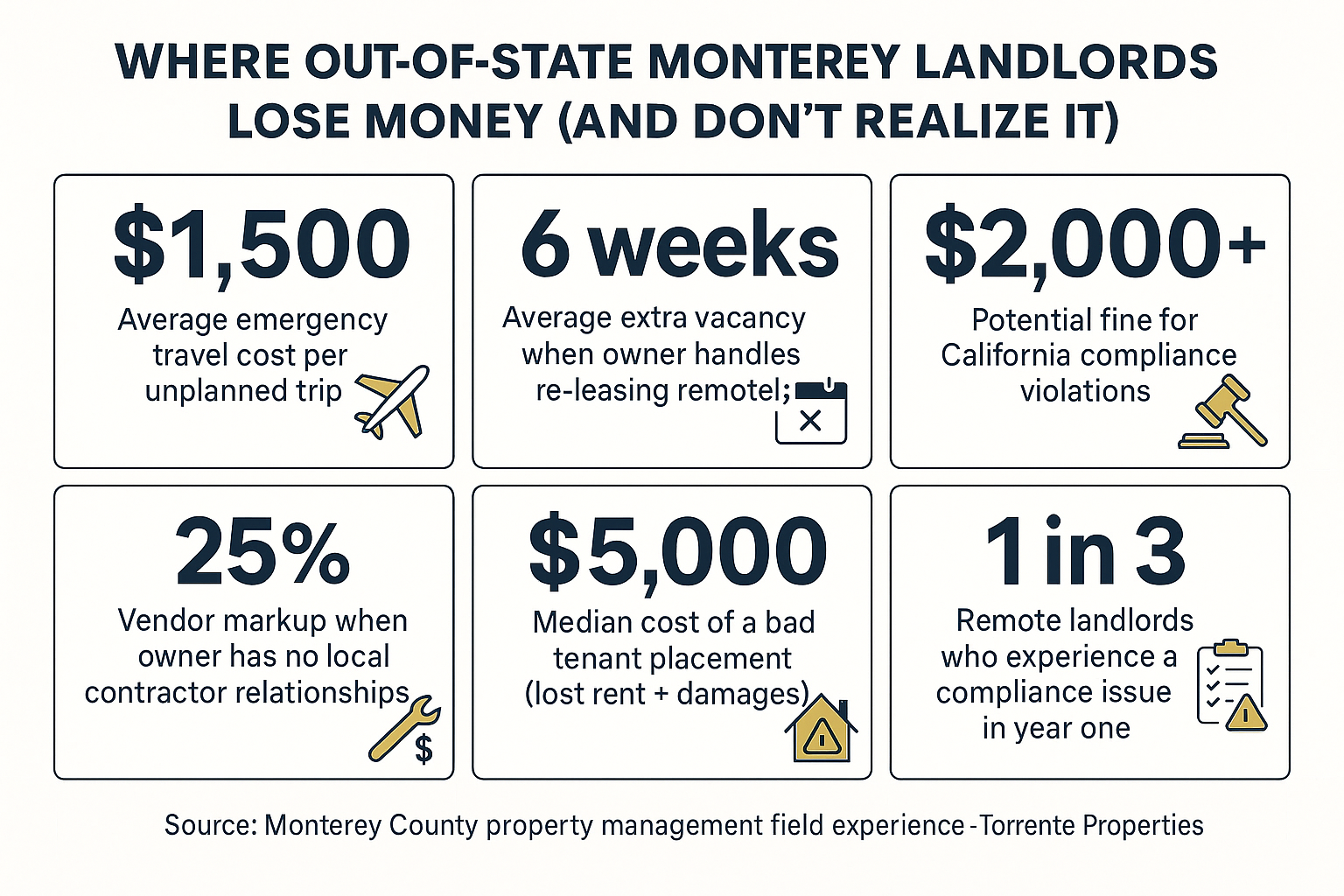
The Real Cost Breakdown for Out-of-State Monterey Landlords
This infographic shows how hidden costs stack up for remote property owners over the course of a typical year — organized by category so you can see where money quietly leaks out.
The Slow Leak: Vacancy and Below-Market Rent
Emergency costs are dramatic. But the slower losses often do more damage over time — and they're almost invisible until you run the numbers at year end.
Vacancy is the clearest example. A Monterey rental sitting empty for six weeks instead of two costs you roughly a month's rent in lost income — anywhere from $2,000 to $4,500 depending on the property and location. That loss happens when a property is priced wrong, listed on only one platform, or shown infrequently because the owner can't be there to open the door.
Below-market rents are just as expensive, and more common than people think. Owners who set rent once and don't adjust it annually — because they're not tracking the local market from out of state — often leave $150 to $400 per month on the table. Over a two-year lease, that's $3,600 to $9,600 you never collected.
This isn't a criticism of landlords who try to manage their own properties. It's a real structural disadvantage of operating from a distance. A landlord in Salinas or Pacific Grove can see what comparable units are renting for because they're living it. An owner in another state is working from data that's already a month or two old.
The difference between listing your house and actually managing it does a good job of explaining why these two things require very different skill sets — and why conflating them is where a lot of owners run into trouble.
What Seasonal and Second-Home Owners Face Specifically
Not every out-of-state owner is a traditional landlord. A significant number of Monterey Peninsula property owners have second homes or seasonal properties that sit vacant for months at a time — and managing those remotely carries a different set of risks.
Vacant homes on the coast are exposed to moisture intrusion, pest activity, and weathering in ways that occupied homes aren't. A small roof leak that a tenant would notice and report within days can go undetected for weeks in a vacant property — and by the time the owner visits, what was a $400 repair has turned into a $6,000 remediation.
For seasonal homeowners specifically, there's also the issue of security. Pebble Beach and Carmel properties have been targeted for break-ins during extended owner absences, and a home that clearly hasn't been checked on in months is a more visible target than one with regular activity.
This is where scheduled property inspections and home watch services fill a real gap. Regular walkthroughs, utility monitoring, and maintenance coordination can catch problems when they're still small — which is the entire point. Caretaker services for seasonal homes on the Monterey Bay outlines what that kind of service actually covers if you're not sure what to look for.
Frequently Asked Questions About Managing a Monterey Property From Out of State
How much does it actually cost to self-manage a Monterey rental from out of state?
It varies a lot depending on how the year goes. In a smooth year with no vacancies or emergencies, you might spend very little. But most remote owners encounter at least one emergency trip, one compliance issue, or one extended vacancy in any given two-year window. When those happen, the out-of-pocket costs typically run $3,000 to $10,000 — often more than what professional management would have cost over the same period.
Do I really need to worry about California rental law if I only own one property?
Yes. California's tenant protection laws apply regardless of how many properties you own. AB 1482 rent caps, the one-month security deposit limit, just-cause eviction requirements, and habitability standards all apply to single-family rentals in Monterey County. Ignorance of the law isn't a defense — and the penalties for violations can be significant.
Is it legal to manage my own rental property in California if I live out of state?
Yes, it's legal. But California does require that landlords be reachable and responsive — and some local ordinances like Salinas' rental registration program require accurate contact information on file. The legal part isn't the problem. The practical part is.
What's the biggest mistake out-of-state Monterey landlords make?
Underestimating how fast small problems become large ones when no one is watching the property regularly. A slow drain, a small water stain, an HVAC filter that hasn't been changed — these are things a tenant might not mention and an absentee owner won't see. By the time something forces attention, the repair is usually much bigger than it had to be.
My property is vacant right now, not rented. Does any of this still apply to me?
Vacant properties carry their own risks — moisture, pest intrusion, security vulnerabilities, and deferred maintenance that compounds without anyone noticing. Seasonal and vacant homes on the Monterey Peninsula are especially vulnerable to marine air and weather-related damage. Regular inspections and a local point of contact are worth it even when no tenant is in place.
Want a Clear Picture of What Your Monterey Property Is Actually Costing You?
Torrente Properties works with property owners across Monterey County — including many who manage from out of state and are realizing the math doesn't add up the way they expected. If you own a rental or vacant home in Monterey, Pacific Grove, Salinas, Carmel, or anywhere on the peninsula, our team can walk you through what local management actually looks like and what it would cost. Reach us by phone at (831) 582-8916 or through the contact form at torrenteproperties.com.


What Happens to Your Monterey Property When You're 500 Miles Away?
You bought property on the Monterey Peninsula — maybe a rental in Seaside, a second home in Pacific Grove, or a house in Salinas you inherited and couldn't quite bring yourself to sell. Now you live in Sacramento, Phoenix, or Portland, and there's a quiet anxiety that comes with not knowing what's happening on the other end of that investment.
That anxiety isn't irrational. Monterey County's rental market moves fast, maintenance issues don't wait for your next visit, and California's landlord-tenant laws change regularly. Most of what goes wrong for out-of-area owners doesn't happen dramatically — it happens gradually, quietly, while you're 500 miles away dealing with your actual life.
This article walks through the two things that matter most: what really breaks down when you're not nearby, and what a realistic management plan looks like for properties along the Central Coast.
The Problems That Start Small and Get Expensive
The most common story we hear from new clients goes something like this: a tenant reported a small leak under the bathroom sink six weeks ago. The owner said they'd handle it on their next visit. By the time anyone looked at it, the subfloor had rotted through and the repair cost $4,200 instead of the $180 it would have been at first call.
Distance doesn't cause deferred maintenance — it just removes the accountability that keeps it from happening. When you're local, you notice the peeling paint, the dripping faucet, the gate that won't latch. When you're in another state, you only find out when the tenant gets frustrated enough to tell you, or when something fails completely.
The same pattern plays out with tenant behavior. A tenant who knows the owner is a four-hour flight away will often feel less observed. That's not a character judgment — it's just human nature. Without regular inspections, small lease violations (unauthorized pets, unapproved occupants, neglected landscaping) become established patterns that are much harder to address legally once they've gone on for months.
In Salinas especially, where multi-unit properties are common and tenant turnover can be higher, renting out your house without a local presence changes the entire dynamic of what you can reasonably expect to catch and correct.
The practical risks of unmanaged distance include:
- Unreported maintenance that compounds into structural damage
- Lease violations that go undetected for months
- Missed inspections that put you out of compliance with local programs
- Vendor overcharging when there's no local eye on the work
- Late rent that drags on because no one is following up consistently

What California Law Requires — Whether You're Here or Not
California doesn't care where you live. Your obligations as a landlord apply regardless of your zip code, and Monterey County has several compliance layers that catch out-of-area owners off guard.
Security deposits are capped at one month's rent as of July 1, 2024, under a law that changed long-standing rules many landlords still think are current. If you collected two months' deposit from a tenant before that date and haven't adjusted your practices for new leases, you may be exposed.
Salinas landlords also have to contend with the city's Residential Rental Registration program, which requires landlords to register their rental units and pay annual fees. Failure to register can result in fines and complicate any future eviction proceedings. It's the kind of administrative detail that's easy to stay current on when you're local — and easy to miss when you're not.
For properties with balconies or exterior elevated elements in multifamily buildings, SB 721 sets inspection deadlines that many owners still haven't addressed. If your Monterey or Salinas apartment building has any exterior stairway, deck, or balcony, there are licensed inspector requirements and repair timelines that carry real legal weight.
Understanding what a property manager actually handles day-to-day goes well beyond rent collection — it includes staying current on exactly these kinds of regulatory requirements so you don't find out about a violation through a fine notice.
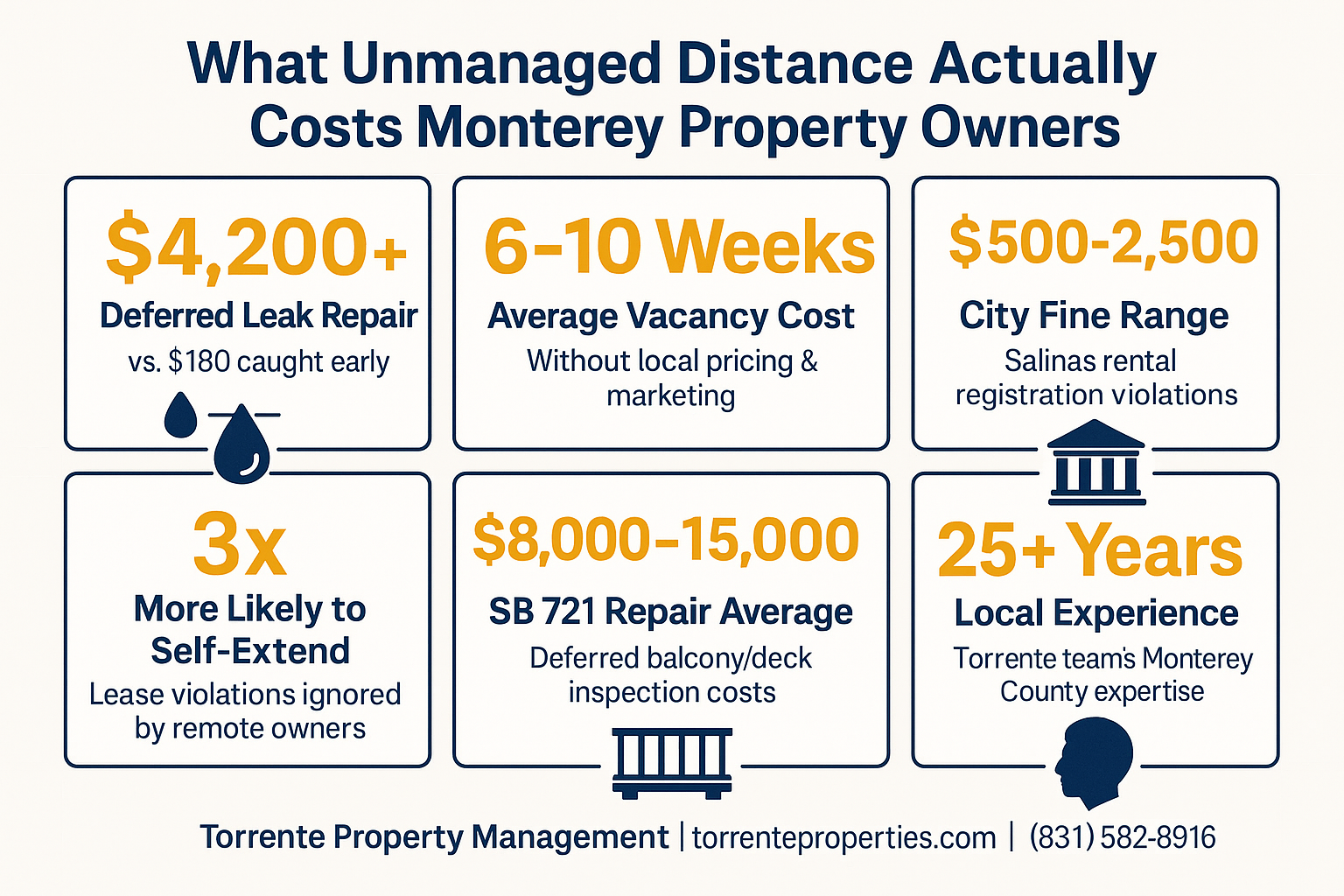
The Real Cost of Unmanaged Distance
This breakdown shows how quickly deferred problems and missed compliance steps add up for out-of-area owners in Monterey County.
Vacant and Seasonal Homes Face a Different Set of Risks
Not every out-of-area owner has a tenant. Many people own seasonal homes on the Monterey Peninsula — places they visit in summer or over the holidays — and those properties sit vacant for months at a time. Vacancy carries its own specific risks that are easy to underestimate.
A home that looks occupied is a harder target for vandalism and break-ins. A home that's clearly vacant — mail piling up, overgrown landscaping, lights never on — signals opportunity. In coastal areas like Pebble Beach and Carmel, where second homes are common, this isn't a theoretical concern.
Beyond security, vacant homes develop problems that tenanted homes rarely do. Water heaters that sit idle can corrode. HVAC systems that don't cycle regularly can fail. Roof issues go unnoticed for entire seasons. Pest intrusions start in the crawl space and are well established before anyone finds them.
For owners in this situation, a scheduled property inspection program — sometimes called home watch or caretaker services — provides the regular eyes-on presence that prevents these silent problems. This typically means bi-weekly or monthly visits to check the property inside and out, coordinate any needed maintenance, and confirm that utilities and systems are functioning. It's a fundamentally different service than tenant management, but equally important for the right property type.
Rented vs. Vacant: What Can Go Wrong and When
The risks look different depending on whether your Monterey County property is occupied or sitting empty. Here's a practical comparison of the most common issues by property type.
| Risk Category | Rented Property | Vacant/Seasonal Property |
|---|---|---|
| Maintenance Detection | Tenant may report — or may not for weeks | No one to notice until next visit |
| Lease Compliance | Violations can go unobserved without inspections | N/A — no tenant |
| Security | Occupied appearance deters break-ins | Visible vacancy increases risk |
| Regulatory Compliance | Registration, deposit rules, habitability laws | Utility oversight, municipal codes |
| Cost of Delayed Action | Lease violation harder to remedy after months | Structural damage accumulates silently |
| Ideal Solution | Full-service property management | Caretaker / home watch program |
What a Realistic Management Plan Actually Looks Like
A lot of out-of-area owners assume they can handle things with a combination of a handyman they trust and a neighbor who keeps an eye out. That setup works until it doesn't — and it usually stops working at the worst possible time.
A real management plan for a distant property owner covers three layers that a handyman-and-neighbor arrangement almost never does:
1. Proactive tenant screening and lease management. The single biggest driver of long-term rental income is tenant quality. A thorough screening process — credit, background, rental history, income verification — done before move-in prevents the majority of problems that happen during tenancy. What makes some rental properties consistently attract reliable tenants starts with who you put in the property, not what you do afterward.
2. Scheduled property inspections. Move-in and move-out inspections are standard. But regular mid-tenancy inspections — typically every 3 to 6 months — are what actually catch lease violations and maintenance issues before they become legal or financial problems. Most self-managing out-of-area owners skip these entirely because they're not physically present to do them.
3. Vendor relationships and financial oversight. A local property manager with established vendor relationships gets faster service and better pricing than a remote owner calling around from out of state. In Monterey County, where skilled tradespeople are in high demand, that access matters. Monthly owner statements and year-end financial summaries also give you a clear picture of your property's performance without having to piece it together from bank records.
For owners who are evaluating whether professional management makes financial sense, do property managers really increase profit breaks down the numbers in plain terms worth reading before you decide.
Frequently Asked Questions About Managing Monterey Property From a Distance
How often should someone inspect a rental property in Monterey County?
At minimum, a move-in inspection, a mid-tenancy inspection every 3 to 6 months, and a move-out inspection. In Salinas, where the city's rental registration program may also trigger compliance checks, more frequent inspections are worth it. For vacant or seasonal homes, bi-weekly or monthly walkthroughs are standard practice to catch issues early.
Do I need to be registered as a landlord in Salinas even if I only own one unit?
Yes. Salinas' Residential Rental Registration program applies to residential rental units in the city regardless of how many you own. There's an annual registration fee and failure to comply can complicate future eviction proceedings. If you're unsure whether your property is registered, that's worth checking immediately.
My tenant handles small repairs themselves and deducts from rent. Is that legal in California?
California law does allow a limited form of 'repair and deduct' — but only under specific conditions, and the deduction is capped at one month's rent. This is a situation where having a proper lease, a clear maintenance reporting process, and a local point of contact prevents most of the ambiguity. Verbal arrangements with tenants around maintenance deductions create legal exposure for the owner.
What's the difference between a property manager and a home watch or caretaker service?
A property manager handles everything related to a tenant — leasing, rent collection, maintenance coordination, compliance, and lease enforcement. A home watch or caretaker service is for vacant or seasonal properties with no tenant. It focuses on regular inspections, utility oversight, security monitoring coordination, and flagging maintenance issues before they get serious. Some firms offer both — which is useful if your property situation changes seasonally.
Can I manage my Monterey rental from out of state without hiring anyone?
Technically, yes. Practically, most owners who try it find that response times suffer, vendor relationships are hard to build remotely, and California's regulatory requirements are difficult to stay current on from a distance. The risk isn't that it's impossible — it's that the gaps compound quietly until something forces your attention.
Ready to Stop Worrying About What You Can't See?
If you own a rental or second home in Monterey, Salinas, Pacific Grove, Seaside, or anywhere along the Central Coast, Torrente Property Management offers the kind of local, hands-on oversight that out-of-area owners genuinely rely on. Our team is based here, knows these neighborhoods, and treats every property we manage with the same attention we'd give our own. Reach us at (831) 582-8916 or through the contact form at torrenteproperties.com — we're happy to talk through your specific situation.
The Difference Between Listing Your House and Actually Managing It
A lot of property owners in Monterey County assume that once they find a tenant and collect the first month's rent, the hard part is over. It isn't. Getting a house listed and filled is a one-time event. Managing that same house is a job that runs every day — whether you're across town in Salinas or across the country in another state.
These two things get confused all the time, and the confusion costs landlords real money. We've seen owners in Pacific Grove and Marina come to us after a rough year of self-managing — not because they couldn't find tenants, but because nobody told them what came after.
This article breaks down where the listing ends and where the actual management begins. If you're weighing whether to handle this yourself or bring in professional help, understanding that line is the most useful place to start.
What the Listing Phase Actually Covers
The listing phase is finite. It starts when you decide to rent and ends when a signed lease is in hand and a qualified tenant has moved in. Done right, it takes two to four weeks in most Monterey County markets.
Here's what's included in a solid listing process:
- Property preparation — cleaning, minor repairs, touch-up paint, and anything that affects first impressions or rental price
- Rental pricing analysis — setting a rate that's competitive for the neighborhood, not just a number you picked from Zillow
- Professional photos and listings — distributed across platforms where Monterey County renters actually search
- Showings and applicant screening — credit checks, background checks, income verification, and rental history review
- Lease drafting and execution — a California-compliant lease that protects you legally from day one
That's a meaningful amount of work, and getting any part of it wrong has consequences. A tenant who looked good on paper but wasn't properly screened, or a lease missing required California disclosures, can turn into an expensive problem. But once that work is done, it's done. What comes next is a different category entirely.
Some landlords understand this well. Others discover it the hard way — usually around month three.
Where Management Starts — and What It Actually Requires
The day after move-in is when property management begins. And unlike the listing phase, it doesn't have an end date.
Management means being responsible for the property in an ongoing, often unpredictable way. For landlords who live out of the area, that responsibility can feel heavy fast. A pipe bursts on a Friday night in Seaside. The tenant calls. Someone has to answer, find a licensed plumber, authorize the work, and document the cost — that night.
The day-to-day management workload includes:
- Rent collection and late payment follow-through — including knowing when and how to issue a legal pay-or-quit notice under California law
- Maintenance coordination — fielding requests, vetting vendors, getting work done at fair prices, and keeping records
- Routine and move-out inspections — documenting property condition with the kind of detail that holds up if there's ever a dispute over a security deposit
- Monthly owner financial statements — tracking income, expenses, and what you actually cleared after repairs and fees
- Compliance tracking — California rental law changes frequently; the one-month security deposit cap that took effect July 1, 2024 caught some self-managing landlords off guard
- Vendor oversight — making sure the landscaper shows up, the HVAC filter gets changed, and small issues don't become expensive ones
None of this is glamorous. And most of it doesn't show up in the listing phase at all. Understanding what a property manager really handles makes the scope clearer than most owners expect before they get into it.
Listing vs. Management: What Each Phase Covers
Here's a side-by-side look at where one phase ends and the other begins — and which one most people underestimate.
| Task | Listing Phase | Ongoing Management |
|---|---|---|
| Rental pricing analysis | ✓ Yes | Periodic only |
| Property photos and marketing | ✓ Yes | As needed |
| Tenant screening and placement | ✓ Yes | On turnover |
| Lease drafting | ✓ Yes | On renewal/turnover |
| Rent collection | — | ✓ Every month |
| Maintenance coordination | — | ✓ Ongoing |
| Routine inspections | Move-in only | ✓ Scheduled |
| Financial reporting | — | ✓ Monthly |
| Compliance monitoring | — | ✓ Ongoing |
| Vendor management | — | ✓ Ongoing |
| Emergency response (24/7) | — | ✓ Year-round |
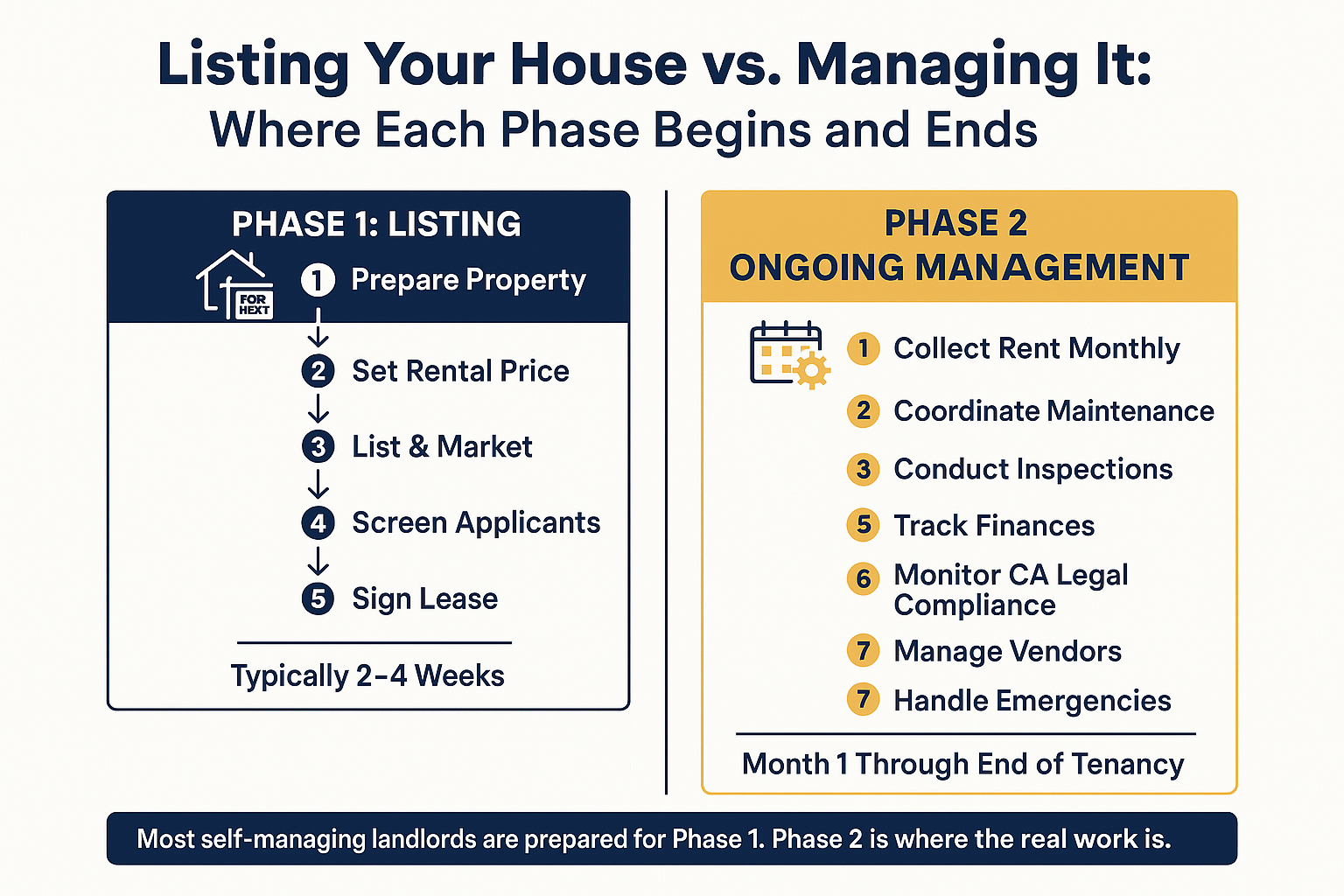
The Property Owner's Timeline: From Listing to Long-Term Management
This timeline shows the two distinct phases of rental ownership and what falls inside each one — helpful for owners deciding where they need support.
Why Monterey County Makes Management Harder Than Most Markets
California landlord-tenant law is already more complex than most states. But Monterey County adds its own layers that catch owners off guard — especially those who moved away and are managing remotely.
Salinas has a Residential Rental Registration program that requires landlords to register rental units with the city. Missing that registration isn't just an oversight — it can affect your ability to enforce a lease. The City of Monterey prohibits short-term rentals under 30 days entirely. And multifamily property owners across the county are working against inspection deadlines tied to AB 2579 and SB 721, which require exterior elevated elements like balconies and decks to be inspected by a licensed professional on a set schedule.
For a landlord managing a Salinas property from out of state, keeping up with these local requirements while also handling day-to-day management isn't just inconvenient — it's genuinely risky. Missing a compliance deadline can mean fines, delays, or worse.
This is also why comparing a flat-fee online listing service to a full-service local property manager isn't a fair comparison. One hands you a tenant. The other keeps you on the right side of California law for as long as that tenant is in your property.
The Decision Most Landlords Face Eventually
At some point, most rental property owners in Monterey County face the same question: is the time and stress of self-managing worth it compared to what professional management costs?
For some owners — especially those who live nearby, have just one property, and genuinely enjoy the work — self-managing can make sense. But for owners who are retired, relocated, out of state, or simply don't want a second job, the math often looks different than expected.
Full-service property management in Monterey County typically runs between 8% and 12% of monthly rent collected. On a home renting for $2,800/month in Salinas, that's roughly $224–$336/month. In exchange, you're handing off the 3 a.m. phone calls, the tenant disputes, the vendor coordination, and the compliance tracking.
What that fee doesn't account for is what a good manager saves you: a faster vacancy fill, a more carefully screened tenant who stays longer, and maintenance issues caught early before they turn into a $4,000 repair. Whether professional management actually increases your bottom line depends on your situation — but the costs of getting management wrong are real and specific.
Owners who inherit a property in Carmel or Pacific Grove and suddenly become accidental landlords tend to underestimate both the time commitment and the local knowledge required. How the housing market has pushed more homeowners into landlord roles has made this a more common situation than it used to be.
Frequently Asked Questions About Listing vs. Managing a Rental Property
Can I just hire someone to find a tenant and then manage the property myself?
Yes, and some landlords do this successfully — especially if they live nearby and have some experience. But be aware that whoever places your tenant may not be available to help when problems come up later. If you go this route, make sure your lease is California-compliant and that you understand Salinas or Monterey's local rental registration requirements before your tenant moves in.
What happens when a tenant stops paying rent? Who handles that?
If you're self-managing, you do. That means issuing a 3-day pay-or-quit notice in the correct legal format, following California's specific timeline, and potentially initiating an unlawful detainer action if the tenant doesn't comply. A property manager handles this entire process on your behalf — including the paperwork and, if necessary, coordinating with a real estate attorney.
Is the security deposit cap new in California?
Yes. As of July 1, 2024, California law limits security deposits to one month's rent for most residential tenancies, regardless of whether the unit is furnished. Previously, landlords could collect up to two months. If you haven't updated your lease language since then, it's worth reviewing.
What's the difference between a property manager and a caretaker service?
A property manager handles occupied rental properties — tenants, rent collection, maintenance, and compliance. A caretaker service is for vacant or seasonal homes where there's no tenant but the property still needs someone checking on it regularly. Torrente Properties offers both, which is relatively uncommon and makes a real difference for seasonal residents and second-home owners on the Monterey Peninsula.
How do I know if a property management company is actually doing the work they say they are?
Ask specifically about monthly financial statements, inspection frequency, and how they handle maintenance requests. A good manager can show you documented records — not just a summary. Referencing their standing with local organizations like the Monterey County Association of Realtors is also a reasonable way to evaluate legitimacy. What landlords often overlook when choosing a property management company is a useful read if you're comparing options.
Ready to Know Exactly What Your Property Needs?
If you own a rental in Monterey County — whether it's occupied, vacant, or somewhere in between — Torrente Properties can give you a clear picture of what's actually involved in managing it well. Our team has been working with Monterey Bay property owners for over 25 years, and we're happy to talk through your situation without pressure or obligation. Call us at (831) 582-8916 or reach out through the contact form at torrenteproperties.com.
Renting Out Your Salinas House? Here's What Changes When You're Not Around
A lot of Salinas homeowners become landlords the same way — a job relocation, a move closer to family, or just the decision that selling didn't make sense right now. So the house stays, a tenant moves in, and suddenly you're managing a property in Monterey County from Sacramento, or Phoenix, or somewhere overseas.
What most people don't anticipate is how much the distance changes the math. The tasks that were easy when you were five minutes away — checking on a noise complaint, approving a repair, confirming the landscaping got done — become real logistical problems when you're three time zones out.
This article focuses on two things that actually matter most when you're renting out a Salinas home from a distance: California's legal requirements that now apply to you as a landlord, and the practical reality of managing maintenance and tenant issues remotely. If you're about to make this transition, both deserve more thought than most first-time landlords give them.
California Landlord Law Doesn't Care Where You Live
Being out of the area doesn't change your obligations under California law — it just makes them harder to stay on top of.
The most significant recent change for Salinas landlords: California's security deposit cap dropped to one month's rent for all residential rentals as of July 1, 2024 (AB 12). It doesn't matter whether the property is furnished, unfurnished, or how many units you own. If you collected two months at any point and haven't adjusted your practices, you're already out of compliance.
Salinas adds another layer with its Residential Rental Registration program, which requires landlords to register rental properties with the city. If you've moved away and let that registration lapse, or never set one up properly, that's a compliance gap that can create problems when you eventually try to resolve a tenant dispute or sell.
Beyond those two, California law generally requires:
- Written notice of entry at least 24 hours in advance for non-emergency situations
- Habitability standards that must be maintained regardless of how far away you are
- Repairs completed within a reasonable timeframe — courts have interpreted this as quickly as a few days for serious issues
- Proper security deposit accounting within 21 days of a tenant moving out, with itemized deductions
The problem with managing these from a distance isn't that the rules are complicated — most are straightforward. The problem is that a delayed response to any of them, because you didn't see the email or couldn't coordinate a vendor in time, can turn a minor compliance issue into a legal one. You can read more about what Salinas landlords often overlook before getting started — a lot of it applies directly to single-family rentals too.
What Remote Maintenance Coordination Actually Looks Like
Maintenance is where most out-of-area Salinas landlords run into the most friction — and the most unexpected costs.
When you're local, you can walk the property yourself, get a second opinion from a neighbor, or call three plumbers and pick the one who can come Tuesday. When you're remote, you're almost entirely dependent on who you have in your vendor network and how fast they respond.
Here's what tends to go sideways without a system in place:
- A tenant reports a water heater issue on a Friday evening. You don't see the message until Saturday morning. By Sunday, they're without hot water — which is a habitability issue under California law.
- A slow roof leak gets reported but not treated as urgent. Six weeks later, the ceiling shows visible damage and the repair cost has doubled.
- A vendor does work you didn't authorize at a price you didn't agree to, because the tenant let them in and the job was done before you could respond.
None of these situations are unusual. They happen regularly to self-managing landlords who are out of the area, even ones who are genuinely trying to stay on top of things.
The cost difference between catching a plumbing issue early versus late can be $200 versus $2,000. In Salinas, where aging housing stock is common in neighborhoods like the East Market Street corridor and older sections of North Salinas, deferred maintenance tends to compound faster than owners expect.
Having a reliable local vendor network — plumbers, electricians, HVAC techs, and a general handyman — takes years to build. And coordinating them from out of state, while also holding down a job or managing family obligations, is a significant time commitment that most people underestimate before they try it. If you're weighing what hands-on management actually involves, this breakdown of what a property manager really handles day-to-day is worth reading before you decide.
Self-Managing vs. Professional Management: The Remote Landlord Comparison
This is a practical look at how the two approaches differ specifically when you're managing from out of the area — not a general comparison.
| Scenario | Self-Managing Remotely | With a Local Property Manager |
|---|---|---|
| Tenant reports a leak on Friday night | You see it Saturday; vendor search starts Monday | On-call coordination begins immediately |
| Salinas rental registration renewal | Your responsibility to track and file | Handled as part of ongoing compliance management |
| Security deposit return (21-day deadline) | You manage itemization, math, and mailing | Handled with documentation trail |
| Routine property inspection | Requires a trip or trust in a neighbor | Scheduled and documented with photos |
| AB 12 deposit compliance (July 2024 change) | Your responsibility to know and apply | Built into lease drafting from the start |
| Tenant communication response time | Depends on your schedule and time zone | Local team responds during business hours |
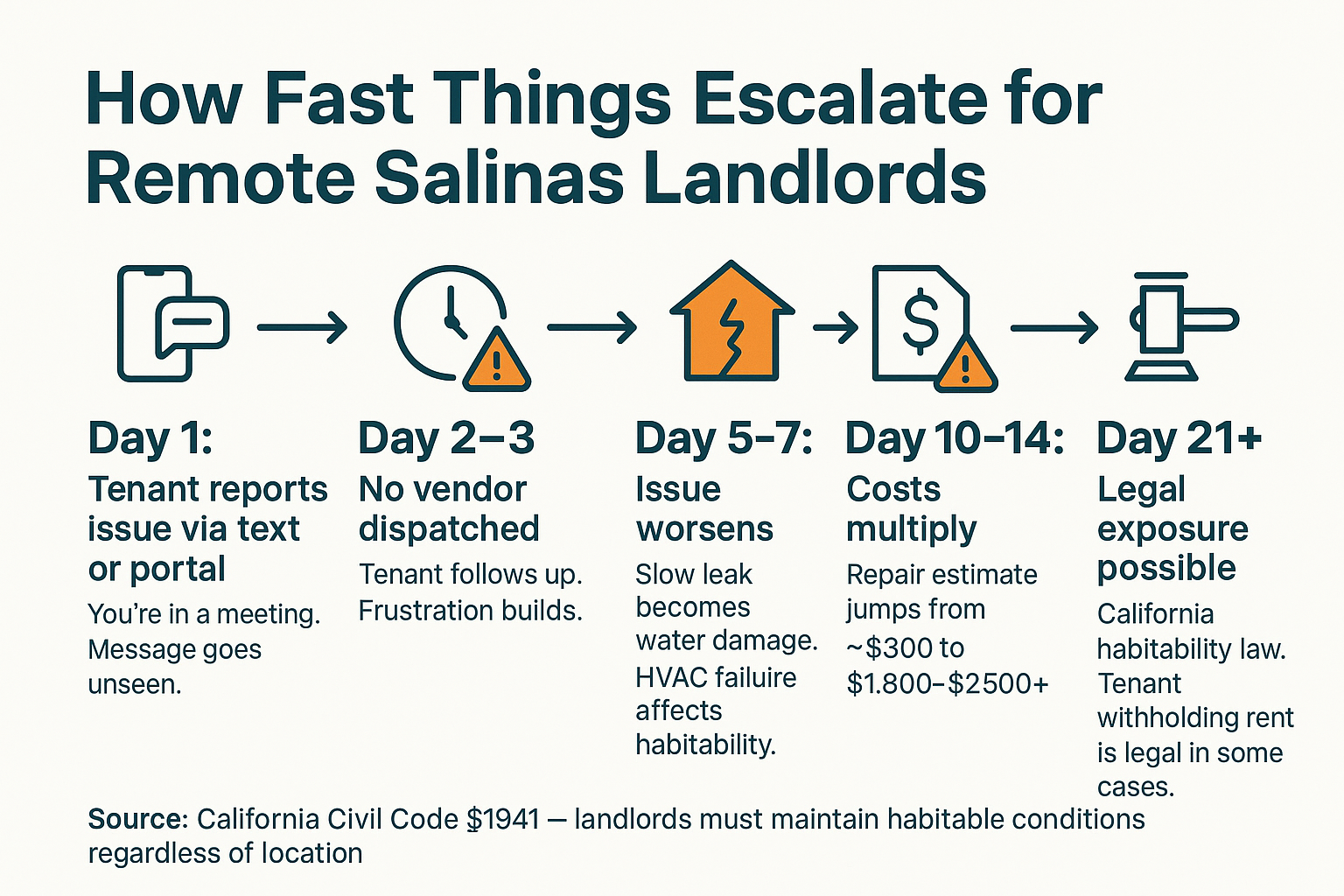
The Remote Landlord's Risk Timeline
This shows how quickly a small, unaddressed issue can escalate when you're managing a Salinas rental from out of the area.
The Tenant Screening Decision You Make Before You Leave
One of the decisions that has the most long-term impact on your experience as a remote landlord is one you make before you're even gone: who you place in the property.
A well-screened tenant in a Salinas rental significantly reduces the number of problems you'll deal with from a distance. A tenant who pays on time, reports issues promptly, and treats the property with basic care changes your workload from reactive to almost passive.
But tenant screening done poorly — or rushed because you wanted the vacancy filled before your move date — tends to follow you for the entire length of that lease.
Here's what a thorough screening process should actually include:
- Full credit report review, not just a score — look at payment history and any prior evictions
- Income verification at a minimum of 2.5–3x the monthly rent (a common threshold in Monterey County)
- Rental history with actual calls to prior landlords, not just references the applicant provides
- Background check through a compliant tenant screening service
In Salinas, where the rental market sees consistent demand from agricultural workers, healthcare employees from Natividad Medical Center, and families relocating from more expensive parts of the Bay Area, there's no shortage of applicants. The temptation to move quickly on a promising-looking application is real — but the cost of a bad placement when you're managing from out of state is much higher than a few extra weeks of vacancy.
For a detailed look at what separates good tenant placement from fast vacancy fills, this piece on how property managers prioritize tenant quality covers the differences clearly.
Frequently Asked Questions About Renting Out a Salinas Home Remotely
Do I have to register my Salinas rental property if I live out of state?
Yes. Salinas's Residential Rental Registration program applies to the property, not to where you live. If you're renting out a home in Salinas, you're expected to register it with the city. The registration requirement doesn't go away because you've relocated.
How much can I charge for a security deposit in California now?
As of July 1, 2024, California limits security deposits to one month's rent for residential properties — regardless of whether the unit is furnished or unfurnished, and regardless of how many units you own. The old two-month rule for furnished units no longer applies.
What happens if a tenant has a maintenance emergency and I can't respond in time?
California Civil Code §1941 requires landlords to maintain habitable conditions. If a serious repair — no heat, no hot water, a significant leak — goes unaddressed for too long, tenants may have legal grounds to withhold rent or arrange repairs themselves and deduct the cost. The threshold is subjective, but courts tend to side with tenants on habitability issues when the landlord is unreachable or slow to act.
Is it legal for me to manage my own rental property from out of state?
Yes, it's legal. There's no California requirement that a landlord live locally or hire a property manager. But the legal obligations — response times, notice requirements, deposit accounting — apply equally whether you're in Salinas or in another state.
If I hire a property manager, what does it actually cost in Salinas?
Management fees for residential properties in the Salinas and Monterey County area typically run 8–12% of monthly rent collected, depending on the company and the scope of services. Some companies charge separately for lease renewals, inspections, or maintenance coordination. On a home renting for $2,800/month, that's roughly $224–$336/month — an amount most landlords recover quickly through fewer vacancy days, better tenant placement, and avoided repair escalations. For more context on whether the cost pencils out, this breakdown of whether property managers actually increase profit is worth reading.
Managing a Salinas Rental From a Distance? Let's Talk.
Our team has worked with Monterey County property owners for over 25 years — including plenty of landlords who inherited a property, relocated for work, or simply reached the point where self-managing from out of state stopped making sense. If you're renting out a Salinas home and want to talk through what professional management would actually look like for your specific situation, we're easy to reach at (831) 582-8916 or through the contact form at torrenteproperties.com.

When Does a Salinas Apartment Actually Need a Property Manager?
Most Salinas landlords don't hire a property manager because they think they can't afford one. Then they spend a year chasing late rent, fielding 11pm maintenance calls, and trying to decode California's AB 1482 rent cap rules — and they recalculate.
The honest answer to when a Salinas apartment needs a property manager isn't a unit count or a dollar figure. It's about what self-managing is actually costing you, and whether that cost is visible or hidden.
This article breaks down the two situations where professional management goes from optional to genuinely necessary — and what the numbers actually look like in Monterey County's rental market.
What Self-Managing a Salinas Apartment Actually Costs You
Most landlords who self-manage think of property management fees as the cost they're avoiding. But that framing leaves out what they're spending instead.
In Salinas, a self-managing landlord typically deals with:
- Tenant screening — credit pulls, rental history calls, employment verification, and cross-checking against eviction databases
- Legal compliance — staying current with California's Tenant Protection Act, AB 1482 rent caps, and Salinas' Residential Rental Registration program
- Maintenance coordination — finding licensed, insured contractors at fair prices, following up on work orders, and being available when something breaks on a Saturday
- Rent collection and accounting — tracking payments, issuing late notices within legal timeframes, and producing records at tax time
- Move-out inspections and deposit accounting — California's security deposit law is strict, and mistakes here lead to small claims court
A landlord managing one four-unit building might spend 10 to 15 hours per month on these tasks during a stable period — and significantly more during a turnover. At any professional's billing rate, that's real money.
And the hidden cost nobody talks about: one bad tenant placement in Salinas can cost $8,000 to $15,000 when you add up lost rent, legal fees, and unit rehabilitation after an eviction. Understanding what Salinas landlords wish they'd known earlier makes clear that most of those expensive lessons involve decisions made at the leasing stage.

The Distance Problem: When Geography Makes Self-Management Impractical
If you own a rental near the Natividad Medical Center corridor or along North Main Street in Salinas and you live more than 30 minutes away, you're already operating at a disadvantage.
California law requires that landlords either live within 25 miles of the rental property or designate a local agent for service of process. That's not optional. And it's just the beginning of what distance complicates.
Here's what remote self-management looks like in practice:
- A tenant reports a water heater failure on a Friday evening. You're in San Jose. You need a licensed plumber in Salinas within a few hours — or you're looking at habitability liability.
- Your unit turns over in October. You need someone to walk the property, document condition, supervise cleaning, and get it relisted before the slower winter rental season costs you a month of vacancy.
- A neighbor reports a noise complaint. The city contacts you. You need to respond and document — fast.
None of this works well from a distance without a local representative. Professional managers in Monterey County typically charge 8% to 10% of monthly rent for ongoing management, plus a leasing fee of roughly one month's rent at placement. On a Salinas two-bedroom renting for $1,800/month, that's about $144 to $180 per month in management fees — a straightforward trade for someone who can't be on-site when problems happen.
For landlords managing from out of state or dealing with a property they inherited, that math is usually obvious. For someone who lives in Monterey or Pacific Grove and thinks they're close enough to handle it themselves, the real test is whether they have the time and the local contractor relationships to respond reliably. Most don't.
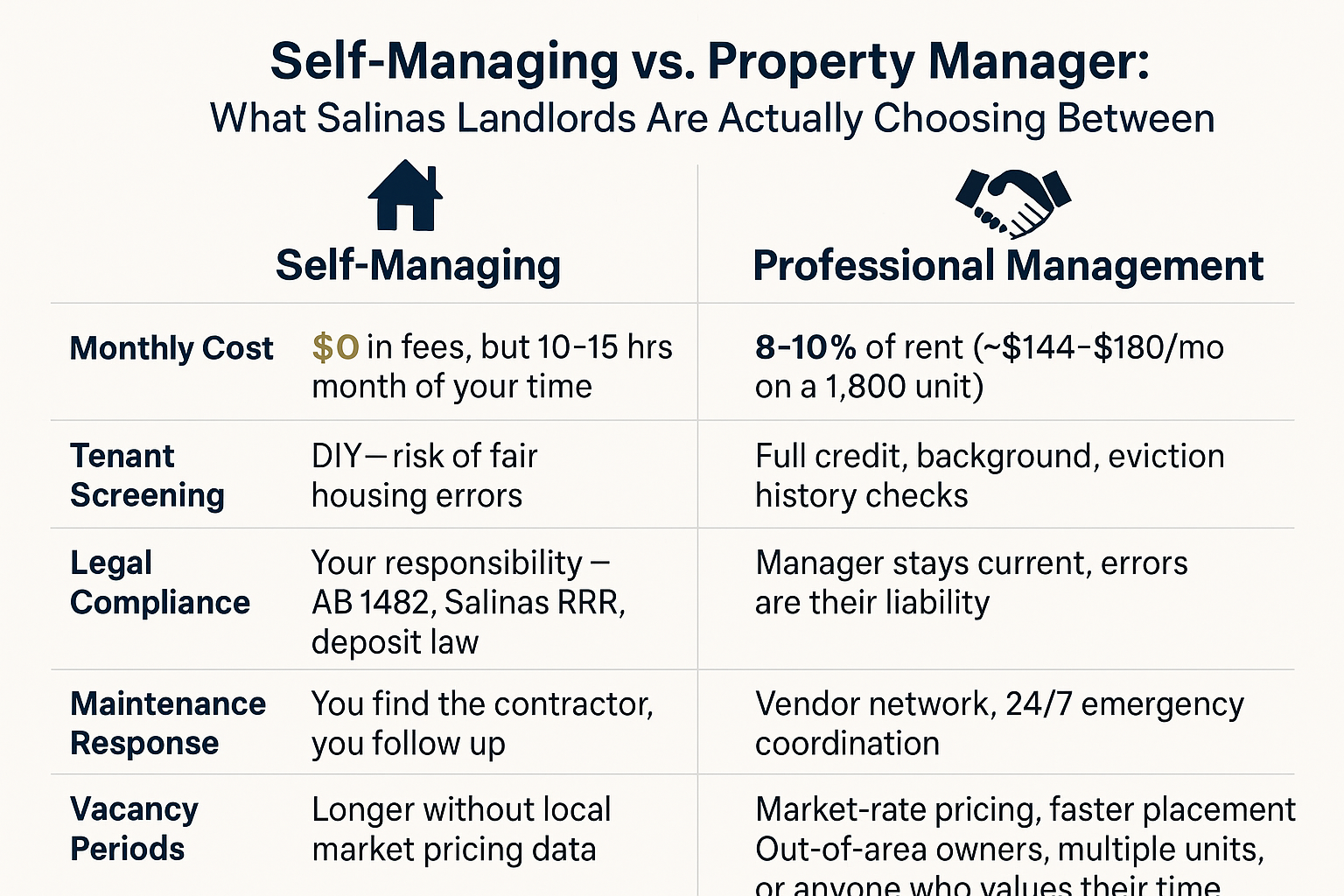
Self-Managing vs. Professional Management: A Side-by-Side Look
This comparison covers the most common decision points Salinas landlords face when weighing self-management against hiring a property manager.
When California Law Starts Requiring More Than Most Landlords Expect
California is one of the most landlord-regulated states in the country, and Salinas adds its own layer on top.
The Salinas Residential Rental Registration (RRR) program requires most rental units to be registered with the city. That's a straightforward compliance step — but it's easy to miss if you're not plugged into local rental housing news. Non-compliance creates exposure you don't want.
Then there's the state-level complexity:
- AB 1482 caps annual rent increases at 5% plus local CPI (or 10%, whichever is lower) for most Salinas apartments built before 2007. Getting this wrong — even by accident — exposes you to tenant legal action.
- California's security deposit law, updated effective July 1, 2024, caps deposits at one month's rent for most residential rentals. Landlords who haven't updated their lease templates are already out of compliance.
- SB 721 requires exterior elevated element inspections (balconies, walkways, stairways) for multifamily buildings with three or more units — with an initial compliance deadline that many Salinas property owners are still catching up on.
None of this is optional, and none of it is intuitive. A property manager who works in Salinas every day stays current on these changes as a matter of course. A self-managing landlord has to actively track legislation, update leases annually, and know when to call an attorney.
For landlords managing apartment properties in Salinas with multiple units, one compliance mistake can affect every tenant in the building simultaneously. The exposure multiplies with unit count.
Salinas Rental Compliance Checklist: What Landlords Are Responsible For
These are the active compliance obligations for residential rental owners in Salinas and under California state law as of 2025. Gaps in any of these areas create legal exposure.
| Requirement | Who It Applies To | Key Deadline / Detail |
|---|---|---|
| Salinas Residential Rental Registration | Most Salinas rental units | Annual registration with the City of Salinas |
| AB 1482 Rent Cap Compliance | Most units built before 2007 | Max increase: 5% + CPI or 10%, whichever is lower |
| Security Deposit Cap (1 month) | Nearly all residential rentals | Effective July 1, 2024 — leases must reflect this |
| SB 721 Balcony Inspection | Buildings with 3+ units | Initial inspection required by state deadline; consult licensed inspector |
| Local Agent Designation | Landlords living 25+ miles from property | Required by California law — must be on file |
| Move-Out Deposit Itemization | All landlords | Must be delivered within 21 days of move-out with receipts |
The Unit Count Question: Does It Actually Matter?
A common rule of thumb says you need a property manager once you hit four or more units. That's a reasonable starting point, but it's not the whole picture.
A landlord with a single four-plex near Sherwood Park in Salinas can absolutely self-manage — if they're local, have solid contractor relationships, and are willing to treat it like a part-time job. Some do it well for years.
But a landlord with one duplex who lives in the Bay Area, works full-time, and has never written a California-compliant lease is more exposed than someone managing eight units who has been doing this for two decades.
The real triggers are:
- Distance from the property — anything over a 30-minute drive makes consistent self-management difficult
- Your availability during business hours — maintenance vendors, city inspectors, and tenant issues don't schedule themselves around your job
- Your familiarity with California tenant law — not knowing the rules isn't a defense when a tenant files a complaint
- Whether a turnover or vacancy would genuinely hurt you financially — if you need that rent to cover a mortgage, an extended vacancy from a slow DIY re-lease is a real risk
Landlords asking whether hiring a property manager in Salinas is actually worth it usually find that the math tips decisively once they factor in their own time and the cost of one bad placement.
Frequently Asked Questions About Salinas Apartment Property Management
How much does a property manager charge for a Salinas apartment?
Most Salinas property managers charge 8% to 10% of monthly rent for ongoing management. On top of that, expect a leasing fee — typically one month's rent — when the manager places a new tenant. On a two-bedroom renting at $1,800/month, ongoing management runs roughly $144 to $180 per month. Some firms charge flat fees instead; compare what's included before focusing on the percentage alone.
Do I legally need a property manager if I live out of state?
Not exactly — but California law requires a local agent for service of process if you live more than 25 miles from your rental property. That local agent can be a property manager, an attorney, or another designee. If you're managing from out of state without one, you're technically non-compliant and could face problems if a legal notice needs to be served.
What is the Salinas Residential Rental Registration program?
Salinas requires most residential rental property owners to register their units with the city through the Residential Rental Registration (RRR) program. It's an annual registration process — not an inspection-based program like Santa Cruz's, but it still requires landlords to stay current. Failure to register can result in fines and complications if you ever need to pursue an eviction through the court system.
Can a property manager help me if I inherited a rental in Salinas?
Yes, and this is one of the most common situations we see. Inherited properties often come with existing tenants, deferred maintenance, and outdated lease agreements. A good local manager can assess the property's current condition, review existing leases for compliance, and get the property operating correctly — often without displacing current tenants. Understanding how some landlords end up owning rentals without planning to is a useful read for families in this situation.
What happens if I get the security deposit wrong under the new California law?
As of July 1, 2024, California limits security deposits to one month's rent for most residential rentals. If you collected more than that under an old lease template, you may need to return the excess. And if you fail to return deposits (minus documented deductions) within 21 days of move-out with proper itemization, tenants can sue for up to twice the deposit amount in small claims court. It's one of the more common — and avoidable — mistakes self-managing landlords make.
Does it make sense to hire a property manager for just one unit?
It depends on your situation more than the unit count. If you live far away, work full-time, or simply don't want to deal with the legal and logistical demands of being a landlord, professional management makes sense for a single unit. The management fee on one unit is real money, but so is the time you'd spend — and the exposure you'd carry — managing it yourself without deep knowledge of California rental law.
Not Sure Where You Stand? Let's Talk Through It.
If you own a rental in Salinas, Monterey, or anywhere in Monterey County and you're trying to figure out whether self-managing still makes sense, Torrente Property Management is glad to have that conversation with you — no pressure, just a clear-eyed look at your situation. Reach us at (831) 582-8916 or through the contact form at torrenteproperties.com.
7 Things Salinas Landlords Wish They Knew Before Managing Apartments
Most landlords in Salinas don't plan to become landlords. They inherit a fourplex from a parent, relocate for work and can't sell, or buy a rental thinking it'll run itself. Then the first difficult tenant shows up, or the first compliance notice from the City, and the learning curve gets very real very fast.
Salinas is one of the most active rental markets on the Central Coast. Monterey County has some of the most tenant-protective rental laws in California, and the City of Salinas adds its own layer of local requirements on top of state law. Missing either one can cost you.
This article pulls together the things experienced Salinas apartment owners most often say they wish someone had told them before they started. No fluff — just the specific lessons that tend to show up the hard way.
1. California's Security Deposit Cap Changed in 2024 — and Many Landlords Still Don't Know
As of July 1, 2024, California law (AB 12) limits security deposits to one month's rent for most residential rentals — regardless of whether the unit is furnished. This was a significant change from the old two-month cap that landlords had relied on for years.
For a typical Salinas apartment renting at $1,800 to $2,200/month, that means your maximum deposit is the same number. You can no longer charge first month, last month, and a deposit separately and still stay legal.
There are limited exceptions — landlords who own two or fewer residential properties with no more than four total units can still collect up to two months. But if you own more than that, the one-month cap applies. The penalty for overcharging isn't just returning the extra amount — a tenant can sue for damages. Getting this wrong on the front end is an expensive mistake that's completely avoidable.
2. Salinas Has a Residential Rental Registration Program
The City of Salinas runs a Residential Rental Registration (RRR) program that requires landlords to register their rental properties and pay an annual fee. A lot of out-of-area owners — and even some local ones — find out about this program only after receiving a notice.
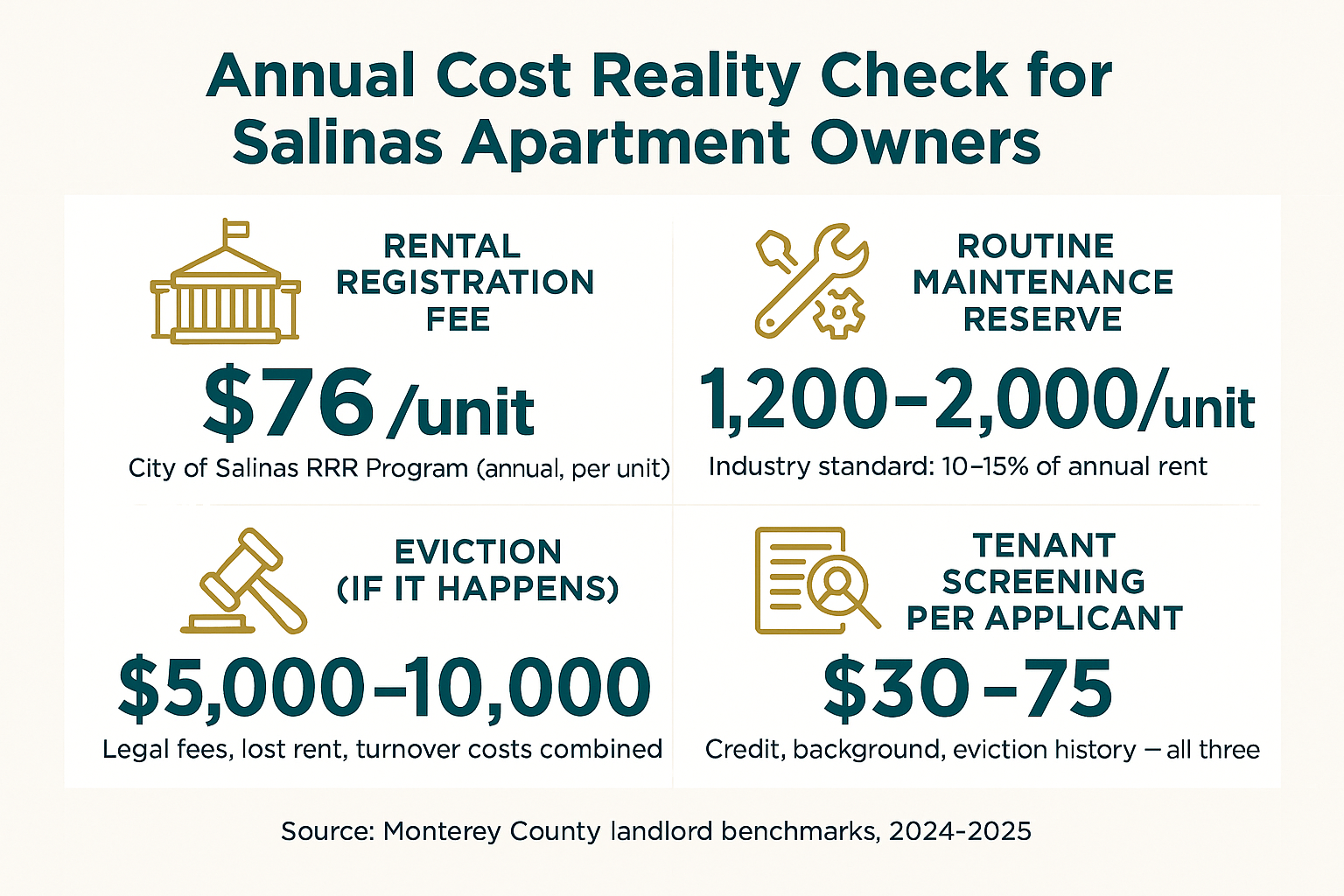
Registration fees are based on unit count and are currently set at $76.15 per unit per year (verify the current rate with the City, as fees adjust). The program also triggers periodic property inspections to verify habitability standards are being met.
Failing to register doesn't just mean a fee — it can complicate your ability to enforce a lease or collect rent in an eviction proceeding. Courts in Monterey County have ruled against landlords on procedural grounds when registration was lapsed. If you own rental property in Salinas, registration isn't optional. It's the cost of doing business in this market.
For a broader view of what managing apartments here actually involves, this guide to apartment property management in Salinas covers the operational side in detail.
3. Tenant Screening Is Where Most Apartment Problems Start
Ask any experienced Salinas landlord what their worst rental year looked like, and almost every story starts the same way: they approved someone they had a bad feeling about, or they moved too fast to fill a vacancy.
In a market where evictions can take 3 to 6 months and legal fees can reach $5,000 to $10,000, the cost of one bad tenant placement far exceeds a month or two of vacancy. Screening isn't about being picky for its own sake — it's about protecting what's often a $500,000+ asset.
A solid screening process for Salinas apartments includes:
- Credit check — look for patterns, not just a score
- Rental history verification — actually call prior landlords, not just the most recent one
- Income verification — most Salinas landlords require gross monthly income of at least 3x the rent
- Background check — criminal history review in compliance with California's fair chance housing rules
- Eviction history search — a separate search from a credit report; don't skip it
California law restricts how you can use certain background information, including specific rules under the Fair Chance Ordinance that apply in some jurisdictions. Knowing those rules before you reject an applicant keeps you out of fair housing complaints. Understanding what makes tenants reliable over time is just as important as the screening checklist itself.
What Salinas Landlords Actually Spend Per Unit Per Year
These are the real recurring costs most first-time apartment owners in Salinas underestimate when building their rental budget.
4. AB 1482 Rent Control Applies to Most Salinas Apartments — and Landlords Often Discover This at the Worst Time
California's AB 1482 (Tenant Protection Act) caps annual rent increases at 5% plus local CPI, or 10% — whichever is lower — for most apartments in California that aren't exempt. In Salinas, where CPI has been running around 3–4%, that generally means you're capped at 8–9% annually.
But the bigger issue is the just cause for eviction requirement. Once a tenant has lived in a covered unit for 12 months, you need a legally recognized reason to end their tenancy — not just a desire to re-rent at a higher rate. Covered reasons include non-payment, lease violations, or owner move-in (with proper notice and relocation assistance in some cases).
Exemptions include single-family homes (with proper written notice to tenants) and condos, properties built within the last 15 years, and some others. But a standard Salinas apartment complex built before 2010 is almost certainly covered.
This matters most when landlords try to raise rents aggressively after a market shift, or when they want to move a family member into a unit. Not knowing the rules going in creates real legal exposure. This overview of the current Salinas property management landscape covers how these rules are playing out for local owners right now.
AB 1482 Quick Reference: Covered vs. Exempt Salinas Rentals
Most Salinas apartment owners are covered by AB 1482 rent and eviction protections. Here's a basic reference — always confirm your specific property with a licensed professional.
| Property Type | AB 1482 Covered? | Key Notes |
|---|---|---|
| Apartment complex built before 2010 | Yes | Rent cap + just cause eviction required |
| Single-family home (with written notice) | Exempt | Must provide AB 1482 exemption notice in lease |
| Condo sold separately | Exempt | Must notify tenant in writing |
| New construction (built 2010 or later) | Exempt for 15 years from cert of occupancy | Exemption expires; track the date |
| Duplex where owner occupies one unit | Exempt | Owner-occupied exemption applies |
5. Maintenance Response Time Is a Legal Issue, Not Just a Customer Service One
California law requires landlords to maintain rental units in a habitable condition at all times. In practice, this means responding to habitability issues — water leaks, heating failures, pest infestations — within a timeframe courts take seriously. A 24-hour response for emergency conditions is the standard most property managers and attorneys recommend.
In Salinas, where rental housing stock includes a lot of older buildings, deferred maintenance is common. But "I didn't know" is not a legal defense when a tenant withholds rent, calls the City's Code Enforcement office at 831-758-7157, or pursues a repair-and-deduct remedy under California Civil Code Section 1942.
The practical issue for apartment owners managing from a distance — or managing multiple units while holding a day job — is having reliable vendors on call. Plumbers, HVAC techs, and electricians in the Salinas/Monterey area are busy. Without pre-established relationships, a 24-hour response can quickly turn into a 72-hour wait and a code complaint.
This is one of the most common reasons landlords eventually decide a property manager is worth the cost — not because they can't manage the property, but because they can't manage it fast enough.
6. The Move-Out Inspection Process Has Strict Rules — and Most Landlords Miss the Pre-Move-Out Step
California is one of the few states that requires landlords to offer tenants a pre-move-out inspection — also called an initial inspection — so tenants have a chance to fix issues before they lose their deposit. Skipping this step, even if unintentional, can forfeit your right to make certain deductions.
The timeline matters:
- Request the initial inspection within 2 weeks of the tenant's notice to vacate
- Conduct the inspection no earlier than 2 weeks before the move-out date
- Provide a written itemized statement of deficiencies after the inspection
- Return the deposit (or itemized deductions) within 21 calendar days of the tenant vacating
Deductions must be for damage beyond normal wear and tear — a term California courts interpret more narrowly than most landlords expect. Repainting a room because a tenant lived there for four years is typically wear and tear. Repainting because of crayon drawings on the walls is not.
Documentation is everything. Move-in and move-out photo sets, dated and organized, are the only evidence that holds up if a tenant disputes deductions in small claims court.
7. Managing Apartments Long-Distance Is a Different Job Entirely
A lot of Salinas apartment owners don't live in Salinas. Some are in the Bay Area, some are out of state, and some are military families managing inherited properties during deployment. Distance changes everything about how property management works.
The problems that are manageable when you live nearby — a tenant who pays late, a slow maintenance vendor, a lease renewal that needs handling — become genuinely difficult to manage from Sacramento or Phoenix. And Salinas tenants, like tenants everywhere, can tell when a landlord isn't watching closely.
Remote ownership works best when there's a clear system in place:
- A local point of contact who can walk a property within hours, not days
- An online portal for rent collection, maintenance requests, and documentation
- Regular property inspections — at minimum annually, ideally twice a year
- A vendor network that doesn't require the owner to coordinate every job
For property owners considering what that structure should look like, this comparison of property management companies in the Salinas market outlines what to look for in a local management partner. And this guide on what landlords commonly overlook when hiring a property manager is worth reading before making that decision.
Frequently Asked Questions from Salinas Apartment Owners
Do I have to register my rental property with the City of Salinas even if I only own one unit?
Yes. The Salinas Residential Rental Registration program applies to rental units regardless of how many you own. The registration fee is currently $76.15 per unit per year, and unregistered properties can face complications in lease enforcement and eviction proceedings. Register through the City of Salinas Code Enforcement division.
My apartment building was built in 2005. Does AB 1482 apply to it?
Almost certainly yes. AB 1482 exempts buildings for 15 years from their certificate of occupancy. A building from 2005 is well past that window, so both the rent cap (5% + CPI or 10%, whichever is lower) and just cause for eviction requirements apply. Double-check your specific certificate of occupancy date to be sure.
A tenant says I owe them relocation assistance for a rent increase. Is that true?
It depends. AB 1482 requires one month's rent in relocation assistance if a landlord terminates a tenancy for a no-fault reason — like owner move-in or substantial remodel — in a covered unit. A rent increase alone doesn't trigger relocation assistance. But if a tenant vacates because you raised rent above the legal cap, you may have larger legal exposure. When in doubt, talk to a California landlord-tenant attorney before acting.
How long do I have to return a security deposit after a tenant moves out?
21 calendar days from the date the tenant vacates. The deposit — or an itemized written statement of deductions with receipts — must be mailed or delivered within that window. Missing this deadline can result in a court awarding the tenant up to twice the deposit amount in penalties.
Is it worth hiring a property manager for a small apartment building in Salinas?
For most owners managing more than two units, or managing from any distance at all, the answer is usually yes — not because management is impossible to do yourself, but because the compliance requirements, maintenance coordination, and tenant relations work adds up fast. A local manager typically charges 8–10% of monthly rent collected. For a 4-unit building in Salinas collecting $8,000/month, that's $640–$800/month for someone handling all of it. Most landlords who've tried it both ways say the trade-off is worth it.
Managing Salinas Apartments and Want a Second Opinion?
Torrente Properties has been working with apartment owners across Monterey County for over 25 years — including landlords who came to us after learning these lessons the expensive way. If you own rental property in Salinas, Monterey, Seaside, or anywhere on the Central Coast and want to talk through your situation, our team is easy to reach at (831) 582-8916 or through the contact form at torrenteproperties.com.

Caretaker Services for Seasonal Homes: Monterey Bay Guide
A lot of second-home owners in Monterey Bay have the same moment of panic. The weather turns, you see a storm warning on your phone, and your mind goes straight to the house. Is the side gate latched? Did anyone notice that small roof issue from the last visit? If a pipe leaks while the place is empty, who finds it before it becomes a major cleanup?
That worry is reasonable. A vacant home on the coast can look perfectly fine one week and develop a costly problem the next. Salt air, wind, fog, landscaping demands, and long stretches without anyone inside all change how the house needs to be managed.
Professional caretaker services for seasonal homes exist for exactly that reason. The point isn't just to "check on the place." It's to create a routine of oversight, documentation, and response so the home doesn't sit unattended in the ways that matter most.
Protecting Your Monterey Bay Home While You're Away
If you're reading this from Arizona, Texas, Nevada, or the Bay Area while your Monterey, Carmel, or Pebble Beach home sits empty, you're probably not worried about the obvious things. You already lock the doors. You likely have an alarm. What usually causes trouble is the quieter stuff. A damp guest bath, a failed irrigation valve, a breaker issue, a gate left unsecured after a vendor visit.

In this area, winter storms get the attention, but many expensive problems start small and stay hidden because no one is there to notice them early. That's why owners increasingly look at vacant-home care as asset protection, not convenience. If you're thinking through broader security measures as well, this overview of Clouddle Inc integrated asset protection is a useful outside reference on protecting property from avoidable exposure.
What owners usually need most
Most seasonal homeowners don't need someone living in the property. They need someone local who notices change, checks vulnerable systems, and keeps a record of what was found and what was done.
That includes things like:
- Scheduled inspections that happen on a real cadence, not "when someone has time"
- Proof of condition through notes and photos
- Vendor coordination when a plumber, roofer, grounds maintenance professional, or electrician needs access
- Utility and systems oversight so a minor issue doesn't sit for weeks
- A clear response path when weather or an equipment failure creates urgency
A vacant house doesn't need constant activity. It needs consistent attention.
A good local primer on that mindset is this guide on how seasonal and second-home owners can protect their property while away. It reflects the same practical reality owners run into here on the coast. The risk isn't just intrusion. It's deferred maintenance that no one catches in time.
Understanding Professional Home Caretaking
A professional caretaker isn't a casual house-sitter and isn't just a neighbor who swings by. The work is closer to routine field management for a physical asset. The home gets checked on a schedule, vulnerable systems are reviewed, changes are documented, and issues are routed to the right vendor before they spread.

What the service really is
The cleanest way to think about it is this. A caretaker acts like a general practitioner for your house. The caretaker does the regular checkups. If something is off, the caretaker brings in the right specialist and follows through so the owner isn't trying to manage everything from a different city or state.
That kind of paid, trusted oversight feels normal to many households now. In the U.S., 59 million Americans provide care to an adult family member, and many spend more than 27 hours per week on those responsibilities, according to the Caregiving in the US 2025 report. The direct parallel isn't that a home is a person. It's that people are already used to hiring reliable help to oversee something important they can't personally supervise every day.
What it is not
It isn't a promise that nothing will ever go wrong. A caretaker can't stop a storm or prevent every equipment failure.
It also isn't effective if it's informal and undocumented. A quick text saying "everything looks okay" doesn't tell you whether anyone checked under sinks, tested system function, noticed signs of moisture, or confirmed that a vendor finished the work correctly.
What works better is a service model built around repeatable inspections, notes, photos, and escalation. That's the difference between simple presence and real stewardship. For a local example of how owners are thinking about that shift, this piece on why Monterey property owners are turning to professional caretaking captures the distinction well.
A Caretaker's Standard Service Checklist
When owners ask what they get from caretaker services for seasonal homes, the answer shouldn't be vague. The service needs to translate into specific tasks, done on a schedule, with enough detail that the owner can tell whether the house is being watched properly.

The technical value is straightforward. Professional caretaking is about controlling deterioration through a documented cadence of inspections focused on failure-prone systems. Guidance on private-duty home care oversight emphasizes scheduled checks, utilities oversight, and monitoring because one undetected issue can turn into mold, water damage, or another major repair.
Inside the home
Interior inspections should be slow and deliberate. Most serious surprises begin inside cabinets, utility areas, bathrooms, laundry spaces, and mechanical rooms.
A solid interior walk-through usually includes:
- Leak and moisture checks under sinks, around toilets, near water heaters, and around appliances
- HVAC review to confirm the system is operating as expected and not showing obvious signs of trouble
- Odor and air-quality observation for mustiness, stale air, smoke residue, or signs of hidden dampness
- Window and door review to catch failed seals, forced entry signs, or water intrusion
- Pest evidence checks for droppings, nesting, insect activity, or chewed materials
Outside the home
Exterior problems often create interior damage later. A caretaker should be looking at the building envelope and the grounds, not just confirming the house is still standing.
That usually means checking:
- Roofline and drainage paths for visible damage, clogged areas, or runoff problems
- Gates, locks, and entry points to confirm the property is secure after storms or vendor visits
- Windows, doors, and garage access for closure, alignment, and signs of tampering
- Landscaping condition so overgrowth, dead irrigation zones, or fallen limbs don't create larger maintenance issues
- General curb appearance because a neglected exterior signals vacancy
Practical rule: If an inspection only confirms that doors are locked, it isn't a caretaker program. It's a drive-by.
Systems and utilities
Vacant homes still need active management. Utilities that are left entirely alone for months can create their own problems.
A caretaker may need to monitor or manage:
- Plumbing status, especially fixtures and shutoff awareness
- Electrical load observations at panels, outlets, lighting, and obvious fault points
- Alarm and security checks to confirm the system is armed and functioning
- Irrigation and exterior water use so the grounds stay healthy without wasting water
- Basic seasonal adjustments to support vacancy conditions
Vendor coordination
Many absentee owners encounter difficulties at this stage. It isn't hard to hire a plumber from far away. It's hard to know whether the plumber got in, fixed the right problem, left the area clean, and whether the original issue is resolved.
A caretaker should be able to:
- Schedule access for approved vendors.
- Document the issue clearly before work starts.
- Verify completion after the visit.
- Report back with photos and notes so the owner has a usable record.
If you want a more owner-focused planning tool, this seasonal home maintenance checklist is a practical complement to a formal caretaker program.
The Financial and Practical Benefits of Caretaking
Owners sometimes think of caretaking as an optional layer of convenience. In practice, it's closer to a loss-prevention system. You're paying for regular attention so the home doesn't drift from "fine" to "expensive."

Preventing expensive chains of damage
The most obvious benefit is catching early-stage problems while they're still manageable. A slow leak, a drainage issue, a broken latch, or an HVAC problem may not look urgent on day one. Left alone in a vacant property, each can become the source of a much larger repair and a much longer cleanup.
That prevention matters more now because insurers are looking more closely at vacant and second homes. As noted in this discussion of caregiver services and proof-of-care documentation, global catastrophe losses reached $380 billion in 2023, and U.S. homeowner's insurance premiums rose nearly 12%. For vacant properties, documented and timestamped inspections can become important proof that the owner was exercising reasonable care.
Better records when something does happen
No caretaker can eliminate every risk. Storm damage, break-ins, or sudden system failures can still happen. What a professional service can do is give the owner a defensible record.
That record matters in several ways:
- It shows inspection cadence rather than sporadic attention
- It creates a timeline of when a condition was first observed
- It supports vendor follow-up when repairs or mitigation are needed
- It helps the owner communicate clearly with insurers, contractors, and other parties
Documentation isn't paperwork for its own sake. It's evidence that the property was actively managed.
Peace of mind that is actually earned
Real peace of mind doesn't come from hearing that "someone checked the place." It comes from knowing what was checked, what changed, and who is handling the next step if something needs attention.
For some owners, that peace of mind also helps answer the common cost question. If you're weighing management costs more broadly, this article on whether rental property services are worth the cost offers a useful framework. The main takeaway applies here too. Prevention usually feels expensive only until you compare it with one avoidable repair.
Monterey Bay Caretaking Considerations
Monterey Bay homes don't behave like inland homes. The coast changes everything. Fog, salt air, wind exposure, and winter weather patterns mean a vacant property in Carmel, Pacific Grove, Pebble Beach, Santa Cruz, or Monterey needs a different kind of watchfulness than a house in a drier inland market.
Coastal moisture is a daily management issue
You don't need a major storm to have a moisture problem here. Marine air, cool mornings, shaded sides of the property, and long closed-up periods can leave a home feeling damp even when there hasn't been dramatic weather.
That affects how a caretaker should inspect the house. The focus has to include bathrooms, laundry areas, lower cabinets, window perimeters, and any room with limited airflow. Owners who live elsewhere often underestimate how much "normal coastal air" can change a closed home over time.
Winter storms test the weak spots
When the weather turns, the vulnerable points show themselves quickly. Roof edges, drains, gutters, exterior doors, garage seals, and outdoor drainage all matter more when the property is empty and no owner is around to notice a new issue.
In Monterey Bay, that means caretaker work has to include local judgment. Which homes get wind-driven rain on a certain side. Which driveways or low areas hold water. Which landscaping setups need attention before a storm and which can wait.
Local vendors matter almost as much as inspections
A caretaker program is only as strong as its follow-through. If the inspection catches something but no reliable local vendor is available, the owner is still exposed.
That is why established local relationships matter so much in this area. A property manager with local systems in place can track inspection photos, maintenance requests, and vendor status in one record. Guidance on technology-enabled care workflows makes the same broader point. Cloud-based records improve accountability, communication, and continuity when the owner is absent.
One practical example is Torrente Property Management, which offers vacant-home and estate caretaker services in the Monterey Bay area, including scheduled inspections, utility oversight, landscaping coordination, and repair facilitation. To see real customer stories and learn more about Torrente Properties, visit their success stories page.
The hardest part of absentee ownership isn't finding help once. It's building a dependable local chain of inspection, access, repair, and reporting that keeps working over time.
Hiring and Onboarding Your Caretaker
Choosing a caretaker should feel more like hiring an operations partner than hiring a casual helper. The interview matters. The onboarding matters just as much. A provider can sound capable on the phone and still have no real inspection process, no reporting standard, and no plan for emergency response.
Questions worth asking before you hire
Start with practical questions. You want to hear clear answers, not polished ones.
- What does a standard inspection include. Ask whether they check interior moisture points, exterior access points, utilities, alarms, and visible signs of vendor neglect.
- How is the visit documented. You want written notes, date-stamped photos, and a clear way to see open and completed items.
- What happens when they find a problem. Ask who contacts vendors, who grants access, who follows up, and how approvals are handled.
- How do they handle urgent calls. A useful outside reference is this guide to property management answering, which highlights why response handling and communication systems matter when a property issue appears after hours.
- Can they coordinate recurring services such as landscaping and repair visits without the owner having to manage every appointment?
- What isn't included. This question is important because vague service boundaries cause frustration later.
A sample caretaker schedule
Service frequency depends on the home, location, systems, and season. The schedule below is a reasonable example of how many seasonal homes are managed.
| Frequency | Task Category | Example Actions |
|---|---|---|
| Weekly | Exterior review | Check gates, doors, windows, visible storm impact, drainage areas, and general curb condition |
| Weekly | Security check | Confirm alarm status, inspect entry points, note signs of tampering or unusual activity |
| Biweekly | Interior inspection | Check for leaks, moisture, odors, pest evidence, HVAC operation, and visible electrical concerns |
| Biweekly | Utilities oversight | Review lights, plumbing function, shutoff awareness, and obvious system irregularities |
| Monthly | Vendor coordination | Meet approved contractors, verify access, confirm work completion, and send owner updates |
| Seasonal | Weather preparation | Adjust for storms, review vulnerable exterior areas, confirm readiness before extended vacancy |
Onboarding that makes the service work
The strongest caretaker relationships begin with a careful setup. The provider should know the property before the first issue happens.
A solid onboarding process usually includes:
- Property orientation with access instructions, alarm procedures, and utility locations.
- Owner priorities such as preferred vendors, response thresholds, and reporting expectations.
- Known trouble spots including past leaks, drainage issues, older systems, or areas that need closer attention.
- A communication plan so everyone knows how routine updates and urgent decisions will be handled.
For owners in this area, this guide to trusted home watch services in Monterey Bay is a helpful starting point for comparing what a formal program should include.
Your Partner in Protecting Your Property
A seasonal home isn't just a building that sits empty between visits. It's an asset that keeps aging, reacting to weather, and depending on routine oversight whether anyone is sleeping there or not.
That's why caretaker services for seasonal homes make sense in practical terms. They reduce blind spots. They give you a repeatable inspection process, better records, and a local response path when something changes. They also help separate real risks from imagined ones, which matters when you're hundreds of miles away and every weather alert feels personal.
The owners who feel best about absentee ownership usually aren't the ones with the fanciest security system or the longest checklist. They're the ones with a dependable person or team on the ground, a clear reporting process, and a workable plan for routine care and unexpected issues.
If your home is in Monterey Bay, that local piece matters more than is commonly understood. Coastal conditions, vendor access, storm prep, and follow-through all become easier when the caretaker understands the area and treats the property like something that needs management, not just occasional observation.
If you own a vacant, seasonal, or second home in Monterey Bay and want a local team to handle scheduled inspections, utility oversight, landscaping coordination, and repair facilitation, Torrente Property Management Inc. provides those caretaker services as part of its residential property management work in Monterey, Carmel, Pacific Grove, Pebble Beach, Salinas, Santa Cruz, and surrounding communities.

Choosing a Rental Management Company in Monterey Bay 2026
Quick Answer
A rental management company handles the day-to-day work of a rental property for the owner, including leasing, rent collection, maintenance coordination, reporting, and tenant communication. If you want the income from a rental without taking on a second job, professional management can protect the property, reduce headaches, and keep operations organized. For a closer look at why owners make that choice, see these practical reasons to hire a property manager in 2026.
Owning a rental in Monterey Bay can be rewarding, but it gets complicated fast when a pipe leaks after hours, a tenant needs a quick answer, or a vacancy drags longer than expected. If you're trying to protect income, keep the property in good shape, and avoid constant interruptions, a rental management company steps in to handle the parts of ownership that wear people down.
That matters whether you live in Monterey County, own from out of town, or are getting ready to rent out a home in Salinas, Carmel, or Pacific Grove. The right manager doesn't just collect rent. They put structure around the whole operation so the property runs properly month after month.
What Is a Rental Management Company?
A rental management company is the firm you hire to act on your behalf as the landlord's operating arm. That means handling leasing, day-to-day tenant issues, maintenance coordination, inspections, reporting, and the paperwork that keeps everything documented and accountable.
In plain terms, you're not hiring someone to do one task. You're hiring a system, a process, and a local point of contact who knows how to keep the property occupied, maintained, and watched closely.

The scale of the business helps explain why so many owners use it. The U.S. property management industry generated more than $130 billion in 2025, and the residential segment makes up nearly 85% of the market, according to TenantCloud's property management industry overview. If you want a basic breakdown of the role itself, this guide on what a property manager is is a useful starting point.
What the company is really doing for you
A good manager becomes the buffer between owner and tenant. That buffer matters more than people think.
Without it, owners often end up making rushed decisions, answering emotionally charged calls, or delaying repairs because they don't have the right vendor lined up. Those delays usually cost more later.
Practical rule: If the property depends on you noticing every issue yourself, it isn't being managed. It's being reacted to.
It is a business relationship, not just convenience
Some owners picture management as a luxury expense. In practice, it's usually a trade: you give up part of the rent in exchange for time, structure, documentation, and fewer costly mistakes.
That trade makes more sense when the property is not nearby, when the owner wants less day-to-day involvement, or when the home needs steady oversight because it sits vacant between occupancies.
A professional company should also be clear about scope. Some firms only place tenants. Others stay involved for the life of the tenancy and beyond. Full-service management is where the primary workload sits.
Core Services of a Rental Management Company
The easiest way to understand a rental management company is to look at the work in phases. The lease signing is only one piece. Most of the value shows up before a tenant moves in and after they've settled into the property.

For owners comparing service levels, this page on full-service property management helps separate real management from basic tenant placement.
Leasing and tenant placement
This phase starts before the property ever hits the market. A manager should walk the home, note anything that will slow leasing, recommend property prep, and set a rental price based on current conditions rather than guesswork.
Leasing work usually includes:
- Property preparation: Identifying cosmetic and functional issues that hurt showings or lead to poor first impressions.
- Marketing and showings: Creating listings, scheduling tours, answering applicant questions, and following up.
- Screening and lease drafting: Reviewing applications, credit and background information, rental history, and then preparing the lease package.
Weak management shows up early in these initial stages. If pricing is sloppy, showings are poorly handled, or screening is inconsistent, the owner pays for it later in vacancy, late payment issues, or turnover.
Ongoing management after move-in
Once a tenant is in place, the workload shifts. Rent has to be collected, maintenance requests need triage, vendors have to be coordinated, and the owner needs clear reporting.
Day-to-day management commonly includes:
- Rent collection and follow-up: Posting charges, tracking payments, and addressing problems quickly.
- Maintenance coordination: Handling routine requests and after-hours issues through a 24/7 response process.
- Inspections and documentation: Keeping an eye on condition, identifying deferred maintenance, and creating a record when issues come up.
- Owner reporting: Monthly statements, year-end summaries, and expense tracking.
This is the part self-managing owners often underestimate. A rental doesn't consume time evenly. It stays quiet for weeks, then demands immediate attention all at once.
A good manager doesn't wait for a small repair to become a major invoice.
Specialized care for vacant homes and estate properties
Monterey Bay has a lot of owners who aren't living full-time in the home they own. Some are between tenants. Some are seasonal owners. Some are military families or adult children helping manage a parent's property from another city.
Those situations call for more than standard rent collection. They require property watch services, scheduled inspections, utility oversight, vendor coordination, landscaping follow-up, and a clear process for keeping a home secure and maintained while it's vacant.
That work is especially important when the property is high value, weather exposed, or lightly occupied through parts of the year.
Why this structure matters financially
Professional management can affect results beyond convenience. According to Keyrenter Jacksonville's data-driven property management analysis, using analytics for pricing, maintenance, and tenant selection can lead to 15 to 20% higher occupancy rates, 10 to 12% shorter vacancy periods, and a 7 to 10% improvement in net operating income.
Those results don't come from a single trick. They come from consistent pricing discipline, faster maintenance handling, better recordkeeping, and fewer avoidable tenant problems.
One practical example is the use of owner and tenant portals, digital maintenance ticketing, and reporting tools such as AppFolio-style systems. Torrente Property Management Inc. uses owner and tenant portals for payments, maintenance requests, and document access, which gives owners a cleaner paper trail and faster visibility into what is happening at the property.
Understanding Property Management Pricing Models
Fees matter, but the cheapest proposal is rarely the lowest-cost decision. When owners compare one rental management company to another, they should be looking at what is included, what triggers extra charges, how maintenance gets handled, and whether the firm's process protects the property.

The common pricing structures
Most firms use a percentage-based management fee. According to DoorLoop's property management industry statistics, property managers typically charge 8% to 12% of monthly rent, with a national average of 10%, and those fees support staffing, technology, insurance, and rising operating costs. The same source notes that maintenance costs rose 12% between 2022 and 2023.
Some companies also charge a leasing or placement fee when they secure a new tenant. Others may offer a flat monthly model.
None of those structures is automatically right or wrong. The fundamental question is whether the fee matches the service and the manager's execution.
What to ask before you compare proposals
Ask for direct answers to these points:
- Included services: Does the monthly fee include inspections, reporting, maintenance coordination, and tenant communication?
- Leasing scope: Who pays for marketing, showings, screening, and lease preparation?
- Repair approval process: What dollar threshold requires owner approval, and what happens in an emergency?
- Vacancy handling: Do they actively manage turnover, or just wait for applications to arrive?
- Technology and access: Will you have an owner portal with statements and documents?
If the answers stay vague, keep looking. A clear contract and a plain explanation of fees usually tell you more than a polished sales pitch.
Owner check: Ask to see a sample monthly statement before you sign anything. If reporting is confusing on day one, it won't improve later.
Monterey Bay factors that affect value
National averages only get you so far. In this area, local fit matters as much as the fee.
In Monterey County, where more than 35% of households speak Spanish, bilingual management can expand the qualified tenant pool by 30 to 40%, according to Second Nature's resident experience content tag page. That has practical value in leasing, maintenance communication, and lease compliance, especially in places like Salinas where local rules can affect how issues are handled.
For owners with gated buildings or controlled-access entry, small operational details matter too. Tools like Nimbio smartphone-controlled gate systems can make access management easier for residents, vendors, and property staff when they fit the building setup.
If you want a more detailed breakdown of what a monthly fee usually covers, this article on what property managers actually do for their monthly fee is worth reading.
Key Benefits for Property Owners
A property in Monterey rents differently when you are local and involved than when you are trying to manage it from San Jose, out of state, or from a second home in Carmel. The benefit of hiring a rental management company is steady oversight. Rent gets tracked, repairs get handled before they turn into bigger bills, and tenants have a clear point of contact when something needs attention.

Better oversight with less hands-on work
Good management does not take decision-making away from the owner. It puts the routine work into a system.
You still approve the larger calls, such as repair limits, lease terms, and strategy on renewals or upgrades. The manager handles the repetitive tasks that wear owners down over time, including tenant communication, coordination with vendors, rent collection follow-up, and recordkeeping. For many owners, that means fewer surprises and a cleaner paper trail at tax time.
Lower vacancy risk and fewer expensive errors
Most ownership problems are not dramatic. They are slow, costly mistakes.
A unit sits vacant because the price started too high. A small leak waits a week too long. An applicant gets approved because the owner is tired of showing the place. In Monterey Bay, those decisions carry different weight depending on the city and the property type. A house in Carmel may need tighter showing coordination and vendor care. A unit in Salinas may benefit from faster follow-up and stronger local communication with applicants and residents.
Good management improves the basics. The property is priced with the local market in mind, showings are handled consistently, maintenance gets triaged sooner, and tenant standards stay steady even when the owner is busy or frustrated.
Less stress for owners who cannot be on site
This matters more than many owners expect.
The owners who benefit most are often not trying to build a large portfolio. They are people with one rental, one former residence, or one inherited property, and they need that home looked after properly. That includes:
- Out-of-area owners who need someone to visit the property, meet contractors, and verify work in person
- Second-home owners who want a local set of eyes on the home between occupancies
- Military families who may need stable oversight when plans change quickly
- Retirement-focused owners who want income without daily calls and scheduling problems
A good manager brings predictability. That is often what owners are really paying for.
Better protection of the property itself
Rental income only holds up if the asset holds up.
Homes near the coast face salt air, moisture, and wear that can shorten the life of exterior paint, hardware, windows, and some mechanical systems. Inland areas such as Salinas bring a different mix of issues, including heat, dust, and heavier day-to-day use in some rental segments. In both cases, deferred maintenance gets expensive fast.
A capable manager watches condition as closely as cash flow. That means noticing the leak under the sink before cabinets swell, dealing with ventilation problems before mold complaints start, and documenting tenant-caused damage while it can still be addressed clearly. Owners do not just get help with operations. They get help preserving the value of the property over time.
How to Choose the Right Manager in Monterey Bay
Choosing a rental management company is less about finding the flashiest website and more about finding a firm that can run your specific property well in your specific city. Monterey, Salinas, Carmel, Pacific Grove, Marina, and Pebble Beach don't all lease the same way, attract the same renters, or create the same management issues.

Start with credentials and process
Ask whether the company operates through a licensed California real estate broker. Then ask how they manage a property once it's under contract.
You want specifics, not slogans. Ask for a sample owner statement, a sample lease, and a plain explanation of maintenance handling, inspection frequency, and communication standards.
A serious company should be comfortable answering questions like these:
| What to ask | Why it matters |
|---|---|
| How do you screen tenants? | Screening quality affects payment history, property care, and turnover risk. |
| Who handles after-hours maintenance? | Emergency response tells you whether the system works when problems are urgent. |
| How do owners receive reports? | Reporting quality affects trust and tax-time organization. |
| What kinds of properties do you manage most? | Experience with your property type matters more than broad claims. |
| How do you handle vacancies? | You need a process, not just a listing upload. |
For a deeper list, this guide on questions to ask a property management company is useful when you're interviewing firms.
Match the manager to the property
A condo in Monterey is not managed the same way as an older single-family home in Salinas or a high-value second home in Carmel. The right company should understand the maintenance profile, tenant expectations, access issues, and leasing rhythm of your exact asset.
That also means understanding owner goals. Some owners want maximum involvement. Others want concise reporting and only major decisions brought to them. Neither is wrong, but the manager needs to work the way you need the relationship to work.
Local knowledge is not optional here
Monterey Bay has a mix of military relocation, estate properties, second homes, long-term residential rentals, and bilingual tenant communication needs. A national template often misses what matters on the ground.
One example is military ownership. In markets with a strong military presence like Monterey Bay, absentee military owners can face up to 25% higher vacancy risk because deployment and relocation schedules change quickly, according to Realty Management Partners' discussion of military-owner challenges. A manager who understands flexible leasing, quicker turnover coordination, and vacant-home oversight is much better positioned to protect that property.
If your manager treats every owner and every property the same, they're missing the part of this business that is actually local.
Watch for red flags during the interview
You can usually spot trouble early. Be careful if you hear vague answers about fees, long pauses around maintenance procedures, or casual language about screening standards.
Other warning signs include:
- Slow communication during the sales process: If they're hard to reach now, that usually won't improve later.
- No sample documents available: Good firms have reporting and lease materials ready to show.
- Overpromising on rent without discussing condition: Inflated pricing talk often leads to longer vacancy.
- No clear local presence: You want someone who can get to the property when needed.
Pay attention to whether they can serve your tenant base
In this region, bilingual service can make a real difference in leasing and in day-to-day management. It affects showing quality, maintenance communication, lease understanding, and conflict prevention.
That is especially relevant if the property is in Salinas or another part of Monterey County where Spanish-speaking households make up a significant share of the rental market. Clear communication is not a cosmetic extra. It affects occupancy, repair coordination, and tenant stability.
Frequently Asked Questions
What does a rental management company handle for me?
For most owners, the company handles the work that keeps a rental running week to week. That usually includes marketing, showings, screening, lease paperwork, rent collection, repair coordination, inspections, accounting, notices, and tenant communication.
In the Monterey Bay area, some firms also handle needs that are less common in national articles, such as vacant-home checks, storm follow-up, and oversight for owners who split time between the Peninsula and somewhere else.
Is hiring a rental management company worth it for one property?
Often, yes.
A single house in Monterey, Salinas, or Carmel can take plenty of time if a repair comes in after hours, a tenant gives notice at a bad time, or you need clean records for taxes and legal protection. Owners with one property often hire management for the same reason larger investors do. They want consistency, coverage, and fewer mistakes.
How do I know if the management fee is fair?
Judge the fee against the service you receive. A lower monthly rate is not a bargain if leasing is weak, maintenance is poorly documented, or vacancies drag on.
Ask what is included, what triggers extra charges, who approves repairs, how often inspections happen, and what owner reporting looks like. In my experience, clear systems matter more than a cheap headline number.
Will I still have control over decisions?
Usually, yes. The agreement should spell out where the manager can act on your behalf and where owner approval is required.
Day-to-day decisions are commonly delegated so the property can operate without delay. Larger repairs, capital projects, and strategy decisions usually stay with the owner unless you choose a different setup.
How important is bilingual management in Monterey County?
It matters for many properties. In parts of Monterey County, Spanish-speaking tenants make up a meaningful share of the rental market, and clear communication affects leasing, maintenance access, lease compliance, and renewals.
This is not just a customer service issue. It can reduce misunderstandings and help keep good tenants in place.
Can a rental management company help if my home sits vacant part of the year?
Yes, if the firm offers home-watch or caretaker services. That can include scheduled walk-throughs, utility checks, vendor access, landscaping oversight, and fast response if a leak, storm issue, or break-in concern comes up.
That service is especially useful for second-home owners on the Peninsula who do not want a vacant property going unchecked.
What should I ask before signing a management agreement?
Ask practical questions. Who takes the emergency call at 9 p.m.? How are vendors selected? What is the repair approval limit? How long does it take to get a vacancy listed? What reports do you send each month? What happens if the tenant stops paying?
Then read the agreement closely. Pay attention to cancellation terms, leasing fees, inspection practices, reserve requirements, and how disputes are handled. A good contract is clear before there is ever a problem.
Call to Action
Finding the right rental management company comes down to trust, local knowledge, and a process that fits your property. If you own a rental in the Monterey Bay Area and want a straightforward conversation about what professional management would look like for your home, help is available.
If you'd like to talk through your property, Torrente Property Management Inc. offers consultations for owners in Monterey, Salinas, Carmel, Pacific Grove, Pebble Beach, Seaside, Marina, Santa Cruz, Soledad, King City, and Prunedale. Call (831) 582-8916, visit 200 Camino Aguajito, Suite 303, Monterey, CA 93940, or start at torrenteproperties.com.

Do Property Managers Really Increase Profit, or Just Maintain the Property?
Quick Answer
Yes, a good property manager can increase profit, not just maintain the property. The ultimate test is net income after rent level, vacancy, maintenance control, compliance, and your time are accounted for. If management only collects rent, it's overhead. If it improves those numbers, it becomes part of the return.
You're probably asking this because the fee is visible and the missed income usually isn't. That's the right question to ask.
When owners ask do property managers really increase profit, or just maintain the property?, the mistake is usually in the comparison. They compare a management fee to zero, when the accurate comparison is professional management versus the full cost of self-management, including vacancy, underpricing, repair timing, legal exposure, and the hours you personally spend keeping the property on track.
The Hidden Costs of Self-Managing a Rental Property
Before getting into management value, it helps to look at the baseline most owners use. They see no monthly management line item and assume they're saving money.
That's only true if the property is rented at the right price, stays occupied, gets maintained early, and doesn't pull you into constant problem-solving. For many owners, especially those living outside Monterey, Salinas, or the wider Monterey Bay Area, self-management is not free. It just hides its costs in different places.
| Comparison point | Self-managing risk | Professional management impact |
|---|---|---|
| Rent pricing | Owners often rely on instinct or old comps | Data-based pricing can lift asking rent |
| Vacancy time | Delayed showings, slower follow-up, weaker renewal process | Faster leasing and stronger retention practices |
| Maintenance | Problems often get handled after they worsen | Inspections and early coordination reduce surprises |
| Compliance | Owners carry the burden of lease, notice, and local rule mistakes | Systems reduce avoidable legal exposure |
| Owner time | Nights, weekends, vendor calls, payment follow-up | Daily tasks move off the owner's plate |

Underpricing hurts more than owners expect
The most common profit leak is rent set too low. A professional manager can often achieve rental rates $100 or more per month higher than a DIY landlord who prices by intuition instead of market data, according to Rosenbaum Realty Group's 2025 analysis of how property managers boost profits and reduce risks.
That gap matters because it affects every month the unit is occupied. Owners tend to focus on the management fee and ignore the income they never collected in the first place.
Vacancy is a cost, not an inconvenience
An empty property doesn't just pause income. It often triggers extra work, cleaning, utilities, touch-up costs, and rushed decisions.
I've seen owners hold out for a number the market won't support, then lose more in vacancy than they would have lost by pricing correctly from day one. I've also seen the opposite. Owners underprice the unit to get it filled quickly, then lock in a lower lease for the full term.
Practical rule: If your leasing process is slow, inconsistent, or handled around your day job, the cost usually shows up as vacant days and weaker applicant quality.
Reactive maintenance gets expensive fast
Most owners don't plan to be reactive. It happens because they're busy, out of town, or unsure which issue needs immediate attention and which can wait.
A leak under a sink, a failing water heater, or an HVAC issue rarely stays cheap when it sits. Preventive attention usually protects net income better than emergency spending. Even something as routine as annual equipment care can prevent a larger interruption later. For owners reviewing maintenance responsibilities, this guide on boiler service for landlords is a useful example of the kind of recurring service that protects both habitability and cost control.
Time has a real financial value
Owners almost never put their own time into the math. They should.
If you're handling inquiries, scheduling showings, collecting rent, following up on late payments, coordinating vendors, reviewing invoices, checking property condition, and keeping up with California rules, that's labor. Whether you enjoy doing it is a separate issue. It still has value.
This is why the question isn't only “What do I pay a manager?” It's also “What does it cost me to be the manager?”
A better DIY calculation
If you want a realistic self-management comparison, track these for one lease cycle:
- Rent gap: Compare your current rent to what a strong local market analysis supports.
- Vacant time: Count every day from notice to signed lease, not just the days the listing was live.
- Repair timing: Note which issues became larger because they weren't caught early.
- Admin hours: Include texting, email, accounting, notices, and vendor coordination.
- Stress cost: Hard to spreadsheet, but very real for out-of-area owners and second-home owners.
If you're sorting through that exact question, Torrente has a practical breakdown on whether you can save money by managing your rental yourself.
How Professional Management Directly Increases Your Rental Profit
A manager increases profit when they improve both sides of the ledger. Income goes up through better pricing, better leasing, better renewals, and better collections. Expenses stay under control through earlier maintenance decisions, tighter vendor coordination, and fewer avoidable mistakes.
That's different from passive oversight. It's active management.

Pricing and renewals drive the income side
The strongest management companies don't set rent by feel. They use current market activity, competing inventory, property condition, timing, and applicant response.
RentalReady's discussion of profitable property management through KPIs points to data-driven pricing and efficient renewal pipelines as core ways firms reduce vacancy and turnover costs. That matters because turnover is where owners often lose money. The lease ends, the property sits, and the owner tells themselves that's just part of the business.
It is part of the business. So is reducing it.
Screening protects income more than most owners think
Every owner wants a tenant who pays on time and stays. The difference is in the process used to get there.
A weak screening process can create months of collection issues, property wear, or early turnover. A consistent screening process narrows that risk. For absentee owners, that structure matters even more because problems are harder to spot early when you're not nearby.
A management company earns its keep when it prevents expensive problems before they become owner emergencies.
Maintenance coordination affects profit, not just property condition
Owners often think maintenance is where managers spend money. Sometimes that's true. Good management also prevents waste.
A manager who knows the property, knows the vendor base, and knows when an issue needs same-day action versus scheduled repair can keep small issues from becoming larger claims or larger repairs. That's one reason local relationships matter. In Monterey County, vendor responsiveness can make the difference between a contained problem and a much bigger one a few days later.
For owners worried about theft, vacancy risk, or vacant-home exposure, security planning can be part of cost control too. If you're managing a property that sits empty between tenants or for part of the year, Overton Security's loss prevention solutions are worth reviewing as a separate layer of protection.
Different owner profiles see value differently
A military family renting out a home during deployment usually values stability, fast response, and clear reporting. They don't want to be chasing repair approvals from another state or another country.
An out-of-area owner in Pacific Grove usually values vendor reliability and trust. They need someone local who can tell the difference between a cosmetic issue, a habitability issue, and a capital item that should be planned instead of deferred.
A local investor with multiple units values repeatability. The profit question changes once the portfolio grows. The issue isn't just one repair call or one lease-up. It's whether the entire operation runs in a way that protects margin month after month.
The fee only matters in context
Management fees are easy to compare because they're obvious. Performance is harder to compare because it's spread across many small decisions.
Those decisions include:
- Rent setting: Whether the asking rent matches the current market.
- Lead handling: Whether inquiries get answered quickly and showings happen without delay.
- Lease renewals: Whether good tenants are retained before the property turns over.
- Collections: Whether rent follow-up is consistent and documented.
- Repairs: Whether the right vendor gets dispatched with the right urgency.
- Reporting: Whether owners can see property performance clearly.
One practical resource for owners weighing that trade-off is this explanation of what a rental property manager actually does for the money.
The short version is simple. If management is only forwarding emails and sending statements, it's overhead. If management is improving rent, reducing downtime, controlling repair timing, and keeping the operation organized, it's contributing to profit.
A Simple ROI Framework to Evaluate Your Property
Most owners don't need a complex spreadsheet to answer this question. They need a clean side-by-side view of current results versus likely managed results.
Start with your real net income, not your hoped-for number. Then test whether professional management changes the inputs that matter most.

Step one is to measure your current result honestly
Use your actual lease history and actual repair records. Don't smooth out the rough parts.
Write down:
- Current monthly rent collected
- Any unpaid rent or collection delays
- Vacant periods between tenants
- Repairs that escalated because they were handled late
- Your own monthly time spent managing the property
That last one matters more than most owners think. If your rental absorbs evenings, weekends, and travel, that workload belongs in the decision.
Step two is to test the variables management can change
Professional management isn't magic. It usually changes a handful of high-impact variables.
Second Nature's profitability analysis for property management notes that a 10% improvement in revenue per unit through better rents and collections can double net profit per unit. That's a strong reminder that small operating gains can have an outsized effect on owner returns when margins are tight.
Owner check: Don't ask whether management costs money. Ask whether it changes rent, occupied days, collections, and repair outcomes enough to improve your net.
A back-of-the-napkin framework that works
Use this sequence:
- Estimate your rent position. Are you at market, below it, or guessing?
- Look at occupied time. How long did the last turnover take from notice to move-in?
- Review maintenance pattern. Are you planning repairs, or reacting to them?
- Assign a value to your time. Even a rough number is better than ignoring it.
- Compare that total to a managed scenario.
If you want help thinking through that gap, Torrente has a straightforward article on how much value you get from hiring a property management company.
For owners who like budget discipline, the same logic shows up in operations work outside real estate too. This guide on mastering financial variance is useful because it trains you to compare what you thought the property would do against what it performed in reality.
Look beyond one month
A lot of owners judge management on a single statement. That's too narrow.
The more accurate measurement is whether the property becomes more stable, more predictable, and less vulnerable to preventable mistakes over a full lease cycle. Profit improves when small decisions are handled well repeatedly. That's usually where owners see the meaningful difference.
Real-World Examples from the Monterey Bay Area
The profit question looks different depending on who owns the property. The mechanics are similar, but the pressure points change.
In Monterey Bay, three owner profiles come up again and again. Out-of-area owners, military families, and local investors usually don't struggle with the same part of the equation.
The Pacific Grove owner living out of state
This owner usually starts with a simple plan. Keep the house rented, keep repairs reasonable, and avoid surprises.
Then the practical issues start. A tenant reports a problem. One vendor doesn't call back. Another gives an unclear diagnosis. The owner can't inspect the issue personally, so every decision feels uncertain. Delays follow, and delays usually cost money somewhere.
For this owner, professional management isn't mainly about collecting rent. It's about local judgment. Someone has to evaluate the problem, coordinate the right repair, document what happened, and keep the tenant informed. When that process is tight, the owner avoids a lot of drift.
The Salinas military family renting out a home during deployment
This is one of the clearest examples of why “just self-manage” can fall apart. The owner isn't available for daily decisions, and the property still needs leasing, follow-up, maintenance response, and records.
The financial side matters, but so does continuity. The family needs to know the home is being watched, tenant issues are being addressed, and the paperwork is being handled correctly. In that situation, management is often less about convenience and more about keeping the asset stable while life is happening elsewhere.
The local investor trying to grow without getting buried in operations
This owner may live close to the properties and understand the market well. Self-management can work for a while.
The friction starts when one property turns into several. Leasing timelines overlap. Repairs stack up. Accounting gets messy. Vendor coordination takes over the week. Growth stalls because the owner spends too much time operating and not enough time making investment decisions.
That's where a management system becomes valuable. The owner still controls the asset. The day-to-day work moves into a structure that can repeat across properties. For investors comparing local options, Monterey Bay real estate management services are usually worth evaluating based on reporting clarity, leasing process, maintenance handling, and local ordinance knowledge.
Self-management can work when the owner is close by, available, organized, and comfortable handling tenant issues directly. It stops working well when distance, time, or portfolio size starts creating delayed decisions.
When self-management can still make sense
There are cases where self-management is reasonable.
- You live minutes away: Not just in the same county, but close enough to act quickly.
- You have schedule flexibility: Showings, notices, and repairs rarely happen at convenient times.
- You know your vendor network: Reliable plumbers, electricians, handymen, cleaners, and inspectors matter.
- You're comfortable with process: Screening, leases, documentation, and recordkeeping can't be casual.
- You want the work: Some owners do. That makes a difference.
For everyone else, the “savings” often disappear into missed rent, delayed action, and preventable wear on the property.
Beyond Monthly Profit The Long-Term Value of Asset Stewardship
Monthly cash flow matters. It just isn't the whole picture.
A rental property is an income-producing asset, but it's also a physical asset that can improve or deteriorate depending on how it's managed. Owners who focus only on this month's statement sometimes miss the bigger issue. The property may be staying occupied while slipping in condition, compliance, or market position.

Stewardship shows up in the decisions owners don't always see
Good management includes routine oversight, capital planning, and paying attention to local rule changes. In Monterey County, that matters because rental rules and city-level requirements can affect rent strategy, notices, and improvement planning.
One useful point from Guardian Property's discussion of how residential property management increases rental income is that in high-regulation markets, tech-enabled managers using AI for rent modeling and energy-efficient retrofits can legally increase rents by 7-10% through value-adds, while DIY owners may miss those opportunities and expose themselves to non-compliance risk. That matters more in markets where owners can't raise rent however they want.
Long-term tenants are part of the profit story
Every turnover creates cost. Some of that cost is visible, and some isn't.
A property that stays in good condition, responds to tenant concerns promptly, and keeps lease administration clean usually has a better shot at retaining solid tenants. That's one reason long-term stewardship matters. It protects both the physical asset and the income pattern attached to it. Torrente has a useful local perspective on why long-term tenants mean long-term profits.
Future-proofing matters more now than it used to
Owners in this region are dealing with more than ordinary maintenance. They're dealing with changing expectations around energy efficiency, tenant communication, digital payments, inspection standards, and local compliance.
That doesn't mean every property needs a major overhaul. It does mean passive ownership has become harder. The properties that hold value well over time usually have someone paying attention to condition, records, tenant experience, and where the market is moving next.
One practical example is Torrente Property Management Inc., which handles leasing, ongoing management, financial reporting, and caretaker services for Monterey Bay owners. For an absentee owner, having one local team manage inspections, vendor coordination, owner reporting, and property oversight can support both current income and long-term asset condition.
An Owner's Guide to Making the Final Decision
The right decision depends less on ideology and more on your actual situation. Some owners should self-manage. Many shouldn't.
You're a reasonable candidate for self-management if you live close to the property, know the local market well, have reliable vendors, keep good records, and don't mind being on call. You also need the time to handle leasing, maintenance coordination, rent follow-up, and tenant communication without delay.
Professional management is usually the better financial choice when any of these are true:
- You live out of the area
- You own a second home or inherited property
- You travel often or have a demanding job
- You want rental income without daily involvement
- You're managing more than one property
- You're not confident on California compliance details
The fee is only expensive if performance stays flat. If rent improves, vacancy shortens, and problems get handled earlier, the fee is part of the operating model, not a drag on it.
If you're still deciding, don't make the call based on the monthly fee alone. Compare your last full lease cycle against what a well-run operation would likely change. That usually gives owners a much clearer answer than a generic pros-and-cons list.
Frequently Asked Questions

If I remove the property manager, will my net income automatically go up?
Not necessarily. You'll remove the management fee, but you may also take on more vacancy, weaker pricing, slower repairs, and more of your own unpaid time. The only way to know is to compare full net income, not just one line item.
What does a property manager do that actually affects profit?
The profit-related work is pricing, leasing, screening, renewals, collections, maintenance coordination, inspections, and reporting. Those tasks affect rent level, occupied time, repair cost, and tenant stability. That's where the financial difference usually shows up.
Is self-management a bad idea for one rental home?
Not always. If you live close, have the time, and are comfortable handling the work directly, it can be workable. It becomes much harder when the property is far away, the owner is busy, or the home needs regular oversight.
How long does it take to see whether management is worth it?
Owners usually need to look at a full lease cycle, not one month. Leasing speed, rent level, tenant quality, maintenance handling, and renewal outcomes show up over time. A single quiet month doesn't tell you much.
Will a property manager help me get a higher rent?
Sometimes yes, if the property is underpriced or poorly positioned in the market. Professional pricing tends to rely on current market evidence rather than guesswork. Whether a rent increase is realistic depends on the property, condition, timing, and local rules.
Do I lose control if I hire a property manager?
No. You still own the property and make the major decisions. Management handles the day-to-day work within the agreement, while the owner keeps authority over larger approvals and overall strategy.
Get a Clear Answer for Your Monterey Bay Property
What would your rental net after management fees, vacancy risk, underpricing, repair handling, and your own time are all counted?
That is the only comparison that matters. Owners often compare a management fee to zero, but zero is not the actual cost of self-management. Lost rent from a slow lease-up, weak screening, delayed maintenance, or conservative pricing can cost more than the monthly fee.
For owners in Monterey, Salinas, and nearby communities, Torrente Property Management Inc. offers direct property reviews based on the rental itself, not a generic rule of thumb. The useful question is simple. Would management raise net income on this property, or would it just add overhead?
Call (831) 582-8916 or stop by 200 Camino Aguajito, Suite 303, Monterey, CA 93940. A short review of rent position, leasing demand, turnover exposure, and management fit can usually make the answer clear.

Best Property Management Company for Landlords in Salinas
Quick Answer
The best property management company for landlords in Salinas depends on your property, your location, and how involved you want to be. For bilingual service, strong local knowledge, and full-service support for out-of-area owners, Torrente Property Management is a top choice. CAL Property Management and Backus Properties are also solid options for landlords with different portfolio needs.
Choosing the best property management company for landlords in Salinas usually happens when you're already dealing with a problem. Maybe you're tired of late-night repair calls, maybe a tenant issue has started eating your weekends, or maybe you live out of town and need someone local who will reliably stay on top of the property.
Salinas has a busy, competitive management market spread across 8 primary ZIP codes, with at least 69 property management companies operating in Salinas. That gives landlords options, but it also makes the choice harder. This guide compares seven companies that stand out for different reasons, so you can match the firm to the kind of owner you are.
If you're also weighing reputation and client experience, it's worth browsing these Five88taxx1 testimonials.
1. Torrente Property Management Inc.
A lot of Salinas landlords reach the same point. The rent is coming in, but the property is still taking too much of their time. Repairs need follow-up, tenants need answers, and small issues turn into weekend interruptions. Torrente Property Management Inc. fits owners who want a local manager to take over the daily work and keep communication clear.
The company stands out most for bilingual service, full-service management, and a model that works well for owners who are not nearby. That combination matters in Salinas, where leasing conversations, maintenance coordination, and tenant communication often go better when both English and Spanish are covered well.
Where Torrente fits best
Torrente is a strong match for landlords who want more than basic rent collection. If you own a single-family home, a small residential portfolio, or an inherited property that needs consistent oversight, this is the kind of firm to put on your short list.
It is also a practical option for:
- Out-of-area owners who need someone local to handle tenant issues, repairs, and inspections
- Relocating families or military owners who want regular reporting and less day-to-day involvement
- Second-home or seasonal property owners who may need vacant-home watch or caretaker support
- Landlords weighing management cost against time savings, especially those comparing whether Salinas property managers are worth the fee for a rental home
That last point matters. A lower monthly fee does not always mean lower cost if you still end up coordinating vendors, chasing late rent, or dealing with turnover yourself.
Practical strengths
Torrente appears built around the parts of management that owners usually care about most. Leasing, tenant screening, lease preparation, rent collection, inspections, maintenance coordination, owner reporting, and online portals are all part of the service mix.
Bilingual communication is a real advantage here, not a brochure detail. In Salinas, it can improve showings, reduce confusion about lease terms, and make maintenance follow-up faster.
The company also looks well suited for owners who want organized reporting. Monthly statements, year-end summaries, and recurring bill payment support can make tax season and long-distance ownership easier.
Trade-offs to consider
Torrente will not be the right fit for every landlord. Public pricing is not posted, so you will need to speak with them directly to compare cost, scope, and contract terms against other firms in this guide. For some owners, that is fine. Others prefer a company that publishes management fees upfront.
It also makes more sense for traditional long-term rental owners than for landlords looking for HOA management or a vacation rental specialist.
That is the trade-off. Torrente looks strongest when you want hands-on residential management with local oversight, not a niche operator for every property type.
Bottom line
For Salinas landlords comparing companies side by side, Torrente belongs in the conversation if your priority is reliable residential oversight, bilingual tenant communication, and support for properties you cannot watch yourself. It is a better fit for owners who value consistency and local follow-through than for owners shopping on price alone.
2. CAL Property Management
CAL Property Management is a practical choice for landlords who want an in-town company with local familiarity and a broad property mix. It has the feel of a hands-on Salinas operator rather than a remote call-center model.
That distinction matters if you own a single-family rental, a small apartment building, or even a commercial suite and want one local point of contact.
Where CAL fits best
CAL looks strongest for owners who prefer a traditional local management relationship. If you like knowing there's a nearby office and a company that's focused on Salinas and the surrounding counties, CAL has appeal.
Its public positioning points to management across residential, multifamily, and commercial or industrial properties. That's useful for landlords whose holdings don't fit neatly into one category.
A lot of owners start by asking what separates one local firm from another. A good place to frame that decision is this guide on how to choose a property management company, because the real issue usually isn't who has the nicest website. It's who can reliably execute on leasing, repairs, communication, and reporting.
Practical pros and possible limits
CAL's strengths are easy to see:
- Local access: A Salinas presence is convenient if you want face-to-face contact.
- Broad asset coverage: It works for landlords with mixed property types.
- Hands-on orientation: Boutique local firms often know the vendor base and neighborhood differences well.
The trade-off is the same one you often get with smaller local operators. During busy leasing periods or heavy maintenance seasons, capacity can feel tighter than it would at a larger regional shop. That doesn't make the service bad. It just means you should ask direct questions about response times, backup coverage, and who handles your account when your main contact is out.
A local office is helpful. Clear processes matter more. Ask who answers after-hours issues, who approves vendors, and how often you'll hear from your manager without having to ask.
CAL is a sensible fit for landlords who want a Salinas-based relationship and don't need a lot of extra packaging around the service.
Website: CAL Property Management
3. Backus Properties
Backus Properties tends to appeal to owners who want structure. If you own multiple rentals, or you're trying to grow from one property into a small portfolio, established systems start to matter more than personality alone.
This company has a regional presence in Monterey County and offers customizable leasing, management, and accounting support.
Why portfolio owners often like Backus
The biggest advantage here is process. Owners with more than one property usually need consistent reporting, repeatable leasing workflows, and clear accounting. Backus also offers a complimentary rental analysis, which can help when you're deciding whether current rents are in line with the market or whether a property should be repositioned before the next lease cycle.
For new landlords, it also helps to understand what a property manager does beyond basic rent collection. Companies like Backus are often strongest when they can apply standard procedures across multiple units and keep the owner from having to reinvent the wheel every time a lease ends or a repair comes up.
Where the trade-offs show up
The upside of a larger operation is consistency. The downside can be distance between the owner and the person handling day-to-day details.
That doesn't mean you'll get poor service. It means you should ask whether you'll have one dedicated contact, how inspections are handled, and how quickly owner questions are answered when several properties are competing for attention.
- Best fit: Portfolio owners and investors who value systems and standardized reporting.
- Less ideal for: Owners who want a highly personal, boutique-style relationship.
- Worth asking about: Account manager access, inspection frequency, and maintenance approval thresholds.
Backus is a good option when your main concern is operational steadiness rather than a highly customized owner experience.
Website: Backus Properties
4. Bay Property Management, Inc. (Salinas)
Bay Property Management works well for landlords who don't want the same service package forever. Some owners want full management. Others just want help finding and placing a tenant, then prefer to handle the rest themselves.
That flexibility is Bay's most useful feature.
Good choice for hands-on landlords
If you're comfortable handling maintenance calls, notices, and day-to-day tenant contact, a rent-up or placement-only option can make sense. Bay offers that kind of choice, along with traditional full management.
That setup is especially useful for owners who live nearby and want to stay involved but don't want to market vacancies, conduct showings, or draft leases on their own. If you're still deciding whether partial help or full management makes more sense, this breakdown of whether Salinas property managers are worth the fee for a rental home is a useful place to start.
What to watch with flexible service models
Flexible service can save money and preserve owner control. It can also create confusion if responsibilities aren't spelled out clearly.
Before signing anything, ask:
- Who handles compliance after move-in: If you self-manage, that responsibility stays with you.
- Who takes the first maintenance call: Make sure tenants know where to go.
- What happens if the placed tenant becomes a problem: Placement-only service usually ends once the lease is signed.
Bay's downtown Salinas office is a plus for local owners who like direct access. The main limitation is visibility into performance details. The public-facing materials don't give much hard detail on leasing speed or collection results, so you'll want those answers in your consultation.
Flexible service only works when the handoff is clean. If the owner and manager both assume the other person is handling something, small issues turn into expensive ones.
For a landlord who wants optionality and plans to stay involved, Bay deserves a look.
Website: Bay Property Management, Inc.
5. Real Property Management TriCounties
Real Property Management TriCounties offers something the purely local firms don't. It brings a national franchise framework into the conversation.
For some landlords, that's a real advantage. If you own properties in more than one market, standard workflows and familiar reporting can make life easier.
Best for investors who like system consistency
National-franchise operators often work best for landlords who care about repeatable process. Portals, workflows, and documentation tend to follow a set model. Owners who are used to one system in another city may prefer that continuity over a highly localized boutique approach.
That can also help when California landlord rules feel like a moving target. If you're trying to stay on top of duties around notices, repairs, and compliance, it's smart to review the basics of landlord responsibilities in California before comparing managers.
Where franchise models can feel less personal
The challenge with any franchise setup is local variation. The brand may be familiar, but the owner experience still depends on the local operator and staff.
That means your due diligence should focus less on the national name and more on the local office. Ask who handles leasing, who authorizes maintenance, and whether you'll be working with the same manager over time.
- Strong fit: Multi-market investors and owners who value standard reporting.
- Possible drawback: Local service quality can vary more than the brand suggests.
- Important question: How much authority does the local office have to solve issues quickly?
Real Property Management TriCounties makes the most sense for owners who favor established systems over a highly personal neighborhood-based management style.
Website: Real Property Management TriCounties
6. Coast & Valley Properties
A higher-rent home creates a different management job. Showing quality matters more. Tenant screening often needs more care. Small communication misses can cost more when the monthly rent and tenant expectations are both higher.
Coast & Valley Properties stands out for that kind of assignment. This looks like a better fit for upper-end residential homes, executive rentals, and some commercial properties than for a basic single-family rental where the main goal is keeping costs tight.
Best for owners who want a more tailored service model
One practical advantage here is flexibility. The company offers full-service management and tenant placement, which gives landlords a cleaner choice between handing off the whole operation or only using help during turnover.
That matters if you're in an in-between stage as an owner. Some landlords are comfortable overseeing repairs and accounting but do not want to field inquiries, run showings, or screen applicants for a premium property. A placement-only option can make sense there.
Another point in Coast & Valley's favor is bilingual capability. In Salinas, that can help with leasing conversations, day-to-day communication, and retention. Not every firm highlights that clearly, and it can be a real difference-maker depending on your tenant pool.
Where landlords should be careful
Premium-style management only pencils out when the property supports it. If you own a straightforward rental with modest rent and predictable turnover, a more polished service model may not add enough value to justify a higher fee or a more customized structure.
Ask direct questions about pricing, inspection frequency, maintenance markups, leasing timelines, and who your actual point of contact will be. With firms that appear to offer a more individualized approach, those details matter more than the branding.
The manager should match the asset. A higher-end home usually needs stronger presentation, tighter communication, and more hands-on leasing than a standard rental.
- Strong fit: Luxury homes, executive rentals, and owners who want a more customized management relationship.
- Possible drawback: May be more service than a basic rental really needs.
- Important question: Which parts of the service are standard, and which are priced separately?
For Salinas landlords comparing side by side, Coast & Valley belongs in the conversation if property presentation and tenant experience are high priorities.
Website: Coast & Valley Properties
7. Waldrick Property Management
Waldrick Property Management is the kind of company some single-property landlords prefer right away. Smaller team, local office, direct contact, and less corporate feel.
That can be a good match if you own one house or a small residential rental and want easier access to the people managing it.
Why boutique still matters
Boutique firms can be especially effective when the owner values responsiveness over scale. Waldrick has a Salinas office, after-hours maintenance contact, and owner and tenant portals through Propertyware. That's a practical mix for landlords who want local access but still expect online visibility into the property.
For a landlord with one residential property, that may be enough. In fact, it may be ideal if what you want most is a direct relationship and quick communication.
Where to ask harder questions
Small firms can provide very good service. They can also be more vulnerable when several urgent issues hit at once or when vendor demand spikes.
Ask direct questions about backup coverage, vendor depth, and who handles your property if the primary manager is unavailable. Also ask how inspections are documented and how often they happen. Smaller shops don't always publish those details, and they matter.
- Best fit: Owners of one or a few residential rentals who want a local boutique relationship.
- Less ideal for: Investors seeking larger-scale systems across several markets.
- Smart question to ask: How does the company handle overlapping emergencies during busy periods?
Waldrick is worth considering if your main priority is responsiveness from a small local team, not a large management platform.
Website: Waldrick Property Management
Top 7 Salinas Property Management Companies Comparison
| Provider | Implementation complexity 🔄 | Resource requirements ⚡ | Expected outcomes 📊 | Ideal use cases 💡 | Key advantages ⭐ |
|---|---|---|---|---|---|
| Torrente Property Management Inc. | Moderate–high, full-service operations, 24/7 maintenance | Higher resource use, vendor network, owner/tenant portals, bilingual staff | Reliable occupancy, CPA-ready reporting, hands‑on crisis response | Out‑of‑area owners, military families, seasonal residents | Local legacy, bilingual service, estate caretaking, tech-enabled |
| CAL Property Management | Moderate, hands-on local workflows across asset types | Local office and vendor network; custom pricing | Consistent day-to-day management for mixed assets | In‑town landlords seeking an accessible, hands‑on partner | Physical Salinas presence, diverse property expertise |
| Backus Properties | Moderate, customizable service levels with established procedures | Established staffing and systems; free rental analysis | Standardized reporting and scalable operations | Portfolio owners needing systems and market rent guidance | Systems for multi-property owners; complimentary rental analysis |
| Bay Property Management, Inc. (Salinas) | Low–moderate, choice of full-service or rent‑up only | In-house showings and screening; downtown office | Flexible outcomes, full management or tenant placement only | Hands‑on landlords who want placement‑only or partial services | Flexible à la carte options; convenient local office |
| Real Property Management TriCounties | Standardized, national processes with local execution | National tech stack and compliance workflows | Consistent reporting, scalable management across markets | Investors with properties in multiple markets | Brand infrastructure, standardized systems for scale |
| Coast & Valley Properties | Moderate–high, concierge, premium workflows | Premium vendor relationships; tech portals; consultation | High-touch service and rigorous tenant screening | Owners of higher‑end or luxury homes and estates | Concierge service, premium positioning, rigorous screening |
| Waldrick Property Management | Low–moderate, boutique, small‑team processes | Small local team, after‑hours line, Propertyware portals | Responsive, hands‑on service for single properties | Owners of individual residential units seeking local access | Local office, small‑team responsiveness, direct contact |
Ready to Maximize Your Salinas Investment?
Picking the best property management company for landlords in Salinas comes down to fit. A good manager for a luxury home isn't always the right one for a single rental house. A strong option for a local hands-on owner may not work nearly as well for someone living out of state.
If I were narrowing this list for practical use, I'd break it down this way. Torrente Property Management is a strong first call for absentee owners, bilingual leasing needs, and full-service support that includes caretaker-style oversight. CAL Property Management is a sensible local option for owners who want an in-town firm with broad property-type experience. Backus Properties fits landlords who think in terms of systems, reporting, and portfolio management. Bay Property Management works well for owners who want placement-only flexibility. Real Property Management TriCounties suits investors who like franchise consistency. Coast & Valley Properties is better aligned with upper-tier homes and premium presentation. Waldrick makes sense for owners who want a smaller local team.
There's no single company that's right for every landlord. There is usually one that's right for your property, your distance from it, and how much day-to-day involvement you want to keep.
Local Market Tips for Salinas Landlords
A Salinas rental can look fine on paper and still turn into a management headache fast. The usual pattern is familiar. Leasing takes longer than expected, a small repair gets deferred, communication slips, and the owner ends up spending more time and money than planned.
Local ownership works better when you plan for the conditions on the ground, not just the monthly rent target.
- Make bilingual communication part of leasing if your tenant pool calls for it: In many Salinas neighborhoods, Spanish-speaking prospects and residents are a large part of the market. Clear communication during showings, screening, lease signing, and maintenance follow-up reduces misunderstandings and helps move qualified applicants through faster.
- Ask direct questions about local compliance: A manager should be able to explain how they track rule changes, notices, habitability issues, and documentation standards in Monterey County. If the answer stays vague and goes back to software or online portals, keep asking.
- Treat maintenance as a budgeting issue, not just a repair issue: Salinas properties deal with wear from fog, moisture, agricultural dust, and heavy day-to-day use. Small exterior problems, drainage issues, and deferred plumbing work tend to spread into larger bills once a tenant is in place.
- Compare fee structure against execution: A lower monthly rate can still cost more if the company places weak tenants, uses slow vendors, or misses inspection details. Owners should compare response times, screening standards, and maintenance process right alongside the management fee.
- Match oversight style to the property itself: A newer single-family home in South Salinas needs a different management approach than an older rental with recurring maintenance, a small multifamily building, or a second home that sits vacant part of the year. Therefore, the side-by-side comparison in this article matters. The right company depends on the asset, the tenant profile, and how involved you want to be.
One practical tip I give local owners all the time is simple. Ask each company to walk you through a real maintenance call, a real late-rent situation, and a real turnover. Their answers will tell you more than a polished sales pitch.
Frequently Asked Questions
How much do property managers in Salinas typically charge
Most companies in Salinas don't post public pricing, and that's normal. Fees usually depend on property type, service level, and whether you want full management or leasing-only help. The only useful way to compare cost is to ask each company for a written breakdown of what is and isn't included.
What services are included in full-service management
Full-service management usually includes marketing the property, showings, tenant screening, lease preparation, rent collection, maintenance coordination, owner reporting, and tenant communication. Some firms also handle inspections and payment of recurring property expenses. Always ask for the exact service list because "full service" doesn't mean the same thing everywhere.
Is it worth hiring a manager for just one rental property
Often, yes. One rental can still create legal exposure, repair headaches, leasing delays, and tenant issues that take up a lot of time. Hiring a manager is especially useful if you live out of town, work long hours, or prefer not to be the one taking every call.
How do you handle tenant screening and background checks
A solid manager should explain the screening process clearly. That usually means reviewing credit, background, rental history, income, and application details before lease approval. If a company gives vague answers here, keep looking.
What makes the Salinas rental market unique right now
Salinas is competitive, active, and served by many professional operators, which gives landlords choices but raises the bar on management quality. Local knowledge matters, bilingual communication matters, and compliance awareness matters. A manager who understands those three things is usually better positioned to protect the property over the long run.
Should I choose a local boutique manager or a larger regional company
That depends on what you value most. Boutique firms often feel more personal and locally accessible, while larger firms may offer more standardized systems and broader staffing. The better choice is the one that fits your communication style, your property complexity, and your need for hands-on support.
Choosing the best property management company for landlords in Salinas is an important step toward protecting your investment. If you'd like a clear, no-obligation assessment of your rental and an honest conversation about what level of support makes sense, contact Torrente Property Management.
You can also explore broader strategy ideas around mastering real estate digital marketing if you're thinking about how leasing visibility affects long-term property performance.
Contact Torrente Property Management at (831) 582-8916, visit the office at 200 Camino Aguajito, Suite 303, Monterey, CA 93940, or learn more at torrenteproperties.com.
If you want straightforward advice on your Salinas rental, reach out to Torrente Property Management Inc.. A quick conversation can help you compare service options, understand what level of management fits your property, and decide on the next step without any pressure.