
Direct Answer: If you inherit a rental, you take over the existing lease and all tenant protections that come with it. Your first 90 days should focus on the lease, insurance, and compliance.
Almost nobody plans to become a landlord this way. A parent passes, a house in Salinas or Seaside changes hands, and suddenly you are responsible for a property you may not have set foot in for years.
I have sat with a lot of families in this exact spot in Monterey County. The grief is real, the family conversations are complicated, and on top of all that, the house needs decisions made about it.
The good news is that most of what matters happens in the first 60 to 90 days. Below is how I would walk through it: who is living there, what the insurance company thinks about it, and what California expects from you once you take the keys.
First Question: Is Someone Already Living There?
If a tenant is in the home, you did not inherit a blank slate. You inherited an active lease, and California expects you to honor it.
That means the remaining lease term stays in place, the rent stays where it is until you follow the proper process to change it, and the tenant keeps every protection they already had. If the property qualifies under AB 1482, that includes rent cap limits and just cause rules for ending a tenancy under California Civil Code Section 1946.2.
This is where I see heirs get into trouble. Several owners have come to me after assuming they could simply ask a long-term tenant to move out so the house could be sold or remodeled.
Here is what actually needs to happen when you step into the landlord role:
- Find the lease. If there is no written lease, the tenancy is likely month to month, and that still carries protections.
- Track down the security deposit. You are responsible for it, even if you never received the money.
- Notify the tenant in writing of the ownership change and where rent goes now.
- Document the current condition of the unit with dated photos before anything changes.
- Get clear on rent history before you consider any increase. Our guide on raising rent in 2026 walks through the limits.
A tenant who has lived there four or five years under a handshake arrangement with your parent is common around here. That relationship deserves care, and it also deserves paperwork.
If the House Is Sitting Empty, Your Insurance Is the Clock
An empty inherited home feels like the safe option. It is usually the riskiest one.
Most standard homeowner policies contain a vacancy clause. After roughly 30 to 60 days with nobody living there and no documented oversight, an insurer can deny a claim for water damage, vandalism, or theft. That is a brutal thing to learn after a pipe lets go.
Call the insurance carrier early and tell them the truth about occupancy. You may need a vacant property endorsement, and the premium change is far cheaper than a denied claim.
The other thing empty houses do around here is quietly fall apart:
- Coastal moisture in Pacific Grove, Carmel, and Monterey feeds dry rot and mildew in closed-up rooms.
- Winter storms overload clogged gutters and find every soft spot in a roof.
- Water heaters and supply lines fail with nobody there to hear it.
- Landscaping and mail pileup advertise that the place is unoccupied.
This is why I push for scheduled, photo-documented inspections on any vacant home. Our seasonal maintenance program checks the exterior, plumbing, leak risk, water heater, and smoke and carbon monoxide detectors four times a year and sends the owner a report with photos.
Even if you never hire anyone, put your own inspection dates on a calendar and keep the photos. Documentation is what protects you with the insurance company.
Three Paths for an Inherited Monterey Bay Property
Every heir I work with ends up choosing one of three directions. Each has a different cost profile and a different set of obligations.
| Path | What It Requires | Main Risk to Watch |
|---|---|---|
| Rent it long term | Property prep, market pricing, screening, lease, ongoing maintenance and reporting | Under-screening the first tenant to fill the vacancy fast |
| Hold it vacant while the estate settles | Insurance review, documented inspections, utilities kept on, landscaping upkeep | Vacancy clause denials and unnoticed water damage |
| Prepare it for sale | Repairs, cleaning, landscaping, staging, and a realistic pricing analysis | Trying to remove a sitting tenant without following the legal process |
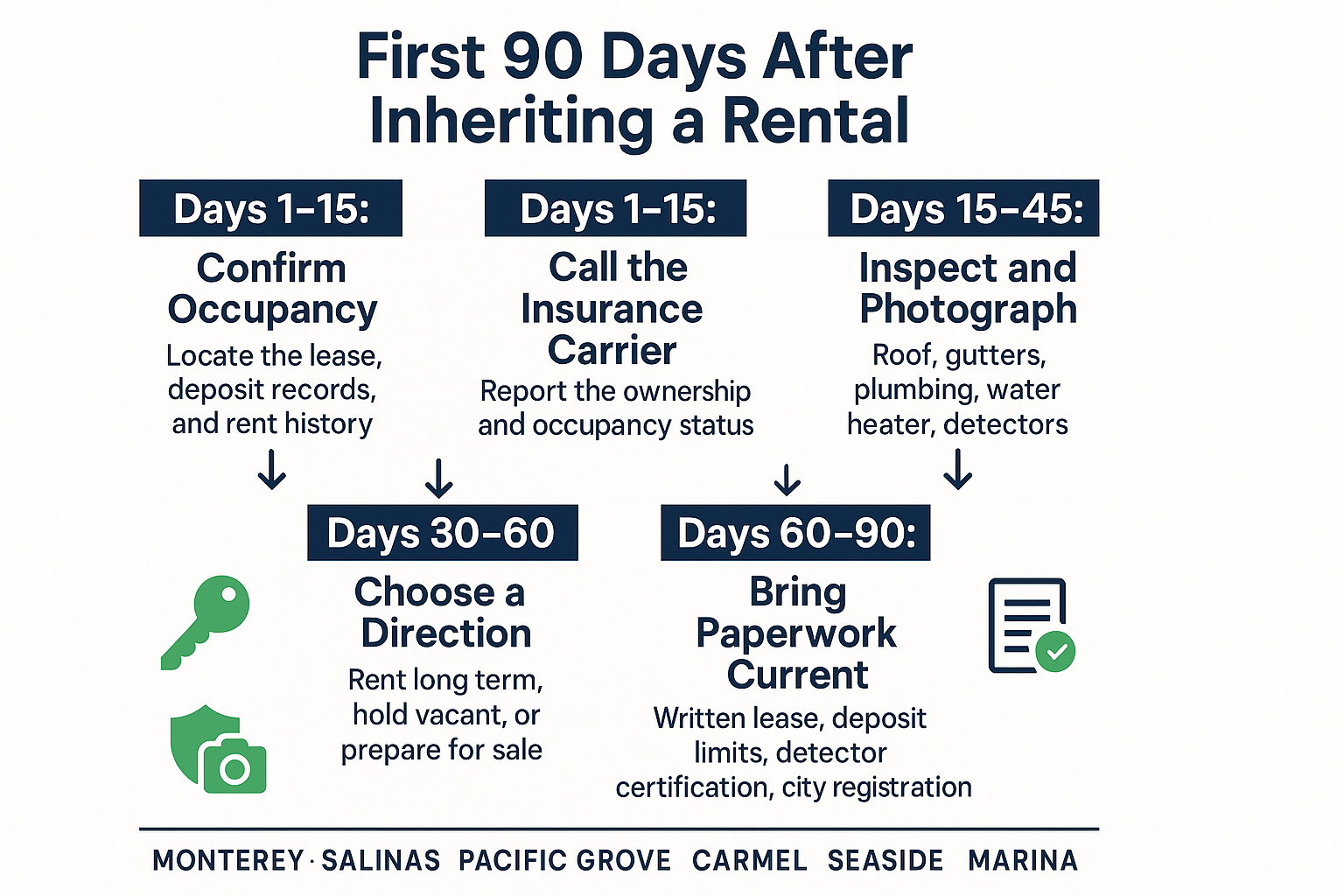
The First 90 Days, In Order
This is the sequence I recommend to heirs, and the order genuinely matters.
The Rules Changed Since Your Parent Was the Landlord
If you decide to rent, understand that the rulebook is not the one your parent used. Two changes matter most.
First, the security deposit. Since July 1, 2024, California caps residential security deposits at the equivalent of one month’s rent for most owners, furnished or unfurnished.
That used to be two months. If you inherited a home full of your parent’s furniture and good condition you want to protect, your cushion just got cut in half.
What replaces that cushion is process:
- Real screening. Credit, nationwide criminal background, eviction history, and verified income and employment. Our tenant screening walkthrough covers what a thorough process includes.
- Move-in documentation. Dated photos and video of every room, appliance, and surface before keys change hands.
- A written lease that spells out condition, maintenance responsibilities, and notice terms.
Second, compliance. A home your parent managed informally for thirty years often has gaps. Working smoke and carbon monoxide detectors are required. Cities have their own layers too, including the Salinas rental registration program and Monterey’s rule against residential rentals under 30 days.
Deferred maintenance shows up here as well. Getting a house from “Dad kept it running” to a documented, legal rental is real work, and what actually has to happen before a rental goes live is worth reading before you list it.
When Siblings Own It Together
Shared ownership is where good intentions go sideways. Three heirs with three opinions about repairs, rent, and whether to sell will stall a property for months.
Settle a few things in writing early:
- One point of contact for decisions, vendors, and any manager you hire.
- A spending limit that one person can approve without a family meeting.
- How rent income and expenses get split and who handles the tax reporting.
- A timeline for revisiting the keep-or-sell question.
And if most of you live out of the area, plan for that reality. Many of the owners I work with are in Southern California, out of state, or overseas, which is exactly why how out-of-area owners manage a Monterey Bay rental is one of the questions I answer most.
Frequently Asked Questions About Inherited Rental Property in Monterey Bay
Can I ask the tenant to move out so I can sell the house?
Not casually. If the property falls under AB 1482, you need a legally recognized reason and proper written notice, and some reasons require relocation assistance. Selling a home with a tenant in place is often the cleaner path. Talk to a real estate attorney before you send any notice.
What if there is no written lease, just a verbal agreement my parent had?
That is still a tenancy, usually month to month, and the tenant still has full protections. The transition is a reasonable time to put a written lease in place going forward, but you cannot change the terms retroactively or without proper notice.
How long can the house sit empty before insurance becomes a problem?
Many policies start limiting coverage somewhere around 30 to 60 days of vacancy. The exact language varies by carrier, so read your policy and call your agent. Documented, scheduled inspections help, and a vacant property endorsement may be the right fix.
What does property management cost if I decide to rent it out?
Fees in Monterey County generally run as a percentage of collected rent, with a separate leasing fee when a new tenant is placed. The range depends on property type, unit count, and condition. We break the factors down in our cost guide, and we are happy to quote your specific property.
Do I really need to redo the smoke and carbon monoxide detectors?
Yes. California requires working smoke alarms and carbon monoxide detectors in rental homes, and this is one of the most common gaps I find in a house that has been owner-occupied for decades. It is inexpensive to fix and a serious liability if you skip it.
Thinking Through an Inherited Property in Monterey County?
If you are sorting out a home in Monterey, Salinas, Seaside, Marina, or anywhere on the Peninsula, we are glad to talk it through, in English or Spanish. Our team has worked with Monterey County families in this situation for more than 25 years, and sometimes the most useful thing is just a clear read on your options. You can reach us at (831) 582-8916 or through the contact form at torrenteproperties.com whenever you are ready.