
Direct Answer: Photograph the damage while water is still visible, log the tenant’s report with a date, and pair it with dated pre-storm photos of the roof, gutters, and drainage.
Most owners I talk to in December are not worried about the forecast. They are worried about the phone call that comes at 9 p.m. saying there is water coming through the ceiling and they are 2,000 miles away with no idea who to call.
That call is more likely this year. NOAA’s Climate Prediction Center has carried an El Nino Advisory since June 2026 and puts the odds of a very strong event above 90 percent for fall and winter, with the heaviest rain signal pointed at coastal California and ramping up hardest January through March 2027. That is a planning fact, not a reason to panic.
This article is about what happens after water gets in. What counts as a real emergency, what to photograph and when, and why the record you build in October decides how a February insurance claim gets treated.
The first 24 to 48 hours: what is an emergency and what can wait
The first judgment call is whether this is a same-night problem or a weekday vendor visit. Getting that wrong costs money in both directions. Owners who treat everything as an emergency pay after-hours rates for a fence repair, and owners who sit on a real one turn a drying job into a reconstruction job.
Treat it as a same-night emergency when:
- Water is actively entering the living space, through a ceiling, a light fixture, a wall, or a window frame
- There is a visible roof breach or missing roofing material
- There is a sewage backup or standing water near electrical panels and outlets
- Heat or power to the unit is down during a cold, wet stretch
The reason the line matters is habitability. Under California law a rental has to stay weatherproof and have working plumbing, heat, and electrical. A leak you knew about and left alone stops being a repair question and becomes a legal one.
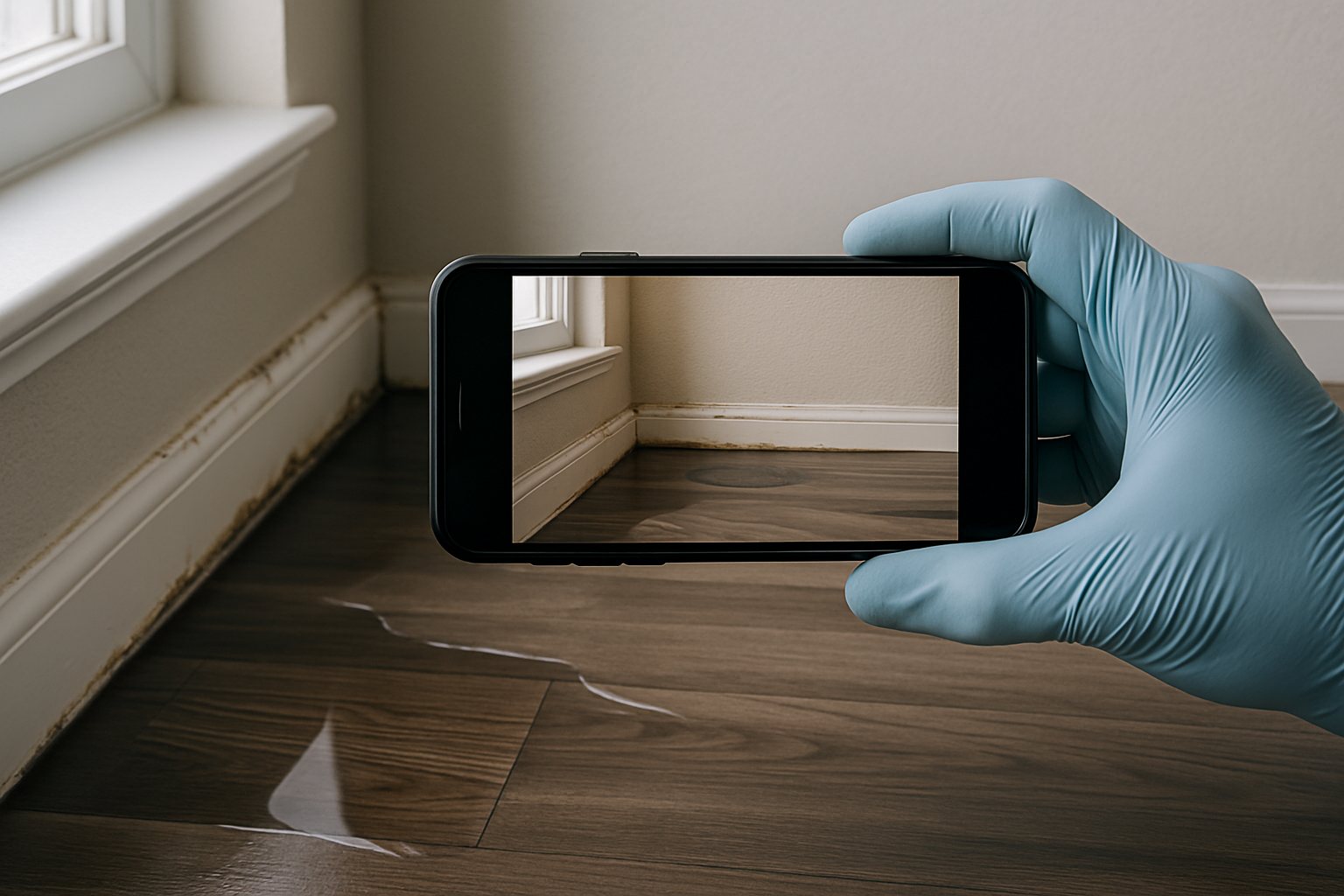
The other thing to get right in those first hours is the photo. A picture taken while water is still standing or actively running is worth far more to a carrier than a careful set taken three days later once everything dried and the stain faded. Timing beats thoroughness on the first walkthrough. The detailed second pass can wait.
Sudden water intrusion vs. slow seepage: the gap that costs owners money
Here is where most claims are won or lost. Carriers treat sudden, accidental water intrusion very differently from slow seepage or deferred maintenance. The first is usually covered. The second usually is not.
What decides which bucket your claim lands in is almost never the damage itself. It is whether you can show the condition of the roof, gutters, and drainage before the storm. Without that, an adjuster is looking at a stained ceiling and a clogged downspout and drawing their own conclusion.
A usable record is simple and boring:
- Dated photos of gutters after cleaning, not before, so there is proof the work happened
- Exterior and roofline images from each side of the building, taken the same day
- Water heater photos showing the base, the pan, and any corrosion at fittings
- Under-sink and shut-off valve shots in every bathroom and the kitchen
- A short written note of when each item was last serviced and by whom
I tell owners to think of it as four sets a year instead of one scramble in January. A quarterly photo record built during dry months is exactly what makes a February claim easy to explain, and it doubles as the baseline you need for deposit deductions after move-out when a tenant eventually leaves.
Storm Call Triage: Emergency or Weekday Visit
This is roughly how our team sorts storm calls across Monterey, Salinas, Seaside, and the Peninsula once the rain starts.
| What the tenant reports | How to treat it | Why |
|---|---|---|
| Water dripping from a ceiling or light fixture | Same-night response | Active intrusion spreads into insulation and framing within hours |
| Missing shingles or a visible roof opening | Same-night tarp | A tarp tonight is a drying bill, not a rebuild |
| Sewage backup or water near the panel | Same-night response | Health and electrical hazard, habitability issue |
| No heat or power during a storm | Same-night response | Habitability requirement under California law |
| Gutter overflowing, no interior sign of water | Next business day | Needs clearing, but no damage clock running yet |
| Standing water in the yard or driveway | Next business day | Drainage issue unless it is reaching the foundation |
| Fence down, limb on the ground | Next business day | Property damage, not a safety or habitability problem |
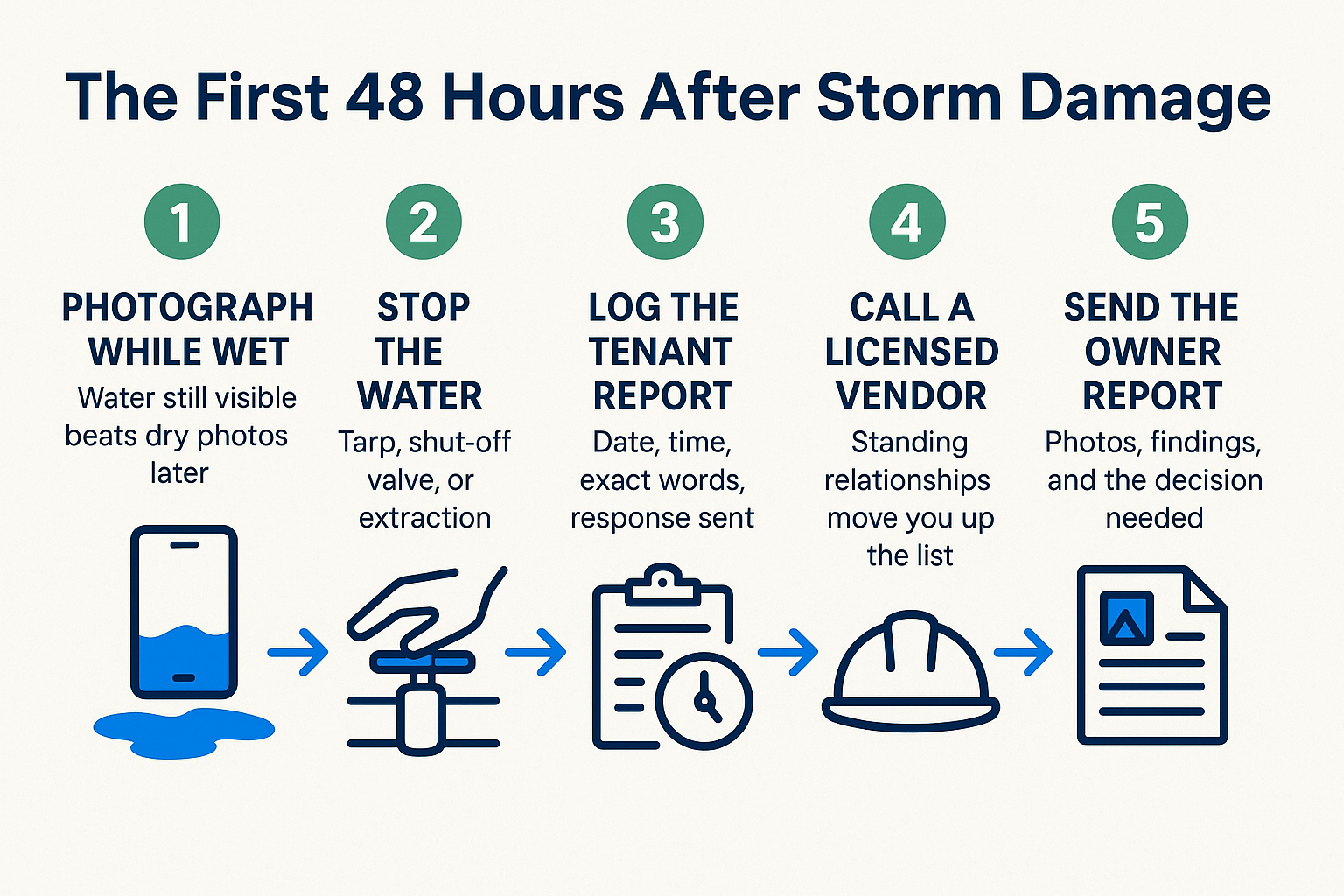
What the First 48 Hours Should Produce
If a storm hits your property, these five things should exist by the end of the second day.
Vacant and seasonal homes: where the damage multiplies
The worst water damage I see is almost never at an occupied rental. It is at a closed-up house in Carmel, Carmel Valley, or Pebble Beach where nobody has walked through since Thanksgiving.
An occupied home has a tenant who notices a drip on night one. A vacant one can go a week or more before anyone sees a slow ceiling leak or a failed water heater. By then you are not pricing a repair. You are pricing drywall, flooring, and dry rot, and those three together drive a number that depends entirely on how long the water sat.
Scheduled checks between storms change the math because they shorten the discovery window. Instead of finding out in March, you find out within a few days.
For an owner who is far away, the report matters as much as the visit. A report you can act on without guessing should include:
- Date and time of the inspection and the weather conditions that week
- Photos from each exterior side, plus the roofline, gutters, and drainage paths
- Interior photos of ceilings, closet corners, under sinks, and around the water heater
- A plain statement of what changed since the last visit
- A clear recommendation and the decision being asked of you
That last line is the one most reports skip. If you are reading an inspection from across the country, you need to know what you are being asked to approve, not just what somebody saw. We cover this further in our guide on how remote homeowners keep control of a Monterey property.
Who is responsible for what, and why a logged leak protects you
Owners get this split wrong more than any other part of storm season. Your tenant is not responsible for the building envelope. They are your early warning system, and their job is to report.
Your job is to log that report and answer it. Date it, record what they said, and record what you did. A reported leak that sits unanswered creates a habitability problem stacked on top of a repair problem, and the written trail is the only thing that shows you acted.
There is a leasing angle here too that owners underestimate. One family planning a move to the Monterey Peninsula wrote to us looking for a long-term home with no known history of mold, water intrusion, or ongoing moisture issues, with a budget in the mid four thousands. That is the exact applicant profile most owners want, and a badly handled leak last winter is what disqualifies a property from that conversation the following year.
The vendor reality after an atmospheric river
National landlord advice never mentions this part. When a storm hits the entire Monterey Bay at once, every roofer, water mitigation crew, and dry rot contractor on the Peninsula is booked solid by morning.
An out-of-state owner cold-calling a Monterey roofer at 9 p.m. during a regional event is at the back of a long line. Someone with a standing relationship and the authority to approve a tarp or an extraction that same night is near the front.
That gap is usually the difference between a drying fee and a reconstruction project. Costs vary widely by property, severity, and how long the water sat, and the real drivers are square footage affected, whether insulation and subfloor got wet, how many trades are involved, and whether mold remediation enters the picture. The only honest number comes from a quote on your specific property.
It also helps to think about this before December rather than during it, which is the whole point of our pre-season checklist for Monterey Bay properties.
Why this hits harder in a flat-rent market
Average asking rents in Salinas and Monterey have moved less than one percent year over year by most market trackers. You cannot repair a bad winter by raising the rent next cycle.
Meanwhile Monterey County’s median property value sits near $781,000, and inside the city of Monterey it runs over a million. Water damage here is a major-asset problem, not a small-dollar annoyance.
So the money this season comes from two places: vacancy days you avoid because a unit stayed livable, and repairs you caught in October instead of February. That is the same logic behind how maintenance decisions affect your rental’s bottom line, and it is why owners who manage from a distance eventually build a routine for watching the property remotely.
Frequently Asked Questions About Storm Damage and Documentation
How soon do I need to photograph storm damage for an insurance claim?
As fast as someone can safely get there, ideally while water is still visible. A photo of standing or running water carries far more weight with an adjuster than a dried stain photographed three days later. Take the quick set first, then do a careful walkthrough once the rain stops.
Will my insurance cover a roof leak during a winter storm?
It depends on whether the carrier reads it as sudden damage or long-term neglect. Sudden intrusion from storm damage is generally covered. Slow seepage, rot, and clogged gutters usually are not. What usually tips the decision is whether you can produce dated pre-storm photos of the roof, gutters, and drainage.
What should I do first if my tenant calls about water coming in?
Log the call with a date and time, ask for photos from the tenant right then, and decide whether it is a same-night emergency. If water is actively entering the building, get a tarp or extraction authorized that night rather than waiting for business hours.
My Carmel house is vacant for the winter. How often should it be checked?
Between storms rather than on a fixed calendar alone. A quarterly photo record is the baseline for insurance purposes, but during an active wet stretch the discovery window is what matters. A week of unnoticed dripping is the difference between patching a ceiling and replacing flooring and framing.
Am I responsible if my tenant does not report a leak right away?
You are still responsible for the building. But a documented reporting process, logged responses, and routine inspections show you were doing your part, which matters both with a carrier and in any habitability dispute.
Want a second opinion on how your property is being watched this winter?
One of the things that sets our team apart in Monterey County is that owners get a photo-documented report on a set schedule, not only after they call and ask. As one review put it, “Whenever maintenance issues came up, their coordination and follow-through were timely and effective.” If you would like to talk through how your property is being checked between storms this season, we are reachable at (831) 582-8916 or through the contact form at torrenteproperties.com.