
Direct Answer: Before January 1, Monterey County landlords should close out income and expense records, confirm Salinas registration fees, set 2027 rent, map lease expirations, prep for rain, and check detectors and insurance.
Most of the owners I talk to in December are not in trouble. They own one or two rentals, they have been handling things as they come up, and they have never once sat down and looked at the whole year at the same time.
December is when that catches up with people. Tax paperwork, lease renewals, city filings, and the wettest months of the year all land inside about eight weeks of each other, and they do not wait their turn.
So think of this as the review a careful owner does the last week of December, not a warning list. Seven items, in the order I would work them, for a rental in Salinas, Monterey, Seaside, Marina, or anywhere else around the bay.
1. Close Out the Year’s Income and Expense Records Before Your Tax Preparer Asks
This is the one self-managing owners handle worst, and it is the one that costs them real money. A shoebox of receipts in April is a smaller deduction than a clean ledger in December.
A clean year looks like this:
- Rent received by month, not one annual total you reconstructed from memory
- Every repair invoice matched to a specific property, with the vendor name on it
- Mileage and management costs kept separate from capital improvements, because they are treated differently
- Deposit money accounted for separately from operating cash, since it was never your income to begin with
- A short note on anything unusual, like an insurance payout or a month of lost rent
Here is the part owners miss. If you paid an unincorporated vendor more than a few hundred dollars over the year, you may have 1099 filing obligations. Raise that with your tax preparer in December, not in April when the deadline is already behind you.
And remember what these assets are worth. Market trackers put the median Monterey County home value somewhere around $781,000, with the city of Monterey running past $1 million. The paper trail you build now matters again the day the property sells or passes to your heirs.

2. Confirm Your Salinas Rental Registration Renewal and Per-Unit Fees
If the property sits inside Salinas city limits, registration runs on the calendar year. That means January is a filing month whether you planned for it or not.
The detail that trips people up is that fees are charged per unit, not per property. The city has run two tiers: roughly $29 per unit per year for units not subject to rent stabilization, and around $112 per unit for units that are, which generally means multifamily built before February 1, 1995.
So a four-unit building in Salinas means four registrations and four fees. I watch that surprise owners of small buildings every single January.
Late payment carries a penalty on top of the base fee, which is an avoidable cost. Fee amounts and dates do get adjusted, so confirm the current year directly on the City of Salinas rental registration and rent stabilization page before you write the check.
If you want the longer version of how the program works, we walked through it in our Salinas rental registration guide.
Salinas Registration at a Glance
Fees and tiers change, so treat this as general context and verify current figures with the city before filing.
| Unit type | Typical annual fee per unit | What owners forget |
|---|---|---|
| Unit not subject to rent stabilization | Around $29 | Fee is charged per unit, so a duplex means two |
| Unit subject to rent stabilization | Around $112 | Generally multifamily built before Feb 1, 1995 |
| Any unit filed late | Base fee plus a penalty | Registration runs on the calendar year, not your lease year |
3. Decide Your 2027 Rent Position and Work Backward From the Notice Period
Rents around here are close to flat, and that changes what a renewal conversation is actually worth. Market trackers put average Salinas apartment rent in the low $2,300s and Monterey in the high $2,700s for 2026, with year over year movement under one percent. At least one source reads Monterey median rent as slightly down.
Sources disagree on the level but agree on the direction. If you are planning next year’s return around a rent bump, you may be planning around something that does not arrive.
The money is somewhere else:
- Days of vacancy avoided, which is usually worth more than a modest increase
- A tenant who renews instead of turning, since a turn costs you prep, marketing, and empty weeks
- A repair caught in December instead of February, before water finds the framing
If you do raise rent, work backward from the notice. California requires more advance notice for larger increases, and units under Salinas rent stabilization are capped by formula at the lesser of 2.75 percent or 75 percent of the most recent 12-month CPI-U increase. Our 2026 guide to raising rent covers the notice math in more detail.
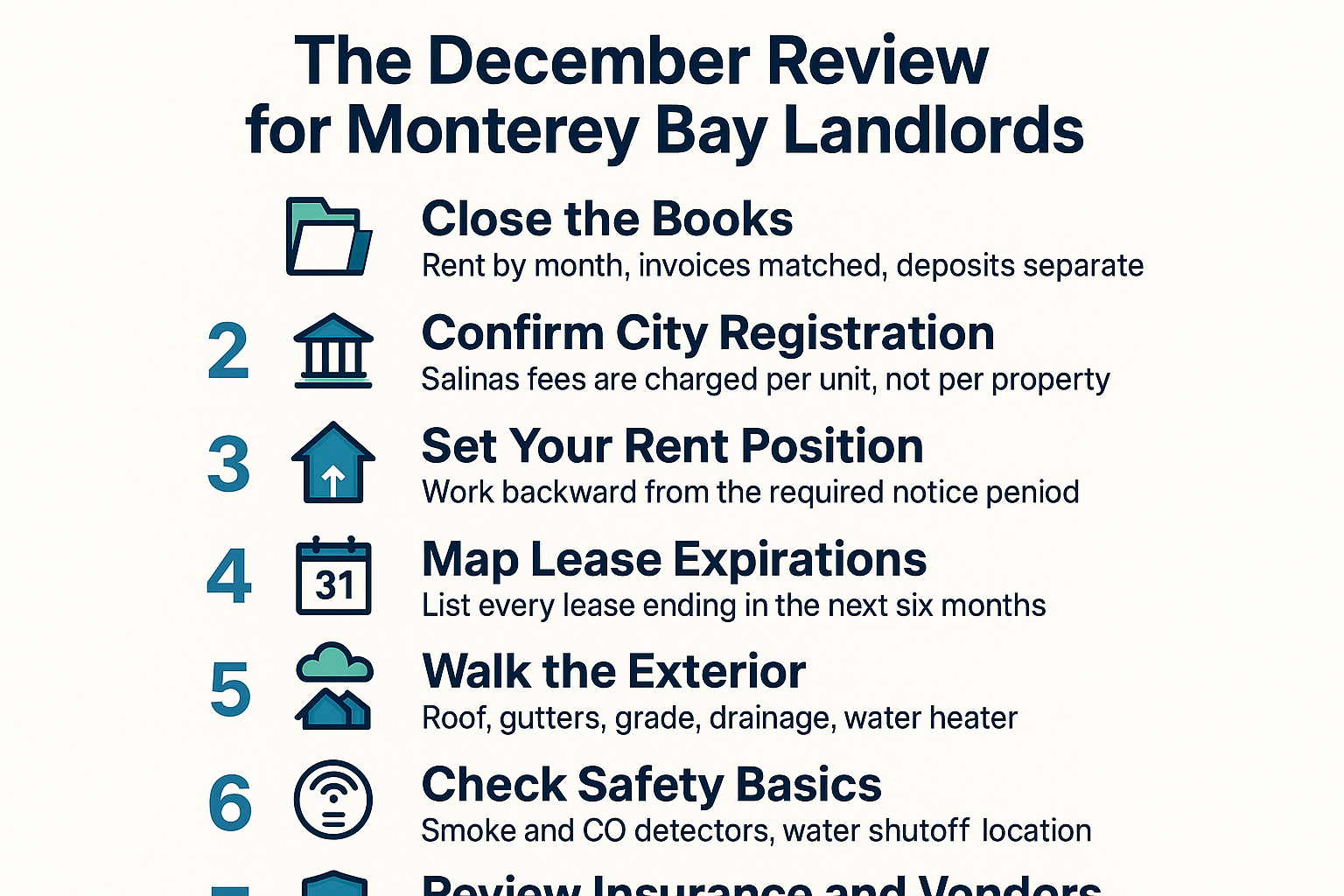
The Seven-Item December Review
Here is the whole checklist in one view, in the order I would work through it.
4. List Every Lease Expiration Falling in the Next Six Months
Write them down on one page. Address, tenant, expiration date, current rent, and whether the lease converts to month to month on its own.
Owners with two or three properties almost never have this list, and that is how a lease quietly rolls over on terms you would not have chosen. It is also how a Monterey Peninsula vacancy lands in February instead of June, when the rental pool is thinner and families are not moving.
Once you have the dates, decide each one early:
- Renew as is, if the tenant pays on time and takes care of the place
- Renew with changes, and start the notice clock in time
- Plan a turn, and budget the prep weeks before you need them
A good tenant who stays another year is usually the most profitable decision on the page.
5. Walk the Exterior and Drainage Before the Heaviest Rain Months
Forecasters have been carrying a strong El Nino signal for the 2026-27 winter, which historically tilts the Central Coast toward wetter than normal conditions and a more active atmospheric river pattern. That makes the December walk worth more than usual.
Keep it to the things that actually fail here:
- Roof and flashing, especially around vents and chimneys
- Gutters and downspouts running clear and discharging away from the house
- Grade and drainage sloping away from the foundation, not toward it
- Water heater age and condition, including the strapping
- Any dry rot that has been sitting on your list since spring
One hour outside in December is cheaper than a water intrusion claim in February. Our pre-rain property checklist goes item by item if you want a printable version.
6. Verify Smoke and Carbon Monoxide Detectors and the Habitability Basics
This one is quick and it is non-negotiable. Test every smoke detector and carbon monoxide detector, replace batteries, and check the manufacture date stamped on the back, since sealed units do expire.
While you are there, write down where the main water shutoff is and make sure the tenant knows. A tenant who can shut off water at 11 p.m. on a Sunday saves you thousands.
California habitability rules have been moving, including new requirements around appliances in rental units. If you have not looked at your lease since 2025, this is the month to read it with fresh eyes.
7. Review Insurance, Occupancy Status, and the Vendor You Would Call at 2 a.m.
Call your insurance agent before January. Confirm the policy is a landlord or dwelling policy, that coverage limits still match what it would cost to rebuild today, and that your loss of rent coverage is real.
Then say the occupancy status out loud. If a second home in Carmel, Pebble Beach, or Pacific Grove will sit empty for weeks while you travel, many policies treat an unoccupied home differently than an occupied one. December is the time to ask that question, not after a claim.
Last, make the 2 a.m. list:
- A plumber who answers after hours
- An electrician and an HVAC tech you have actually used
- A roofer you can reach during a storm, not a week later
- Someone local who can physically look at the property if you are out of state
If that last line is where your list runs out, you are not alone. It is the single most common reason owners managing from a distance finally pick up the phone.
What Owners Are Usually Glad to Hand Off
An owner reached out to us this summer saying it was their first time renting out a property and they just wanted to understand how the process works. That is a reasonable question, and the answer is less dramatic than people expect.
The parts owners tell us they are happiest to stop doing are the same three every time: month by month statements they do not have to assemble, year-end summaries that go straight to the accountant, and repairs coordinated without the owner making the calls. One review from an owner we work with put it simply: “Whenever maintenance issues came up, their coordination and follow-through were timely and effective.”
There is local footing behind that. An owner-broker with more than 25 years in Monterey County, Accredited Residential Manager credentials, and service in both English and Spanish, which matters a great deal in Salinas where a large share of owners and tenants prefer Spanish. If you are weighing it, our piece on when self-managing stops making sense is an honest look at the tradeoff.
Frequently Asked Questions About Year-End Rental Tasks in Monterey County
Do I have to register my rental if it is in Salinas but I only own one house?
Yes. The Salinas program applies to residential rental units inside city limits, and the fee is charged per unit. A single-family rental is one registration and one fee. Confirm current dates and amounts with the city before you file.
If rents are flat, is it even worth raising rent next year?
Sometimes, but run the math first. If a $75 monthly increase pushes a good tenant to leave, a single month of vacancy plus turnover prep usually erases a year of that gain. In a flat market, keeping the unit occupied is often the stronger move.
What records does my tax preparer actually want from me?
Rent received by month, repair and maintenance invoices matched to each property, mortgage interest and property tax statements, insurance premiums, and any capital improvements kept separate from routine repairs. Bring vendor payment totals too, since 1099 obligations can apply to unincorporated vendors you paid over a few hundred dollars.
My house in Carmel will be empty for two months this winter. Does that matter?
It can. Many policies handle an unoccupied or vacant home differently than an occupied one, and some limit coverage after a certain number of days empty. Call your agent before you leave, and make sure someone local can check the property after a storm.
How far ahead do I need to give notice of a rent increase in California?
It depends on the size of the increase, with larger increases requiring more advance notice. Units under Salinas rent stabilization are also capped by formula. Work backward from your target effective date so the notice goes out with room to spare.
Want a Second Set of Eyes on Your December List?
If you are working through this checklist for a property in Salinas, Monterey, Seaside, Marina, or anywhere else around the bay, our team is happy to talk through any single item on it. Reach us at (831) 582-8916 or through the contact form at torrenteproperties.com, in English or Spanish, whenever it is convenient for you.