
Direct Answer: Remote rental ownership in Monterey Bay works when you have local eyes on the property, a reliable vendor network, and clear financial reporting, without those three things, distance creates real problems fast.
The anxiety is real, and it makes sense. You have a home in Monterey Bay, maybe a townhouse near the Presidio, a condo in Marina, a house in East Garrison, and you are about to leave. You are not sure whether to rent it or sell it, and if you do rent it, you have no idea what that actually looks like once you are in another state.
I work with owners in this exact situation on a regular basis. Some are military families leaving Naval Postgraduate School. Some are relocating for work and cannot sell at a price that makes financial sense in this rate environment. Some inherited a property and are trying to figure out what to do with it from three time zones away. What they all have in common is that they are not passive investors, they are people making a high-stakes decision under time pressure.
This article walks through the three things that actually determine whether remote rental ownership works: getting the property ready before you leave, finding and placing the right tenant, and sustaining everything from a distance after you go. Most owners focus on the first and forget about the other two until something goes wrong.
Phase One: Getting the Property Ready Before You Leave
This is the phase most owners understand, at least in concept. The property needs to be clean, functional, and competitive with what else is available in the local market. But what that actually requires is more specific than most people expect.
The Monterey Bay rental market is not forgiving of deferred maintenance. Tenants in Salinas, Seaside, and Marina have options, and a property with a water-stained ceiling, a temperamental water heater, or a front yard that needs attention will sit vacant longer than a well-prepped one. Vacancy in this market costs real money, even a few extra weeks without rent adds up fast.
The prep work that actually moves the needle tends to fall into a few categories:
- Fresh interior paint in neutral tones (this is the single highest-return prep task in almost every rental I have seen)
- Functional appliances, California law now requires a working stove and refrigerator in residential rentals, so this is not optional
- Clean carpets or finished floors, with no visible damage
- Smoke and carbon monoxide detectors installed in required locations per California code
- Landscaping cleaned up and exterior pressure-washed if needed
- Any deferred maintenance addressed before listing, not after a tenant complains
If you are still nearby when this work happens, you can oversee it yourself. But if you are already gone, you need someone on the ground to coordinate vendors, verify the work was done right, and do a pre-listing walkthrough. Getting a Monterey Bay rental ready involves more moving parts than most first-time landlords anticipate, and those parts do not coordinate themselves.

Phase Two: The Leasing Window, The Part Owners Underestimate Most
This is the phase I see catch people off guard more than any other. Owners spend time thinking about rent-ready prep and then assume the tenant placement piece is mostly paperwork. It is not.
Placing a qualified tenant requires someone physically present in the market. Showings have to happen in person. Move-in inspections have to be documented with photos. Lease signing and key handoff require coordination. If you are in Texas or Washington state when all of this is happening, none of it works without a local representative who can move quickly.
Setting the right rent price is also something that goes wrong more often than it should. Owners sometimes anchor to a number they read online, or what a neighbor got two years ago, or what they feel the property is worth emotionally. The actual market rental rate in Seaside is different from Pacific Grove, which is different from Salinas, and the rate shifts seasonally. Pricing too high extends your vacancy. Pricing too low leaves money on the table permanently, because that lease sets your baseline for the year.
One owner who reached out to us was preparing to leave East Garrison and had not yet decided whether to rent or sell. He needed a realistic rent estimate before he could make that call. That is exactly the right question to ask first, and it requires someone with current, local market data, not a Zillow estimate. How Monterey Bay rental prices actually get set explains what goes into that analysis and why owners who guess tend to guess wrong.
Tenant screening during this window is also where mistakes get made that owners live with for a year or more. A thorough screening process covers:
- Full credit report review
- Nationwide criminal background check
- Eviction history search
- Income and employment verification (standard benchmark is gross income at 2.5 to 3 times monthly rent)
- Rental history and prior landlord references
What a real tenant screening process looks like goes deeper on each of these steps, and why cutting corners on any one of them tends to cost more than it saves.
The Three Phases of Remote Rental Ownership
Most out-of-area owners think about rental management as one continuous job. In practice, it breaks into three distinct phases, each with its own requirements and failure points.
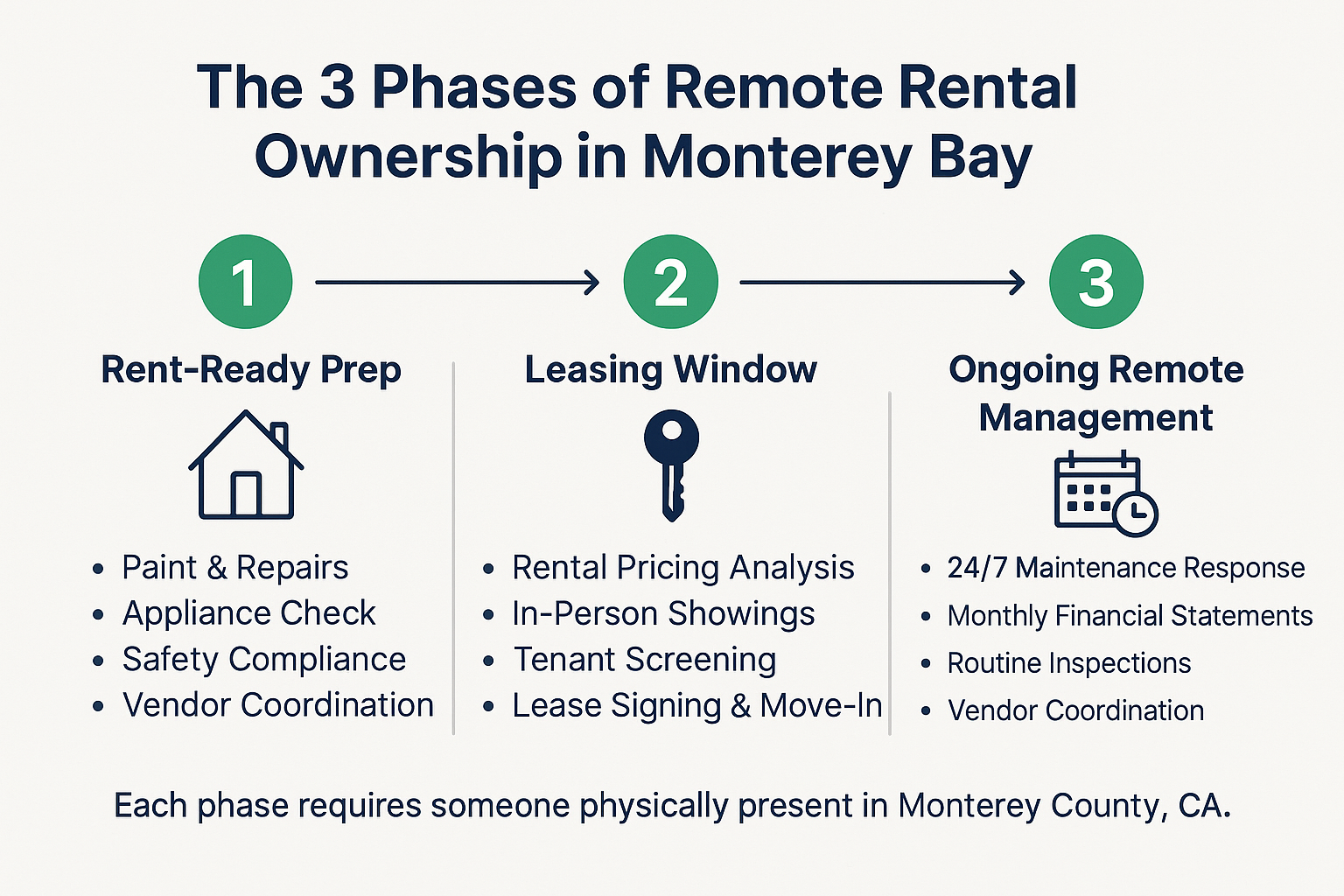
Phase Three: Maintenance From a Distance, Where Remote Ownership Most Often Breaks Down
Once a tenant is in place and you are a few hundred or a few thousand miles away, the day-to-day reality of ownership shows up fast. And the place it shows up most painfully is maintenance.
The Monterey Bay contractor market is tight. Good licensed plumbers, electricians, and HVAC techs stay booked. During summer, trades are stretched. After significant rainfall, and we see real water intrusion events across Seaside, Marina, and the Salinas Valley every wet season, emergency service calls spike across the whole peninsula simultaneously. An owner trying to find a licensed plumber on a Sunday from Houston is solving a fundamentally different problem than a local manager who already has standing relationships with trusted vendors and can get someone out the same day.
This is not a small distinction. A slow response to a water leak can turn a $400 repair into a $4,000 remediation. The California Department of Consumer Affairs notes that unlicensed contractor work creates real liability exposure for property owners, which means it matters not just who responds, but who they are.
Beyond emergencies, routine maintenance coordination requires local knowledge:
- Knowing which vendors are reliable and which overpromise
- Following up to confirm work was actually completed and done correctly
- Documenting repairs in a way that protects you legally if a dispute arises
- Flagging small issues during inspections before they become expensive
For owners with vacant properties, second homes, or properties between tenants, what can go wrong in an empty house is a genuinely important read, because vacancy risk is different from occupied-property risk and often gets no attention until there is a problem.
Financial Reporting: What Out-of-Area Owners Actually Need
Rent hitting your bank account is not the same as understanding your investment. I hear from out-of-area owners regularly who have been receiving monthly deposits for years and have no idea what their actual net income is after maintenance, vacancy, and fees.
What a proper owner reporting setup looks like in practice:
- Monthly statements that break out gross rent collected, management fees, individual maintenance expenses with descriptions, and any other disbursements
- Year-end summaries in a format that makes tax filing straightforward, owners should not be reconstructing the year from bank statements
- Income projections before a property is listed, so the owner can evaluate whether renting makes financial sense compared to selling
- Owner portal access so you can pull documents, review payment history, and check on maintenance requests without making a phone call
Several owners who contacted us before they had even listed their property specifically asked for income forecasts and year-end summaries. That is a smart question. Knowing what the property will realistically generate, after all costs, is the foundation of any good decision about whether to rent, how long to hold, or when to reinvest in improvements.
For a plain-language breakdown of what professional management actually costs and what that gets you, what property management costs in the Monterey Bay area lays it out clearly.
And if you have been managing on your own and are considering the transition, how to hand off a rental you have been managing yourself walks through what that process actually looks like.
Remote Ownership: What You Can Handle Yourself vs. What Requires a Local Presence
This is not an exhaustive list, but it reflects the division most out-of-area owners run into when they try to self-manage from a distance.
| Task | Manageable Remotely? | Why It Matters Locally |
|---|---|---|
| Rent collection and payment tracking | Yes, with an online portal | Automated systems handle the mechanics, late fee rules vary by California law |
| Setting the right rental price | Rarely | Monterey Bay submarkets shift; Salinas and Pacific Grove are not the same market |
| Conducting in-person showings | No | Tenants expect to walk the property; virtual-only tours reduce applicant quality |
| Tenant screening and lease execution | Partially | Credit checks can run online; lease signing and move-in inspection require physical presence |
| Emergency maintenance response | No | Contractor relationships and same-day response require a local network |
| Routine property inspections | No | Photo-documented walkthrough reports require someone on the ground |
| Year-end financial summaries | Yes | Can be delivered digitally, quality depends on how well monthly records were kept |
| Coordinating repairs after storm damage | No | Monterey County weather events (especially El Nino winters) require fast local response |
A Note on the Reluctant Landlord
There is a specific type of owner I want to speak to directly, because I see this situation more and more. You bought your home when rates were lower. Selling now does not make financial sense. So you are renting instead, not because you set out to be a landlord, but because the math left you with no better option.
This is different from investing. You have a relationship with that property. You may plan to come back to it someday. The thought of a stranger living there, and something going wrong, is not abstract anxiety, it is a reasonable concern based on what you know can happen.
What I would tell you is this: professional management is not just a transaction service. It is a way to protect your relationship with a property you care about. Regular inspections, documented condition reports, responsive maintenance, and careful tenant placement all add up to a property that comes back to you in the same shape you left it, or better.
For owners in that position, when self-managing your rental stops making sense addresses the decision honestly, without pushing you toward any particular answer.
Frequently Asked Questions About Managing a Monterey Bay Rental Remotely
How do I know what my Monterey Bay property will actually rent for before I leave?
A reliable rental price estimate comes from current, local comparable data, active listings in your specific neighborhood, recent lease comps, and seasonal demand patterns. Online estimates like Zillow’s Rent Zestimate can be a starting point but are often off by $200 or more in submarkets like East Garrison, the Dunes in Marina, or central Salinas. A local property manager who is actively leasing in your area can give you a realistic range and explain what prep work, if any, would move that number up.
Can I manage a Monterey Bay rental myself from out of state?
Technically yes, some parts of it. Rent collection, owner accounting, and document storage can all be handled digitally. But showings, move-in inspections, emergency maintenance response, and routine property inspections require a physical presence. Most remote self-managers hit a wall the first time there is a maintenance emergency or a tenant dispute, and that is usually when they call us.
What happens to my property between tenants if I’m not local?
Vacancy is one of the riskier periods for a property. Without regular inspections, small problems, a slow leak, a pest entry point, storm damage, can go unnoticed for weeks. If you are out of the area, you need someone making regular, documented visits to the property during any vacancy. Our Seasonal Property Maintenance Program handles this with quarterly exterior and interior checks and photo-documented reports sent directly to the owner.
Is there a California law that affects my security deposit as a landlord?
Yes. As of July 1, 2024, California limits security deposits to one month’s rent for most residential rentals, down from two months for unfurnished units. This is now the law statewide regardless of city. It affects how much protection you have upfront if a tenant causes damage, which makes thorough move-in documentation and careful screening even more important.
What does a monthly owner statement actually tell me?
A well-prepared monthly statement breaks out your gross rent collected, the management fee deducted, every maintenance expense with a description of what the work was, any other fees or payments made on your behalf, and your net owner disbursement for the month. It should be clear enough that you can hand it to your accountant at year-end without any additional explanation. If your current reporting is just a deposit confirmation, that is not enough information to evaluate your investment.
I’m a military homeowner with PCS orders, what should I do with my Monterey Bay property?
This situation comes up often in the Monterey area given the Naval Postgraduate School and other installations. The Servicemembers Civil Relief Act has provisions that may affect your lease obligations as a departing tenant, but as a property owner, your main priorities are pricing the property correctly, placing a vetted tenant before you leave, and having a local manager in place who can handle everything from maintenance to lease renewals while you are at your next duty station. PCS orders and your Monterey Bay home covers this situation in more detail.
Ready to Talk Through Your Situation Before You Leave?
If you are preparing to move out of the Monterey Bay area and are not sure whether renting makes sense, what your property would realistically bring, or what professional management actually involves, we are happy to walk through it with you, no pressure, just a real conversation. Our team serves owners across Monterey, Salinas, Pacific Grove, Seaside, Marina, and Carmel, and we know this market well enough to give you honest answers. Reach us at (831) 582-8916 or through the contact form at torrenteproperties.com.