
How Delistings Are Reshaping Salinas Property Management
A major change is sweeping through the housing market, and it's creating a new kind of landlord in Salinas. As more homeowners pull their properties off the for-sale market, the shift in delistings is changing affordable property management in Salinas. This trend is creating more rental competition and forcing property owners to get smarter about protecting their investments.
This isn’t just a small trend. It's a big change that redefines what "affordable" really means for a property owner.
The Market Shift Shaking Up Salinas Rentals
The national housing market is seeing a major shift. A powerful new trend is gaining steam, and we're feeling its impact right here in Salinas.
A huge increase in home "delistings" is changing the rental scene. The number of homes pulled from the sales market has jumped a shocking 47% nationally year-over-year. Faced with a slower market where homes take longer to sell—sometimes up to 47 days in California areas, according to Wolf Street—many owners are now renting their properties instead.
This has created a wave of "accidental landlords". These are people who never planned to be landlords but are now entering the rental market. For Salinas property owners, this means one thing: more competition.
This flowchart shows how national delistings are increasing the local rental supply in Salinas, putting pressure on existing rentals.

When homes for sale become rentals, it creates instant competition for every landlord in town.
What This Means for Your Salinas Rental
With more properties on the market, tenants have more options. This is where the old definition of "affordable property management" starts to break down.
Hiring a manager just because they charge the lowest fee can lead to problems in a competitive market. A cheap but ineffective strategy can easily lead to long vacancies and lost money.
The new reality is that affordable management is about predictable cash flow, lower risk, and preserved property value—not just a lower monthly fee.
This shift is both a challenge and an opportunity. The challenge is making your property stand out. The opportunity is to use a smarter strategy to protect your income.
Understanding these market changes is the first step. You might be interested in our guide on the 6 trends that make or break rentals in Salinas this year. Heading into the 2026 market, the right management strategy will be key to your success.
Why More Rental Homes Mean Higher Risks for Owners
The growing number of rental homes in Salinas creates new financial risks for property owners. With more choices available, tenants now have more power. This creates a tough environment where even a small mistake can cost you.
Think of it like the Salinas farmers' market. If only a few stalls sell strawberries, they can set their prices. But if a dozen new vendors show up with fresh berries, everything changes. Only the vendors with the best fruit, fair prices, and good service will sell out.
That's what's happening in our local rental market. As "accidental landlords" list their homes, your property becomes one of many choices. This flood of competition directly affects your bottom line.
The New Definition of "Affordable" Management
In this crowded market, we need to rethink what "affordable" property management means. Picking a manager with the lowest fee is like setting up the cheapest stall at a busy market. You might save a little at first, but you'll lose more in the long run.
A cheap, passive management style often leads to costly problems:
- Longer Vacancy Periods: If your property isn't priced right and marketed well, it will sit empty. Tenants will choose other homes down the street.
- Increased Tenant Turnover: If your manager is slow with maintenance or has poor communication, good tenants will leave. Turnover brings new cleaning, repair, and marketing costs.
- Reactive Maintenance Costs: Ignoring small issues leads to expensive emergency repairs. A leaky pipe can turn into a major problem.
You can learn more about why more homes are becoming rentals in 2026 and what it means for landlords.
In a competitive market, a cheap manager who lets a $2,500/month property sit vacant for just one extra month costs you far more than you save on their fee.
The shift in delistings is changing affordable property management in Salinas by showing how expensive a passive strategy is. True affordability is not about the lowest fee—it's about the highest net income. This means reducing vacancies, finding great tenants fast, and keeping them happy.
The Gap Between Affordable Fees and Affordable Results

When the rental market has many options, Salinas property owners can easily make a big mistake. They look for "affordable property management" and think the company with the lowest fee is the best deal. This is a trap that often leads to higher costs later.
Choosing a property manager based only on a low fee is a risk. True affordability is not about the fee you pay; it’s about the net income you keep.
The hidden costs of cheap management can quickly erase any savings. In a market where tenants have many choices, a passive approach is not enough. This is where the gap between paying for a service and paying for results becomes clear.
Where Low-Cost Management Fails
Self-managing or hiring a discount service can lead to financial trouble. These options often fall short in four key areas:
- Inaccurate Rent Pricing: A manager without local data might price your rent too low, leaving money on the table. Or they might price it too high, causing long vacancies.
- Slow Tenant Placement: Cheap services often have weak marketing. Without professional photos and good listings, your property gets lost in the crowd.
- Reactive-Only Maintenance: A manager who only reacts to problems lets small issues grow. A slow drip can turn into a huge repair bill.
- Compliance Missteps: California's landlord-tenant laws are complex. One mistake with security deposits or evictions can lead to a costly legal battle.
These failures show a key truth. The shift in delistings is changing affordable property management in Salinas by forcing owners to look beyond price and focus on value.
Affordable management that lacks strategy can become expensive very quickly.
This is a financial reality. The cost of one extra month of vacancy or a single legal issue can wipe out years of savings from a lower management fee. If you're questioning your current setup, you can learn what to expect from affordable property management in Salinas.
The New Playbook for Property Management in Salinas

The market has changed, and the old way of managing rentals is no longer effective. To protect your investment, you need a modern, strategic plan.
This new approach is about getting ahead of problems with smart, data-backed strategies. It’s not just about filling a vacancy; it’s about creating long-term value. The new standard for affordable property management in Salinas is built on four key pillars.
Pillar 1: Accurate, Market-Driven Rent Pricing
Setting the right rent is crucial now that tenants have more choices. If you price your rental too high, you'll have a costly vacancy. If it's too low, you'll lose money every month. The solution is data-driven pricing.
A strategic manager uses real-time local data to find the best price for your property. This ensures your home is competitive enough to attract tenants while maximizing your income.
Pillar 2: Fast and Strategic Tenant Placement
In a crowded market, your property must be visible. A winning strategy means getting your property in front of the right people quickly and screening them carefully.
This involves:
- Professional Listings: Creating an attractive online listing that makes your property stand out.
- Wide Marketing: Making sure your rental appears on all the platforms where good renters are looking.
- Thorough Screening: Running background and credit checks to find reliable, long-term tenants.
Placing a great tenant quickly is your first defense against lost income.
Pillar 3: Proactive Maintenance Coordination
A key difference between a discount manager and a strategic one is how they handle maintenance. A reactive manager waits for problems, which leads to tenant frustration and expensive emergency repairs.
A proactive strategy focuses on preventive care. Regular inspections and fixing small issues early can significantly reduce repair costs and keep tenants happy. This approach protects your property's value. You can learn more about how technology helps in our guide on property management workflow automation and by exploring the best property management apps.
Pillar 4: Ongoing Compliance Oversight
California’s landlord-tenant laws are complex and always changing. A small mistake can lead to expensive legal issues. The shift in delistings is changing affordable property management in Salinas by making legal compliance more critical than ever.
An expert property manager ensures your rental follows all local and state rules. This oversight protects you from legal risks that could wipe out a year's profit. Torrente Property Management combines this expertise to help owners compete in Salinas’s evolving market.
How Strategic Management Protects Your Rental Income
A modern approach to property management produces real financial results. Every part of a good strategy—from pricing and tenant placement to maintenance and legal compliance—adds money to your pocket and reduces your stress.
This is the difference between just owning a property and running a profitable rental business.
True affordability isn’t measured by a management fee, but by your final net income.
Filling Vacancies Faster for Predictable Cash Flow
Nothing hurts a rental's bottom line more than a vacancy. Every day a home sits empty, you lose income you can't get back. Strategic management reduces the time between tenants.
It starts with setting the right rent. We analyze local market data to price your property to attract immediate interest. Then we use aggressive marketing with professional photos to make your listing stand out.
The result is a steady stream of qualified applicants. This allows us to quickly screen and place a great tenant, turning a potential income loss into steady cash flow.
Retaining Good Tenants to Control Costs
Once you have a great tenant, keeping them is key. Tenant turnover is a silent profit killer, bringing a flood of expenses:
- Marketing fees to find a new renter.
- Cleaning and repair costs to prepare the property.
- Lost rent during the vacancy.
Strategic management focuses on tenant retention through professional service. By handling maintenance requests quickly and communicating clearly, we create a positive experience. Happy tenants are more likely to renew their leases, saving you thousands. You can learn about the value you get from hiring a property management company.
Preventing Surprises to Preserve Your Bottom Line
The final piece is preventing costly surprises. An unexpected major repair or a legal issue can wipe out months of profit. A strategic manager protects your asset with proactive oversight.
This means regular inspections to catch small maintenance issues before they become disasters. It also means staying compliant with California's complex landlord-tenant laws, shielding you from fines.
Salinas's market data from the FRED economic data site shows active listings are low, which means demand is high. A professional must act fast to place tenants and keep your property profitable.
By preventing expensive surprises, a strategic manager doesn't just collect rent—they preserve your property's value and protect your net income.
This is what truly defines affordable property management in Salinas. It’s not about the cheapest fee; it’s about the financial security you gain.
Why Local Salinas Expertise Matters Now More Than Ever
Knowing national rental trends is one thing. Knowing how they affect each street in Salinas is another. In today’s market, deep local expertise is essential for protecting your rental income.
A generic management company can't keep up in the 2026 market. An out-of-town manager won’t know the rent differences between neighborhoods or have a trusted plumber on call. That lack of local knowledge can cost you time and money.
At Torrente Property Management, we are part of the Salinas community. Our local roots give us an unmatched understanding of what it takes to succeed here.
The Power of a Local Partner
In a competitive market, a local partner is your biggest advantage. Our community ties and market knowledge will set your property apart.
- Community Insight: We know every Salinas neighborhood, which allows us to market your property effectively and price it with precision.
- Vetted Local Vendors: We have a network of reliable, cost-effective local contractors. When a repair is needed, we get it done quickly and affordably.
- Bilingual Advantage: In Salinas, being bilingual is essential. Our ability to speak both English and Spanish opens up a wider pool of qualified tenants and ensures clear communication.
These local advantages lead to better financial results for you. You get faster placements, lower maintenance costs, and stronger tenant relationships.
Deep local knowledge is the most powerful tool for maximizing your rental income and minimizing risks.
As the shift in delistings is changing affordable property management in Salinas, it’s clear that generic strategies are failing. Owners who partner with a management company that understands the local landscape will thrive.
If you own rental property in Salinas and feel the pressure of this competitive market, it’s time to review your strategy.
Contact Torrente Property Management today at (831) 582-8916 for a personalized consultation on how our local expertise can protect your income.
Frequently Asked Questions About Property Management in Salinas
Here are answers to common questions property owners are asking about the changing Salinas rental market.
Why Are More Homes Being Rented Out in Salinas?
Many homeowners are choosing to rent their properties instead of selling them. The sales market has cooled, so they are becoming "accidental landlords" to avoid selling at a lower price. This increases the number of available rentals in Salinas and creates more competition.
What Is the Biggest Risk in a More Competitive Rental Market?
The biggest risk is a long vacancy. With more rentals to choose from, tenants will skip over properties that are overpriced or poorly marketed. Every day your property is empty, you lose money. This is why the shift in delistings is changing affordable property management in Salinas—preventing vacancy is more valuable than a low fee.
Isn't the Cheapest Property Manager the Most "Affordable"?
Not anymore. In today's market, "affordable" means protecting your total income, not just paying the lowest fee. A discount manager often leads to costly vacancies, lower rent, and high tenant turnover. True affordability comes from a partner who keeps your property filled and minimizes costs.
How Does a Strategic Manager Keep My Property Competitive?
A strategic manager uses a four-part plan. They use data-driven pricing to set the right rent. They use aggressive marketing and thorough screening to find a great tenant fast. They focus on proactive maintenance to prevent costly repairs and keep tenants happy. Finally, they provide compliance oversight to protect you from legal issues.
Why Is Local Salinas Expertise So Important Now?
Local expertise is crucial. A manager with deep roots in Salinas understands the local market and can price your property accurately. They also have a network of trusted vendors and can communicate effectively in both English and Spanish, which expands your pool of qualified tenants.
Protecting your investment requires a partner who combines local expertise with a proven strategy. At Torrente Property Management, we treat your property like our own.
Contact Torrente Property Management today at (831) 582-8916 to discuss a management plan that delivers affordable results.


Is Hiring a Property Management Company in Pacific Grove Worth It?
If you own a rental in Pacific Grove, you’ve likely asked yourself: is hiring a property management company worth it? You’re really asking about more than cost. You want to know if a company will protect your home, be responsive, and truly understand the local market.
The answer is yes—if you hire the right partner. A great manager acts as an asset manager, protecting your investment. A bad one just collects rent. More than half of property managers (60%) report an increased workload just for compliance, according to a recent full industry report. This shows how complex the job has become.
The Pacific Grove Landlord’s Core Dilemma

Owning a home in Pacific Grove means you have a valuable asset. The fear of hiring the wrong manager is real. Many owners worry they will hire someone who only collects rent and reacts to problems.
This is a valid concern. When you search for "property management company in Pacific Grove," you are asking deeper questions:
- Will this company truly protect my home?
- Are they responsive to me and my tenants?
- Do they understand the local Pacific Grove rental market?
- Can I trust them to follow complex California laws?
For owners living outside the area, the main fear is hiring a manager who isn’t proactive.
The Rising Bar for Professional Management
The rental industry gets more complex every year. In a high-value area like Pacific Grove, tenant expectations are high. A manager who just reacts to problems creates risk for you.
Landlords often complain that managers “just collect rent and call a plumber,” a point highlighted in industry research. At the same time, the compliance workload for managers keeps growing. Proactive oversight and strong documentation are essential.
Hiring a property manager should feel like hiring an asset manager. Their job is to protect your property's value, not just react to problems.
To understand the stakes, it helps to see the difference between managing a property yourself and hiring a professional.
DIY vs Professional Management: A Pacific Grove Snapshot
Here is a quick look at the differences between self-managing your Pacific Grove property and hiring a professional firm.
| Management Aspect | The DIY Reality | The Professional Advantage |
|---|---|---|
| Tenant Screening | Relies on basic checks, often missing crucial red flags. | Uses comprehensive, Fair Housing-compliant screening (credit, background, rental history). |
| Legal Compliance | High risk of violating complex state and local tenant laws. | Stays current on all legal requirements, protecting you from costly lawsuits. |
| Maintenance | Scrambles for vendors during emergencies, often overpaying for subpar work. | Leverages a network of vetted, reliable vendors for timely and cost-effective repairs. |
| Vacancy Time | Longer vacancy periods due to limited marketing reach and availability. | Minimizes vacancy with professional marketing, data-driven pricing, and efficient showings. |
| Your Time & Stress | Constant interruptions, late-night calls, and a steady stream of worry. | Handles all day-to-day operations, giving you genuine peace of mind and your time back. |
This snapshot makes it clear. The DIY path may seem cheaper upfront, but it often costs more in lost time, legal risks, and stress.
The Hidden Costs of Self-Managing a Pacific Grove Property

It’s easy to think managing your own rental saves money on fees. But the hidden costs, especially in a premium market like Pacific Grove, almost always catch up with you. These costs are real financial drains.
One of the biggest issues is extended vacancy. In Pacific Grove, a few weeks of lost rent can mean thousands of dollars gone. Without professional marketing and data-driven pricing, a great property can sit empty for too long.
This problem is worse for owners who live far away. Juggling showings from a distance is stressful and inefficient. Every day without a tenant is a direct hit to your bottom line.
The High Price of Legal and Maintenance Headaches
California’s landlord-tenant laws are a minefield. They are complex and change often. One wrong move, like mishandling a security deposit, can lead to a legal battle costing thousands.
Maintenance is another financial trap. When a pipe bursts at 2 AM, who do you call? Without a network of reliable vendors, DIY landlords often make frantic calls that come with high rates.
These are not just potential problems; they are ongoing risks. The amount of work involved in managing an investment property is huge. A good manager has the legal processes and trusted vendors in place to handle issues correctly.
The true cost of self-management isn't the hours you work—it's the financial risk you take on. It's the money you lose from vacancies and the legal fees you risk by navigating laws alone.
For many owners, the question of is hiring a property management company in Pacific Grove worth it becomes clearer once they see these real costs.
The Intangible Toll on Absentee Owners
There is also a significant non-financial cost, especially for those managing a Pacific Grove property from afar. This cost is paid in stress and late-night anxiety.
Think about these common scenarios for an out-of-area owner:
- Late-Night Emergencies: A call about a flood when you're hundreds of miles away creates immediate stress.
- Vendor Coordination: Trying to hire a plumber in a city where you have no local contacts is full of uncertainty.
- Property Condition: You may constantly worry if your valuable asset is being maintained properly.
These worries take a real toll on your quality of life. The peace of mind from having a trusted expert on the ground is a huge return on your investment.
How to Choose the Right Pacific Grove Property Manager
Choosing a property manager in Pacific Grove based on the lowest fee is a common mistake. The goal is to find a true asset manager who will protect your investment.
To do that, you must ask the right questions and look past the sales pitch. Owners often don't ask about inspection frequency, maintenance documentation, or average vacancy timelines. Without those answers, the risk shifts back to the owner.
The latest industry report from Buildium offers great insights into what makes a manager effective. You need a structured way to evaluate their skills, similar to finding and vetting the best service providers.
Moving Beyond the Standard Sales Pitch
Many owners get stuck comparing management fees. This can lead to hiring a company that talks a good game but lacks proactive systems. When that happens, the risks of maintenance oversights and long vacancies fall back on you.
Instead of focusing on price, evaluate these key areas:
- Proactive Maintenance: How do they plan for preventative care?
- Legal Compliance: What is their process for tracking changes to California tenant laws?
- Vacancy Timelines: What is their average time to lease a property in Pacific Grove?
- Documentation: How do they document inspections and maintenance work?
A manager's ability to give clear answers to these questions shows their strength.
A great property management company acts like an asset manager—not just a rent collector. Their focus is preserving your property’s value and reducing your risk.
To help you dig deeper, we’ve put together a checklist of questions. For a more detailed guide, see our article on the 10 expert questions to ask a property management company.
Vetting Checklist for Your Property Manager
Use this checklist during your conversations with potential managers. A vague response is a major red flag.
| Category | Critical Question | What a Great Answer Looks Like |
|---|---|---|
| Maintenance | "How do you handle proactive maintenance versus emergency repairs?" | "We create a preventive maintenance schedule. For emergencies, we have a 24/7 on-call system with vetted vendors who offer pre-negotiated rates." |
| Legal Compliance | "How do you stay updated on and implement new California rental laws?" | "Our team completes annual training. We subscribe to legal updates and immediately update our leases and procedures." |
| Financials | "What is your process for rent collection and handling late payments?" | "Tenants pay online via a secure portal. Our lease outlines a strict-but-fair late fee policy that we enforce consistently to protect your cash flow." |
| Performance | "How do you determine the optimal rent price and minimize vacancy days?" | "We analyze hyper-local comps from the MLS and our own data. We recommend a price to balance maximum rent with minimal vacancy, aiming for under 21 days." |
| Communication | "What are your communication standards for owners?" | "You'll receive a detailed monthly statement. We respond to non-emergency issues within one business day and contact you for approval on major repairs." |
Asking these questions helps you assess competence. Torrente Property Management is built on providing clear answers. We offer hands-on oversight, full-service leasing, and careful compliance tracking to protect your investment.
Calculating Your Return on Investment for Management Services
A quality property manager is an investment, not an expense. To answer the question, is hiring a property management company in Pacific Grove worth it?, you must look past the fee and calculate the real return.
This return comes from boosting revenue, cutting expenses, and protecting you from risk. A great manager earns their fee by positively impacting your profit and loss statement.
Maximizing Rental Income
A manager’s most immediate impact is setting the right rent. DIY landlords often get this wrong, either pricing too low or causing long vacancies by asking too much.
A professional uses hyper-local Pacific Grove data to find the sweet spot. This maximizes income while minimizing vacancy days.
Let's say a home could rent for $4,200 per month.
- DIY Scenario: You list it at $4,000 to be "safe." You lose $2,400 in potential income for the year.
- Professional Scenario: A manager's data confirms the $4,200 price. They use professional marketing to find a great tenant quickly.
That difference alone often covers a large part of the annual management cost.
This decision tree shows the key points when choosing a manager to maximize your return on investment (ROI).

The image highlights that a manager’s true value is in their proactive strategies and local expertise.
Reducing Your Largest Expenses
A huge part of your ROI comes from what a manager saves you. The two largest costs for landlords are maintenance and tenant turnover.
A professional property manager tackles these costs directly.
- Preventative Maintenance: They create a plan to catch small issues before they become major disasters.
- Vetted Vendor Network: They dispatch trusted, local vendors at fair, pre-negotiated rates.
- Thorough Tenant Screening: Their screening process is your best defense against costly evictions and damage. Placing a reliable tenant is the best way to reduce turnover costs.
The ROI of professional management is not just in the money you make, but in the costly expenses you avoid. One bad tenant can easily cost more than a year of management fees.
To learn more, you might be interested in our deep dive into how much value you get from hiring a property management company.
A Realistic Pacific Grove ROI Scenario
Let's compare a DIY-managed property to one with a professional. We'll assume a monthly rent of $4,500.
| Expense Category | DIY Management (Annual Cost) | Professional Management (Annual Cost) |
|---|---|---|
| Vacancy (3 weeks) | $3,375 | $0 (assuming zero vacancy) |
| Repairs (Reactive) | $2,500 | $1,500 (Preventative & Vetted) |
| Management Fee (9%) | $0 | $4,860 |
| Total Annual Cost | $5,875 | $6,360 |
At first glance, professional management looks a bit more expensive. But this table leaves out the biggest costs: a legal mistake or a major repair.
If that DIY landlord faces one $5,000 legal issue, their total cost skyrockets to $10,875. Suddenly, the professional manager is the more profitable and secure choice.
Why Hyper-Local Expertise in Monterey County Matters

When deciding if hiring a property management company in Pacific Grove is worth it, local knowledge is critical. Generic strategies don't work on the Monterey Peninsula. A true local manager understands what makes this community unique.
A local manager knows the rental cycles here. They understand how demand shifts during events like Monterey Car Week. This knowledge means less vacancy and more income for you.
If you own a rental or second home in Pacific Grove, a local manager can help preserve your investment. They reduce stress and ensure your property stays compliant and well-maintained.
Navigating City-Specific Rules and Ordinances
Every city in Monterey County has its own rules. A manager with local roots knows how to navigate these ordinances, keeping your property compliant and avoiding fines.
A local manager has also spent years building a network of trusted vendors. When you need a plumber, they can make one call to a proven professional. This saves you money, time, and stress.
For absentee and second-home owners, a local expert is the ultimate form of asset protection. They act as your eyes and ears, safeguarding your investment when you can't be there.
The Advantage of a True Local Advocate
A local expert is your strategic partner. They can advise you on which improvements will deliver the highest return in the Pacific Grove market.
Think about the advantages a local can offer:
- Accurate Rental Pricing: They use real-time, neighborhood-specific data to set the right rent.
- Targeted Marketing: They know how to write a listing that speaks to people who want to live here.
- Community Relationships: A respected local manager has deep ties with other professionals, creating a powerful referral network.
A manager with deep property management expertise in Monterey County is your advocate. They ensure your property performs at its absolute best in our unique market.
Frequently Asked Questions About Pacific Grove Property Management
Thinking about hiring a property manager is a big decision. Here are answers to common questions we hear from property owners.
What Is a Typical Property Management Fee in Pacific Grove?
In Pacific Grove, management fees usually range from 8% to 12% of the monthly rent. Most companies also charge a separate leasing fee. Be cautious of low fees, as they often mean you get fewer services.
Will I Lose Control of My Property if I Hire a Manager?
Not at all. You keep full ownership and have the final say on big decisions. A management agreement clearly defines what the manager can do, including setting limits on repair spending.
How Do Property Managers Handle Tenant Screening?
Professional managers use a tough, consistent screening process to find reliable tenants. This is your best defense against evictions or property damage. The process includes credit reports, background checks, income verification, and a rental history review.
What Happens During a Late-Night Maintenance Emergency?
This is a major reason owners hire us. A professional manager has a 24/7 system for emergencies. Torrente Property Management has an on-call team and trusted local vendors ready to handle any issue, so you don't get a 2 a.m. phone call.
Can a Manager Help Me Set the Correct Rent Price?
Yes, and this is one of their most valuable services. A good manager uses hyper-local market data and deep knowledge of the Pacific Grove market to price your property competitively. This maximizes your income and reduces vacancy time.
Staying on top of local laws is another key part of our service. You can learn more about the legal side in our guide on what new California rental laws you need to know.
At Torrente Property Management, our goal is to provide peace of mind by protecting your asset and maximizing its returns. We handle every detail with integrity and responsiveness. If you are ready for worry-free ownership in Pacific Grove, contact Torrente Property Management today at (831) 582-8916 or visit us online.

How Does Commercial Property Management in Salinas Actually Work? A Guide
When you search for "how does commercial property management in Salinas actually work?", you’re likely asking more than just who collects the rent. You want to know who will handle tenant issues, how to keep your valuable commercial spaces leased, and what happens if a business tenant stops paying.
In short, you're asking how to protect one of your most significant financial assets. Commercial properties mean higher rents and longer leases, but they also bring more complex responsibilities than residential rentals.
What Is Commercial Property Management in Salinas?
For owners of retail, office, or small mixed-use properties in Salinas, property management is not just about maintenance. It's a strategic plan to protect your investment and ensure it grows. It goes far beyond what is needed for a simple residential unit.
The stakes are higher with commercial real estate. Leases are more complex, and business tenants have different expectations. With compliance regulations on the rise, professional oversight is more critical than ever. According to one industry report, 60% of property managers say that increased regulations have added to their workload.
The Big Misconceptions for Commercial Owners
Many property owners in Salinas consider managing their own properties to save on fees. This decision is often based on common myths that can be costly.
Many owners assume:
- "Business tenants are easier than residential tenants."
- "Once the lease is signed, there’s not much to manage."
- "I’ll just handle maintenance calls myself."
In reality, commercial tenants expect quick, professional service. They need clear communication about Common Area Maintenance (CAM) and consistent property upkeep. Poor management can lead to tenant turnover, deferred maintenance, and a drop in your property's value.
The real goal of professional management isn’t just to solve today’s problems. It’s about making smart, strategic decisions that protect and enhance your property’s value for years to come. That means focusing on tenant retention and proactive upkeep, not just putting out fires.
Professional Oversight vs. DIY
Hiring a professional firm is a big shift from a do-it-yourself approach. A professional manager brings structure, local market knowledge, and foresight to your investment. It turns a reactive, time-consuming task into a strategic process. Understanding what a property manager does is the first step toward making an informed decision.
Here’s a look at how these two approaches compare when handling the realities of owning commercial property in Salinas.
Self-Management vs Professional Management in Salinas
| Task | Self-Managed Approach | Professional Management Approach |
|---|---|---|
| Tenant Issues | Handles calls directly, often after hours; may lack a formal process. | Provides a 24/7 professional point of contact and follows established, documented protocols. |
| Leasing | Markets the property casually; may rely on basic, generic lease templates. | Deploys a strategic marketing plan to find qualified tenants; drafts and negotiates complex commercial leases. |
| Rent Collection | Follows up on late payments personally; may hesitate to enforce penalties. | Strictly enforces all lease terms and handles the entire legal notice process for non-payment. |
| Maintenance | Reacts to problems as they happen; may be tempted to try DIY repairs. | Implements a preventative maintenance plan and coordinates with a network of vetted, insured vendors. |
The professional approach is built on systems and expertise designed to protect your investment and free up your time. It’s not just about getting tasks done—it's about getting them done right.
What a Salinas Commercial Manager Actually Does
So, what do you really get when you hire a commercial property manager in Salinas? Think of them as the expert who guides your investment. Their job is to protect your asset, grow its value, and secure your income.
This is what separates professional management from simply having a "rent collector." It’s about building a robust system that handles everything from marketing to maintenance, all while keeping you informed.
Strategic Marketing and Leasing
An empty commercial space costs you money every single day. A manager's most critical job is to reduce downtime between tenants. This begins with smart marketing aimed at attracting the right kind of business for your property.
Once they find promising tenants, the real work begins. A manager handles:
- Thorough Tenant Screening: This goes beyond a basic credit check. It means digging into a business’s financial health, operating history, and reputation to ensure they’re a stable partner.
- Expert Lease Administration: A manager negotiates and enforces all the detailed terms of complex commercial leases, from rent increases to rules on property use and Common Area Maintenance (CAM) charges.
This diagram shows how these duties, along with managing tenant issues and rent, all serve the primary goal of protecting your asset.

As you can see, asset protection is the ultimate goal, supported by the daily functions of handling tenants, leases, and rent collection.
Financial Oversight and Reporting
Clear, accurate financial management is the backbone of any successful investment. A professional manager brings discipline and transparency to your property’s finances.
Effective commercial property management isn’t just about the physical building; it’s about managing the asset as a business. This requires meticulous financial tracking and proactive planning to maximize profitability and protect your long-term returns.
Key financial services include:
- Diligent Rent Collection: This involves strict enforcement of late fees and other lease terms to ensure consistent cash flow.
- Expense Management: A core service is to help owners keep track of business expenses, from utilities and property taxes to insurance and maintenance.
- Detailed Financial Reporting: You receive clear monthly statements that break down all income and expenses, plus year-end summaries ready for your accountant.
Preventative Maintenance and Vendor Management
For a business, a leaky roof or a broken air conditioner is more than an inconvenience—it's a disruption that costs them money. Commercial tenants expect immediate, professional responses to any maintenance issues.
A good manager implements a preventative maintenance plan to address potential issues before they become expensive emergencies. This includes regular HVAC servicing, roof inspections, and parking lot upkeep.
A manager also takes charge of all vendor relationships. This means hiring licensed and insured contractors for every job, which protects you from liability. This network of vetted professionals is one of the most valuable resources a manager provides, a topic we explore in our guide to full-service property management.
Navigating the Unique Salinas Market
Salinas has a unique commercial real estate environment. A generic management strategy won't work here. To succeed, you need a manager who understands the Salinas Valley—its market, its rules, and its community.
This local knowledge is what keeps your property competitive and profitable.

Why Local Market Knowledge Matters
The Salinas economy is driven by its powerful agricultural industry. This affects the demand for different types of commercial spaces, from ag-tech offices to retail stores serving the local workforce.
Leasing a storefront in Oldtown Salinas is very different from filling an office park near the airport. This is where local expertise becomes a major financial advantage. A local manager knows how to market your property to the right businesses in an increasingly competitive rental environment.
The Bilingual Advantage in Monterey County
The Salinas market includes a large, vibrant Spanish-speaking community. A property management firm that offers bilingual (English/Spanish) services is not just a minor convenience—it's a fundamental business asset.
In Monterey County, operating in both English and Spanish is essential. It expands your pool of potential tenants, improves communication, and builds community trust.
When your management team can speak with every tenant, every part of the job gets smoother. This leads to longer, more stable tenancies for your commercial property.
Managing Complex Local Regulations
California has a complex web of regulations, and Salinas adds its own local rules. One mistake can lead to fines or legal battles.
A professional manager's job is to keep your property compliant with all rules, from zoning codes and accessibility standards to business license requirements. Staying on top of these regulations is a full-time job in itself.
Is Hiring a Manager Worth the Fee?
For many commercial property owners, the big question is: is it worth the cost? It's easy to see the management fee as just another expense.
However, a management fee is an investment that protects and grows your income. Its real value is in preventing costly vacancies, late payments, and expensive emergency repairs. Many owners hesitate because they question the fees, but vacancy reduction can significantly impact long-term cash flow.
The Real Cost of an Empty Unit
Let's look at a simple example. Imagine you own a small commercial space in Salinas that rents for $3,500 per month. If that unit sits empty for just three months while you look for a tenant, you've lost $10,500 in income.
Now, consider a typical management fee of around 6% of collected rent. For that same property, the annual management fee would be about $2,520.
In this example, three months of vacancy costs more than four years of professional management fees. This shows how quickly the cost of self-managing can add up.
When you see it this way, professional management is a strategy that drives profit, not just another bill.
Cost of Vacancy vs. Management Fee
This table shows how the cost of one vacancy can be much higher than the annual fee for professional management. A good manager fills your space faster, saving you thousands.
| Metric | Example Scenario (Self-Managed) | Example Scenario (Professionally Managed) |
|---|---|---|
| Vacancy Period | 3 months (average for DIY) | 1 month (due to expert marketing) |
| Lost Rent | $10,500 ($3,500 x 3 months) | $3,500 ($3,500 x 1 month) |
| Annual Management Fee | $0 | $2,310 (6% of 11 months' rent) |
| Net Outcome | -$10,500 income loss | -$5,810 total cost (vacancy + fee) |
| Net Savings | $4,690 in the first year |
When you also factor in stronger lease terms and fewer maintenance surprises, the financial case for professional management is clear. You can learn more about what property managers actually do for their monthly fee.
The Technology Driving Modern Management
Today, top-tier commercial property management in Salinas is driven by technology. This brings efficiency, transparency, and better financial results for you as the owner. The goal is to give you peace of mind with 24/7 access to your investment's performance.
The core of this approach is a central online platform that connects owners, tenants, and managers.
Owner and Tenant Portals
An owner portal is your personal dashboard. You can log in anytime to see financial statements, review maintenance requests, and access documents. This instant access means you are never in the dark.
At the same time, tenant portals empower your renters. They can submit maintenance requests online, pay rent, and communicate with the management team. This improves communication and tenant satisfaction, and some firms even use real estate live chat solutions for faster service.
Digital Maintenance and Payments
When a maintenance issue occurs, speed is key. Digital work order systems allow tenants to report a problem instantly. The system then notifies the right vendor and tracks the repair status.
Online payment systems are a game-changer for cash flow. They make it easy for tenants to set up automatic rent payments, which reduces late payments. This feature stabilizes your income and removes the hassle of paper checks. You can learn more in our guide on tech tools that make managing rentals easier today.
The goal of this technology is simple: make every part of managing your property more efficient and transparent. These tools give you the data needed to protect your asset and maximize its return.
How Torrente Property Management Helps
Torrente Property Management provides structured oversight for income-producing properties in the Salinas area. Our focus isn’t just on collecting rent—it’s on protecting your long-term asset value and tenant stability.
We provide:
- Lease coordination and tenant communication
- Maintenance management and vendor supervision
- Detailed financial reporting for owners
With strong local market knowledge and hands-on responsiveness, our team focuses on maintaining occupancy and preserving your property’s value—not just handling paperwork.
FAQs About Salinas Commercial Property Management
Here are concise answers to common questions from local commercial property owners.
What is the biggest difference between managing commercial and residential properties?
The biggest differences are lease complexity and tenant expectations. Commercial leases are far more detailed, and business tenants expect faster, more professional service for maintenance issues because their operations depend on it.
How do you find tenants for a commercial space?
We use strategic marketing to target businesses that are a good fit for the property and location. Our screening process is deep, reviewing a business's financial health, history, and industry reputation to find a stable, long-term tenant.
Is the property manager responsible for CAM charges?
Yes. Managing Common Area Maintenance (CAM) is a key responsibility. We create budgets, handle collections, and manage all services for shared spaces like parking lots and lobbies, ensuring everything is transparent for both owners and tenants.
What happens if my commercial tenant stops paying rent?
We act quickly by following a structured process that starts with formal communication to enforce the lease. We handle all required legal notices and, if necessary, manage the eviction process to protect your income and find a new, paying tenant.
My property is small. Do I still need a manager?
Yes, even a single-unit commercial property involves significant risks and responsibilities. A professional manager helps you navigate complex leases and local regulations, protecting your investment and freeing up your time, no matter the size of the building.
Ready to protect your investment and maximize your returns? Torrente Property Management combines local Salinas expertise with a hands-on approach to deliver peace of mind. Contact us today at (831) 582-8916 to learn how we can help.

Who Helps With Long-Term Planning for My Rental Property?
As a Monterey Bay property owner, it's easy to get caught up in fixing leaks and collecting rent. But true success comes from planning for the next decade, not just managing today’s tasks. Asking, "who helps with long-term planning for my rental property?" is the first step toward becoming a smart investor.
While many owners manage properties themselves, this can be risky. Data shows only 36% of landlords use a professional manager. Many who go it alone struggle with legal issues, cash flow problems, and high tenant turnover. Treating your property like a "fix-it" service instead of a business is a common mistake that limits its potential.
Building a team of trusted advisors is key to creating long-term wealth. Instead of just reacting to problems, this team helps you increase your property's value. They can also help with tax strategies, plan for upgrades, and even time your next property sale or purchase.
This guide introduces the key experts you need on your team. We will cover:
- Who they are and what they do.
- When to hire them.
- Important questions to ask before hiring.
- How they add value to your Salinas, Carmel, or Monterey County rental.
1. Property Manager
When you ask, "who helps with long-term planning for my rental property?", the first answer is a property manager. This professional is the foundation of your investment. They do more than just collect rent.
A property manager handles the daily operations of your rental. This includes screening tenants, managing leases, coordinating maintenance, and providing financial reports. Their job is to ensure steady income, keep vacancies low, and protect your property’s value.

From "Fix-It" Service to Strategic Partner
Many landlords see property management as just a "fix-it" service. However, a good manager is a strategic partner. While only about 36% of landlords hire professional managers, those who self-manage often face more challenges. These include tenant turnover and legal mistakes.
A quality manager acts as a long-term advisor. They give advice on rent increases, property upgrades, and market timing. A key part of their job is understanding how to market rental properties and fill vacancies fast to keep your income steady.
When to Hire a Property Manager
A property manager is vital in several situations. If you live far away, a local manager is your expert on the ground. They are also critical for investors with multiple properties or for owners of second homes in places like Carmel who need someone to look after their asset.
Key Questions to Ask
Before you hire a manager, ask these questions:
- What is your experience with local Monterey Bay Area rules?
- Can you provide a clear fee schedule?
- What technology do you use for communication?
- What is your process for screening tenants?
A common misstep is treating a manager as just a repair service instead of a proactive partner. The right manager is an asset who tracks your property's value and advises on big decisions. Learn more about whether professional property services are a worthwhile investment.
2. Real Estate Attorney
While a property manager handles daily tasks, a real estate attorney protects you legally. An attorney who specializes in property law deals with the complex legal rules around your rental.
Their work includes writing strong leases, handling tenant disputes, and managing evictions. Answering "who helps with long-term planning for my rental property?" must include this expert. They are crucial for protecting your investment from costly legal problems.

Proactive Legal Planning
Many landlords wait until there is a crisis to call a lawyer, which is a costly mistake. Planning ahead is much cheaper than reacting to a lawsuit. For example, an investor with properties in both Monterey and Pacific Grove needs an attorney to ensure each lease follows local laws.
This forward-thinking approach is the foundation of a secure investment.
When to Hire a Real Estate Attorney
You should hire an attorney before a problem arises. They can create a strong legal foundation for your rental. They are also essential for complex property sales or defending against legal claims.
Key Questions to Ask
Before hiring an attorney, ask these questions:
- Do you specialize in real estate law in California?
- What is your experience with landlord-tenant laws in Monterey County?
- Can you provide a fee schedule?
- How familiar are you with California's latest tenant-protection laws?
The biggest legal mistake a landlord can make is using a generic online lease. These often don't cover specific California laws, leaving you exposed. To understand the legal landscape, review the key landlord-tenant laws in California.
3. CPA / Tax Advisor
A property manager handles operations, but a CPA or tax advisor focuses on maximizing your after-tax profits. This professional is more than just a tax preparer.
For investors asking, "who helps with long-term planning for my rental property?", a real estate CPA is key to building wealth. They help you follow IRS rules while creating a tax-efficient strategy around depreciation, deductions, and capital gains.

Maximizing Your Returns
Many landlords only talk to a CPA at tax time, often missing out on thousands in savings. A strategic CPA works with you all year. They can help you structure a 1031 exchange, which allows you to defer capital gains tax when selling one property to buy another. This is a powerful tool for growing your portfolio.
When to Hire a CPA / Tax Advisor
A real estate CPA is essential from day one. They can advise you on the best way to structure your purchase for maximum tax benefits. They are especially important for investors with multiple properties or those facing large capital gains from a sale.
Key Questions to Ask
Look for a CPA with specific real estate knowledge.
- Do you specialize in real estate?
- Can you explain depreciation and how it will affect my strategy?
- What is your experience with 1031 exchanges?
- How will you work with my property manager?
A common mistake is not keeping good records of all business expenses. A real estate CPA helps you set up a system for this, which is your best defense in an audit. To get started, explore the many rental property tax deductions you might be missing.
4. Financial Planner
While your accountant looks at past finances, a financial planner helps you plan for the future. This professional answers, "who helps with long-term planning for my rental property?" by fitting your property into your overall wealth plan.
A planner with real estate experience understands the numbers that drive rental success. These include cash-on-cash returns and cap rates. Their role is to make sure your rental properties help you reach your financial goals. They can teach you how to calculate cap rate to evaluate new opportunities.
Integrating Real Estate into Your Wealth Plan
For example, a couple in their 40s with three rentals in the Monterey Bay area might find they can retire five years earlier. This is thanks to a planner's model that combines their rental income with other investments.
When to Hire a Financial Planner
Hire a financial planner when your real estate becomes a large part of your net worth. They are essential for investors who are nearing retirement. They can also help during major life events, like inheriting a property.
Key Questions to Ask
Choosing the right planner is important.
- Are you a fiduciary (meaning you must act in my best interest)?
- What is your experience with real estate investments?
- Do you operate on a fee-only basis?
- How will you work with my CPA and property manager?
The biggest mistake investors make is seeing their rental property by itself. A specialized planner ensures your real estate works together with your entire financial life. Making the choice between holding a property for rent or selling it is a big one. A planner can help before you decide on renting instead of selling a home.
5. Real Estate Agent / Broker
When asking "who helps with long-term planning for my rental property?", many owners only think of an agent when buying or selling. However, a broker who specializes in investment properties is a key long-term advisor.
Their role goes beyond just making deals. They provide advice on market timing, growing your portfolio, and exit strategies. This expert helps you know when to hold, when to sell, and how to use tools like a 1031 exchange to build your wealth.
Beyond the Transaction
While any agent can list a property, an investment specialist provides a deeper analysis. They understand metrics like cap rates and cash-on-cash return. For example, a Salinas investor could work with an agent to sell a single-family rental and use a 1031 exchange to buy a duplex in Marina. This could double their monthly cash flow without immediate tax consequences.
When to Hire a Real Estate Agent / Broker
An investment-focused agent is not just for buying or selling. Engage one when you need to check your property's market value, explore expansion, or plan an exit.
Key Questions to Ask
Ask specific questions that go beyond a typical home sale.
- What is your experience with investment properties and 1031 exchanges in the Monterey Bay area?
- How do you analyze a property’s performance?
- Can you provide examples of how you have helped other investors?
- How do you stay current on local market trends in cities like Salinas and Monterey?
A true investment partner will help you analyze the hold-versus-sell decision objectively. They work with your tax advisor and property manager to make sure the timing benefits your overall financial plan.
6. Insurance Broker
When thinking about "who helps with long-term planning for my rental property?", an insurance broker is a critical but often overlooked partner. This professional does more than just sell a policy.
A broker specializing in landlord insurance acts as your risk management advisor. They make sure your valuable asset is protected from major loss. They find coverage for liability, property damage, and loss of rent.
Protecting Your Investment
Many landlords mistakenly think their standard homeowner's policy is enough. This is wrong and creates a huge gap in coverage. A landlord policy, found by an expert broker, is designed for the unique risks of a rental property.
When to Hire an Insurance Broker
You should hire an insurance broker as soon as you decide to rent out a property. Their expertise is vital for owners with multiple properties or high-value assets in areas like Pebble Beach or Carmel.
Key Questions to Ask
Find a long-term risk advisor, not just a salesperson.
- What is your experience with landlord insurance in the Monterey Bay area?
- What are the differences between a landlord policy and a homeowner's policy?
- What liability limits do you recommend?
- Does the policy include "loss of rents" coverage?
A common mistake is not reviewing your insurance policy each year. As your property value and rents increase, an old policy may leave you underinsured. A proactive broker will schedule an annual review to adjust your coverage.
7. Contractor / Renovation Consultant
When considering "who helps with long-term planning for my rental property?", a contractor who understands rentals is a key part of the answer. This professional helps you plan, budget, and complete upgrades that increase your property’s life and rental value.
A real estate-focused contractor provides analysis on the return on investment for major upgrades. They help you weigh the costs of a new kitchen or roof against the potential for higher rent.
Smart Upgrades for Higher Returns
For instance, an investor in Salinas can use a contractor to prioritize a maintenance budget across several units. The contractor might suggest fixing high-impact items like roofing and HVAC systems first to manage cash flow and reduce vacancy.
When to Hire a Contractor or Renovation Consultant
A specialized contractor is essential when you have major expenses or deferred maintenance. An older Monterey home with an old HVAC system is a good example. A contractor can estimate that a $6,000 replacement could save on utilities and support a rent increase, showing a clear payback.
Key Questions to Ask
Before hiring a contractor, ask these questions:
- Are you licensed, bonded, and insured in California?
- Can you provide references from other rental property owners?
- What is your experience with durable, cost-effective materials for rentals?
- Will you provide a detailed scope of work and a clear timeline?
A common mistake is choosing the cheapest bid without thinking about long-term value. A smart investor partners with a contractor who knows that rental upgrades must be durable and cost-effective. You can learn more about 4 smart upgrades that raise rent to make informed decisions.
FAQs: Building Your Long-Term Planning Team
Who helps with the day-to-day tasks of my rental property?
A property manager is your primary contact for daily operations. They handle tenant screening, rent collection, maintenance requests, and lease enforcement, ensuring your property runs smoothly.
How do I protect my rental property from legal issues?
A real estate attorney is your best defense. They draft strong leases, help you comply with local laws (like those in Monterey or Salinas), and represent you in any legal disputes.
Who can help me save money on taxes for my rental?
A CPA specializing in real estate is essential for tax strategy. They help you with depreciation, identify all possible deductions, and advise on structures like a 1031 exchange to minimize your tax burden.
How does my rental property fit into my retirement plan?
A financial planner integrates your rental property into your overall wealth strategy. They help you understand how rental income and property value growth contribute to your long-term financial goals, like retirement.
When is the right time to sell my rental property?
An investment-focused real estate agent or broker provides market analysis to help you decide when to sell. They can also help you find new investment opportunities or execute a 1031 exchange to grow your portfolio.
Your Next Step: From Planning to Partnership
You started by asking, "Who helps with long-term planning for my rental property?" The answer is a dedicated team, not just one person. The most successful investors in Monterey County build a team to proactively plan for growth.
Shifting from a "Fix-It" Mindset to a Strategic Partnership
The most common mistake for landlords is viewing property management as a reactive service—a number to call when something breaks. A strategic partner does much more. They don't just manage your property; they help manage your wealth.
A proactive approach separates stressed landlords from investors who see steady growth. In a market like the Monterey Bay area, having local experts who understand regional trends is a major advantage.
Ready to build a real estate plan that matches your long-term goals? A great property manager often acts as the leader of your investment team. At Torrente Property Management Inc., we offer both expert daily management and the strategic brokerage insights you need.
Contact Torrente Property Management Inc. today or call us at (831) 582-8916 to start the conversation.

How Much Value Do You Get From a Property Manager?
Hiring a property management company isn't just about handing off tasks. It's about turning your real estate asset into a true, hands-off investment instead of a second job. The right manager boosts your Return on Investment (ROI) by cutting costly vacancies, finding better tenants, and navigating tricky legal waters.
In fact, a 2021 analysis found that professionally managed properties can yield a one-year ROI of 7.5%, while self-managed homes often see returns as low as 1.32%. Often, the service pays for itself through higher revenue and fewer headaches.
Calculating the Real ROI of Professional Property Management
Many landlords in the Monterey Bay area are skeptical about the management fee. They often see it as just another monthly expense. That’s a common misstep—it's like viewing a financial advisor's fee as a loss instead of an investment in growing your portfolio.
The real question isn't about the fee. It's about the value that fee generates.
To understand how much value you get from hiring a property management company, you must shift your thinking from "cost" to "ROI." You are not just paying for a service. You are hiring an expert to grow your investment more effectively than you could on your own.
This all comes down to comparing financial outcomes. When you self-manage, you might save an 8-10% fee, but what are you losing in return?
A Quick Look at Self-Management vs Professional Management ROI
This side-by-side comparison shows the typical outcomes for landlords who go it alone versus those who partner with a professional firm.
| Metric | Self-Managed Property (Average) | Professionally Managed Property (Average) |
|---|---|---|
| Vacancy Rate | 4-6 weeks per turnover | Under 3 weeks per turnover |
| Tenant Quality | Varies; relies on instinct | Consistent; data-driven screening |
| Legal Risk | High; one mistake can cost thousands | Low; managed by compliance experts |
| Annual ROI | 1.32% | 7.5% |
The numbers don't lie. A strategic partnership often leads to significantly stronger, more reliable returns.
The True Cost of Self-Management
Without a professional team, landlords often face predictable and expensive problems.
These include:
- Longer Vacancies: Every day a property sits empty is money out of your pocket.
- Higher Turnover: Losing good tenants costs a fortune in turnover expenses.
- Costly Mistakes: One legal slip-up can lead to thousands in legal fees.
- Time Drain: Managing a property is a demanding, time-intensive job.
Data shows that professionally managed residential properties yield an average one-year ROI of 7.5%. In contrast, new or self-managed single-family homes often see returns as low as 1.32%.
This chart drives the point home, visualizing the huge difference in performance.

As you can see, professional management isn't a small improvement. It can lead to a return on investment that is more than five times higher than going it alone.
Maximizing Your Investment’s Potential
When you partner with Torrente Property Management, you plug into a system designed to maximize your Net Operating Income. When evaluating the true return on investment, it's beneficial to understand how specialized services, such as those offered by a professional Single Family Rental Company, contribute to overall profitability.
Our deep knowledge of the Monterey Bay market—from Salinas to Carmel—means we set optimal rent prices. We market your property to the right audience and secure qualified tenants faster. This hands-on approach ensures your property performs at its peak.
How Rapidly Filling Vacancies Offsets Management Costs
An empty property is a financial drain. It actively loses money every day it sits vacant. The most direct value a great property management company delivers is shrinking that expensive downtime between tenants.
Skeptical landlords often focus on the monthly fee. They can lose sight of the bigger financial hit from a long vacancy.
Calculating the Daily Cost of an Empty Unit
Let's do some quick math for a rental in Salinas or Monterey. If your property rents for $3,000 per month, the calculation is simple.
First, divide the monthly rent by 30 days:
- $3,000 / 30 days = $100 per day
That’s right. Every day that front door stays locked, you lose $100. That lost revenue adds up fast and can easily pass the cost of a management fee.
A classic mistake for DIY landlords is weighing the management fee in a vacuum. The real comparison isn't the fee versus zero; it’s the fee versus the staggering cost of a slow, inefficient leasing process.

How Professionals Accelerate the Leasing Process
A professional property manager runs a strategic campaign to fill vacancies fast. This is one of the biggest wins you get from a management firm. Data shows that professional property managers can reduce vacancy periods by an average of 13%.
This shorter vacancy time can often offset the management fee itself.
Here’s a look at how we make that happen:
- Data-Driven Pricing: We analyze real-time Monterey Bay market data to price your property right from day one.
- Targeted Marketing: Our marketing goes beyond a simple online listing. We reach interested renters across dozens of platforms.
- Streamlined Showings & Screening: Our efficient systems shorten the time from application to a signed lease. Explore our expert tenant placement services to see how.
A Tale of Two Landlords: A Real-World Scenario
Let’s use our $3,000/month Monterey rental as an example.
- The DIY Landlord: Handles it all, taking a typical 45 days to place a new tenant.
- Vacancy Cost: 45 days x $100/day = $4,500 in lost rent.
- The Professionally Managed Property: Torrente Property Management gets a qualified tenant moved in within 20 days.
- Vacancy Cost: 20 days x $100/day = $2,000 in lost rent.
In this scenario, professional management saved the owner $2,500 in lost income. That savings alone often covers the management fee for an entire year.
At Torrente, we also use our bilingual services to connect with the 35% of local households that speak Spanish. This expands the qualified tenant pool, ensuring we find the right fit faster.
The Hidden Financial Gains: Tenant Retention and Smart Maintenance
Finding a great tenant is a huge win. But keeping them is where you build long-term wealth. It’s always more profitable to keep a great tenant than to constantly hunt for a new one.
A happy, long-term tenant provides a stable income stream. They treat your home with respect and eliminate recurring costs that chip away at your profits.
A professional property manager knows that tenant retention is a core strategy. We build systems for clear communication and rapid responses. This approach leads to higher satisfaction and more lease renewals.
Why Tenant Turnover Is So Expensive
Every time a tenant leaves, you face a wave of costs. These expenses can easily eat up a month's rent or more.
Here’s a breakdown of what turnover really costs:
- Lost Rent: This is the biggest cost.
- Marketing and Advertising: Placing ads on multiple platforms has a price tag.
- Cleaning and Repairs: You'll need to pay for professional cleaning, carpet shampooing, and often fresh paint.
- Administrative Time: The hours spent showing the property and screening applicants is time you could have spent elsewhere.
High retention rates are a sign of a well-managed property. Professional managers often achieve 70-80% retention rates, while self-managers typically hover around 50%.
Shifting from Reactive to Proactive Maintenance
Smart maintenance is the other side of the value coin. For most DIY landlords, "maintenance" means reacting to a late-night call about a burst pipe. This reactive approach is stressful and expensive.
Emergency repairs almost always cost more than planned fixes.
A professional property manager flips this script. We implement a proactive maintenance strategy to catch small issues before they become huge failures. This means regular inspections and scheduled upkeep. Learn more about our approach in our guide to smart maintenance for your rental property.
A leaky faucet might seem minor. But left unfixed, it can lead to water damage, mold, and a repair bill in the thousands. Proactive management addresses the drip today to prevent a disaster tomorrow.
Our network of vetted, reliable vendors in Monterey County means you get quality work at fair prices. This system not only saves you money on repairs but can also help identify other financial efficiencies. For instance, a savvy property management company can help identify things like the 10 Tax Deductions UK Landlords Often Miss, boosting your net income.
The value here is clear: smart maintenance isn't a cost—it's an investment in your property's future.
Protecting Your Investment from Costly Legal Mistakes
Beyond ROI calculations, one of the most critical values a property manager brings is risk reduction. The world of housing law is a minefield of complex federal, state, and local regulations.
A single, unintentional mistake can quickly spiral into a legal nightmare. A poorly worded ad, an improperly handled security deposit, or a flawed eviction notice can lead to thousands in fines and legal fees.
Hiring a professional property manager is like taking out an insurance policy against these legal battles. We act as your legal shield, ensuring every step is fully compliant.
Navigating the Maze of Housing Laws
The legal landscape for landlords is not simple. Staying current requires constant vigilance and education. This is where a professional’s expertise becomes invaluable.
We manage these key legal areas to protect your investment:
- Tenant Screening: We follow strict, non-discriminatory screening processes that adhere to all fair housing laws.
- Lease Agreements: Our leases are drafted to comply with California regulations and protect your rights.
- Security Deposits: We handle security deposits according to precise state laws.
- Evictions and Notices: If an eviction is needed, we manage the process legally and efficiently.
A Local Shield for Monterey Bay Owners
In Monterey County, local knowledge is a necessity. At Torrente Property Management, we bring a deep understanding of local rules, backed by ongoing education from organizations like IREM and NAR.
You can learn more about how we handle the legal shifts reshaping rental management in California.
Think of the management fee as a predictable cost. A lawsuit is an unpredictable and potentially catastrophic expense. Professional management is about choosing the former to avoid the latter.
This legal protection is a core part of the value you get. You are partnering with a compliance expert dedicated to safeguarding your asset.
Reclaiming Your Time and Gaining Peace of Mind
Financial metrics make a strong case. But the conversation about how much value you get from hiring a property management company isn't complete without discussing time and stress.
For many owners, this is the most valuable return of all.
Hiring a manager is a lifestyle decision. It’s about turning your property from a demanding job into a source of truly passive income. It's about getting your weekends back.

Calculating Your "Landlord Hourly Rate"
Think about the hours you currently sink into your rental property. Now, put a dollar value on that time.
It's easy to forget all the little things that add up:
- Answering late-night calls.
- Coordinating with plumbers and electricians.
- Navigating difficult conversations about late rent.
- Spending weekends showing the property.
- Keeping up with complex paperwork.
If your time is worth $100 per hour and you spend 10 hours a month on landlord duties, that’s $1,000 of your time gone. A management fee is a small fraction of that cost.
The Value of True Peace of Mind
This benefit is especially crucial for owners here in Monterey Bay. The rewards of real estate shouldn’t come with constant headaches.
Peace of mind isn't just a feeling; it's a tangible asset. It’s the freedom from the constant stress that comes with being responsible for everything.
For our clients, peace of mind looks like this:
- For the busy professional: Knowing tenant issues are handled while you’re in a meeting.
- For the retiree: Enjoying your free time without being tied down by maintenance calls.
- For the out-of-area owner: Having confidence that your Pebble Beach second home is cared for.
- For the military family: Knowing that while you’re deployed, your home in Seaside is in trusted, local hands.
This freedom from the daily grind is often the most profound value a management company provides.
How We Help Monterey Bay Owners Maximize Their Returns
So, what’s the real value of hiring a property manager? It all comes down to turning ideas like "time savings" into tangible results for your bottom line. At Torrente Property Management, our three-generation legacy in Monterey Bay is built on doing exactly that.
Our approach is designed to hit the biggest pain points. We don't just fill vacancies; we use our market knowledge and bilingual services to find qualified tenants faster. We don’t just react to maintenance; we use a proactive strategy to protect your asset.
Flexible Plans That Pay for Themselves
We understand every owner's situation is different. That’s why we offer flexible plans, from tenant placement-only to full-service management. The goal is always the same: to deliver a return that makes our partnership a clear financial win.
At Torrente, we measure our success by your success. Our hands-on oversight and local leasing speed are designed to deliver an ROI that more than covers our management fee.
Our services translate into measurable value:
- Local Leasing Speed: We know the Monterey, Salinas, and Carmel markets. That lets us price your rental correctly and fill it faster.
- Bilingual Advantage: By communicating with the 35% of local Spanish-speaking households, we broaden your tenant pool.
- Legal Protection: We stay on top of changing California housing laws, shielding you from costly mistakes. See how we are different from other property managers in Monterey County.
- Asset Preservation: Our smart maintenance approach keeps your property in top condition.
Torrente's Value-Added Services at a Glance
| Service | How It Boosts Your Value | Ideal For... |
|---|---|---|
| Expert Tenant Placement | Reduces vacancy time with targeted marketing, professional showings, and rigorous screening to find reliable tenants. | Owners who want to handle day-to-day management but need help finding and vetting high-quality tenants. |
| Proactive Maintenance | Prevents small issues from becoming costly repairs by scheduling regular inspections and using trusted, local vendors. | Any owner who wants to protect their property's long-term value and avoid unexpected, expensive emergencies. |
| Legal Compliance | Navigates complex California housing laws, from lease agreements to eviction procedures, to protect you from fines and lawsuits. | All Monterey Bay owners, especially those living out-of-state or unfamiliar with ever-changing local regulations. |
| Full Financial Reporting | Provides clear, monthly statements that track income, expenses, and profitability, simplifying your bookkeeping and tax prep. | Investors who need a precise, real-time overview of their portfolio's performance without getting bogged down in details. |
The best way to see how this applies to your property is to see the numbers for yourself. We invite you to ask for a free ROI analysis.
Contact Torrente Property Management today at (831) 582-8916 for a free, no-obligation ROI analysis on your property. Let our family's legacy of trust start working for you.
Frequently Asked Questions About Property Management Value
Here are answers to the most common questions we hear from property owners in the Monterey Bay.
Are Property Management Fees Really Worth the Cost?
Yes, for most owners, the fees are a sound investment. A good management company makes you money by boosting your overall ROI. They do this by slashing vacancy periods, finding higher-quality tenants, and cutting maintenance costs, with financial gains that often cover the fee itself.
How Exactly Does a Property Manager Increase My Rental Income?
A professional manager boosts your income in two key ways. First, they conduct a market analysis to pinpoint the optimal rent price. Second, they shrink costly vacancy periods with strategic marketing and a streamlined tenant placement process for consistent, reliable income.
Can't I Save More Money Just by Managing the Property Myself?
While you save on the management fee upfront, self-managing often has hidden costs. You’re more likely to face higher expenses from longer vacancies and pay retail prices for repairs. You also risk potential legal fees from not keeping up with complex California housing laws.
What’s the Biggest Non-Financial Benefit?
The biggest non-financial benefits are time savings and peace of mind. A manager takes on all the day-to-day headaches, from late-night tenant calls to emergency repairs. This frees you from the stress of being a landlord and turns your property into a source of passive income.
How do you justify the fee if my property rents out quickly?
Even when a property rents fast, a manager’s value goes far beyond filling a vacancy. The real work is in ongoing management: retaining that great tenant, handling communication, coordinating maintenance, and ensuring legal compliance. This continuous oversight protects your asset's long-term value.
Ready to unlock the full potential of your Monterey Bay property? The team at Torrente Property Management Inc. is here to provide the expertise and peace of mind you deserve. Contact us today for a free, no-obligation ROI analysis on your property.

Is My Property Manager Doing Enough? A Guide for Owners
Are you asking yourself, "Is my property manager doing enough?"
This question often comes up when you see a confusing financial statement. It might also pop up after a tenant calls you with a problem your manager should have handled.
If you own property in Monterey or Salinas, this is a serious question. You need to know if your investment is being protected. You're not alone if you wonder whether you're getting real value or just paying for minimal effort.
Uncertainty vs. Confidence
Let's be clear: not all property management is the same. It's a common misstep to think every manager is proactive. Many just react to problems as they happen.
This is why 54% of investors hesitate to hire property managers, citing unclear ROI and a lack of transparency. This guide will help you measure your manager’s performance with clear benchmarks.
This flowchart shows how to move from questioning your service to feeling confident in your choice.

The path starts with your concerns. It then moves to a structured evaluation and ends with the peace of mind that your property is in good hands.
How to Quickly Grade Your Property Manager
Sometimes you need a quick check. This table helps you compare top-tier management with the red flags of an under-performer. Use it as a scorecard to see where your manager stands.
| Service Area | What a High-Performer Does | What an Under-Performer Does (Red Flag) |
|---|---|---|
| Communication | Gives proactive updates and responds within 24 hours with clear answers. | You have to chase them for information. Emails go unanswered for days. |
| Financial Reporting | Provides detailed, easy-to-read monthly statements in an online portal. | Sends vague, late, or confusing reports. Offers no online access. |
| Maintenance | Uses a preventative approach with vetted vendors and responds quickly to repairs. | Is reactive only. Uses overpriced or slow vendors. Tenants complain. |
| Leasing & Vacancy | Keeps vacancy rates low (under 5%) with thorough tenant screening. | Has long vacancy periods. Finds poor-quality tenants, leading to issues. |
If you see more red flags than high-performer actions, it’s time to look closer.
What Proactive Management Looks Like in Monterey County
In a market like Monterey Bay, a proactive manager is a huge advantage. They don't wait for you to ask for a rent analysis; they provide one before a lease renewal.
At Torrente Property Management, this is our standard. We offer full-service rental property management. Every owner gets an online portal with 24/7 access to financial reports, maintenance tracking, and inspection details.
This transparency builds trust. For owners away from Monterey or Carmel, this level of service is critical. A great manager keeps occupancy rates above 95%.
A poor manager can cause 20-30% higher vacancy losses. Their maintenance costs can also balloon to over 10% of gross rents. If you're questioning your service, see our guide on what to expect from real estate management in Salinas.
How to Read Your Financial Statements
Your monthly statement is the financial story of your property. It must be clear. If you have more questions than answers after reading it, that’s a big red flag.
Good financial management is about more than collecting rent. It's about maximizing revenue and controlling costs. It gives you the data you need to make smart decisions.

A top property manager delivers detailed reports that are easy to understand. You shouldn’t need an accounting degree to see how your investment is performing.
Look Beyond the Bottom Line
A positive number doesn't tell the whole story. You need to look at the details. A proactive manager provides reports that track key metrics over time.
Check these areas on every statement:
- Rent Collection: What percentage of rent was on time? A rate of 98% or more shows effective screening and follow-up.
- Late Payments: Are late payments a pattern? A good manager has a legal process to handle them immediately.
- Vacancy Loss: This number should be near zero. High vacancy loss points to problems with marketing or pricing.
Torrente provides an online owner portal so you can monitor these figures in real-time. It gives you complete visibility and control.
Check Vendor Invoices and Maintenance Costs
Maintenance is where costs can get out of control. Your statement should have a detailed breakdown of all repair charges.
When you review these costs, ask:
- Are the invoices detailed? You should see what work was done, the materials used, and the labor hours.
- Are the costs reasonable? A great manager has a network of trusted local vendors who charge fair prices.
- Are repairs repeated? Fixing the same thing over and over may mean a cheap patch was used instead of a real solution.
Understanding service costs is powerful. For instance, knowing how security guard services determine a bill rate helps you know if you're getting a good price. This protects your bottom line.
A clear financial statement helps you plan. It shows your property's true financial health. For a deeper look, our article on calculating net operating income is a great resource.
How to Evaluate Property Maintenance
Effective maintenance protects your investment's long-term value. It separates the pros from the amateurs. A manager's approach to upkeep is key.
A great manager doesn't wait for things to break. They know that preventing a problem is always cheaper than fixing one.

This means they have systems for everything. They can handle a small leak or a burst pipe in the middle of the night.
Reactive Fixes vs. Proactive Care
Many property managers are only reactive. They act only when a tenant calls with a problem. This approach often costs you more in the long run.
A proactive manager schedules preventative maintenance. This is a core financial strategy.
Consider these scenarios:
- Reactive: The HVAC fails in a Salinas summer. This leads to an emergency fee and a rushed, expensive replacement.
- Proactive: Scheduling biannual HVAC service extends the system's life and prevents most failures.
- Reactive: Water damage occurs in a Pacific Grove rental after clogged gutters overflow.
- Proactive: Arranging for annual gutter cleaning in the fall prevents costly water damage.
A proactive approach saves you money. It also keeps good tenants happy and encourages them to renew their lease.
The Importance of Scheduled Inspections
A great manager physically inspects your property regularly. These inspections are crucial for catching small issues before they become expensive problems.
In a high-demand area like Monterey Bay, this is critical. Proactive managers who do scheduled inspections can cut vandalism losses by 50%, according to industry data. This also reduces deferred maintenance costs that can erode a property's value.
A manager who never inspects your property isn't managing it. They are just collecting rent. This is a huge red flag.
Check Maintenance Response and Quality
You also need to know how your manager handles needed repairs. Speed and quality matter most. A slow response is a top reason good tenants leave.
Ask your manager these direct questions:
- What is your process for tenant requests? Is there a modern online portal for tracking?
- Who are your vendors? Do they have a network of trusted, licensed, and insured local contractors?
- How do you handle emergencies? Is there a clear, 24/7 process for urgent issues?
A top manager should provide clear answers and show you a log of maintenance requests. Our guide on smart maintenance tips for rental properties is a great place to start. A manager who can’t offer this transparency is likely not providing the service you deserve.
Smart Tenant Management for Better Returns
Good maintenance and financials are important. But they don't mean much without quality tenants. Your rental income depends on the people living in your property.
Good tenant management blends strategy, diligence, and communication. It's how your investment is protected.
Your First Defense: Strong Tenant Screening
Choosing the wrong tenant can cost you thousands. A thorough screening process is your best safeguard. A manager who cuts corners here is gambling with your asset.
A complete screening should include:
- A Full Credit Check: Look at the whole report, not just the score.
- Background & Eviction History: Uncover any past rental issues.
- Income Verification: Confirm tenants earn at least 3x the monthly rent.
- Landlord References: Call previous landlords to ask about payments and property care.
This diligence pays off. Properties with a solid screening routine see 30% fewer turnover issues.
A Winning Leasing and Marketing Strategy
Attracting a great tenant starts long before you get applications. A "For Rent" sign is not enough in competitive markets like Monterey County.
First impressions matter. Use professional photos and write great descriptions. List the property on all major rental sites to reach more people.
In communities like Salinas and Seaside, bilingual support can reduce vacancy time by 20–25%. At Torrente, our English/Spanish team ensures clear communication. This helps you fill units faster.
Firm and Fair Lease Enforcement
Getting a quality tenant is just the start. Consistent lease enforcement is the main event. A manager must apply every lease term, from rent deadlines to pet policies, without exception.
Inconsistent rules create confusion. Professional teams document procedures for late payments and violations. This stops small issues from becoming big problems.
Find more on keeping great residents in our tenant retention strategies in our detailed guide.
The Communication and Tech You Should Expect
How your property manager communicates shows how they operate. It’s about more than getting a call back. It’s about having instant, transparent access to your investment's performance.
If you wonder, "is my property manager doing enough?", check their technology first. Modern tools replace guesswork with real-time data.

What Is a Modern Owner Portal?
A good owner portal is your command center. It should give you immediate access to the metrics that matter.
Here’s what you should be able to do:
- See Real-Time Financials: Check rent status, view expenses, and pull reports.
- Review Inspection Reports: Access photos and notes right after an inspection.
- Track Maintenance Live: Follow a request from start to finish.
- Confirm Digital Payments: See that tenants can pay online easily.
These features are now the standard. If your portal feels outdated, that’s a major red flag. A great owner portal gives you peace of mind, not just data.
Managers who use modern portals with e-payment options can reduce late payments by up to 40%. Automated reminders and easy access help tenants pay on time.
Signs of Outdated Communication
Some signs of a manager falling behind are obvious.
- You were never given a portal login.
- Rent reminders are sent by mail.
- Maintenance calls go to voicemail with no tracking.
Modern tools should make life easier. If your manager’s tech creates more questions than answers, it's time to speak up. Our guide, Tech Tools That Make Managing Rentals Easier Today, explains more.
Key Questions to Ask Your Manager
Get proactive. Don't just ask if they have a portal; ask to see it. Request a live demo.
During the walkthrough, ask these questions:
- Can I view financial status and pull reports in real time?
- Show me how a tenant submits a maintenance request and how I can track it.
- What payment options are available to tenants?
Their answers and the quality of their tech will tell you if they are using one of the best software for property managers or falling behind.
When and How to Make a Change
You have tracked performance and spotted red flags. Now what? If problems are minor, a direct conversation is the best first step.
But if you see a pattern of neglect or poor financial management, it's time to consider a change. Switching managers is a necessary business decision. Don't let fear trap you in an underperforming relationship.
How to Have a Professional Conversation
Before ending your contract, schedule a formal meeting. Come prepared with specific examples from your financial reports, maintenance logs, and communication records.
Use clear, data-driven language. For example, instead of, "You never get back to me," try, "My last three emails took over 48 hours for a response. Our agreement sets a 24-hour expectation."
Clear Signs It’s Time to Switch
Sometimes, a conversation isn't enough. You know it’s time to move on when you see these signs:
- Breach of Contract: The manager fails to perform duties in your agreement, like inspections or timely reports.
- Loss of Trust: You've found dishonesty, hidden fees, or a lack of transparency.
- High Tenant Turnover: Good tenants are leaving due to poor management or slow maintenance.
- Legal Issues: They are exposing you to risk by not following local or state housing laws.
How to End Your Contract
Your management agreement is your guide. Review the termination clause to understand the notice period, which is typically 30 to 60 days.
Send a formal termination notice by certified mail. This creates a paper trail. A professional new management company, like Torrente, can handle the rest of the transition for you.
FAQs: Property Manager Performance
Here are common questions Monterey Bay property owners ask us about their managers.
What is a typical property management fee in this area?
Most full-service managers in the Monterey Bay area charge 8-12% of collected rent. Be wary of very low fees, as they can signal hidden costs or poor service.
How often should my property manager communicate with me?
You should get a detailed financial statement every month. A proactive manager will also give you immediate updates on major issues. The best firms provide 24/7 portal access for real-time information.
What are the biggest red flags my manager is failing?
Key red flags include poor communication, high vacancy rates, and confusing financial reports. If you are constantly chasing your manager for answers, that is a clear sign they are underperforming.
How long does it take to switch property managers?
The process usually takes 30-60 days, based on your current agreement's notice period. A professional new management company will handle the entire transition for you.
Why is local expertise so important for my rental?
Local expertise is critical. It helps a manager set the right rent prices and use a network of trusted local vendors. A manager with deep roots in Monterey County will find qualified tenants faster.
The team at Torrente Property Management offers transparent service reports, an online owner portal, and the proactive property care that exceeds the industry norm. Monterey and Salinas landlords trust us to deliver more than the basics.
Schedule a free property performance review today. Contact Torrente Property Management today at (831) 582-8916 or learn more about our services.

How Do I Maintain My Vacation Home When I’m Not There?
Owning a vacation home in a beautiful place like Monterey Bay is a dream. But leaving it empty for long periods can cause a lot of worry. Many owners are shocked by how much damage a small leak can cause when no one is around to see it.
The key to real peace of mind is having a plan. This guide will show you how to maintain your vacation home when you’re not there, protecting your investment and letting you relax. A consistent plan with scheduled visits is the best way to prevent problems instead of reacting to them.
Why an Empty Vacation Home Is at Risk
An empty house is vulnerable in ways your primary home isn't. Small issues you would normally catch right away can turn into major disasters. This is a common fear for people who own a second home.
A tiny drip under a sink can become a huge water damage problem with mold. Pests can move in and cause damage to the structure. Even an overgrown lawn can signal to burglars that the house is empty.
The Problem with Relying on Neighbors
Many owners ask a neighbor to "keep an eye on things." While this seems easy, it is not a reliable solution. Your neighbors are busy and aren't trained to spot the early signs of trouble.
A quick look from the sidewalk won't catch:
- A tripped breaker that turned off your fridge.
- The faint smell of a slow gas leak.
- Early signs of pests in the attic.
- Moisture on a wall from a hidden leak.
This informal approach gives you a false sense of security. It leaves your valuable property exposed to serious risks. You can learn more by reading about the top estate care mistakes Central Coast homeowners make.
The High Cost of Waiting
Ignoring small issues can lead to huge repair bills. In fact, a recent report found that 39% of homeowners were unprepared for the cost of home maintenance emergencies. For owners of empty homes, that risk is even higher because problems have more time to grow. You can read a complete guide to buying and owning a vacation home to understand these costs.
A vacant home needs active protection. You must shift from hoping for the best to planning for the worst. It's the only way to truly stop worrying.
The best solution is a clear vacant home care plan. This involves scheduled walkthroughs, photo documentation, and maintenance alerts. For homes in Carmel, Salinas, or Monterey, professional oversight becomes essential insurance for your property.
How to Create a Vacant Home Care Plan
Moving from worry to action is how you protect your investment. A clear plan, or playbook, helps you manage your home's needs from afar. It breaks down the big job of home care into smaller, manageable tasks.
A good strategy is the difference between hoping your home is okay and knowing it is. This is especially true on the Central Coast, where the weather can change quickly.
This diagram shows how homeowners can move from anxiety to a feeling of security.

It shows that being proactive is the best way to reduce risk and gain peace of mind.
Your Interior Walkthrough Checklist
A good interior check is more than a quick glance. It's a detailed inspection designed to catch small problems before they get big. This check should be done regularly and documented each time.
Your interior checklist should include:
- Run Water: Briefly run all faucets and flush toilets to keep water in the pipes, which prevents sewer gas and pests from getting in.
- Check for Leaks: Look under every sink, around toilets, and near the water heater for any sign of moisture.
- Test Safety Devices: Push the test button on all smoke and carbon monoxide detectors to make sure they work.
- Look for Pests: Check corners and inside cabinets for any evidence of pests, like droppings.
- Check Appliances: Make sure the fridge and freezer are running. Double-check that the thermostat is set to your "away" temperature.
For owners who also rent out their home, a detailed plan is a must. An ultimate vacation rental cleaning checklist can help keep the property in top shape.
Securing the Outside of Your Home
Your home's exterior is its first defense. Keeping it looking good protects its value and creates a "lived-in" look that deters intruders.
An empty home doesn't need to look abandoned. Consistent exterior care shows that the property is actively monitored, whether it's in Carmel or Salinas.
Key tasks include checking for storm damage, keeping the yard tidy, and making sure all doors and windows are secure. It’s all about making the home look cared for.
Seasonal Upkeep for the Monterey Bay Climate
The Central Coast has unique weather that requires a specific seasonal plan. Your maintenance schedule must adapt to dry summers and rainy winters. A Seasonal Maintenance Calendar can help you stay organized.
This calendar is a great start, but you should adjust it for your property's specific needs. To learn more, check out our guide to creating a seasonal home maintenance checklist for Monterey County homes.
Smart Security for an Empty Property
An obviously empty home can attract trouble. Protecting your investment requires multiple layers of security that work even when you are far away. This combines modern technology with common sense.
Smart home devices like video doorbells and automated lights give you control from your phone. You can see who is at your door and set lighting schedules to make it look like someone is home.

This connection provides real-time updates and priceless peace of mind.
Using Technology for Monitoring
Cameras and alarms are a good start, but smart security goes deeper. The right devices can warn you about common problems that are not related to break-ins.
Consider adding these to your security plan:
- Smart Water Leak Sensors: Place these small devices under sinks and near water heaters. They send an alert to your phone at the first sign of moisture.
- Smart Thermostats: Monitor your home's temperature remotely to prevent issues like frozen pipes.
- Automated Water Shut-Off Valves: This is your best defense against major water damage. If a leak is detected, it can automatically shut off the main water supply.
Security isn't just about keeping people out; it's about protecting your home from itself. The most common threats are often silent, like a slow leak.
Technology is a great tool, but it has limits. Read our article on the risk of relying on cameras alone to watch your second home to learn more.
Making Your Home Look Lived-In
Your goal is to make your home look occupied. Simple, low-tech tactics can be very effective at discouraging unwanted attention.
A pile of flyers on the porch or an overflowing mailbox are clear signs that a house is empty. Taking care of these details is a big part of your security plan.
Arrange for these simple tasks:
- Mail and Package Pickup: Make sure all mail and packages are collected regularly.
- Yard Maintenance: A neat lawn and trimmed shrubs make the house look cared for.
- Light Timers: Use smart plugs to turn lights on and off in the evening.
- Trash Bins: Have someone bring in the trash and recycling bins after pickup.
A professional can help you combine these strategies into a complete system. You can explore comprehensive residential security solutions to learn more. This approach is the most effective way to maintain your vacation home when you're not there.
How to Hire a Professional Home Watch Service
After learning about all the maintenance and security tasks, you might wonder if you should do it all yourself. Managing everything from another city can be stressful. This is when many owners realize professional help is a smart choice.
A professional home watch service, also called an estate caretaker, acts as your representative on-site. Their job is to look after your property when you can't be there. This is a formal, documented service designed to protect your investment.

What a Professional Caretaker Does
A home watch professional is consistent and follows a detailed checklist on every visit. This careful approach is what separates professional care from a friendly favor.
A typical service includes:
- Scheduled Inspections: Weekly or bi-weekly walkthroughs to spot early signs of leaks, pests, or security issues.
- Photo and Video Reports: You get a digital report with photos after every visit, so you have a clear record of your home's condition.
- Storm Preparation: For coastal areas like Monterey and Carmel, this is very important. A caretaker will secure outdoor items and check for damage after a storm.
- Vendor Coordination: If a repair is needed, your caretaker handles it. They use a network of trusted local vendors and oversee the work for you.
The Benefits of a Professional Service
Choosing between a DIY approach and hiring a pro often comes down to cost. But the cost of one undetected issue, like a slow leak, can be much more than the fees for a professional service.
The table below shows the key differences.
| Feature | DIY Management | Professional Caretaker Service |
|---|---|---|
| Reliability | Depends on your schedule or a neighbor. Often inconsistent. | Guaranteed, scheduled visits with documented reports. |
| Expertise | Relies on your own knowledge. You might not know what to look for. | Trained professionals who spot early warning signs of damage. |
| Vendor Access | You must find, vet, and coordinate contractors remotely. | Access to a pre-vetted network of trusted local professionals. |
| Emergency Response | Delayed reaction time since you are not there. | Immediate on-site response to alarms, leaks, or storm damage. |
| Peace of Mind | The nagging worry and constant stress of remote management. | The confidence that your investment is being actively protected. |
A professional home watch service from Torrente Property Management can lift this burden from your shoulders. We act as an on-site guardian for your empty home, providing weekly checks, storm prep, and video or photo reports. If you're still deciding, our article can help: Do I Need Someone to Check on My Vacation Home While I’m Away?.
Frequently Asked Questions (FAQs)
Here are answers to common questions from owners of second homes in Monterey, Carmel, and Salinas.
How often should my vacant home be checked?
Your vacant home should be inspected at least once a week. This frequency helps catch small issues like leaks or tripped breakers before they cause thousands of dollars in damage. A casual check-in from a neighbor is not enough to protect your investment.
Do I need special insurance for an empty home?
Yes, this is very important. You must tell your insurance agent that the property will be empty for long periods. Most standard policies have a "vacancy clause" that can limit or cancel your coverage if the home is empty for more than 30 or 60 days.
What is the biggest mistake second-home owners make?
The most common and costly mistake is relying on neighbors for check-ins. This approach is unreliable and lacks the expertise and documentation of a professional service. A professional caretaker follows a detailed checklist and provides you with a report after each visit for true peace of mind.
How much does a home watch service cost?
The cost varies based on your property's size and needs. It is best to see this service as an investment in protecting your asset. The fee is small compared to the potential cost of an undetected disaster like a burst pipe or a break-in.
Can you help prepare my home for storms when I'm away?
Absolutely. Proactive storm preparation is a key service we offer on the Monterey Peninsula. Our team secures outdoor furniture, clears drains to prevent water damage, and performs a full inspection after the storm passes to check for any issues.
Your vacation home is a major investment that needs professional protection. Torrente Property Management offers a Vacant Home and Estate Caretaker Service to give your property the expert oversight it needs. We serve Monterey, Carmel, and Salinas, specializing in protecting seasonal homes.
Contact us today at (831) 582-8916 for a vacant home assessment or learn more online.

What House Rental Management Actually Involves
When landlords ask what we do, many think it’s just collecting a check and calling a handyman. But modern property management is a full-time job focused on one thing: protecting and growing your real estate investment. It's less about simple tasks and more about having a dedicated operations manager for your asset.
Beyond Rent Collection: A Deeper Look
For most property owners in the Monterey Bay area, a rental property is a massive financial asset. It's easy to believe that management is simple: find a tenant, get rent on time, and fix the occasional leak.
This view is dangerously simple. It can lead to high tenant turnover, surprise costs, and a shrinking return on your investment. In fact, 61% of DIY landlords say property upkeep is the single worst part of their job, showing it's more demanding than it looks.
Myth vs. Reality: The Truth About Management
| Common Myth | The Professional Management Reality |
|---|---|
| "It's just collecting rent." | It's strategic financial oversight, including expense tracking, clear monthly statements, and reporting to show your asset's performance. |
| "Anyone can find a tenant." | It's diligent tenant acquisition, involving tough screening to find reliable residents and building good relationships to keep them. |
| "You just fix things when they break." | It's proactive property maintenance, focusing on preventative care to preserve value, prevent emergencies, and keep tenants happy. |
| "It's just a simple contract." | It's rigorous legal compliance, navigating complex landlord-tenant laws to reduce risk and protect you from liability. |
This multi-layered approach is why the U.S. property management industry has grown into a $134.2 billion market. It's about the expertise needed to manage a rental home as the serious investment it is.
A good manager, for example, will advise tenants on their responsibilities, like securing proper coverage such as Renters Insurance California. It’s a small step that protects the tenant’s belongings and adds a crucial layer of liability protection for you.
This is even more critical for second homes or properties that are empty for part of the year. A full asset protection strategy includes understanding the risks of an unoccupied property, something we specialize in with our vacant home caretaking services.
The Four Pillars of Comprehensive Management
To understand what house rental management actually involves, think of it as a structure built on four essential pillars. Each one supports the others to protect your asset, maximize your return, and give you peace of mind.
This structure is what turns a rental property from a side hustle into a high-performing investment.

True management means giving constant attention to all four areas to keep your property stable, profitable, and secure.
Pillar 1: Tenant Lifecycle Management
The first pillar is managing the entire tenant journey, from their first inquiry to move-out. Finding the right tenant is a science. This pillar covers everything related to the people who live in your property.
It starts with marketing that reaches a wide pool of qualified applicants. In a diverse area like Monterey County, that includes leveraging our bilingual (English/Spanish) services to connect with more great potential renters.
Once applications arrive, a tough screening process begins. It's much more than a credit score. A complete tenant screening digs into:
- Credit and Background Checks: We review credit history and run background checks for safety.
- Rental History Verification: We call previous landlords to confirm on-time payments and property care.
- Income and Employment Verification: We confirm stable income to ensure rent is affordable.
After placing a great tenant, the focus shifts to retention. Responsive communication and prompt service help keep good tenants, which is key to minimizing costly vacancies.
Pillar 2: Proactive Maintenance and Asset Preservation
Many owners think maintenance just means fixing things when they break. But that reactive approach leads to expensive emergencies and unhappy tenants. This pillar shifts from a "fix-it" mindset to a preventative one that protects your investment.
A professional manager doesn't just wait for a problem. They actively work to prevent issues through scheduled, preventative care.
This proactive approach involves a regular maintenance schedule. Think of it like a routine check-up for your property. Key tasks include:
- Seasonal HVAC Servicing: Inspecting heating and cooling systems before peak seasons hit.
- Gutter and Roof Inspections: Clearing debris to prevent water damage before winter rains.
- Appliance Checks: Testing major appliances to catch minor issues early.
This pillar also means having a deep network of trusted local vendors. When a repair is needed, we have reliable professionals ready to go. This ensures quality work at fair prices without you having to scramble in an emergency.
Pillar 3: Financial and Administrative Oversight
The third pillar is the financial engine of your rental. It’s the system of managing money, from collecting rent to giving you clear financial reports. A great manager brings order and transparency to your investment.
Reliable rent collection is the start. We make it easy for tenants to pay on time through secure online portals. But it goes much deeper. Financial oversight includes:
- Expense Management: We handle property-related bills, from the mortgage to vendor invoices.
- Detailed Monthly Statements: You get a clear breakdown of all income and expenses.
- Year-End Reporting: We deliver organized summaries to make tax time simple.
This level of detail gives you a real-time pulse on your property's performance. For a deeper look into the specifics of this role, you can explore our detailed guide on Rental Property Services.
Pillar 4: Legal Compliance and Risk Mitigation
This final pillar is arguably the most important for your protection: navigating complex landlord-tenant laws. Owning a rental in California means dealing with a dense web of regulations. One wrong move can lead to costly fines or lawsuits.
Think of this pillar as your legal shield. It’s about staying current on every law, including:
- Fair Housing Laws: Ensuring every step is free from discrimination.
- Habitability Standards: Making sure your property meets all legal safety requirements.
- Lease Agreements: Drafting and executing legally solid leases that protect you.
- Local Ordinances: Understanding specific rules in cities like Monterey and Salinas.
Effective management here means handling everything by the book. If an eviction becomes necessary, we manage the process correctly and professionally, minimizing your risk. This quiet but critical work protects you from liability.
Protecting Your Asset with Proactive Maintenance
Many landlords see maintenance as stressful, late-night calls about a broken water heater. That reactive cycle is what professional management is designed to break. True asset protection is about stopping problems before they start.

From Reactive Repairs to Proactive Care
Proactive maintenance is like a routine health check-up for your property. It’s all about catching small issues before they become big, expensive emergencies. This hands-on approach preserves your home’s value and keeps tenants happy.
Recent insights show that 39% of property managers spend 20+ hours per month just on maintenance tasks. This isn't just about calling a handyman. It’s a constant cycle of preventative care, diligent tenant communication, and coordinating with vendors to stay ahead of problems.
This proactive care directly impacts your bottom line. A well-maintained home has lower tenant turnover, avoids long-term damage, and boosts your return on investment. For practical ideas, check out this helpful seasonal home maintenance checklist.
Building a Local Vendor Network
Finding a good contractor in an emergency can be a headache for self-managing owners. You risk overpaying for a rush job or hiring someone who does poor work. A professional manager has already done the hard work.
We have a curated list of local pros—plumbers, electricians, and more—who deliver quality work at fair prices. That pre-vetted network is priceless, whether for routine upkeep or a 2 AM emergency.
A Practical Action Plan for Your Property
If you're managing your own rental, you can start building a proactive strategy today. Create a recurring quarterly checklist to get ahead of potential issues. It's a simple step that can save you thousands.
Your checklist should include tasks like:
- HVAC Servicing: Schedule tune-ups in the spring and fall.
- Gutter Clearing: Have gutters cleaned twice a year.
- Landscaping Upkeep: Maintain curb appeal and prevent overgrowth.
- Photo-Documented Walk-Throughs: Conduct inspections to check for leaks and test smoke detectors.
Of course, the most effective approach is to have a management firm handle this for you. We integrate these practices into our services. Learn more in our guide to smart maintenance for rental properties.
Navigating the Legal Landscape in Monterey County
Owning a rental property in California means navigating a dense and shifting web of laws. A huge part of what house rental management actually involves is acting as your legal shield. We protect your investment from costly, and often unintentional, missteps.
One of the biggest legal pillars in California is the "implied warranty of habitability." This is a legal mandate that your property must be safe and livable. A seemingly minor issue can become a major legal problem if not handled correctly.
On top of that, strict Fair Housing laws dictate every interaction you have with applicants and tenants. These laws are designed to prevent discrimination and are not optional.
Local Rules Add Another Layer of Complexity
While state laws set the foundation, local ordinances in Monterey County add another layer of complexity. Cities like Monterey and Salinas have their own specific rules landlords must follow.
Just keeping up with these local rules is a full-time job. A local ordinance might detail the exact procedure for entering a tenant's home for an inspection. If you don't follow it perfectly, you could face legal action.
This is where true local expertise becomes so critical. A manager on the ground in the Monterey Peninsula every day knows the nuances of these local rules. That local knowledge is the single best defense against fines and lawsuits.
From Lease to Eviction, Procedure is Key
Every step in the rental cycle is governed by a precise legal procedure. A professional lease is your first line of defense. When difficult situations arise, like an eviction, following the legal process perfectly is non-negotiable.
One tiny mistake can get an entire eviction case thrown out of court. This forces you to start the whole expensive process over again. This isn't just about knowing the law; it's about executing every step with precision.
Professional management ensures every action is documented and compliant. You can learn more about how these regulations are evolving by reading our guide on the legal shifts reshaping rental management in California.
The Financial Engine Room of Your Rental Property
Let's look at the financial side of your investment. Professional management is the engine room of your rental property. It drives your return on investment and involves much more than just cashing a check.
It’s about building a consistent, transparent, and efficient financial system. This system provides clarity and boosts your property's long-term value.

It starts with making it easy for tenants to pay on time. By offering secure online payment options, we ensure a reliable, timely cash flow for you.
More Than Just Rent Collection
A huge part of what house rental management actually involves is taking care of all property-related bills. Imagine no longer juggling due dates for the mortgage, property taxes, insurance, or vendor invoices.
A professional manager handles this administrative load. This ensures your financial obligations are met accurately and on schedule. This core function brings financial stability and frees you up.
Transparency Through Detailed Reporting
How do you know if your property is performing well? The answer is clear, detailed financial reporting. Every month, you get a comprehensive statement that gives you a full breakdown of all income and expenses.
A detailed owner statement is your property’s monthly report card. It should provide complete transparency, showing you exactly where every dollar came from and where it went, so you can track your ROI with confidence.
Here’s a simplified example of what you can expect in your monthly statement.
Sample Monthly Owner Statement Breakdown
| Category | Description | Income (+) | Expense (-) |
|---|---|---|---|
| Rental Income | Monthly rent collected from tenant | $3,500.00 | |
| Management Fee | 8% of collected rent | $280.00 | |
| Maintenance | Invoice from plumber for leaky faucet | $150.00 | |
| Landscaping | Monthly yard maintenance service | $125.00 | |
| Net Income | Funds deposited to your account | $2,945.00 |
This level of detail is critical for understanding your property’s financial health.
At Torrente Property Management, we provide 24/7 access to these statements through a secure online owner portal. This means you always have a clear, real-time picture of your investment. You can learn more by exploring our guide on what is net operating income.
This financial system does more than just organize your books. It builds trust and gives you peace of mind. And when tax season comes, you’ll get a simple, CPA-ready year-end statement.
FAQs: What House Rental Management Actually Involves
What are typical management fees in Monterey Bay?
Management fees in areas like Monterey and Salinas usually range from 8% to 12% of the monthly rent. A lower fee isn't always a better deal, as it can sometimes mean a lower level of service. Most companies also charge a one-time leasing fee to cover the cost of marketing and screening for a new tenant.
How do you handle late rent or evictions?
Our approach is firm but professional, starting with automated reminders. If rent is late, we follow a strict, legally-compliant process, including serving all required notices. Our tough screening makes evictions rare, but if needed, we manage the entire process correctly and efficiently.
What happens in a middle-of-the-night emergency?
We provide a 24/7 emergency line for tenants, so urgent issues are addressed immediately, day or night. For a major pipe burst or furnace failure, our team dispatches a vetted emergency vendor from our trusted local network. This rapid response protects your property from further damage and keeps tenants safe.
How do you screen tenants for my rental home?
Finding a high-quality renter is the most important part of a successful rental. Our thorough process includes a full credit check, a national criminal background check, and an eviction history search. We also verify employment and income and call previous landlords to get a complete picture of each applicant.
How can you manage my property if I live out of state?
We specialize in working with out-of-area owners. Our secure online owner portal is your digital lifeline, giving you 24/7 access to financial statements, maintenance records, and detailed inspection reports with photos. Through proactive updates and clear reporting, you'll always feel connected and confident that your investment is in great hands.
Want a manager who treats your home like their own? Talk to Torrente about full-service house rental management in Monterey Bay. Contact Torrente Property Management today at (831) 582-8916.

Do Property Managers Actually Manage Apartments?
Yes, a professional property manager does much more than collect rent. They act as your strategic partner to protect and grow the value of your apartment building. Many Monterey Bay landlords worry their manager isn't really watching over their investment. This guide explains what active, hands-on apartment management should look like.
Recent data shows that 80% of investors agree that property managers should do more than just collect rent. This shows a big shift in what owners expect.
What Real Apartment Management Looks Like Now
The job of a property manager has changed. It used to be about cashing checks and calling a plumber. Now, it requires financial skill, legal knowledge, and operational expertise.
This isn't just a feeling; it's a fact. The global property management market, valued at $26.49 billion recently, is expected to reach $42.78 billion by 2030. This growth shows the high demand for skilled managers who can handle today's tough rental market.
More Than Just Collecting Rent
A modern manager protects your asset for the long term. Instead of just reacting to problems, a good manager plans ahead to prevent them.
They use tools like multifamily property management software to run daily operations smoothly. This technology helps with everything from rent collection to maintenance requests. It leads to better organization and faster responses for tenants.
The core job of a professional manager is to maximize your investment returns while minimizing your stress. This is done through a mix of proactive maintenance, diligent financial oversight, and excellent tenant relations—tasks that go far beyond simply collecting the rent. To learn more about specific services, check out our guide on what property managers do for their monthly fee.
The Four Pillars of Great Apartment Management
To answer "do property managers actually manage apartments?", we have to look past a simple to-do list. Good management is a system built on four key pillars. When these pillars work together, they support your investment's health and profit.
Think of your property as a small business. A great manager is its CEO. They oversee every part to make sure it runs well and makes a profit.
This chart shows how a professional manager acts as your strategic partner. They coordinate the core functions that increase your property's value.

This structure makes it clear that a manager’s role is strategic. They handle every moving part to help you meet your financial goals.
Pillar 1: Proactive Maintenance
This is the most visible and important pillar. It's about taking care of the physical building, not just fixing a leaky faucet when a tenant calls.
Proactive management means we look ahead. We do regular property inspections with photos to find small issues before they become expensive emergencies. We also create a preventive maintenance schedule for big items like HVAC systems and roofing.
Pillar 2: Smart Leasing and Tenant Relations
An empty apartment loses you money every month. This pillar focuses on keeping vacancies low and tenant quality high.
It starts with great marketing to attract qualified applicants. Then, we use a tough screening process. This includes credit checks, rental history verification, and background checks to find reliable tenants.
Good tenant relations are key to reducing turnover. We handle concerns quickly and communicate clearly to keep good tenants happy.
Pillar 3: Detailed Financial Oversight
This pillar ensures your property runs like a business. A professional manager handles every financial detail with accuracy and transparency. This includes collecting rent, following up on late payments, and paying property bills like the mortgage and insurance.
You should expect clear, itemized monthly statements showing all income and expenses. This makes tax time much easier. Learn more in our guide on full-service property management.
Pillar 4: Legal and Regulatory Compliance
Navigating housing laws is one of a manager's most valuable jobs. One mistake with Fair Housing laws or California's eviction rules can lead to serious legal trouble.
A professional manager makes sure your lease is solid and handles security deposits correctly. This pillar protects you from risk and gives you peace of mind.
Protecting Your Investment with Active Maintenance

This is where a great property manager really proves their worth. Maintenance is about actively preserving your asset, not just fixing things as they break. It’s the difference between waiting for problems and having a strategy to prevent them.
This strategic care is at the heart of what professional managers actually do. It's no surprise that recent insights show that 39% of property managers spend 20+ hours per month on maintenance coordination alone. This is a huge part of the job.
What Proactive Maintenance Really Means
So, what does a proactive system look like? It’s a well-organized machine of scheduled checks, detailed reports, and smart, long-range planning.
This involves a few key activities:
- Scheduled Property Inspections: Regular walk-throughs of units and common areas, documented with photo reports, to catch small issues early.
- Preventive Maintenance Schedules: A calendar for servicing major systems—like HVAC and plumbing—to make them last longer.
- Vetted Vendor Network: A list of trusted and insured local contractors in the Monterey Bay area, ensuring quality work at a fair price.
From Repair Logs to Long-Term Planning
An effective manager thinks like an investor. They keep detailed repair logs to spot recurring problems. This helps them decide when a simple fix isn't enough and a replacement is the smarter financial move. Understanding how to use data accuracy to dominate real estate investing separates proactive decisions from reactive panic.
This approach leads to long-term capital improvement planning. By planning for major expenses—like a new roof in five years—your manager helps you budget for the future. You can learn more by checking out our guide on how to implementing smart maintenance for your rental property.
A Day in the Life of a Monterey Bay Manager

To understand what property managers do, you have to look at a typical day. The job is a constant mix of planning, problem-solving, and communication. No two days are ever the same, but they are always full.
A manager's day often starts with the numbers. They might spend the morning on a multi-unit property in Salinas, checking financial reports. This ensures every dollar is accounted for.
From Financials to Fieldwork
By midday, things can change fast. An urgent call about a plumbing leak in an apartment in Carmel comes in. This is where a manager’s value shines. A trusted local plumber is on the way in minutes, and the tenant gets a clear update.
This quick action prevents more damage and keeps the tenant happy. It avoids the stress a self-managing owner would face trying to find a good contractor.
The Bilingual Advantage in Our Community
In a diverse community like Monterey County, clear communication is vital. Part of the day could be spent talking with a Spanish-speaking tenant in Salinas to explain a maintenance visit. This helps build trust and ensures everyone is on the same page.
This bilingual capability isn't just a nice feature—it's essential for effective management here. It ensures clear communication, builds trust with tenants, and widens our network of reliable local vendors. This directly benefits the properties we manage.
The day often ends back at the office, finalizing leases and responding to owners. This constant multitasking is what it means to truly manage apartments. Learn more about our approach through our real estate management services.
Red Flags of Poor Property Management
How can you tell if your manager is actively protecting your investment? Recognizing the warning signs can save you from frustration and financial loss. Many apartment owners in Monterey Bay feel their manager isn't solving recurring issues.
This is a common frustration for landlords with small-to-mid-size apartment complexes. If your manager seems absent, they are likely falling behind on core duties. This reactive approach is a major red flag that costs you money.
Poor Communication and Vague Reports
One of the biggest red flags is silence. If your calls and emails go unanswered for days, it's a sign of a disorganized manager. This lack of communication often extends to financial statements.
If your monthly reports are confusing or lack copies of vendor invoices, you can't be sure where your money is going. Every expense should be documented and clear. Vague reports can hide problems and prevent you from seeing your property's true performance.
The Accountability Test: The Property Care Report
Ask your manager for a “property care report” that includes recent inspection photos, a detailed repair log, and a schedule for preventive maintenance. A proactive manager will have this information. If they don't offer it, it's a red flag.
High Tenant Turnover and Recurring Emergencies
Constantly finding new tenants is expensive. While some turnover is normal, a high rate often points to management issues. Happy tenants are much more likely to renew their leases.
Similarly, frequent "emergency" repairs often mean there is no preventive care. A manager who isn't scheduling regular HVAC service or inspecting for small leaks isn't managing—they're just reacting. This is one of the costliest common missteps Salinas owners must avoid.
The Torrente Difference: How We Manage Apartments
Good apartment management includes proactive inspections and long-term planning, not just reacting to emergency calls. At Torrente Property Management, this is the core of everything we do. We offer transparent communication and treat every property like our own.
Our deep roots in Monterey Bay give us an advantage. With years of experience in Monterey, Salinas, and Carmel, we understand the local market. Our fully bilingual team delivers clear and effective oversight.
A Partnership Focused on Your Investment
The property management industry is growing because owners need a real partner. They need someone to handle the complex tasks of owning rental properties. The market is projected to grow to $38.48 billion by 2034, a sign that owners want professional services to protect their investments. You can review the latest market research for more details.
We are here to manage your apartments as the valuable investments they are. Our goal is simple: to make sure your property generates reliable returns while giving you complete peace of mind.
Want a manager who treats your apartments like a long-term investment, not just a rent roll? Contact Torrente Property Management today at (831) 582-8916 for a walk-through of how we manage multi-unit properties differently.
FAQs About Apartment Management
Here are straightforward answers to common questions from apartment owners in the Monterey Bay area.
How often should my property manager contact me?
Communication should be proactive. You should get a detailed monthly financial statement at a minimum. A great manager will also reach out with timely updates on maintenance, lease renewals, and inspections before you have to ask.
What should I expect in my financial reports?
You should receive monthly statements that clearly list all income and expenses. These reports should include copies of actual invoices. This transparency helps you understand exactly how your investment is performing.
Who finds and screens new tenants?
This is the property manager's job. They market the property, show it to potential renters, and conduct thorough background checks. This process includes checking credit, criminal records, and past rental history to find reliable tenants.
How are late rent payments handled?
A professional manager follows a strict, legal process for late rent. This includes sending official notices as required by California law. If needed, they will manage the entire eviction process to protect you from liability.
What is a property care report?
A property care report is a health checkup for your investment. It should include inspection photos, repair logs, and a preventive maintenance schedule. This report proves your manager is actively monitoring your property's condition and not just waiting for things to break.

Converting Your Airbnb to a Long-Term Rental in Monterey
Are you wondering how to convert your Airbnb into a long-term rental in Monterey? You're asking at the right time. Many local property owners are swapping the stress of short-term bookings for the steady income of a long-term lease.
The reason is clear: consistent monthly rent without the constant guest turnover, cleaning, and late-night messages. This shift is a smart response to a changing market. In fact, short-term rental delistings rose 47% nationally in 2025, with many owners choosing to rent their properties long-term instead of selling (Source: Business Insider).
This guide will show you how to make this change in the Monterey Bay area. We'll cover everything from local laws to getting your property ready for a tenant who will call it home.
Why Switch from Short-Term Bookings to Long-Term Renting?
The Monterey Rental Market is Changing
Short-term rentals (STRs) seem attractive because of high nightly rates. But those numbers don't show the full picture. They don't include slow seasons, high operating costs, and increasing local regulations.
More property owners are finding that the stability of a year-long lease provides a more reliable income. You trade the constant work of managing bookings for a simpler, more passive cash flow. As local STR rules get tighter, converting to a long-term rental is becoming the safer, more profitable choice.
A common misstep is assuming you can list your furnished Airbnb "as-is" for a long-term tenant. Long-term renters have different needs. They look for privacy, storage, and reliable appliances, and they expect a formal lease, not a list of house rules.
From Vacation Spot to Someone's Home
To succeed, you need to change your mindset. You're no longer offering a quick getaway; you're providing a home. This affects how you prepare and market your property.
Here are a few key steps for a smooth transition:
- Property Prep: Long-term tenants need a blank slate. This means removing personal decor, making sure there is enough storage, and checking that all appliances are durable and working well.
- Legal Rules: The laws for long-term rentals are much stricter than for STRs. You must follow California's habitability standards and use a legal, compliant lease agreement.
- Tenant Screening: Finding the right long-term tenant requires a thorough screening process. This includes credit checks, background checks, and reviewing rental history to protect your investment.
This change is a big move. For more on the financial benefits, read our article on why long-term tenants mean long-term profits. A thoughtful switch ensures your property stays profitable for years to come.
Understanding Monterey's Long-Term Rental Laws
Switching your Airbnb to a long-term rental means learning a new set of rules. The laws for long-term rentals in Monterey County are very different from vacation rental rules. They are more detailed and are designed to protect tenants.
The City of Monterey has strict rules against short-term rentals to keep housing available for local residents. This makes converting to a long-term lease the most secure option for property owners. It's a smart response to the city's clear housing goals.
The Local Move Away from Short-Term Rentals
Monterey's rules have gotten tighter over time. The city passed an ordinance that banned most short-term rentals and enforced it with large fines.
City officials want to create more housing for people who live and work here. This tells property owners that the long-term rental market is the most stable path. Trying to bend the rules can lead to fines and stress.
What You Need for a Compliant Long-Term Rental
To legally rent your property long-term in Monterey, you must shift from hospitality rules to landlord-tenant law. This includes a few key duties.
- Business Licenses: Most cities, including Monterey, require landlords to have a business license. This is a basic step to operate legally.
- Certificate of Occupancy: Your property must be approved for people to live in. A Certificate of Occupancy confirms it is safe and meets housing standards.
- Building Codes: Long-term rentals must meet strict building, health, and safety codes. These cover everything from wiring and plumbing to fire safety.
These are just the first steps. You also need to make sure your property meets California's standards for habitability.
California's "Implied Warranty of Habitability"
In California, every long-term lease includes an "implied warranty of habitability." This is a legal promise that your rental is fit to live in for the entire lease. You cannot get out of this responsibility.
This legal standard means landlords must keep the property in a livable condition. This includes working plumbing, electricity, and effective waterproofing. If you fail to do this, tenants may have the legal right to stop paying rent or break their lease.
A property that was fine for a weekend guest may not meet these stricter legal standards. To learn more, see our guide on how short-term rentals are on the way out in Monterey County.
Why a Strong Lease Agreement is Essential
Your most important tool to protect your investment is the lease agreement. A generic online template is not enough and can expose you to legal risks.
A proper lease for a Monterey property must follow California law and clearly state all key details:
- The length of the lease (e.g., one year)
- The rent amount and due date
- The security deposit amount and rules for its return
- Who is responsible for maintenance and repairs
- Rules on pets, guests, and property changes
A strong lease sets clear expectations from the start. It is your main tool for protecting your rights as a landlord. Getting these details right is where professional help can save you from future problems.
Nightly Rates vs. Monthly Rent: A Realistic Look
The high nightly rates of an Airbnb look great on paper. But when you look at the net income—what you actually keep—the story often changes. Let's compare the two rental models with a focus on real numbers in the Monterey market.
A smart investment strategy looks beyond gross income to the steady profit a long-term rental can provide. To do that, we need to look at the hidden costs that reduce your short-term rental profits.
The Hidden Costs of an Airbnb
Running an Airbnb is expensive and time-consuming. It's a hospitality business, not a passive investment. An STR owner pays for everything, all the time.
These costs add up quickly:
- Frequent Cleanings: The property needs a deep cleaning after every guest. This can cost hundreds of dollars a week during peak season.
- Constant Restocking: You have to restock everything from toilet paper and soap to coffee and snacks. These small costs become a large monthly expense.
- Higher Utility Bills: You pay for electricity, gas, water, and internet. Guest usage is often high and unpredictable.
- More Wear and Tear: Constant guest turnover leads to faster damage to furniture, appliances, and floors. This means more frequent and costly repairs.
This chart shows the key legal and financial details to consider, including permits, leases, and fines for not following the rules.
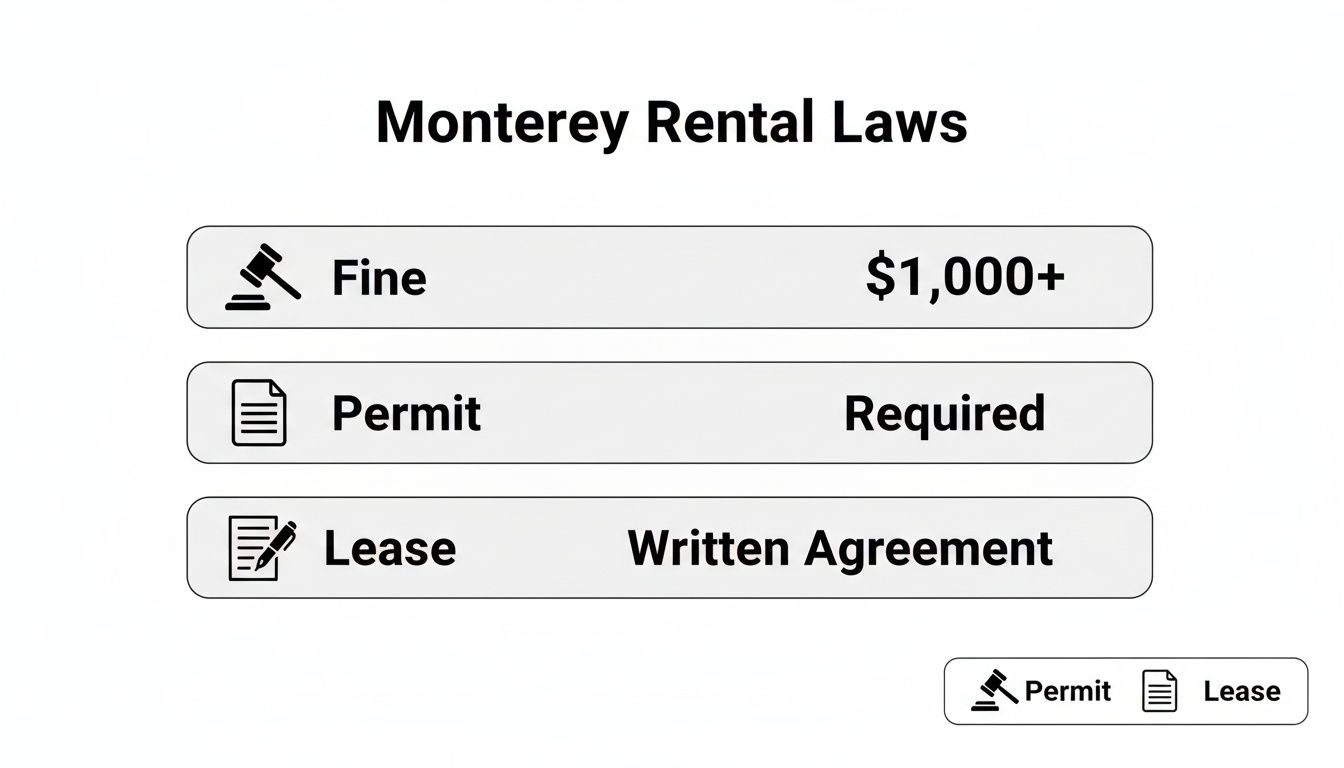
A successful long-term rental strategy is built on following the law, which helps you avoid the regulatory headaches of the short-term market.
Stable Revenue vs. Market Changes
While a short-term rental can bring in high nightly rates, that income is not guaranteed. It depends on tourism, seasons, and competition. Long-term rentals offer a predictable income stream without the seasonal dips.
Long-term tenants also have higher expectations. They want a home with privacy, storage, and reliable appliances. Making sure your property meets these needs is key to keeping good tenants. To prepare, you'll need to remove STR extras, set up proper utility billing, and create a solid lease agreement.
Let's compare the two models side-by-side.
| Short-Term Vs. Long-Term Rental Financial Snapshot In Monterey |
| :--- | :--- | :--- |
| Financial Factor | Short-Term Rental (Airbnb) | Long-Term Rental |
| Potential Gross Revenue | High but Unstable | Moderate & Stable |
| Typical Expenses | Very high: cleaning, utilities, supplies, marketing fees, higher maintenance. | Low: property taxes, insurance, major repairs. Tenant covers utilities. |
| Income Stability | Volatile: Depends on tourism, seasons, and competition. | High: Locked in with a 12-month lease, providing predictable monthly income. |
| Management Effort | High: Constant guest communication, booking management, and turnover coordination. | Low: Minimal interaction after tenant placement. |
The choice is between the high-effort potential of an Airbnb and the stable, low-stress income of a long-term lease. Understanding your new tax situation is also important. We suggest you review a guide on the tax on rental income to prepare.
Calculating Your True Profit
Your final decision should be based on Net Operating Income (NOI), not just gross revenue. NOI is the income left after all operating costs are paid. For many Monterey owners, a long-term rental provides a stronger and more reliable NOI.
When you add up the savings from fewer management tasks, lower vacancy risk, and much lower daily costs, the financial benefits are clear. The long-term model turns your property from a high-maintenance business into a simple, income-producing asset.
To learn more about this key number, read our guide on what is net operating income and how to calculate it for your property.
How to Prepare Your Property for Long-Term Tenants
One of the biggest mistakes owners make is thinking their property is ready for a long-term tenant as-is. A successful switch requires a new approach. You are no longer offering a vacation spot; you are providing a home.
This means preparing the space to meet the daily needs and legal standards that someone expects when signing a year-long lease.
Create a Blank Canvas for a New Home
Long-term renters want to imagine their life in your property. They want a neutral space they can make their own.
Start by decluttering and depersonalizing. Remove themed decor, family photos, and unique artwork. The goal is to create a clean "blank canvas" that feels open and full of potential.
Next, think about storage. Vacationers use a suitcase. Residents need closets and cabinets for their belongings. Clear out any owner closets and make sure all storage is empty and clean.
A big decision is whether to offer the property furnished or unfurnished. A furnished unit might attract some renters, but it narrows your options. Most long-term renters in Monterey already have furniture and are looking for an unfurnished home.
Focus on Durability and Function
Appliances that worked for occasional guests might not handle daily use. Durability is now your top priority.
Check the condition of all major appliances:
- Refrigerator: Is it large enough and in good working order?
- Washer and Dryer: Are they reliable and energy-efficient?
- Stove and Oven: Make sure every part works perfectly.
- HVAC System: Has the heating and cooling system been serviced recently?
Under California law, landlords must provide a property that meets basic habitability standards. This includes functional appliances and utilities. Investing in durable equipment now helps you avoid costly repairs and unhappy tenants later.
The Essential Pre-Listing Checklist
Before you list your property, a full inspection and a deep clean are required. This is about making a good first impression and meeting your legal duties as a landlord.
Walk through the property to find any needed repairs. Look for leaky faucets, running toilets, or sticky doors. For more help, our article on the top 5 prep tips for first-time landlords in 2026 has a helpful checklist.
Finally, make sure all safety features are up to code. This is a must.
Mandatory Safety Checks:
- Smoke Alarms: Test every smoke alarm and replace the batteries. California law requires them in each bedroom and on each level of the home.
- Carbon Monoxide Detectors: Make sure CO detectors are installed and working outside each sleeping area.
- Locks: All windows and doors must have secure, working locks.
A professional cleaning should be the last step. A clean property shows tenants that you are a responsible landlord and sets a positive tone from the start.
Marketing Your Rental and Finding Quality Tenants
Now that your property is ready, it's time to find a great, reliable tenant. Marketing a long-term rental is very different from listing on Airbnb. You are not trying to attract a tourist for a weekend. You are appealing to someone looking for a home for a year or more.
Your strategy needs to change, from the photos you take to the words you use. The goal is to attract many qualified applicants so you can choose the best person for your property.
Creating an Effective Rental Listing
Your rental listing is your main advertising tool. A boring description won’t work in the competitive Monterey Bay market. Your listing needs to be detailed, professional, and tell a story.
Start with a headline that gets attention. For example, "Spacious 3-Bedroom Pacific Grove Home with Ocean Views." This gives people a reason to click.
In the description, go beyond the basics. Paint a picture of what it's like to live there.
- Describe the experience: Mention the sunny kitchen in the morning or the quiet street.
- Highlight upgrades: If you installed new appliances or flooring, say so. It shows you care for the property.
- Be clear and honest: State the rent, security deposit, and pet policy upfront. This saves time for everyone.
The Importance of Professional Photos
In today's market, this is a must. Listings with professional photos rent faster and for more money. The quick phone pictures that were fine for Airbnb won't work for long-term tenants.

Good photos should make your property look bright, clean, and welcoming. A professional photographer knows how to use light and angles to make rooms look bigger. This small investment shows you are a serious landlord.
Where to List Your Monterey Rental
Long-term renters are not looking on Airbnb. To reach the right people, you need to list your property on the platforms they use.
The most popular sites for long-term rentals include:
- Zillow Rental Manager
- Apartments.com
- Rent.com
- Facebook Marketplace
Listing your property on multiple sites will get you the most exposure. The real work begins when applications start coming in.
The Most Important Step: Tenant Screening
If you only remember one thing from this guide, let it be this: never skip a thorough tenant screening process. This is the best way to protect your investment. A bad tenant can cost you thousands in unpaid rent and property damage.
A good screening process must be consistent for every applicant to follow Fair Housing laws.
Your screening should do more than check if an applicant can pay rent. It should give you a full picture of their financial responsibility and history as a tenant. This helps you find someone who is reliable, respectful, and stable.
A professional screening process always includes these four parts:
- Credit Check: This shows their financial health, including debts and payment history.
- Background Check: This looks for any criminal history that could be a risk.
- Income Verification: Confirm that their income is enough to cover the rent (usually 3x the monthly rent).
- Rental History: Contact past landlords to ask if they paid on time and cared for the property.
A strict screening system helps you make an informed decision based on data. This careful process is key to a successful and profitable long-term rental.
Making the Switch with a Property Manager
Converting your Airbnb into a long-term rental in Monterey involves a lot more than just changing a listing. You are entering a world of legal duties, market analysis, and tenant screening. This is where hiring a local expert can make the process smooth and stress-free.
A professional property manager is a partner who guides you through every step. They take the guesswork out of the process and protect your investment from common mistakes.
Why Local Expertise Matters
The Monterey Bay rental market is unique. A professional manager has deep local knowledge that online tools cannot provide. They know what tenants in Salinas want is different from what renters in Carmel expect.
This local expertise is key for several tasks:
- Accurate Rent Pricing: A manager analyzes the market to set a competitive rent price. This helps you maximize income and avoid long vacancies.
- Strategic Marketing: They know where to advertise to attract the best applicants in the area.
- Thorough Tenant Screening: A professional uses a consistent, legal process to check every applicant's credit, background, and rental history.
At Torrente Property Management, we guide owners through this entire transition. Our house rental management service includes rent pricing, tenant screening, maintenance setup, and full compliance with California rental law. We help you avoid vacancy and find quality tenants.
Avoid Vacancy and Maximize Your Return
The goal is to turn your property into a profitable, hands-off investment. An experienced property manager helps you avoid costly mistakes and find high-quality tenants. They handle the daily work so you don’t have to. To learn more, check out these helpful questions to ask a property management company.
This kind of partnership provides peace of mind. Knowing your property is legally compliant and managed by a professional lets you enjoy the benefits of ownership without the daily stress. For more tips, our guide on how to find a good property manager offers more great information.
Frequently Asked Questions About Converting Your Rental
Thinking about converting your Airbnb? You probably have some questions. Here are simple answers to what we hear most from Monterey property owners.
Should I rent my property furnished or unfurnished?
Most long-term renters in Monterey already have their own furniture. Offering your property unfurnished will attract a larger pool of qualified applicants. It gives them a blank canvas to make the space their own home.
Is a long-term rental more profitable than an Airbnb?
Often, yes. While an Airbnb may have higher gross income in peak season, the net profit from a long-term rental is usually higher and more stable. This is because of much lower operating costs—no more constant cleaning fees, restocking supplies, or paying all utilities.
How do I get a legal lease for Monterey County?
Using a generic online template is risky. A lease must follow all current California and local rental laws. A professional property manager uses attorney-reviewed lease agreements that are designed to protect you and ensure you are fully compliant.
What is the biggest mistake owners make during this switch?
The most common mistake is not understanding how different the legal duties and tenant expectations are. A long-term tenant is a resident with legal rights to privacy and a safe home. Listing your Airbnb "as-is" without changing your approach can lead to serious legal problems.
How do I start the conversion process?
Begin by reviewing local rental laws and getting your property ready for a long-term tenant. This includes deep cleaning, making necessary repairs, and deciding on a competitive rent price. A property manager can provide a local market analysis and a checklist to guide you.
If your Monterey Bay vacation rental needs a new plan, Torrente is here to help. We have helped many other owners make the switch smoothly and profitably.
Let's start with a local market analysis and a rental-readiness checklist for your property. Contact Torrente Property Management today at (831) 582-8916 or connect with us online.