
How Do I Maintain My Vacation Home When I’m Not There?
Owning a vacation home in a beautiful place like Monterey Bay is a dream. But leaving it empty for long periods can cause a lot of worry. Many owners are shocked by how much damage a small leak can cause when no one is around to see it.
The key to real peace of mind is having a plan. This guide will show you how to maintain your vacation home when you’re not there, protecting your investment and letting you relax. A consistent plan with scheduled visits is the best way to prevent problems instead of reacting to them.
Why an Empty Vacation Home Is at Risk
An empty house is vulnerable in ways your primary home isn't. Small issues you would normally catch right away can turn into major disasters. This is a common fear for people who own a second home.
A tiny drip under a sink can become a huge water damage problem with mold. Pests can move in and cause damage to the structure. Even an overgrown lawn can signal to burglars that the house is empty.
The Problem with Relying on Neighbors
Many owners ask a neighbor to "keep an eye on things." While this seems easy, it is not a reliable solution. Your neighbors are busy and aren't trained to spot the early signs of trouble.
A quick look from the sidewalk won't catch:
- A tripped breaker that turned off your fridge.
- The faint smell of a slow gas leak.
- Early signs of pests in the attic.
- Moisture on a wall from a hidden leak.
This informal approach gives you a false sense of security. It leaves your valuable property exposed to serious risks. You can learn more by reading about the top estate care mistakes Central Coast homeowners make.
The High Cost of Waiting
Ignoring small issues can lead to huge repair bills. In fact, a recent report found that 39% of homeowners were unprepared for the cost of home maintenance emergencies. For owners of empty homes, that risk is even higher because problems have more time to grow. You can read a complete guide to buying and owning a vacation home to understand these costs.
A vacant home needs active protection. You must shift from hoping for the best to planning for the worst. It's the only way to truly stop worrying.
The best solution is a clear vacant home care plan. This involves scheduled walkthroughs, photo documentation, and maintenance alerts. For homes in Carmel, Salinas, or Monterey, professional oversight becomes essential insurance for your property.
How to Create a Vacant Home Care Plan
Moving from worry to action is how you protect your investment. A clear plan, or playbook, helps you manage your home's needs from afar. It breaks down the big job of home care into smaller, manageable tasks.
A good strategy is the difference between hoping your home is okay and knowing it is. This is especially true on the Central Coast, where the weather can change quickly.
This diagram shows how homeowners can move from anxiety to a feeling of security.

It shows that being proactive is the best way to reduce risk and gain peace of mind.
Your Interior Walkthrough Checklist
A good interior check is more than a quick glance. It's a detailed inspection designed to catch small problems before they get big. This check should be done regularly and documented each time.
Your interior checklist should include:
- Run Water: Briefly run all faucets and flush toilets to keep water in the pipes, which prevents sewer gas and pests from getting in.
- Check for Leaks: Look under every sink, around toilets, and near the water heater for any sign of moisture.
- Test Safety Devices: Push the test button on all smoke and carbon monoxide detectors to make sure they work.
- Look for Pests: Check corners and inside cabinets for any evidence of pests, like droppings.
- Check Appliances: Make sure the fridge and freezer are running. Double-check that the thermostat is set to your "away" temperature.
For owners who also rent out their home, a detailed plan is a must. An ultimate vacation rental cleaning checklist can help keep the property in top shape.
Securing the Outside of Your Home
Your home's exterior is its first defense. Keeping it looking good protects its value and creates a "lived-in" look that deters intruders.
An empty home doesn't need to look abandoned. Consistent exterior care shows that the property is actively monitored, whether it's in Carmel or Salinas.
Key tasks include checking for storm damage, keeping the yard tidy, and making sure all doors and windows are secure. It’s all about making the home look cared for.
Seasonal Upkeep for the Monterey Bay Climate
The Central Coast has unique weather that requires a specific seasonal plan. Your maintenance schedule must adapt to dry summers and rainy winters. A Seasonal Maintenance Calendar can help you stay organized.
This calendar is a great start, but you should adjust it for your property's specific needs. To learn more, check out our guide to creating a seasonal home maintenance checklist for Monterey County homes.
Smart Security for an Empty Property
An obviously empty home can attract trouble. Protecting your investment requires multiple layers of security that work even when you are far away. This combines modern technology with common sense.
Smart home devices like video doorbells and automated lights give you control from your phone. You can see who is at your door and set lighting schedules to make it look like someone is home.

This connection provides real-time updates and priceless peace of mind.
Using Technology for Monitoring
Cameras and alarms are a good start, but smart security goes deeper. The right devices can warn you about common problems that are not related to break-ins.
Consider adding these to your security plan:
- Smart Water Leak Sensors: Place these small devices under sinks and near water heaters. They send an alert to your phone at the first sign of moisture.
- Smart Thermostats: Monitor your home's temperature remotely to prevent issues like frozen pipes.
- Automated Water Shut-Off Valves: This is your best defense against major water damage. If a leak is detected, it can automatically shut off the main water supply.
Security isn't just about keeping people out; it's about protecting your home from itself. The most common threats are often silent, like a slow leak.
Technology is a great tool, but it has limits. Read our article on the risk of relying on cameras alone to watch your second home to learn more.
Making Your Home Look Lived-In
Your goal is to make your home look occupied. Simple, low-tech tactics can be very effective at discouraging unwanted attention.
A pile of flyers on the porch or an overflowing mailbox are clear signs that a house is empty. Taking care of these details is a big part of your security plan.
Arrange for these simple tasks:
- Mail and Package Pickup: Make sure all mail and packages are collected regularly.
- Yard Maintenance: A neat lawn and trimmed shrubs make the house look cared for.
- Light Timers: Use smart plugs to turn lights on and off in the evening.
- Trash Bins: Have someone bring in the trash and recycling bins after pickup.
A professional can help you combine these strategies into a complete system. You can explore comprehensive residential security solutions to learn more. This approach is the most effective way to maintain your vacation home when you're not there.
How to Hire a Professional Home Watch Service
After learning about all the maintenance and security tasks, you might wonder if you should do it all yourself. Managing everything from another city can be stressful. This is when many owners realize professional help is a smart choice.
A professional home watch service, also called an estate caretaker, acts as your representative on-site. Their job is to look after your property when you can't be there. This is a formal, documented service designed to protect your investment.

What a Professional Caretaker Does
A home watch professional is consistent and follows a detailed checklist on every visit. This careful approach is what separates professional care from a friendly favor.
A typical service includes:
- Scheduled Inspections: Weekly or bi-weekly walkthroughs to spot early signs of leaks, pests, or security issues.
- Photo and Video Reports: You get a digital report with photos after every visit, so you have a clear record of your home's condition.
- Storm Preparation: For coastal areas like Monterey and Carmel, this is very important. A caretaker will secure outdoor items and check for damage after a storm.
- Vendor Coordination: If a repair is needed, your caretaker handles it. They use a network of trusted local vendors and oversee the work for you.
The Benefits of a Professional Service
Choosing between a DIY approach and hiring a pro often comes down to cost. But the cost of one undetected issue, like a slow leak, can be much more than the fees for a professional service.
The table below shows the key differences.
| Feature | DIY Management | Professional Caretaker Service |
|---|---|---|
| Reliability | Depends on your schedule or a neighbor. Often inconsistent. | Guaranteed, scheduled visits with documented reports. |
| Expertise | Relies on your own knowledge. You might not know what to look for. | Trained professionals who spot early warning signs of damage. |
| Vendor Access | You must find, vet, and coordinate contractors remotely. | Access to a pre-vetted network of trusted local professionals. |
| Emergency Response | Delayed reaction time since you are not there. | Immediate on-site response to alarms, leaks, or storm damage. |
| Peace of Mind | The nagging worry and constant stress of remote management. | The confidence that your investment is being actively protected. |
A professional home watch service from Torrente Property Management can lift this burden from your shoulders. We act as an on-site guardian for your empty home, providing weekly checks, storm prep, and video or photo reports. If you're still deciding, our article can help: Do I Need Someone to Check on My Vacation Home While I’m Away?.
Frequently Asked Questions (FAQs)
Here are answers to common questions from owners of second homes in Monterey, Carmel, and Salinas.
How often should my vacant home be checked?
Your vacant home should be inspected at least once a week. This frequency helps catch small issues like leaks or tripped breakers before they cause thousands of dollars in damage. A casual check-in from a neighbor is not enough to protect your investment.
Do I need special insurance for an empty home?
Yes, this is very important. You must tell your insurance agent that the property will be empty for long periods. Most standard policies have a "vacancy clause" that can limit or cancel your coverage if the home is empty for more than 30 or 60 days.
What is the biggest mistake second-home owners make?
The most common and costly mistake is relying on neighbors for check-ins. This approach is unreliable and lacks the expertise and documentation of a professional service. A professional caretaker follows a detailed checklist and provides you with a report after each visit for true peace of mind.
How much does a home watch service cost?
The cost varies based on your property's size and needs. It is best to see this service as an investment in protecting your asset. The fee is small compared to the potential cost of an undetected disaster like a burst pipe or a break-in.
Can you help prepare my home for storms when I'm away?
Absolutely. Proactive storm preparation is a key service we offer on the Monterey Peninsula. Our team secures outdoor furniture, clears drains to prevent water damage, and performs a full inspection after the storm passes to check for any issues.
Your vacation home is a major investment that needs professional protection. Torrente Property Management offers a Vacant Home and Estate Caretaker Service to give your property the expert oversight it needs. We serve Monterey, Carmel, and Salinas, specializing in protecting seasonal homes.
Contact us today at (831) 582-8916 for a vacant home assessment or learn more online.


What House Rental Management Actually Involves
When landlords ask what we do, many think it’s just collecting a check and calling a handyman. But modern property management is a full-time job focused on one thing: protecting and growing your real estate investment. It's less about simple tasks and more about having a dedicated operations manager for your asset.
Beyond Rent Collection: A Deeper Look
For most property owners in the Monterey Bay area, a rental property is a massive financial asset. It's easy to believe that management is simple: find a tenant, get rent on time, and fix the occasional leak.
This view is dangerously simple. It can lead to high tenant turnover, surprise costs, and a shrinking return on your investment. In fact, 61% of DIY landlords say property upkeep is the single worst part of their job, showing it's more demanding than it looks.
Myth vs. Reality: The Truth About Management
| Common Myth | The Professional Management Reality |
|---|---|
| "It's just collecting rent." | It's strategic financial oversight, including expense tracking, clear monthly statements, and reporting to show your asset's performance. |
| "Anyone can find a tenant." | It's diligent tenant acquisition, involving tough screening to find reliable residents and building good relationships to keep them. |
| "You just fix things when they break." | It's proactive property maintenance, focusing on preventative care to preserve value, prevent emergencies, and keep tenants happy. |
| "It's just a simple contract." | It's rigorous legal compliance, navigating complex landlord-tenant laws to reduce risk and protect you from liability. |
This multi-layered approach is why the U.S. property management industry has grown into a $134.2 billion market. It's about the expertise needed to manage a rental home as the serious investment it is.
A good manager, for example, will advise tenants on their responsibilities, like securing proper coverage such as Renters Insurance California. It’s a small step that protects the tenant’s belongings and adds a crucial layer of liability protection for you.
This is even more critical for second homes or properties that are empty for part of the year. A full asset protection strategy includes understanding the risks of an unoccupied property, something we specialize in with our vacant home caretaking services.
The Four Pillars of Comprehensive Management
To understand what house rental management actually involves, think of it as a structure built on four essential pillars. Each one supports the others to protect your asset, maximize your return, and give you peace of mind.
This structure is what turns a rental property from a side hustle into a high-performing investment.

True management means giving constant attention to all four areas to keep your property stable, profitable, and secure.
Pillar 1: Tenant Lifecycle Management
The first pillar is managing the entire tenant journey, from their first inquiry to move-out. Finding the right tenant is a science. This pillar covers everything related to the people who live in your property.
It starts with marketing that reaches a wide pool of qualified applicants. In a diverse area like Monterey County, that includes leveraging our bilingual (English/Spanish) services to connect with more great potential renters.
Once applications arrive, a tough screening process begins. It's much more than a credit score. A complete tenant screening digs into:
- Credit and Background Checks: We review credit history and run background checks for safety.
- Rental History Verification: We call previous landlords to confirm on-time payments and property care.
- Income and Employment Verification: We confirm stable income to ensure rent is affordable.
After placing a great tenant, the focus shifts to retention. Responsive communication and prompt service help keep good tenants, which is key to minimizing costly vacancies.
Pillar 2: Proactive Maintenance and Asset Preservation
Many owners think maintenance just means fixing things when they break. But that reactive approach leads to expensive emergencies and unhappy tenants. This pillar shifts from a "fix-it" mindset to a preventative one that protects your investment.
A professional manager doesn't just wait for a problem. They actively work to prevent issues through scheduled, preventative care.
This proactive approach involves a regular maintenance schedule. Think of it like a routine check-up for your property. Key tasks include:
- Seasonal HVAC Servicing: Inspecting heating and cooling systems before peak seasons hit.
- Gutter and Roof Inspections: Clearing debris to prevent water damage before winter rains.
- Appliance Checks: Testing major appliances to catch minor issues early.
This pillar also means having a deep network of trusted local vendors. When a repair is needed, we have reliable professionals ready to go. This ensures quality work at fair prices without you having to scramble in an emergency.
Pillar 3: Financial and Administrative Oversight
The third pillar is the financial engine of your rental. It’s the system of managing money, from collecting rent to giving you clear financial reports. A great manager brings order and transparency to your investment.
Reliable rent collection is the start. We make it easy for tenants to pay on time through secure online portals. But it goes much deeper. Financial oversight includes:
- Expense Management: We handle property-related bills, from the mortgage to vendor invoices.
- Detailed Monthly Statements: You get a clear breakdown of all income and expenses.
- Year-End Reporting: We deliver organized summaries to make tax time simple.
This level of detail gives you a real-time pulse on your property's performance. For a deeper look into the specifics of this role, you can explore our detailed guide on Rental Property Services.
Pillar 4: Legal Compliance and Risk Mitigation
This final pillar is arguably the most important for your protection: navigating complex landlord-tenant laws. Owning a rental in California means dealing with a dense web of regulations. One wrong move can lead to costly fines or lawsuits.
Think of this pillar as your legal shield. It’s about staying current on every law, including:
- Fair Housing Laws: Ensuring every step is free from discrimination.
- Habitability Standards: Making sure your property meets all legal safety requirements.
- Lease Agreements: Drafting and executing legally solid leases that protect you.
- Local Ordinances: Understanding specific rules in cities like Monterey and Salinas.
Effective management here means handling everything by the book. If an eviction becomes necessary, we manage the process correctly and professionally, minimizing your risk. This quiet but critical work protects you from liability.
Protecting Your Asset with Proactive Maintenance
Many landlords see maintenance as stressful, late-night calls about a broken water heater. That reactive cycle is what professional management is designed to break. True asset protection is about stopping problems before they start.

From Reactive Repairs to Proactive Care
Proactive maintenance is like a routine health check-up for your property. It’s all about catching small issues before they become big, expensive emergencies. This hands-on approach preserves your home’s value and keeps tenants happy.
Recent insights show that 39% of property managers spend 20+ hours per month just on maintenance tasks. This isn't just about calling a handyman. It’s a constant cycle of preventative care, diligent tenant communication, and coordinating with vendors to stay ahead of problems.
This proactive care directly impacts your bottom line. A well-maintained home has lower tenant turnover, avoids long-term damage, and boosts your return on investment. For practical ideas, check out this helpful seasonal home maintenance checklist.
Building a Local Vendor Network
Finding a good contractor in an emergency can be a headache for self-managing owners. You risk overpaying for a rush job or hiring someone who does poor work. A professional manager has already done the hard work.
We have a curated list of local pros—plumbers, electricians, and more—who deliver quality work at fair prices. That pre-vetted network is priceless, whether for routine upkeep or a 2 AM emergency.
A Practical Action Plan for Your Property
If you're managing your own rental, you can start building a proactive strategy today. Create a recurring quarterly checklist to get ahead of potential issues. It's a simple step that can save you thousands.
Your checklist should include tasks like:
- HVAC Servicing: Schedule tune-ups in the spring and fall.
- Gutter Clearing: Have gutters cleaned twice a year.
- Landscaping Upkeep: Maintain curb appeal and prevent overgrowth.
- Photo-Documented Walk-Throughs: Conduct inspections to check for leaks and test smoke detectors.
Of course, the most effective approach is to have a management firm handle this for you. We integrate these practices into our services. Learn more in our guide to smart maintenance for rental properties.
Navigating the Legal Landscape in Monterey County
Owning a rental property in California means navigating a dense and shifting web of laws. A huge part of what house rental management actually involves is acting as your legal shield. We protect your investment from costly, and often unintentional, missteps.
One of the biggest legal pillars in California is the "implied warranty of habitability." This is a legal mandate that your property must be safe and livable. A seemingly minor issue can become a major legal problem if not handled correctly.
On top of that, strict Fair Housing laws dictate every interaction you have with applicants and tenants. These laws are designed to prevent discrimination and are not optional.
Local Rules Add Another Layer of Complexity
While state laws set the foundation, local ordinances in Monterey County add another layer of complexity. Cities like Monterey and Salinas have their own specific rules landlords must follow.
Just keeping up with these local rules is a full-time job. A local ordinance might detail the exact procedure for entering a tenant's home for an inspection. If you don't follow it perfectly, you could face legal action.
This is where true local expertise becomes so critical. A manager on the ground in the Monterey Peninsula every day knows the nuances of these local rules. That local knowledge is the single best defense against fines and lawsuits.
From Lease to Eviction, Procedure is Key
Every step in the rental cycle is governed by a precise legal procedure. A professional lease is your first line of defense. When difficult situations arise, like an eviction, following the legal process perfectly is non-negotiable.
One tiny mistake can get an entire eviction case thrown out of court. This forces you to start the whole expensive process over again. This isn't just about knowing the law; it's about executing every step with precision.
Professional management ensures every action is documented and compliant. You can learn more about how these regulations are evolving by reading our guide on the legal shifts reshaping rental management in California.
The Financial Engine Room of Your Rental Property
Let's look at the financial side of your investment. Professional management is the engine room of your rental property. It drives your return on investment and involves much more than just cashing a check.
It’s about building a consistent, transparent, and efficient financial system. This system provides clarity and boosts your property's long-term value.

It starts with making it easy for tenants to pay on time. By offering secure online payment options, we ensure a reliable, timely cash flow for you.
More Than Just Rent Collection
A huge part of what house rental management actually involves is taking care of all property-related bills. Imagine no longer juggling due dates for the mortgage, property taxes, insurance, or vendor invoices.
A professional manager handles this administrative load. This ensures your financial obligations are met accurately and on schedule. This core function brings financial stability and frees you up.
Transparency Through Detailed Reporting
How do you know if your property is performing well? The answer is clear, detailed financial reporting. Every month, you get a comprehensive statement that gives you a full breakdown of all income and expenses.
A detailed owner statement is your property’s monthly report card. It should provide complete transparency, showing you exactly where every dollar came from and where it went, so you can track your ROI with confidence.
Here’s a simplified example of what you can expect in your monthly statement.
Sample Monthly Owner Statement Breakdown
| Category | Description | Income (+) | Expense (-) |
|---|---|---|---|
| Rental Income | Monthly rent collected from tenant | $3,500.00 | |
| Management Fee | 8% of collected rent | $280.00 | |
| Maintenance | Invoice from plumber for leaky faucet | $150.00 | |
| Landscaping | Monthly yard maintenance service | $125.00 | |
| Net Income | Funds deposited to your account | $2,945.00 |
This level of detail is critical for understanding your property’s financial health.
At Torrente Property Management, we provide 24/7 access to these statements through a secure online owner portal. This means you always have a clear, real-time picture of your investment. You can learn more by exploring our guide on what is net operating income.
This financial system does more than just organize your books. It builds trust and gives you peace of mind. And when tax season comes, you’ll get a simple, CPA-ready year-end statement.
FAQs: What House Rental Management Actually Involves
What are typical management fees in Monterey Bay?
Management fees in areas like Monterey and Salinas usually range from 8% to 12% of the monthly rent. A lower fee isn't always a better deal, as it can sometimes mean a lower level of service. Most companies also charge a one-time leasing fee to cover the cost of marketing and screening for a new tenant.
How do you handle late rent or evictions?
Our approach is firm but professional, starting with automated reminders. If rent is late, we follow a strict, legally-compliant process, including serving all required notices. Our tough screening makes evictions rare, but if needed, we manage the entire process correctly and efficiently.
What happens in a middle-of-the-night emergency?
We provide a 24/7 emergency line for tenants, so urgent issues are addressed immediately, day or night. For a major pipe burst or furnace failure, our team dispatches a vetted emergency vendor from our trusted local network. This rapid response protects your property from further damage and keeps tenants safe.
How do you screen tenants for my rental home?
Finding a high-quality renter is the most important part of a successful rental. Our thorough process includes a full credit check, a national criminal background check, and an eviction history search. We also verify employment and income and call previous landlords to get a complete picture of each applicant.
How can you manage my property if I live out of state?
We specialize in working with out-of-area owners. Our secure online owner portal is your digital lifeline, giving you 24/7 access to financial statements, maintenance records, and detailed inspection reports with photos. Through proactive updates and clear reporting, you'll always feel connected and confident that your investment is in great hands.
Want a manager who treats your home like their own? Talk to Torrente about full-service house rental management in Monterey Bay. Contact Torrente Property Management today at (831) 582-8916.

Do Property Managers Actually Manage Apartments?
Yes, a professional property manager does much more than collect rent. They act as your strategic partner to protect and grow the value of your apartment building. Many Monterey Bay landlords worry their manager isn't really watching over their investment. This guide explains what active, hands-on apartment management should look like.
Recent data shows that 80% of investors agree that property managers should do more than just collect rent. This shows a big shift in what owners expect.
What Real Apartment Management Looks Like Now
The job of a property manager has changed. It used to be about cashing checks and calling a plumber. Now, it requires financial skill, legal knowledge, and operational expertise.
This isn't just a feeling; it's a fact. The global property management market, valued at $26.49 billion recently, is expected to reach $42.78 billion by 2030. This growth shows the high demand for skilled managers who can handle today's tough rental market.
More Than Just Collecting Rent
A modern manager protects your asset for the long term. Instead of just reacting to problems, a good manager plans ahead to prevent them.
They use tools like multifamily property management software to run daily operations smoothly. This technology helps with everything from rent collection to maintenance requests. It leads to better organization and faster responses for tenants.
The core job of a professional manager is to maximize your investment returns while minimizing your stress. This is done through a mix of proactive maintenance, diligent financial oversight, and excellent tenant relations—tasks that go far beyond simply collecting the rent. To learn more about specific services, check out our guide on what property managers do for their monthly fee.
The Four Pillars of Great Apartment Management
To answer "do property managers actually manage apartments?", we have to look past a simple to-do list. Good management is a system built on four key pillars. When these pillars work together, they support your investment's health and profit.
Think of your property as a small business. A great manager is its CEO. They oversee every part to make sure it runs well and makes a profit.
This chart shows how a professional manager acts as your strategic partner. They coordinate the core functions that increase your property's value.

This structure makes it clear that a manager’s role is strategic. They handle every moving part to help you meet your financial goals.
Pillar 1: Proactive Maintenance
This is the most visible and important pillar. It's about taking care of the physical building, not just fixing a leaky faucet when a tenant calls.
Proactive management means we look ahead. We do regular property inspections with photos to find small issues before they become expensive emergencies. We also create a preventive maintenance schedule for big items like HVAC systems and roofing.
Pillar 2: Smart Leasing and Tenant Relations
An empty apartment loses you money every month. This pillar focuses on keeping vacancies low and tenant quality high.
It starts with great marketing to attract qualified applicants. Then, we use a tough screening process. This includes credit checks, rental history verification, and background checks to find reliable tenants.
Good tenant relations are key to reducing turnover. We handle concerns quickly and communicate clearly to keep good tenants happy.
Pillar 3: Detailed Financial Oversight
This pillar ensures your property runs like a business. A professional manager handles every financial detail with accuracy and transparency. This includes collecting rent, following up on late payments, and paying property bills like the mortgage and insurance.
You should expect clear, itemized monthly statements showing all income and expenses. This makes tax time much easier. Learn more in our guide on full-service property management.
Pillar 4: Legal and Regulatory Compliance
Navigating housing laws is one of a manager's most valuable jobs. One mistake with Fair Housing laws or California's eviction rules can lead to serious legal trouble.
A professional manager makes sure your lease is solid and handles security deposits correctly. This pillar protects you from risk and gives you peace of mind.
Protecting Your Investment with Active Maintenance

This is where a great property manager really proves their worth. Maintenance is about actively preserving your asset, not just fixing things as they break. It’s the difference between waiting for problems and having a strategy to prevent them.
This strategic care is at the heart of what professional managers actually do. It's no surprise that recent insights show that 39% of property managers spend 20+ hours per month on maintenance coordination alone. This is a huge part of the job.
What Proactive Maintenance Really Means
So, what does a proactive system look like? It’s a well-organized machine of scheduled checks, detailed reports, and smart, long-range planning.
This involves a few key activities:
- Scheduled Property Inspections: Regular walk-throughs of units and common areas, documented with photo reports, to catch small issues early.
- Preventive Maintenance Schedules: A calendar for servicing major systems—like HVAC and plumbing—to make them last longer.
- Vetted Vendor Network: A list of trusted and insured local contractors in the Monterey Bay area, ensuring quality work at a fair price.
From Repair Logs to Long-Term Planning
An effective manager thinks like an investor. They keep detailed repair logs to spot recurring problems. This helps them decide when a simple fix isn't enough and a replacement is the smarter financial move. Understanding how to use data accuracy to dominate real estate investing separates proactive decisions from reactive panic.
This approach leads to long-term capital improvement planning. By planning for major expenses—like a new roof in five years—your manager helps you budget for the future. You can learn more by checking out our guide on how to implementing smart maintenance for your rental property.
A Day in the Life of a Monterey Bay Manager

To understand what property managers do, you have to look at a typical day. The job is a constant mix of planning, problem-solving, and communication. No two days are ever the same, but they are always full.
A manager's day often starts with the numbers. They might spend the morning on a multi-unit property in Salinas, checking financial reports. This ensures every dollar is accounted for.
From Financials to Fieldwork
By midday, things can change fast. An urgent call about a plumbing leak in an apartment in Carmel comes in. This is where a manager’s value shines. A trusted local plumber is on the way in minutes, and the tenant gets a clear update.
This quick action prevents more damage and keeps the tenant happy. It avoids the stress a self-managing owner would face trying to find a good contractor.
The Bilingual Advantage in Our Community
In a diverse community like Monterey County, clear communication is vital. Part of the day could be spent talking with a Spanish-speaking tenant in Salinas to explain a maintenance visit. This helps build trust and ensures everyone is on the same page.
This bilingual capability isn't just a nice feature—it's essential for effective management here. It ensures clear communication, builds trust with tenants, and widens our network of reliable local vendors. This directly benefits the properties we manage.
The day often ends back at the office, finalizing leases and responding to owners. This constant multitasking is what it means to truly manage apartments. Learn more about our approach through our real estate management services.
Red Flags of Poor Property Management
How can you tell if your manager is actively protecting your investment? Recognizing the warning signs can save you from frustration and financial loss. Many apartment owners in Monterey Bay feel their manager isn't solving recurring issues.
This is a common frustration for landlords with small-to-mid-size apartment complexes. If your manager seems absent, they are likely falling behind on core duties. This reactive approach is a major red flag that costs you money.
Poor Communication and Vague Reports
One of the biggest red flags is silence. If your calls and emails go unanswered for days, it's a sign of a disorganized manager. This lack of communication often extends to financial statements.
If your monthly reports are confusing or lack copies of vendor invoices, you can't be sure where your money is going. Every expense should be documented and clear. Vague reports can hide problems and prevent you from seeing your property's true performance.
The Accountability Test: The Property Care Report
Ask your manager for a “property care report” that includes recent inspection photos, a detailed repair log, and a schedule for preventive maintenance. A proactive manager will have this information. If they don't offer it, it's a red flag.
High Tenant Turnover and Recurring Emergencies
Constantly finding new tenants is expensive. While some turnover is normal, a high rate often points to management issues. Happy tenants are much more likely to renew their leases.
Similarly, frequent "emergency" repairs often mean there is no preventive care. A manager who isn't scheduling regular HVAC service or inspecting for small leaks isn't managing—they're just reacting. This is one of the costliest common missteps Salinas owners must avoid.
The Torrente Difference: How We Manage Apartments
Good apartment management includes proactive inspections and long-term planning, not just reacting to emergency calls. At Torrente Property Management, this is the core of everything we do. We offer transparent communication and treat every property like our own.
Our deep roots in Monterey Bay give us an advantage. With years of experience in Monterey, Salinas, and Carmel, we understand the local market. Our fully bilingual team delivers clear and effective oversight.
A Partnership Focused on Your Investment
The property management industry is growing because owners need a real partner. They need someone to handle the complex tasks of owning rental properties. The market is projected to grow to $38.48 billion by 2034, a sign that owners want professional services to protect their investments. You can review the latest market research for more details.
We are here to manage your apartments as the valuable investments they are. Our goal is simple: to make sure your property generates reliable returns while giving you complete peace of mind.
Want a manager who treats your apartments like a long-term investment, not just a rent roll? Contact Torrente Property Management today at (831) 582-8916 for a walk-through of how we manage multi-unit properties differently.
FAQs About Apartment Management
Here are straightforward answers to common questions from apartment owners in the Monterey Bay area.
How often should my property manager contact me?
Communication should be proactive. You should get a detailed monthly financial statement at a minimum. A great manager will also reach out with timely updates on maintenance, lease renewals, and inspections before you have to ask.
What should I expect in my financial reports?
You should receive monthly statements that clearly list all income and expenses. These reports should include copies of actual invoices. This transparency helps you understand exactly how your investment is performing.
Who finds and screens new tenants?
This is the property manager's job. They market the property, show it to potential renters, and conduct thorough background checks. This process includes checking credit, criminal records, and past rental history to find reliable tenants.
How are late rent payments handled?
A professional manager follows a strict, legal process for late rent. This includes sending official notices as required by California law. If needed, they will manage the entire eviction process to protect you from liability.
What is a property care report?
A property care report is a health checkup for your investment. It should include inspection photos, repair logs, and a preventive maintenance schedule. This report proves your manager is actively monitoring your property's condition and not just waiting for things to break.

Converting Your Airbnb to a Long-Term Rental in Monterey
Are you wondering how to convert your Airbnb into a long-term rental in Monterey? You're asking at the right time. Many local property owners are swapping the stress of short-term bookings for the steady income of a long-term lease.
The reason is clear: consistent monthly rent without the constant guest turnover, cleaning, and late-night messages. This shift is a smart response to a changing market. In fact, short-term rental delistings rose 47% nationally in 2025, with many owners choosing to rent their properties long-term instead of selling (Source: Business Insider).
This guide will show you how to make this change in the Monterey Bay area. We'll cover everything from local laws to getting your property ready for a tenant who will call it home.
Why Switch from Short-Term Bookings to Long-Term Renting?
The Monterey Rental Market is Changing
Short-term rentals (STRs) seem attractive because of high nightly rates. But those numbers don't show the full picture. They don't include slow seasons, high operating costs, and increasing local regulations.
More property owners are finding that the stability of a year-long lease provides a more reliable income. You trade the constant work of managing bookings for a simpler, more passive cash flow. As local STR rules get tighter, converting to a long-term rental is becoming the safer, more profitable choice.
A common misstep is assuming you can list your furnished Airbnb "as-is" for a long-term tenant. Long-term renters have different needs. They look for privacy, storage, and reliable appliances, and they expect a formal lease, not a list of house rules.
From Vacation Spot to Someone's Home
To succeed, you need to change your mindset. You're no longer offering a quick getaway; you're providing a home. This affects how you prepare and market your property.
Here are a few key steps for a smooth transition:
- Property Prep: Long-term tenants need a blank slate. This means removing personal decor, making sure there is enough storage, and checking that all appliances are durable and working well.
- Legal Rules: The laws for long-term rentals are much stricter than for STRs. You must follow California's habitability standards and use a legal, compliant lease agreement.
- Tenant Screening: Finding the right long-term tenant requires a thorough screening process. This includes credit checks, background checks, and reviewing rental history to protect your investment.
This change is a big move. For more on the financial benefits, read our article on why long-term tenants mean long-term profits. A thoughtful switch ensures your property stays profitable for years to come.
Understanding Monterey's Long-Term Rental Laws
Switching your Airbnb to a long-term rental means learning a new set of rules. The laws for long-term rentals in Monterey County are very different from vacation rental rules. They are more detailed and are designed to protect tenants.
The City of Monterey has strict rules against short-term rentals to keep housing available for local residents. This makes converting to a long-term lease the most secure option for property owners. It's a smart response to the city's clear housing goals.
The Local Move Away from Short-Term Rentals
Monterey's rules have gotten tighter over time. The city passed an ordinance that banned most short-term rentals and enforced it with large fines.
City officials want to create more housing for people who live and work here. This tells property owners that the long-term rental market is the most stable path. Trying to bend the rules can lead to fines and stress.
What You Need for a Compliant Long-Term Rental
To legally rent your property long-term in Monterey, you must shift from hospitality rules to landlord-tenant law. This includes a few key duties.
- Business Licenses: Most cities, including Monterey, require landlords to have a business license. This is a basic step to operate legally.
- Certificate of Occupancy: Your property must be approved for people to live in. A Certificate of Occupancy confirms it is safe and meets housing standards.
- Building Codes: Long-term rentals must meet strict building, health, and safety codes. These cover everything from wiring and plumbing to fire safety.
These are just the first steps. You also need to make sure your property meets California's standards for habitability.
California's "Implied Warranty of Habitability"
In California, every long-term lease includes an "implied warranty of habitability." This is a legal promise that your rental is fit to live in for the entire lease. You cannot get out of this responsibility.
This legal standard means landlords must keep the property in a livable condition. This includes working plumbing, electricity, and effective waterproofing. If you fail to do this, tenants may have the legal right to stop paying rent or break their lease.
A property that was fine for a weekend guest may not meet these stricter legal standards. To learn more, see our guide on how short-term rentals are on the way out in Monterey County.
Why a Strong Lease Agreement is Essential
Your most important tool to protect your investment is the lease agreement. A generic online template is not enough and can expose you to legal risks.
A proper lease for a Monterey property must follow California law and clearly state all key details:
- The length of the lease (e.g., one year)
- The rent amount and due date
- The security deposit amount and rules for its return
- Who is responsible for maintenance and repairs
- Rules on pets, guests, and property changes
A strong lease sets clear expectations from the start. It is your main tool for protecting your rights as a landlord. Getting these details right is where professional help can save you from future problems.
Nightly Rates vs. Monthly Rent: A Realistic Look
The high nightly rates of an Airbnb look great on paper. But when you look at the net income—what you actually keep—the story often changes. Let's compare the two rental models with a focus on real numbers in the Monterey market.
A smart investment strategy looks beyond gross income to the steady profit a long-term rental can provide. To do that, we need to look at the hidden costs that reduce your short-term rental profits.
The Hidden Costs of an Airbnb
Running an Airbnb is expensive and time-consuming. It's a hospitality business, not a passive investment. An STR owner pays for everything, all the time.
These costs add up quickly:
- Frequent Cleanings: The property needs a deep cleaning after every guest. This can cost hundreds of dollars a week during peak season.
- Constant Restocking: You have to restock everything from toilet paper and soap to coffee and snacks. These small costs become a large monthly expense.
- Higher Utility Bills: You pay for electricity, gas, water, and internet. Guest usage is often high and unpredictable.
- More Wear and Tear: Constant guest turnover leads to faster damage to furniture, appliances, and floors. This means more frequent and costly repairs.
This chart shows the key legal and financial details to consider, including permits, leases, and fines for not following the rules.
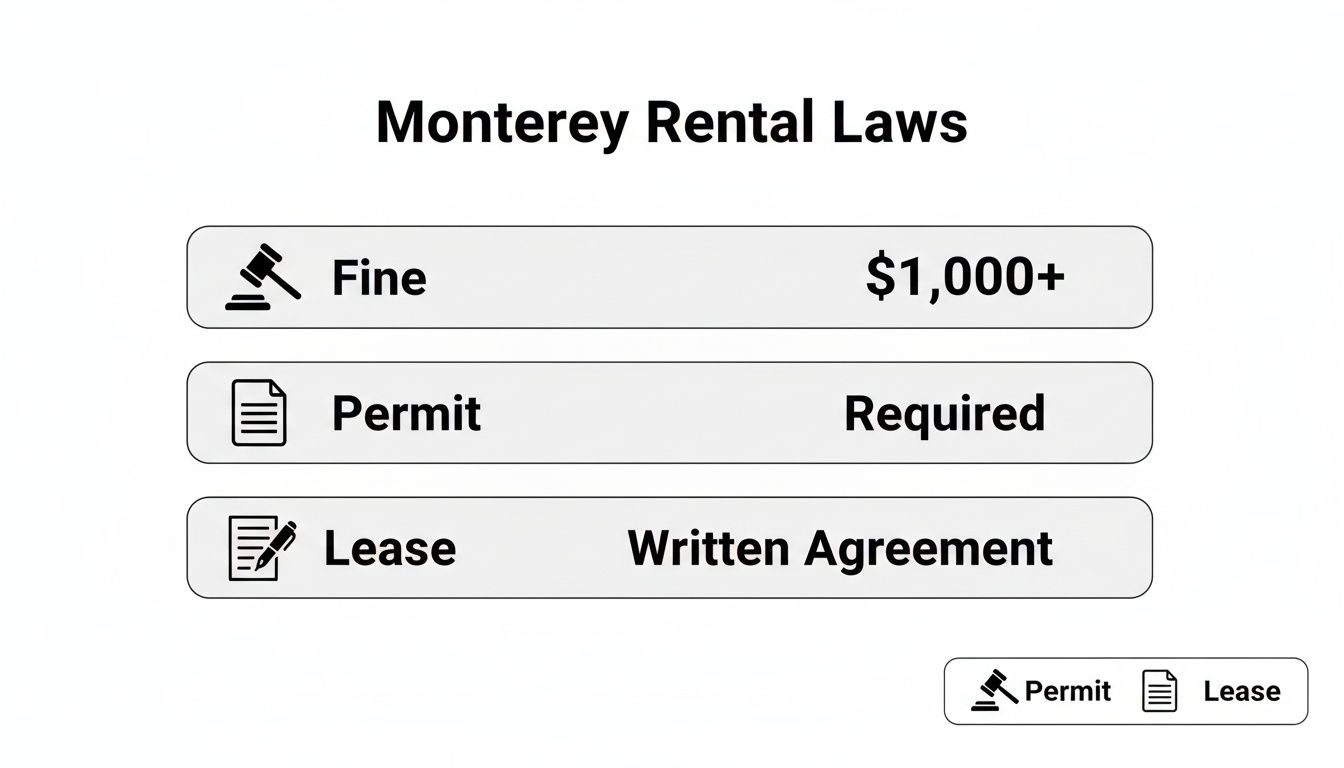
A successful long-term rental strategy is built on following the law, which helps you avoid the regulatory headaches of the short-term market.
Stable Revenue vs. Market Changes
While a short-term rental can bring in high nightly rates, that income is not guaranteed. It depends on tourism, seasons, and competition. Long-term rentals offer a predictable income stream without the seasonal dips.
Long-term tenants also have higher expectations. They want a home with privacy, storage, and reliable appliances. Making sure your property meets these needs is key to keeping good tenants. To prepare, you'll need to remove STR extras, set up proper utility billing, and create a solid lease agreement.
Let's compare the two models side-by-side.
| Short-Term Vs. Long-Term Rental Financial Snapshot In Monterey |
| :--- | :--- | :--- |
| Financial Factor | Short-Term Rental (Airbnb) | Long-Term Rental |
| Potential Gross Revenue | High but Unstable | Moderate & Stable |
| Typical Expenses | Very high: cleaning, utilities, supplies, marketing fees, higher maintenance. | Low: property taxes, insurance, major repairs. Tenant covers utilities. |
| Income Stability | Volatile: Depends on tourism, seasons, and competition. | High: Locked in with a 12-month lease, providing predictable monthly income. |
| Management Effort | High: Constant guest communication, booking management, and turnover coordination. | Low: Minimal interaction after tenant placement. |
The choice is between the high-effort potential of an Airbnb and the stable, low-stress income of a long-term lease. Understanding your new tax situation is also important. We suggest you review a guide on the tax on rental income to prepare.
Calculating Your True Profit
Your final decision should be based on Net Operating Income (NOI), not just gross revenue. NOI is the income left after all operating costs are paid. For many Monterey owners, a long-term rental provides a stronger and more reliable NOI.
When you add up the savings from fewer management tasks, lower vacancy risk, and much lower daily costs, the financial benefits are clear. The long-term model turns your property from a high-maintenance business into a simple, income-producing asset.
To learn more about this key number, read our guide on what is net operating income and how to calculate it for your property.
How to Prepare Your Property for Long-Term Tenants
One of the biggest mistakes owners make is thinking their property is ready for a long-term tenant as-is. A successful switch requires a new approach. You are no longer offering a vacation spot; you are providing a home.
This means preparing the space to meet the daily needs and legal standards that someone expects when signing a year-long lease.
Create a Blank Canvas for a New Home
Long-term renters want to imagine their life in your property. They want a neutral space they can make their own.
Start by decluttering and depersonalizing. Remove themed decor, family photos, and unique artwork. The goal is to create a clean "blank canvas" that feels open and full of potential.
Next, think about storage. Vacationers use a suitcase. Residents need closets and cabinets for their belongings. Clear out any owner closets and make sure all storage is empty and clean.
A big decision is whether to offer the property furnished or unfurnished. A furnished unit might attract some renters, but it narrows your options. Most long-term renters in Monterey already have furniture and are looking for an unfurnished home.
Focus on Durability and Function
Appliances that worked for occasional guests might not handle daily use. Durability is now your top priority.
Check the condition of all major appliances:
- Refrigerator: Is it large enough and in good working order?
- Washer and Dryer: Are they reliable and energy-efficient?
- Stove and Oven: Make sure every part works perfectly.
- HVAC System: Has the heating and cooling system been serviced recently?
Under California law, landlords must provide a property that meets basic habitability standards. This includes functional appliances and utilities. Investing in durable equipment now helps you avoid costly repairs and unhappy tenants later.
The Essential Pre-Listing Checklist
Before you list your property, a full inspection and a deep clean are required. This is about making a good first impression and meeting your legal duties as a landlord.
Walk through the property to find any needed repairs. Look for leaky faucets, running toilets, or sticky doors. For more help, our article on the top 5 prep tips for first-time landlords in 2026 has a helpful checklist.
Finally, make sure all safety features are up to code. This is a must.
Mandatory Safety Checks:
- Smoke Alarms: Test every smoke alarm and replace the batteries. California law requires them in each bedroom and on each level of the home.
- Carbon Monoxide Detectors: Make sure CO detectors are installed and working outside each sleeping area.
- Locks: All windows and doors must have secure, working locks.
A professional cleaning should be the last step. A clean property shows tenants that you are a responsible landlord and sets a positive tone from the start.
Marketing Your Rental and Finding Quality Tenants
Now that your property is ready, it's time to find a great, reliable tenant. Marketing a long-term rental is very different from listing on Airbnb. You are not trying to attract a tourist for a weekend. You are appealing to someone looking for a home for a year or more.
Your strategy needs to change, from the photos you take to the words you use. The goal is to attract many qualified applicants so you can choose the best person for your property.
Creating an Effective Rental Listing
Your rental listing is your main advertising tool. A boring description won’t work in the competitive Monterey Bay market. Your listing needs to be detailed, professional, and tell a story.
Start with a headline that gets attention. For example, "Spacious 3-Bedroom Pacific Grove Home with Ocean Views." This gives people a reason to click.
In the description, go beyond the basics. Paint a picture of what it's like to live there.
- Describe the experience: Mention the sunny kitchen in the morning or the quiet street.
- Highlight upgrades: If you installed new appliances or flooring, say so. It shows you care for the property.
- Be clear and honest: State the rent, security deposit, and pet policy upfront. This saves time for everyone.
The Importance of Professional Photos
In today's market, this is a must. Listings with professional photos rent faster and for more money. The quick phone pictures that were fine for Airbnb won't work for long-term tenants.

Good photos should make your property look bright, clean, and welcoming. A professional photographer knows how to use light and angles to make rooms look bigger. This small investment shows you are a serious landlord.
Where to List Your Monterey Rental
Long-term renters are not looking on Airbnb. To reach the right people, you need to list your property on the platforms they use.
The most popular sites for long-term rentals include:
- Zillow Rental Manager
- Apartments.com
- Rent.com
- Facebook Marketplace
Listing your property on multiple sites will get you the most exposure. The real work begins when applications start coming in.
The Most Important Step: Tenant Screening
If you only remember one thing from this guide, let it be this: never skip a thorough tenant screening process. This is the best way to protect your investment. A bad tenant can cost you thousands in unpaid rent and property damage.
A good screening process must be consistent for every applicant to follow Fair Housing laws.
Your screening should do more than check if an applicant can pay rent. It should give you a full picture of their financial responsibility and history as a tenant. This helps you find someone who is reliable, respectful, and stable.
A professional screening process always includes these four parts:
- Credit Check: This shows their financial health, including debts and payment history.
- Background Check: This looks for any criminal history that could be a risk.
- Income Verification: Confirm that their income is enough to cover the rent (usually 3x the monthly rent).
- Rental History: Contact past landlords to ask if they paid on time and cared for the property.
A strict screening system helps you make an informed decision based on data. This careful process is key to a successful and profitable long-term rental.
Making the Switch with a Property Manager
Converting your Airbnb into a long-term rental in Monterey involves a lot more than just changing a listing. You are entering a world of legal duties, market analysis, and tenant screening. This is where hiring a local expert can make the process smooth and stress-free.
A professional property manager is a partner who guides you through every step. They take the guesswork out of the process and protect your investment from common mistakes.
Why Local Expertise Matters
The Monterey Bay rental market is unique. A professional manager has deep local knowledge that online tools cannot provide. They know what tenants in Salinas want is different from what renters in Carmel expect.
This local expertise is key for several tasks:
- Accurate Rent Pricing: A manager analyzes the market to set a competitive rent price. This helps you maximize income and avoid long vacancies.
- Strategic Marketing: They know where to advertise to attract the best applicants in the area.
- Thorough Tenant Screening: A professional uses a consistent, legal process to check every applicant's credit, background, and rental history.
At Torrente Property Management, we guide owners through this entire transition. Our house rental management service includes rent pricing, tenant screening, maintenance setup, and full compliance with California rental law. We help you avoid vacancy and find quality tenants.
Avoid Vacancy and Maximize Your Return
The goal is to turn your property into a profitable, hands-off investment. An experienced property manager helps you avoid costly mistakes and find high-quality tenants. They handle the daily work so you don’t have to. To learn more, check out these helpful questions to ask a property management company.
This kind of partnership provides peace of mind. Knowing your property is legally compliant and managed by a professional lets you enjoy the benefits of ownership without the daily stress. For more tips, our guide on how to find a good property manager offers more great information.
Frequently Asked Questions About Converting Your Rental
Thinking about converting your Airbnb? You probably have some questions. Here are simple answers to what we hear most from Monterey property owners.
Should I rent my property furnished or unfurnished?
Most long-term renters in Monterey already have their own furniture. Offering your property unfurnished will attract a larger pool of qualified applicants. It gives them a blank canvas to make the space their own home.
Is a long-term rental more profitable than an Airbnb?
Often, yes. While an Airbnb may have higher gross income in peak season, the net profit from a long-term rental is usually higher and more stable. This is because of much lower operating costs—no more constant cleaning fees, restocking supplies, or paying all utilities.
How do I get a legal lease for Monterey County?
Using a generic online template is risky. A lease must follow all current California and local rental laws. A professional property manager uses attorney-reviewed lease agreements that are designed to protect you and ensure you are fully compliant.
What is the biggest mistake owners make during this switch?
The most common mistake is not understanding how different the legal duties and tenant expectations are. A long-term tenant is a resident with legal rights to privacy and a safe home. Listing your Airbnb "as-is" without changing your approach can lead to serious legal problems.
How do I start the conversion process?
Begin by reviewing local rental laws and getting your property ready for a long-term tenant. This includes deep cleaning, making necessary repairs, and deciding on a competitive rent price. A property manager can provide a local market analysis and a checklist to guide you.
If your Monterey Bay vacation rental needs a new plan, Torrente is here to help. We have helped many other owners make the switch smoothly and profitably.
Let's start with a local market analysis and a rental-readiness checklist for your property. Contact Torrente Property Management today at (831) 582-8916 or connect with us online.

New California Rental Laws for 2026: What Landlords Must Know
If you're a landlord in California, you know the legal landscape is always changing. Keeping up with constant updates to rent control, security deposits, and tenant rights can feel like a full-time job. It’s tough to know what’s mandatory—and what could get you sued if you get it wrong.
Staying informed isn’t just good practice; it’s the only way to protect your investment and maintain peace of mind. As we head into 2026, understanding the new rules is more important than ever.
Why Staying Current on Rental Laws Is Non-Negotiable
Ignoring new legislation is a major risk for any property owner. The rules that applied last year might not protect you today, leading to costly compliance mistakes.
The Pace of Legal Changes
Things move fast in California’s rental market. In fact, a Q1 report noted 11 new landlord-tenant laws passed in California in 2025 alone. These aren't minor tweaks. They include major updates that impact your daily operations, such as:
- Photo Documentation: Mandated requirements for before-and-after tenancy photos to justify security deposit deductions.
- Credit Reporting Options: New rules for offering tenants the option to report positive rent payments to credit bureaus.
- Notice Timelines: Updated timelines and requirements for nonpayment notices and other critical communications.
To really get a handle on these regulations, it helps to understand the broader field of Property Law.
Common (and Costly) Missteps
Many landlords skim headlines or rely on outdated advice. This can lead to illegal lease clauses, mishandled security deposits, or improper notice delivery—all common triggers for lawsuits or tenant complaints. As I've covered before, the legal shifts reshaping rental management in California/ are complex.
The best way to stay compliant is to use a plain-English checklist. Update lease templates yearly, document property conditions thoroughly, and understand city-specific rent caps in places like Monterey or Salinas. If this sounds like a lot, it’s because it is—and it’s why many landlords choose professional support.
Navigating Rent Caps and Just Cause Eviction Rules
If you own rental property in California, the Tenant Protection Act of 2019 (AB 1482) is a law you must know inside and out. It sets limits on how much you can raise rent and gives specific reasons you can ask a tenant to leave. Misunderstanding these rules is one of the fastest ways to land in legal trouble.
The Annual Rent Cap Formula
The law puts a firm ceiling on annual rent increases. You can raise the rent by 5% plus the local Consumer Price Index (CPI), but the total increase can never go over 10%. This formula helps you adjust for inflation while protecting tenants from sudden price hikes.
For example, imagine you own a rental in Monterey with a monthly rent of $2,500. If the local CPI is 3.5%, your maximum increase is calculated like this:
- 5% (base rate) + 3.5% (local CPI) = 8.5% total increase.
- $2,500 x 8.5% = $212.50.
- Your new maximum rent would be $2,712.50.
It’s critical to use the current CPI for your specific region every year.
This visual guide helps simplify key areas of California rental law, helping you make compliant decisions regarding rent increases, security deposits, and property maintenance.
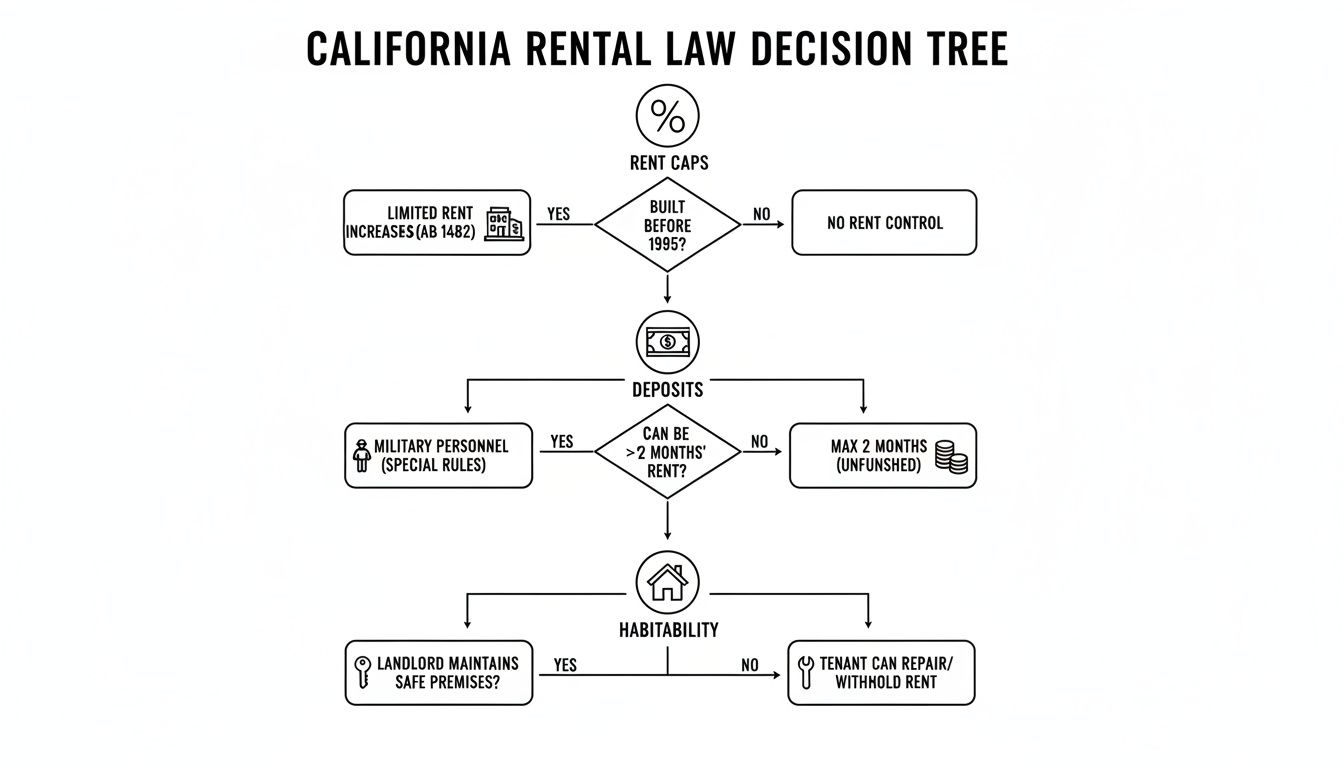
As the decision tree shows, each area of the law has its own set of specific rules and exceptions that landlords must follow to avoid penalties.
To discover more about the 2025-2026 legal shifts for California landlords, it’s important to understand the specifics.
The Two Types of Just Cause Eviction
Besides capping rent, AB 1482 also requires a "just cause" for eviction. This means you can't end a tenancy after the first year without a legally valid reason. These reasons fall into two clear categories.
1. At-Fault Just Cause
This happens when the tenant has done something wrong or violated the lease. Common examples include:
- Failing to pay rent
- Causing major damage to the property
- Engaging in criminal activity on the premises
- Breaking a significant lease rule
In these cases, you must give the tenant a formal notice to fix the problem (like paying overdue rent) before you can start an eviction.
2. No-Fault Just Cause
This is when you, the owner, need to end the tenancy for reasons unrelated to the tenant's behavior. Valid reasons include:
- You or a direct family member plan to move in.
- You are taking the property off the rental market.
- You need to comply with a government order to vacate.
- You're planning major renovations that require the unit to be empty.
A key detail for no-fault evictions is that you must provide relocation assistance to the tenant, usually equal to one month's rent. This is a detail many independent landlords miss.
Meeting New Habitability and Appliance Standards
The definition of a “habitable” rental is getting a major update in 2026. For a long time, California law has required properties to be safe and livable. But new rules are getting more specific, especially about kitchens.
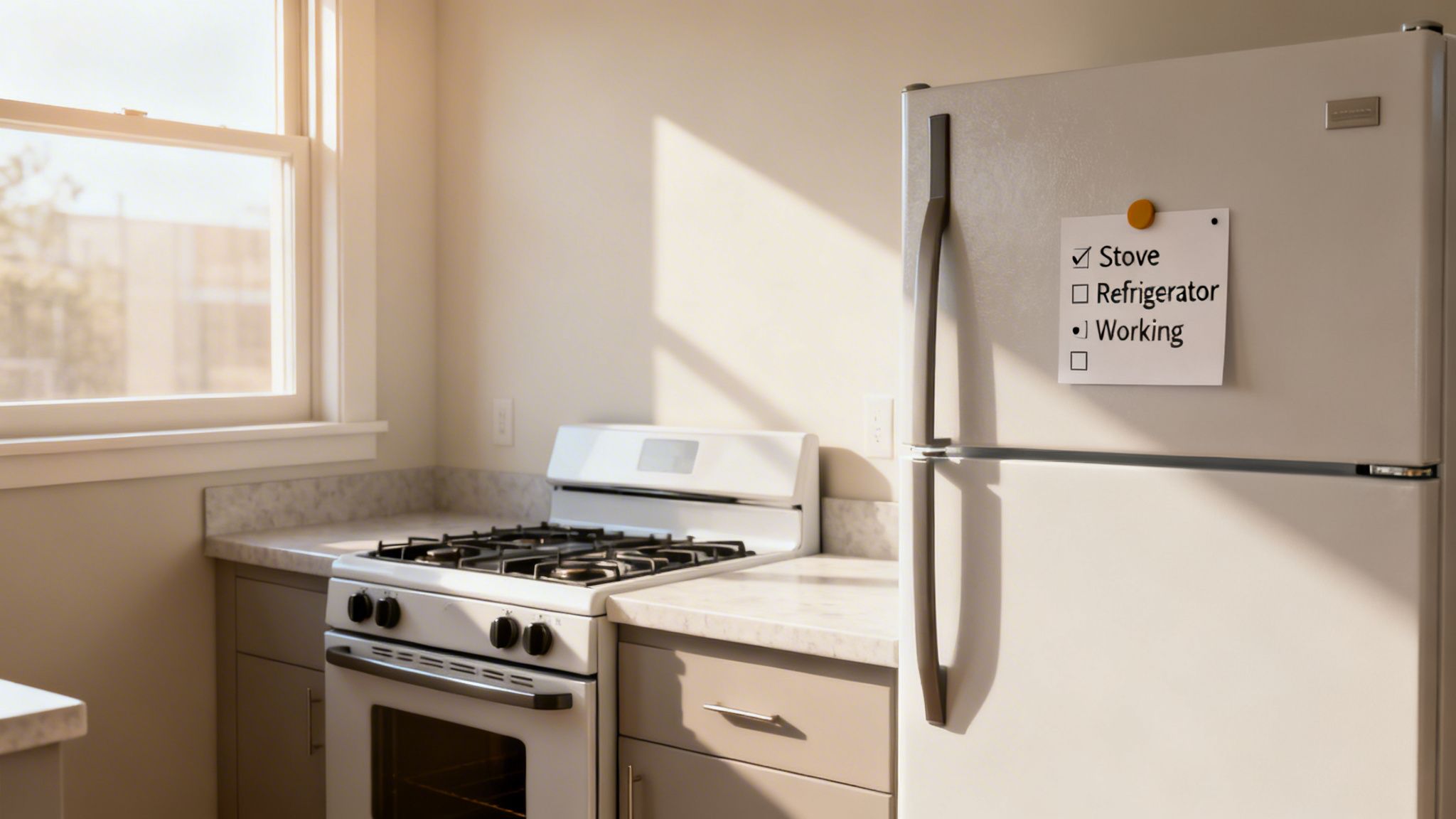
Starting January 1, 2026, a new law mandates that landlords must provide working stoves and refrigerators in most rental units. Before, these appliances were in a gray area. This law makes them a clear requirement.
Here in Monterey County, this update changes expectations for both tenants and landlords. It’s a big deal for military families in Monterey needing move-in-ready homes or for agricultural workers in Salinas who need a functional kitchen.
Which Properties Are Affected?
This new law applies to most long-term residential rentals, but there are a few exceptions. You are not required to provide these appliances if:
- Tenant-Supplied Appliances: The lease clearly states the tenant will provide their own.
- Communal Kitchens: The property has shared kitchens, like in some dorms.
- Certain Subsidized Housing: Some specific types of subsidized housing have different rules.
You must review your lease agreements to see if your units must comply.
Your Responsibility for Maintenance and Repairs
Just providing the appliances isn't enough. You are also responsible for their maintenance and repair. If a stove or refrigerator breaks, you must fix it promptly.
If you don't, tenants may have the right to withhold rent or break their lease. Landlords can also face steep daily fines for violations.
A helpful resource for planning updates is this article on what price range of appliances to buy for rental apartments. At Torrente Property Management, we help clients turn this legal requirement into a smart upgrade.
Understanding Major Changes to Security Deposit Rules
Security deposits have always been a point of friction between landlords and tenants. Starting in 2026, the rules are getting even tighter, making it more important than ever to handle them perfectly. The goal is to boost transparency and fairness.
One of the biggest changes is a new statewide cap. For most rental properties, landlords can now only charge a security deposit equal to one month's rent. This change is designed to lower the financial barrier for renters.

Exceptions to the One-Month Rule
While the one-month cap applies to most, there is a key exception for small, independent landlords. If you own no more than two residential rental properties with no more than four total units, you may be exempt.
This exception allows qualifying small landlords to collect up to two months' rent for an unfurnished unit. However, you must confirm you meet the exact criteria before charging more than one month's rent.
Strict Deadlines and Itemization Rules
The process of returning a deposit is also heavily regulated. You have a strict 21-day deadline to either return the full security deposit or provide an itemized statement of deductions after a tenant moves out.
Your itemized statement must be very detailed. You must list every repair or cleaning charge and provide copies of receipts. Vague claims like "general cleaning" without proof of cost will not hold up if challenged. You can review more key landlord-tenant laws in California.
Ordinary Wear and Tear vs. Actual Damage
This is where many landlords get into trouble. A security deposit can only be used to cover actual damage beyond normal wear and tear. You cannot charge for faded paint or minor scuffs on the wall.
- Wear and Tear (Not Deductible): Faded paint, gently worn carpets, minor scratches.
- Actual Damage (Deductible): Large holes in the wall, broken windows, pet stains on carpet.
Because the line can feel blurry, good documentation is your best defense. This is where professional management makes a huge difference. At Torrente Property Management, we conduct exhaustive move-in and move-out inspections with time-stamped photos to create a clear record.
How Torrente Property Management Ensures Your Compliance
Keeping up with California’s rental laws is a full-time job, but it doesn't have to be yours. This is where professional management becomes a necessity, not a convenience. At Torrente Property Management, we offer full legal compliance as part of our real estate management service.
We act as your compliance shield. We stay current on Monterey and California law, automatically updating your leases and policies. This keeps you out of court and in control.
Proactive Lease and Policy Updates
An outdated lease is a common trap for landlords. An agreement from 2025 could easily be out of compliance by 2026. We solve this with annual lease updates that build in every new state and local rule.
When a law changes, your lease agreements are updated to match. No guesswork, no last-minute stress. It's handled.
Expert Documentation and Financial Handling
Tenant disputes often come down to documentation. A solid paper trail protects you when disagreements arise. Our team handles everything from move-in documentation to eviction compliance.
Our process includes:
- Automated Compliance Checks: Our systems flag key deadlines to ensure notices are sent on time.
- DRE-Compliant Trust Accounting: Security deposits are handled according to strict state regulations for total transparency.
- Meticulous Record-Keeping: Every notice and invoice is logged, creating a comprehensive history for each property.
Deep Local and Bilingual Expertise
State law is only half the battle. Cities like Salinas and Monterey often have their own local rules. Our team has deep roots in the Monterey Bay community, giving us an unmatched understanding of these local details. For more, learn how to stay compliant with landlord rules in our guide.
Plus, our fully bilingual team is a key advantage. Clear communication in English and Spanish prevents misunderstandings that can lead to legal issues. This comprehensive approach gives you peace of mind that your investment is managed with integrity.
Protect Your Investment With Expert Guidance
Staying on top of California's rental market in 2026 requires constant attention. The key to protecting your assets is staying ahead of the rules.
A Quick Recap of Your 2026 Duties
To keep things simple, your core responsibilities for 2026 boil down to three key areas:
- Adhere to Rent Caps: Always use the correct local CPI when calculating rent increases and never exceed the legal limit.
- Meet Habitability Standards: Ensure your units have required, working appliances like stoves and refrigerators.
- Follow Security Deposit Rules: Strictly follow the new one-month deposit cap and the 21-day deadline for returning funds.
Falling short in any of these areas can create serious financial and legal risks.
The Surest Path to Compliance
For landlords in the Monterey Bay area, the best way to ensure compliance is to partner with a trusted, local expert. If you own property in Salinas, Monterey, or surrounding areas, let Torrente help you navigate the legal side of being a landlord. We keep your property—and your paperwork—bulletproof.
Check out these 5 reasons to hire a property manager in 2026.
Let us show you how our local expertise can safeguard your investment. We treat every property as if it were our own, ensuring your rentals are both profitable and compliant.
Contact Torrente Property Management today at (831) 582-8916.
FAQs on California's 2026 Rental Laws
New laws bring new questions. Here are clear answers to some of the most common questions landlords and tenants have about the changes for 2026.
Do the 2026 rent cap laws apply to my single-family home?
For the most part, single-family homes are exempt from statewide rent caps and just cause eviction rules. However, this only applies if the home is not owned by a corporation, REIT, or LLC. You must also provide tenants with a written disclosure stating the property is exempt.
What happens if my tenant lived in the property before these new laws passed?
The new laws apply to all current tenants once they take effect. For example, the requirement to provide a stove and refrigerator applies regardless of how long someone has lived there. You must bring your property and lease agreements up to current standards for all residents.
Can I still screen prospective tenants based on their credit score in 2026?
Yes, you can still use credit scores as part of your screening process. However, California law requires transparency. If you deny an application based on a credit report, you must provide a written notice explaining why and give them the contact information for the credit reporting agency you used.
As a military service member renting out my home while deployed, do any special rules apply?
Yes, they do. Active service members may be exempt from the one-month security deposit limit. If you are an active service member and rent out no more than two properties (with four or fewer total units), you may be able to collect up to two months' rent for an unfurnished unit.
What are the new rules for providing receipts for security deposit deductions?
The new rules demand total transparency. You cannot just estimate repair costs. You must provide tenants with copies of the actual invoices or receipts from the vendors who did the work. If you did the repairs yourself, you must provide a detailed breakdown of the work, hours, and hourly rate.
At Torrente Property Management Inc., we handle these complexities so you don't have to. Our team ensures every lease, notice, and deposit is managed with expert precision, keeping you compliant and your investment secure. Visit us at https://torrenteproperties.com to learn how we can bring you peace of mind.

What If Something Breaks in My House While It’s Vacant?
If you own a property in Monterey County but live elsewhere, you’ve probably had this thought: what if something breaks in my house while it’s vacant? A small issue, like a dripping pipe, can turn into a huge expense if no one is there to catch it. This can cause a lot of stress when you're managing it from far away.
Owning a vacant home doesn't have to be a source of constant worry. With the right local partner, you can avoid costly surprises and late-night phone calls.
The Risk of an Unattended Home
The fear of something going wrong in an empty home is very real. Imagine a big winter storm hits the Monterey Peninsula. You're hundreds of miles away wondering if your roof is holding up or if a pipe has burst. This isn't just anxiety; it's a real risk for absentee owners.
An empty home is vulnerable. A small leak under a sink can run for weeks, causing thousands of dollars in damage. This can lead to:
- Water Damage: Ruining floors, walls, and cabinets.
- Mold Growth: Creating a health hazard that is expensive to remove.
- Pest Problems: Attracting insects and rodents that are drawn to moisture.
Common Problems in Vacant Houses
A furnace failing during a cold snap in Salinas can lead to frozen pipes that burst. This can cause a flood that goes unnoticed for weeks, turning a simple repair into a major restoration project.
Some owners assume nothing can go wrong in a “nice neighborhood,” but vacant homes are always at risk. The average property manager spends over 20 hours a month on maintenance issues, according to Property Management Inc. This shows how much work goes into preventing small problems from becoming big ones.
Protecting your property means having a system in place to catch issues early. As you'll see, professional caretaking is one of the most effective ways to make your vacant home less vulnerable.
How Small Breaks Lead to Big Costs
When a house in the Monterey Bay area sits empty, even a small problem can become a financial headache. It’s not just about the cost of one repair. The damage can lower your property's value and even raise your insurance rates.
An unattended problem can trigger a chain reaction of expenses. What starts as a simple fix can quickly become a much bigger, more expensive mess.
- Higher Insurance Premiums: Filing a major claim for preventable damage, like a slow leak, will likely cause your insurance premiums to go up.
- City Fines: Cities like Salinas and Monterey have rules to prevent neighborhood blight. An overgrown yard or visible disrepair can lead to costly fines.
- Faster Depreciation: Small issues can wear down a home. A slow roof leak can damage the structure over time, while a broken HVAC system can lead to humidity that warps wood.
This infographic shows just how quickly common issues can pop up in an empty house.
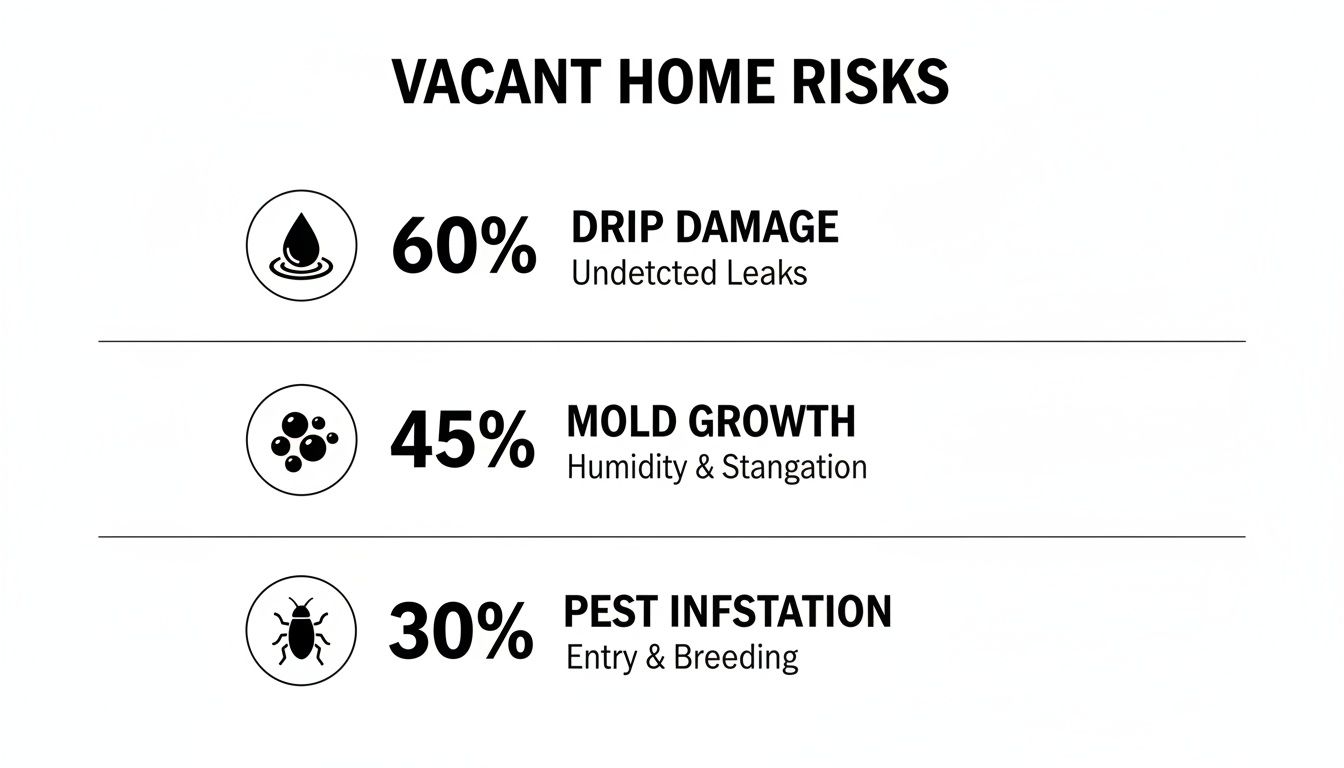
These aren't just possibilities—they're what happens when a property isn't being watched.
To protect your investment from a disaster, it’s smart to use a good home inventory software. A detailed record of your belongings can help you file an insurance claim and recover the full value of your losses. Avoiding common estate care mistakes that Central Coast homeowners make is the first step toward protecting your home.
Hidden Dangers in Empty Properties
When a property sits empty, the risks go beyond a leaky faucet. A vacant home that looks neglected can attract serious problems that affect the whole neighborhood.
An empty house in Salinas or Monterey with an overgrown lawn or a full mailbox sends a clear signal that no one is home. This makes it a target for squatters, vandals, and other illegal activity.
More Than Just an Empty House
The problems with a vacant property often affect the surrounding community. Here are a few examples:
- Pest Infestations: An unkept yard can become a breeding ground for rodents and insects, which can spread to neighboring homes.
- Safety Hazards: An unmaintained property can have broken fences, unsecured pools, or dry vegetation that creates a fire hazard.
- Illegal Dumping: A vacant driveway can look like a convenient spot for others to dump their trash, leaving you with the cleanup bill.
The Link Between Vacancy and Crime
Research from Case Western Reserve University found that prolonged vacancies were linked to a 19% increase in nearby violent crime. This shows that property maintenance is not just about protecting your asset; it’s about being a responsible member of the community.
Think about one of the worst things that can happen in a vacant home—a burst pipe. This can lead to major water damage and a difficult pipe burst water damage claim dispute with your insurance company. Keeping your property secure and well-maintained protects its value and helps the neighborhood. While technology can help, remember the risk of relying on cameras alone to watch your second home is high. Nothing replaces having a real person checking on your property.
Your Plan to Protect an Empty Home
Knowing the risks of leaving a home empty is the first step. The next step is to create a solid plan to protect it. Instead of just reacting to problems, you can take control by preparing your property for when it’s vacant.
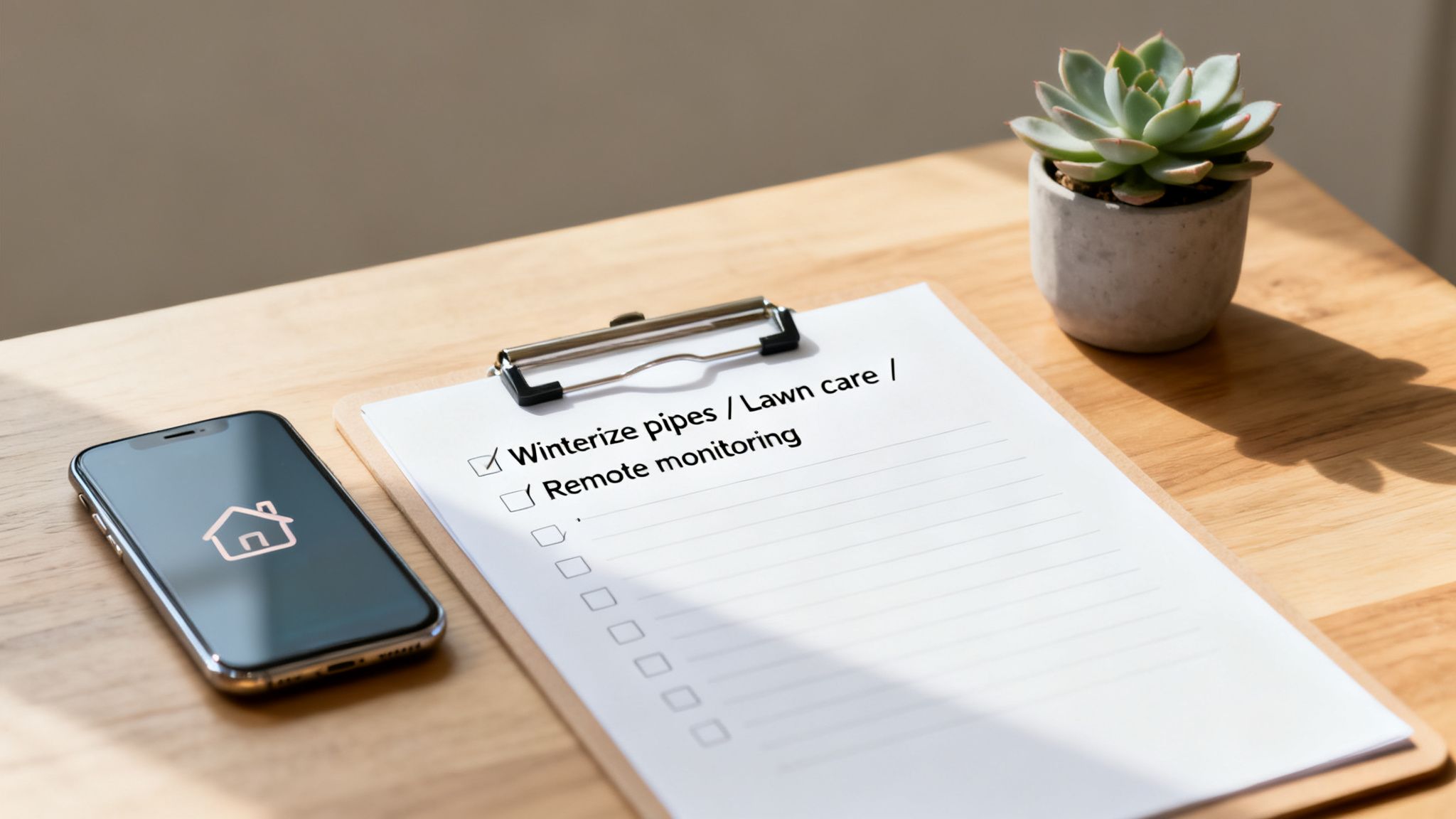
This is about taking smart, preventive steps to protect your investment from common threats like water damage and security issues. By handling these things before you leave, you can reduce the chances of something breaking while your house is vacant.
The Essential Vacant Home Checklist
This checklist helps you prepare your home. Following these steps can bring you peace of mind, knowing your property is secure.
A well-maintained vacant home is less attractive to vandals and less likely to have damage from the weather. Simple things like stopping mail and keeping the yard clean create a 'lived-in' look that keeps trouble away.
Vacant Home Protection Checklist
This checklist is designed to help absentee homeowners maintain their vacant property throughout the year.
| Task Category | Action Item | Frequency / Timing |
|---|---|---|
| Security & Appearance | Forward mail and halt newspaper deliveries. | Before Departure |
| Arrange for regular landscaping to maintain curb appeal. | During Vacancy | |
| Install and test motion-activated lights and a security system. | Before Departure | |
| Plumbing & Utilities | In winter, shut off the main water supply and drain pipes. | Seasonally (Winter) |
| Set the thermostat to 55-80°F to prevent mold and damage. | During Vacancy | |
| Unplug non-essential electronics to save energy and reduce fire risk. | Before Departure | |
| Interior Protection | Close blinds or curtains to protect interiors from sun damage. | Before Departure |
| Check all windows and doors to ensure they are securely locked. | Before Departure | |
| Notify your local police department and a trusted neighbor. | Before Departure | |
| Seasonal Maintenance | Clean gutters and downspouts to ensure proper drainage. | Seasonally (Fall) |
| Have the HVAC system professionally serviced. | Annually | |
| Test smoke and carbon monoxide detectors. | Before Departure |
This checklist is a strong start. For more tips, you can read our guide on the best way to care for your home when it’s sitting empty. While these steps are effective, nothing beats having a local professional regularly check on your property.
Why You Need a Local Expert
Asking a neighbor to keep an eye on your home in Carmel or Pebble Beach is a common but risky mistake. An empty home is vulnerable, and a casual check-in might miss the early signs of a big problem. This is where a professional local partner makes all the difference.

A property manager performs regular, documented inspections to catch issues early. We use a structured process to spot problems before they get worse.
- Photo Reports: After each visit, we send you a report with photos. This gives you a clear record of your property’s condition.
- Local Knowledge: A local expert understands the challenges of Monterey's coastal climate. We look for signs of moisture, humidity, and salt air corrosion.
- Trusted Vendors: When something breaks, who do you call from far away? We have a network of trusted local vendors ready for any emergency.
This level of service turns worry into confidence. Instead of wondering what might be wrong, you have a partner making sure everything is right.
How Torrente Property Management Helps
At Torrente Property Management, our Home Watch and Estate Caretaker services are designed for owners who live elsewhere. If your home in Salinas, Monterey, or Pebble Beach sits empty, we are your local partner. We act as your eyes and ears on the ground.
We perform scheduled inspections, handle emergency repairs right away, and provide monthly photo reports. This means you’re never in the dark, no matter where you live. We catch small issues before they become big ones. To learn more, see our full breakdown of why smart second homeowners rely on local property managers.
Protect Your Monterey Bay Investment
Leaving your valuable Monterey Bay home to chance is not an option. It’s a gamble against burst pipes, pests, and break-ins. The consequences are almost always expensive and stressful.
The worry of "what if something goes wrong?" doesn't have to be your reality. Torrente Property Management acts as your eyes and ears on the ground, turning that worry into confidence.
From Worry to Confidence
Our approach is all about proactive care. We don't wait for problems to happen; we work to stop them before they start.
- Scheduled Inspections: Our Home Watch and Maintenance Plans are built around regular, documented inspections to catch small issues early.
- Modern Tech: We use technology like tenant portals to keep you informed, so you're always in control.
- Bilingual Support: With fluent English and Spanish support, we make sure nothing gets lost in translation with local vendors.
We handle the late-night emergency calls and coordinate repairs so you never have to. Whether your home is in Salinas, Monterey, or Pebble Beach, our team has the local knowledge and trusted vendors to respond immediately.
Don’t let the future of your investment be a question mark. It’s time to secure your peace of mind.
Contact Torrente Property Management today at (831) 582-8916 to learn how our Home Watch and Maintenance Plans can safeguard your home.
FAQs: Vacant Home Care
Here are answers to common questions we hear from owners of vacant homes in the Monterey Bay area.
How often should my vacant property be inspected?
We recommend weekly or bi-weekly inspections. Many insurance policies for unoccupied homes require this frequency. Regular check-ins are the best way to catch small issues, like a slow leak or signs of pests, before they become expensive problems.
Does homeowners insurance cover damage if my house is empty?
Your standard policy may have a "vacancy clause" that can reduce or void coverage if the home is empty for 30 to 60 days. You should call your agent to add a "vacant home" endorsement to your policy. Without it, you could be at risk.
What is the most common problem in a vacant Monterey Bay home?
Because of our coastal climate, moisture is the biggest issue. It can cause slow plumbing leaks that lead to hidden water damage and mold. It's important to keep air circulating to prevent humidity from warping floors and damaging furniture.
Can you manage repairs if an issue is found?
Yes, that is a core part of our service. When we find a problem, we use our network of trusted local vendors to fix it quickly. We manage the entire process, from getting quotes to making sure the work is done right, while keeping you informed.
What temperature should I leave my vacant house?
We recommend setting the thermostat between 55°F in the winter and 80°F in the summer. This moderate range helps prevent mold and protects your home from extreme temperature changes without running up a high energy bill.
Don't leave your investment's safety to chance. The best way to deal with something breaking in your vacant house is to have a plan to prevent it from happening in the first place.
For expert oversight and peace of mind, contact Torrente Property Management today at (831) 582-8916 or learn more about our Home Watch and Maintenance Plans.

How to Keep Good Tenants From Leaving Your Rental
Losing a great tenant is one of the biggest threats to your rental income. If you've ever asked, "how do I keep good tenants from leaving my rental?" you're focusing on the right thing. Tenant turnover isn't just a hassle; it costs you real money.
Keeping the reliable tenants you already have is the best way to protect your investment. A recent report showed that maintenance delays are a top reason tenants leave. This guide will show you how to prevent that.
The Real Cost of a Vacancy
Losing a good tenant costs more than just one month's rent. It starts a chain reaction of expenses that hurt your bottom line. Every day your Monterey or Salinas property sits empty, you lose money.
Many property owners don't realize how much a vacancy truly costs. The expenses add up quickly and can eat into the profits you've worked hard to build.
Breaking Down the Turnover Expenses
When a tenant moves out, your list of tasks and costs grows fast. These are direct hits to your annual income.
- Lost Rent: This is the most obvious cost. If your rent is $2,500 a month, a 30-day vacancy is a $2,500 loss.
- Marketing and Advertising: Listing your property on sites like Zillow isn't always free. You'll need good photos and a strong description to attract quality applicants.
- Repairs and Maintenance: Even the best tenants leave some normal wear. You'll need to handle repairs, repaint walls, or deep clean carpets.
- Your Time: Screening tenants, showing the property, and writing a new lease takes hours of your valuable time.
This chart shows how lost rent, repairs, and marketing add up during a turnover.
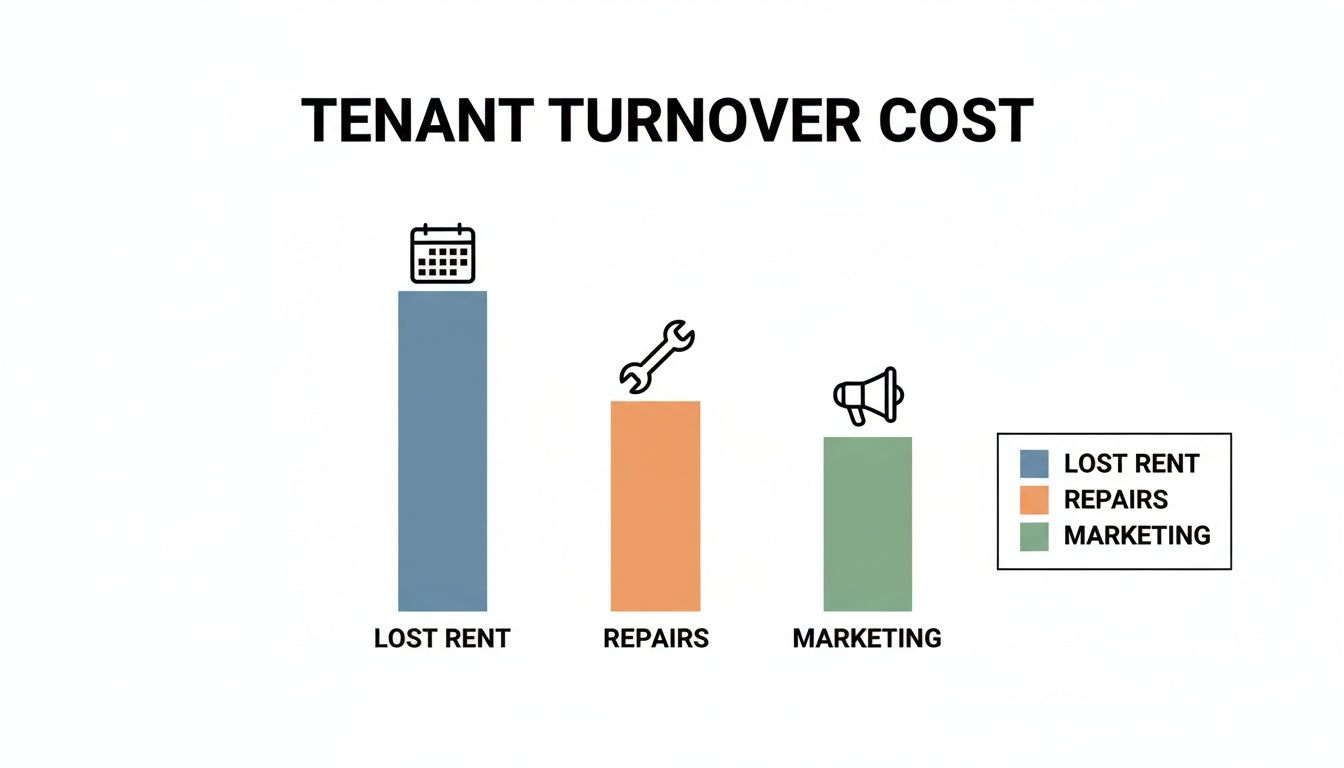
Lost rent is usually the biggest expense. But repairs and marketing also take a big bite out of your profit.
A Salinas Rental Example
Let’s look at a real-world example for a home in Salinas. Imagine your tenant moves out, and the rent is $2,800 per month.
Vacancy Scenario: Salinas Single-Family Home
- Lost Rent (1 month): $2,800
- Repairs & Cleaning: $950 (paint touch-ups, carpet cleaning, minor fix)
- Marketing & Screening: $200
- Your Time (Admin): Priceless, but a huge drain.
Total Immediate Cost: $3,950
Just like that, one turnover costs you almost $4,000. That number doesn't even include the stress involved. This is why keeping a good tenant is so important.
Focusing on tenant retention is a key financial strategy. Once you understand the costs, your goal shifts from filling vacancies to preventing them. Our guide on why long-term tenants mean long-term profits explains this idea in more detail.
Make Maintenance Your Best Retention Tool

Ask tenants what frustrates them, and slow maintenance is always at the top of the list. When a great tenant leaves, it's often not about the rent. It’s because it took a week to fix the dishwasher.
A leaky faucet or a broken appliance is a test. How you respond decides if your tenant stays or starts looking for a new place.
Be Proactive, Not Reactive
Some landlords think tenants will “just deal with it” if a repair takes a few days. But renters today expect quick updates and proactive care. A slow manager can cost you thousands in vacancy losses.
Treat your tenants like valued customers. A fast response shows you care about their comfort and safety.
A simple, same-day reply like, "We got your request for the dishwasher and have called a technician. We'll update you with a time soon," makes a huge difference. It shows respect and turns a bad situation into a good one.
This proactive communication is key to keeping good tenants.
Use a Modern Maintenance System
Forget sticky notes and phone calls. A modern maintenance system is crucial for keeping tenants happy. This is especially true if you live outside the Monterey Bay area.
A good system includes:
- A 24/7 Tenant Portal: Give tenants an easy way to submit and track repair requests online. This creates a clear record for everyone.
- Trusted Local Vendors: Having reliable plumbers and electricians in Monterey and Salinas on standby is critical for fast service.
- Clear Communication Rules: Set a standard to reply to all non-emergency requests within 24 hours. Keep tenants updated every step of the way.
Remember, a well-kept property is also a pest-free one. Regular upkeep, like knowing the role of carpet cleaning in pest control, adds to tenant comfort.
Seasonal Maintenance for the Central Coast
Our coastal climate has unique challenges. A seasonal maintenance plan prevents costly repairs and shows tenants you care for their home.
Your Monterey Bay checklist should include:
- Fall/Winter Prep:
- Inspect the roof and gutters before the rainy season.
- Check window and door seals to stop drafts.
- Service the heating system for safety and efficiency.
- Spring/Summer Prep:
- Test smoke and carbon monoxide detectors.
- Schedule power washing to remove mildew.
- Check landscaping and irrigation systems.
A structured approach helps you answer the question, "how do I keep good tenants from leaving my rental?" For more tips, read our article on smart maintenance for your rental property.
Build Trust with Clear Communication
After a tenant moves in, communication is the most important factor in keeping them happy. A great property can feel bad if a tenant feels ignored or disrespected.
Clear and respectful communication is the key to a strong landlord-tenant relationship. If you're asking, "how do I keep good tenants from leaving my rental?", the answer is often found in how you talk to them.
Start Off on the Right Foot
The move-in process is your best chance to make a good impression. A professional welcome sets clear expectations and shows you care.
A great move-in should include:
- A Welcome Packet: Include utility contacts, trash schedules, and emergency numbers all in one place.
- A Property Walkthrough: Walk through the home with your new tenant. Show them how appliances work and where the water shut-off is.
- A Clear Policy Review: Briefly go over important lease rules, like how to pay rent or request maintenance.
This first meeting is about opening a line of communication built on respect.
The Power of a Tenant Portal
Today, tenants expect digital options. Over 72% of renters prefer digital communication, making a tenant portal a must-have tool.
A portal is a central place for everything. It allows tenants to:
- Pay rent online
- Submit and track maintenance requests
- Access their lease
- Receive building news
This tool gives tenants control and transparency. They can see their request was received, which removes the frustration of feeling ignored. To understand this better, learn what today's tenants expect from a property manager.
The Advantage of Bilingual Service
In a diverse community like Monterey County, language should not be a barrier. Offering bilingual communication in English and Spanish builds trust.
When tenants in Salinas or other local areas can discuss an issue in their native language, it reduces stress. It shows you are committed to serving the whole community. This is a core part of our service at Torrente—we make sure everyone feels heard.
Pro Tip: A simple email or text a month after move-in asking if everything is okay shows you are an attentive landlord. This simple step reinforces a positive relationship.
Great communication is about being responsive, respectful, and reliable. Using modern tools and clear channels makes tenants feel valued and more likely to stay for years.
How to Handle Renewals and Rent Increases
The lease renewal is your best chance to keep a great tenant. How you handle this conversation says a lot about you as a landlord.
Answering, "how do I keep good tenants from leaving my rental?" often comes down to this moment. A surprise rent increase can push a happy tenant to leave. A respectful approach shows you value them.
The 90-Day Renewal Rule
Start the renewal talk 90 days before the lease ends. This industry best practice gives your tenant time to think without feeling rushed.
This early start is also a smart move for you. If they decide to leave, you have three months to market the property and find a new renter. It turns a stressful event into a calm business process.
Setting Fair Rent Increases
Rent increases are a normal part of owning a rental, but they require a careful approach. A fair increase balances your profit with your tenant’s budget. Do your homework on market rates in Monterey County first.
The goal isn't to get every last dollar. A modest increase is often more profitable than risking an expensive vacancy. A stable tenant is your most valuable asset.
Smart, strategic rent increases for renewals are typically in the 3-4% range. This keeps your income on track with the market without pushing away your tenant.
Renewal Incentives That Really Work
Sometimes, a small gesture is all it takes to convince a tenant to stay. An incentive adds real value and shows you are invested in their comfort.
Effective renewal incentives include:
- Professional Carpet Cleaning: A fresh, clean space at no cost to them.
- A Smart Thermostat: An upgrade like a Nest or Ecobee adds convenience and helps them save on utility bills.
- A Small Rent Credit: A one-time $100 credit on the first month of the new lease is a powerful perk.
- New Fixtures: Upgrading an old faucet or showerhead is a low-cost touch tenants see every day.
When you manage renewals this way, you are acting like a true professional. For more details on the legal side, see our guide on how to handle rent increase letters.
Smart Upgrades That Tenants Will Love
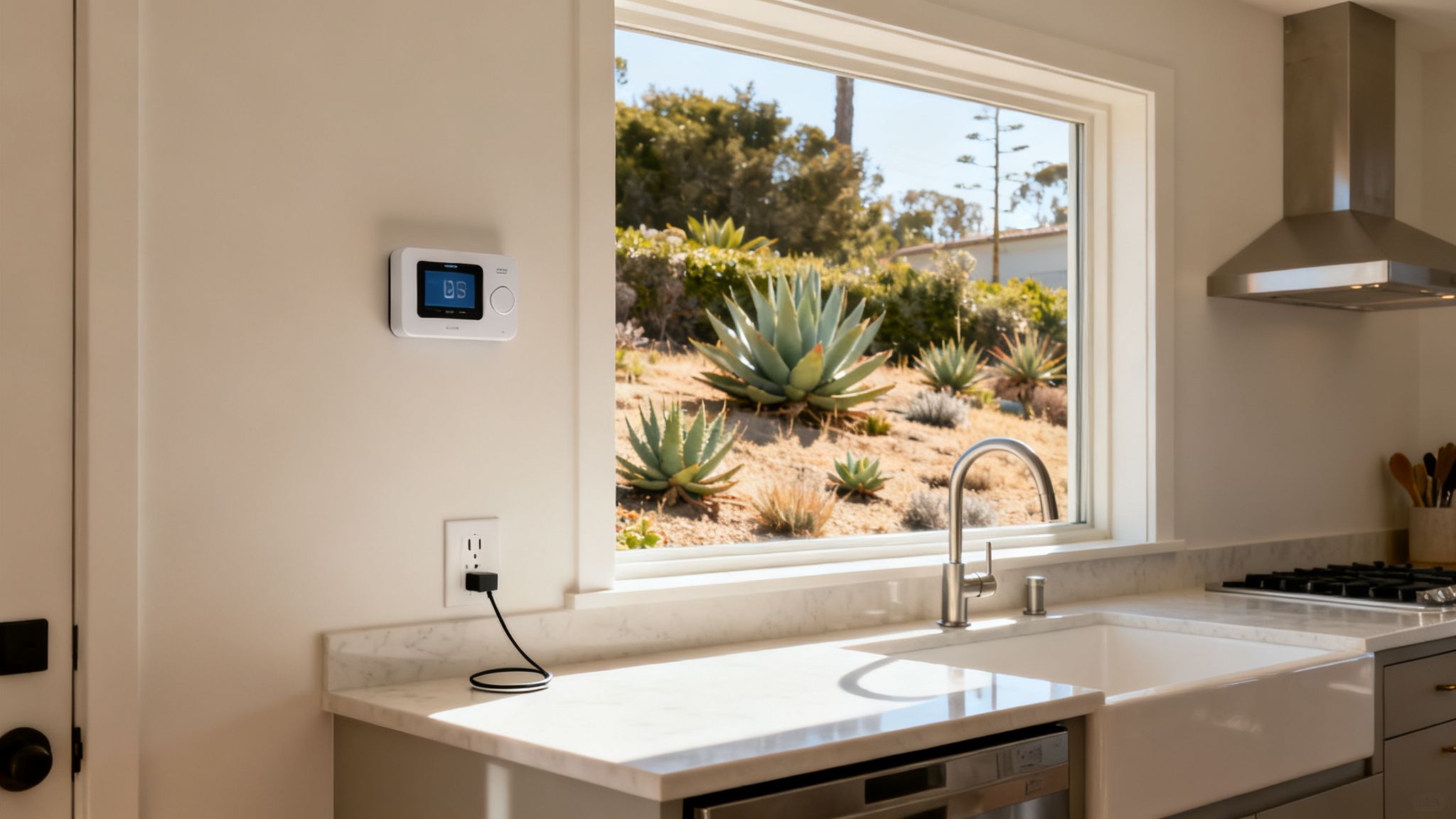
Investing in your property is smart, but not all upgrades convince a tenant to stay. The best improvements are the ones tenants see and use every day.
Thoughtful touches show you care about their quality of life. Answering, "how do I keep good tenants from leaving my rental?" can be as simple as making their home a better place to live.
High-Impact, Low-Cost Fixes
You don't need a huge budget to make a big difference. Some of the most appreciated upgrades are affordable and quick.
Here are a few ideas that work well:
- Modern Lights and Fixtures: Swap out a dated ceiling fan or old bathroom light for a modern LED model. A new kitchen faucet also makes a space feel fresh.
- USB Charging Outlets: This simple swap is something tenants love. Replace a few standard outlets in the kitchen and bedrooms with ones that have built-in USB ports.
- Fresh Paint and Clean Carpets: Never underestimate a fresh start. A clean coat of paint and professionally cleaned carpets make a home feel bright and cared for.
Upgrades That Add Long-Term Value
When you're ready for a bigger investment, focus on upgrades that boost both tenant happiness and property value. These often improve efficiency and convenience.
Key Fact: Research shows that features tied to lower utility bills, like smart thermostats, are a top priority for today's renters. These upgrades show you invest in quality and long-term comfort.
If your property has eco-friendly features, keep them working well. For example, ensuring solar panels perform optimally helps deliver on the promise of lower energy bills.
Monterey Bay Specific Upgrades
Here on the Central Coast, some upgrades have special appeal. Drought-tolerant landscaping is a great investment for a Salinas or Monterey property. It looks great and cuts down on water use.
Another game-changer is in-unit laundry. Adding a washer and dryer can earn you higher rent and dramatically improve tenant retention. To learn more, see our guide on 4 smart upgrades that raise rent in 2026.
FAQs: How to Keep Good Tenants
Here are quick answers to common questions from Monterey and Salinas property owners about keeping good tenants.
How early should I talk about lease renewal?
Start the conversation 90 days before the lease ends. This gives your tenant plenty of time to decide without feeling pressured and gives you a safety net if they decide to leave.
Is it better to raise rent or keep a good tenant?
It is almost always more profitable to keep a good tenant with a modest rent increase. The cost of a vacancy can easily wipe out the gains from a large rent hike.
What is the biggest mistake that drives tenants away?
The biggest mistake is poor communication about maintenance. When repair requests are ignored, good tenants feel disrespected and start looking for a new home.
Are renewal incentives legal in California?
Yes, offering renewal incentives is a smart and legal strategy in California. Popular ideas include a gift card, a small rent credit, or a property upgrade like a smart thermostat.
What if my long-term tenant pays rent late once?
If a good, long-term tenant pays late, start with a polite and supportive conversation. A simple call or email asking if everything is okay can often resolve the issue while preserving the relationship.
If you own rental property in Monterey or Salinas and want to improve tenant retention, let Torrente show you how responsive service pays off. Our property management services include fast-response maintenance, a tenant portal, and transparent communication that keeps tenants happy. Contact Torrente Property Management today at (831) 582-8916 to learn how we can help you achieve peace of mind.

Can I Save Money by Managing My Rental Myself?
Many Monterey Bay property owners ask themselves this question. On paper, skipping a management fee looks like an easy way to boost your monthly income. But the simple math often hides the true costs of going it alone.
The time, stress, and expensive mistakes that come with self-managing can quickly erase any savings. In fact, a recent industry report found that landlords using property managers reduce vacancy time by about 0.6 weeks, which can save hundreds in lost rent. The cheapest option isn't always the most profitable one.
The True Cost of Managing a Rental Yourself
If you're wondering, "can I save money by managing my rental myself?" you're not alone. Many owners with one or two rentals look at that management fee and wonder if they’re paying for tasks they could handle themselves. While avoiding an 8-10% fee sounds good, it's key to understand what you give up.
Self-management is never free. You pay for it with your time, your energy, and your exposure to risk.

DIY vs. Professional Management: A Quick Look
The biggest mistake owners make is underestimating the job. Property management is much more than collecting a check. It’s a mix of marketing, legal compliance, tenant relations, and being on-call 24/7 for emergencies.
Here’s a simple look at the trade-offs.
| Factor | DIY Self-Management | Professional Management |
|---|---|---|
| Upfront Cost | Low (software, listing fees) | Higher (monthly fee, leasing fee) |
| Time Investment | High (5-10 hours/month) | Minimal (reviewing statements) |
| Legal Risk | High (your responsibility) | Low (covered by expert) |
| Vendor Access | Limited to your network | Access to vetted, affordable pros |
| Vacancy Time | Potentially longer | Often shorter due to marketing |
This table shows a clear picture. While DIY saves you a direct fee, it costs you dearly in time and risk. Professional management turns those unpredictable variables into a fixed, predictable expense.
To get a true sense of your returns, you must calculate your net operating income by factoring in all costs. This includes the value of your time and the high price of potential mistakes.
How Much is Your Time Really Worth?
The biggest hidden cost of self-managing isn't on a spreadsheet. It's your time. Every hour you spend on landlord duties has a real value that eats into your profit.
Many owners think it's just a few phone calls a month. But the reality is far more demanding. Those "quick" tasks can snowball, turning your passive investment into a part-time job.

Calculating Your "Time Cost"
To see the real cost, put a dollar figure on your time. What do you earn at your job? Even at a modest rate of $50 per hour, the cost adds up fast.
This is especially true for owners who don't live nearby. If you have to drive from Monterey to Salinas for a small repair or showing, your time costs skyrocket.
A simple formula helps: (Hours Spent Monthly x Your Hourly Rate) = Your True Management Cost. If this number is higher than a professional fee, you are paying more to do all the work yourself.
Where Does the Time Go?
Landlords who go it alone often spend 4-8 hours per month on routine tasks. This includes chasing rent, fielding calls, and coordinating maintenance. If your time is worth $50 an hour, that's $200-$400 a month—often more than a professional fee.
And that’s for a smooth month. A single vacancy can easily add 15-20 more hours of work.
- Marketing the Vacancy: Writing good listings and posting them online.
- Answering Inquiries: Handling the flood of emails and calls from renters.
- Showing the Property: Giving up your nights and weekends for tours.
- Screening Applicants: Running background checks and calling references.
During these busy times, any savings you thought you had can disappear. Some landlords use a real estate answering service to handle calls, but that's another cost.
Tracking your hours is as important as tracking your money. Learn more in our guide to rental property bookkeeping. When you see a management fee as an investment in your freedom, you're on the right track.
The Financial Risks of DIY Landlording
Beyond the time you spend, managing a rental yourself comes with serious financial risks. Skipping a management fee can seem like a win, but one costly mistake can wipe out those savings in an instant.
Many new landlords learn these lessons the hard way. A professional manager is trained to spot these issues before they hurt your bottom line.
The High Cost of a Bad Tenant
Placing the wrong tenant is the single most expensive mistake a DIY landlord can make. It's not just about one missed rent payment. The costs can spiral out of control.
This is where a professional's tough screening process is priceless. Without it, you risk:
- Eviction Costs: In California, a formal eviction can cost $3,500 to $5,000 in legal fees alone. That doesn’t include the months of lost rent during the process.
- Property Damage: A bad tenant can cause thousands of dollars in damage, often more than the security deposit can cover.
- Long Vacancy: After an eviction, the unit almost always needs repairs. Every month it sits empty is another month of lost income.
Legal Mistakes and Vendor Problems
Another big trap is navigating California's complex landlord-tenant laws. A single mistake in your lease or a missed notice can lead to big fines. You can see how complex the rules are in our summary of California's landlord-tenant laws.
Many owners assume management is just rent collection. But that mindset overlooks the hidden costs of self-managing: missed legal updates, bad tenant decisions, longer vacancies, or poor maintenance follow-up—all of which erode profits over time.
Then there's maintenance. When a pipe bursts at your Salinas property, who do you call? DIY landlords often scramble and overpay for emergency service. A professional manager has a list of trusted, affordable vendors ready to go.
A single large repair bill from an overpriced vendor can wipe out a year's worth of "saved" management fees. Professional oversight isn't just a cost—it's protection for your Monterey County investment.
Comparing the Hard Costs: DIY vs. Pro
When you ask, "Can I save money by managing my rental myself?" it often comes down to a simple cost comparison. A professional fee is easy to see, while DIY costs are often hidden and spread out.
Self-managing isn't free—it just comes with a different set of bills. You have to pay for every tool and service needed to run your rental like a business.
The True Expenses of Going It Alone
As a DIY landlord, you'll find that good management requires paid services. These costs add up fast.
Here are a few common expenses you'll have:
- Listing Fees: Paying for top spots on sites like Zillow or Apartments.com.
- Screening Services: Running background, credit, and eviction checks for $30 to $50 per applicant.
- Legal Documents: Buying state-specific lease agreements to protect yourself.
- Online Rent Platforms: Paying monthly fees for rent collection software.
This chart shows some of the biggest financial risks that can quickly erase any savings from self-managing.
As you can see, one bad tenant or legal issue can cost more than years of management fees. This highlights the value of professional risk management.
How Professional Management Fees Work
With a professional manager, these scattered costs are bundled into a clear fee. This is usually a percentage of the collected rent and sometimes a separate fee for placing a new tenant.
That fee covers everything from rent collection to maintenance calls. Most importantly, it gives you access to the manager's network of affordable vendors. This benefit alone often leads to big savings on repairs.
For example, a recent industry report found that landlords with property managers reduced vacancy time by about 0.6 weeks, which can save hundreds in lost rent. And that’s just one piece of the puzzle—compliance, tenant screening, and maintenance response all factor into the ROI.
The biggest benefit is turning a dozen unpredictable expenses into one fixed, budgetable cost. This is key for financial planning and maximizing your rental property tax deductions. By consolidating these services, a management company often provides oversight for less than the combined cost of doing it all yourself.
Cost Comparison Table
| Expense Category | Typical DIY Cost | Included in Professional Fee? |
|---|---|---|
| Marketing & Advertising | $50 - $300 per vacancy | Yes |
| Tenant Screening | $30 - $50 per applicant | Yes |
| Lease Document Prep | $50 - $150 per lease | Yes |
| Rent Collection Software | $20 - $40 per month | Yes |
| Accounting Software | $25 - $60 per month | Yes |
| Legal Consultations | $250+ per hour | (Expertise included) |
| Maintenance Coordination | Your Time + Vendor Markups | Yes (often with vendor discounts) |
This table shows how quickly the separate costs of self-management add up. A professional fee replaces multiple, often fluctuating, individual expenses.
When to Hire a Property Manager
While some local landlords can succeed on their own, there are times when hiring a pro is the smarter financial move. For many owners, the question isn't "can I save money?" It's "will I earn more with an expert?"
Think of rental property services as an investment, not just an expense. A good manager handles leasing, maintenance, and tenant communication. This frees your time while protecting your asset.

Who Benefits Most from a Manager?
Certain owners almost always see a higher return when they partner with a management firm.
- Out-of-Area Owners: If you live hours away, managing a property in Monterey or Carmel is a nightmare. A pro gives you a local presence for showings, emergencies, and inspections.
- Active-Duty Military Families: The demands of military life and frequent moves make self-management nearly impossible. A local manager provides stability and peace of mind.
- Investors with Multiple Properties: Once you own more than a couple of rentals, the time required grows fast. A professional firm has the systems to run your portfolio efficiently.
The Local Expertise Advantage
In a diverse market like Monterey Bay, local knowledge is money. An expert knows how to price a rental in Carmel for top dollar versus one in Salinas to fill it quickly. This knowledge means more money in your pocket.
Key Takeaway: For many owners, professional management is a strategic investment. It maximizes income, reduces legal risks, and protects your property with proactive maintenance.
Torrente Property Management also offers bilingual (English/Spanish) services. This helps attract more qualified tenants in communities like Salinas, reducing vacancy time. While full management offers great value, some owners use a Property Management Executive Assistant for specific tasks.
Ultimately, professional management is about getting better results. Learn more about the benefits of property management and how it protects your investment.
Frequently Asked Questions (FAQs)
What percentage do property managers charge in Monterey Bay?
Most property managers in the Monterey Bay area charge between 8% and 10% of the monthly collected rent. This fee typically covers core services like rent collection, tenant communication, and financial reporting.
Is hiring a manager worth it for just one rental property?
Yes, it can be. With a single property, one major mistake—like a bad tenant or a legal issue—can wipe out your profits for years. Professional management protects you from these high-stakes risks, no matter how many properties you own.
Can I hire a property manager just to find a tenant?
Absolutely. This service is called “tenant placement” or “leasing only.” It’s a great option if you are comfortable with daily management but want an expert to handle marketing, showings, and tenant screening.
How do property managers handle late-night emergencies?
Professional managers have a 24/7 system in place. When a tenant calls with an emergency, they reach our on-call team, not you. We have a network of trusted vendors who can respond quickly to protect your property.
What are the biggest hidden costs of self-management?
The biggest hidden costs are long vacancies, the high cost of an eviction, and overpaying for maintenance. A good property manager minimizes these expenses with expert marketing, strict tenant screening, and access to affordable vendors.
The goal for your rental property should be to earn more and stress less. Torrente Property Management brings over 20 years of local expertise to help you do just that. Whether your property is in Salinas, Monterey, or Carmel, our data-driven approach helps you grow your income.
Ready to see how professional management can boost your bottom line? Contact Torrente Property Management today at (831) 582-8916 for a personalized analysis of your property.

Caring for Your Empty Home: A Monterey Bay Guide
What’s the best way to care for my home when it’s sitting empty? The answer is a formal, hands-on care plan. This means regular, documented check-ins both inside and out.
Are you wondering how to keep your home safe and damage-free while you’re away for weeks or months? Whether it’s a second home in Carmel or a rental between tenants in Salinas, the risks add up when no one’s watching. According to the U.S. Census Bureau, the national homeowner vacancy rate was 0.8% in the first quarter of 2024, highlighting how many properties sit empty at any given time. (Source).
Why Your Empty Monterey Bay Home Needs a Care Plan
Leaving a home empty opens the door to costly surprises. A small leak that goes unchecked for a week can cause thousands of dollars in water damage.
Many homeowners assume a neighbor doing a quick drive-by or a few security cameras is enough. But smart devices can’t fix a broken pipe or handle damage from a sudden Monterey Bay windstorm. Without a consistent, qualified presence, minor issues get missed and turn major.
This visual guide breaks down the three core pillars of protecting your empty home.
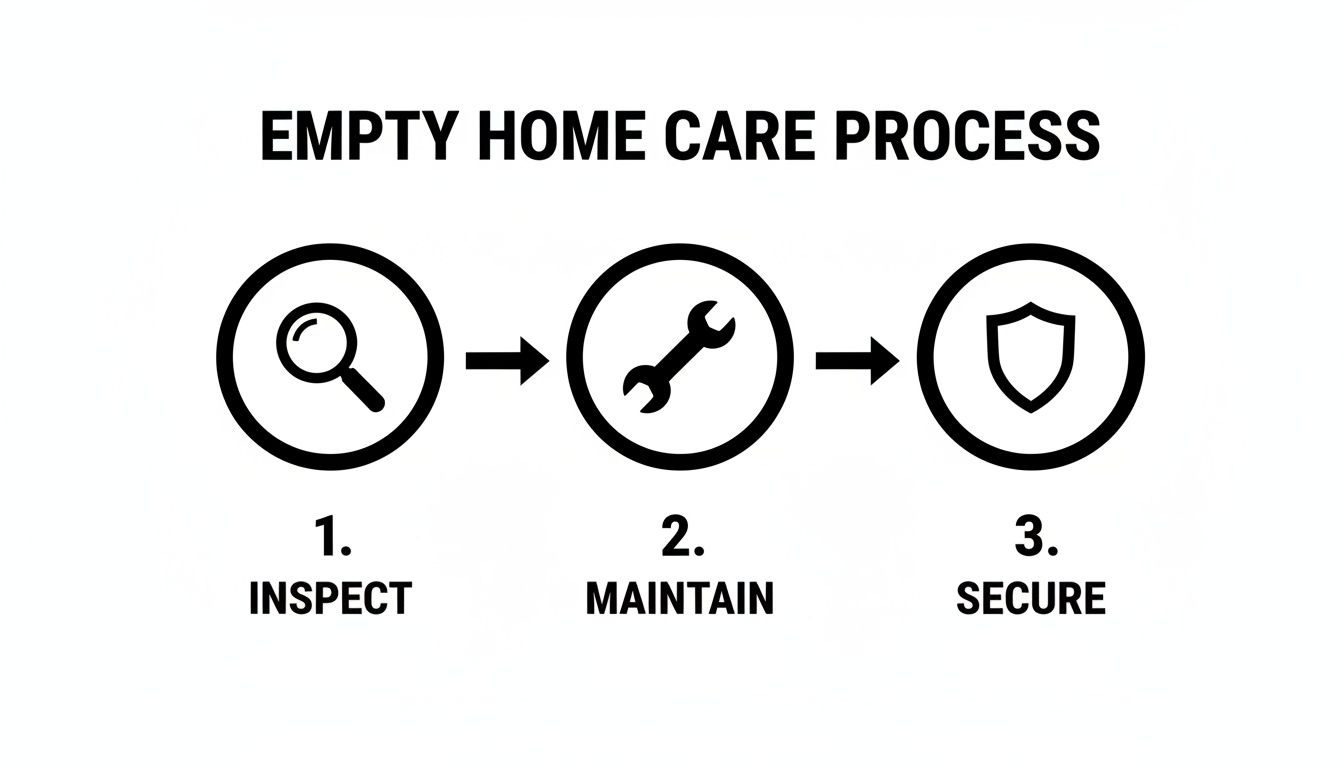
This process shows how inspection, maintenance, and security work together to protect your property.
Understanding the Risks of a Vacant Property
An unoccupied home is a target for maintenance failures and security threats. The data confirms that vacant homes face higher risks when left unattended.
This is why a formal vacant home care plan is so important. It should include scheduled, documented check-ins, routine tasks like flushing toilets, and storm-proofing. For anyone who owns property on the Monterey Peninsula, taking these steps is about protecting your financial investment. You can learn more about this hands-on approach by reading our guide on why Monterey property owners are turning to professional caretaking.
Quick Guide to Vacant Home Care
| Care Category | Key Actions | Why It Matters |
|---|---|---|
| Interior Inspections | Run faucets, flush toilets, check for leaks under sinks and around appliances, and look for signs of pests or mold. | Prevents water damage from dried-out plumbing seals, catches leaks early, and stops infestations before they cause structural harm. |
| Exterior & Security | Remove flyers/mail, inspect for forced entry, check windows/doors, and ensure landscaping looks maintained. | A lived-in appearance is a powerful deterrent for criminals. It also prevents HOA violations and spots potential entry points. |
| System Checks | Test HVAC systems, check circuit breakers, verify security alarms are functioning, and test smoke detectors. | Ensures critical systems are operational, preventing mold growth from a failed AC unit or a security lapse from a dead battery. |
This table covers the fundamentals. A truly effective plan is tailored to your property’s needs.
At Torrente Property Management, we become your trusted eyes and hands. We make sure your home in Monterey, Pebble Beach, or Salinas is protected because we treat your property like our own.
Your Essential Interior Home Care Checklist
Inside an empty home, small issues can quickly become big disasters. This checklist covers the critical tasks to prepare your home's interior, ensuring it stays safe and clean.
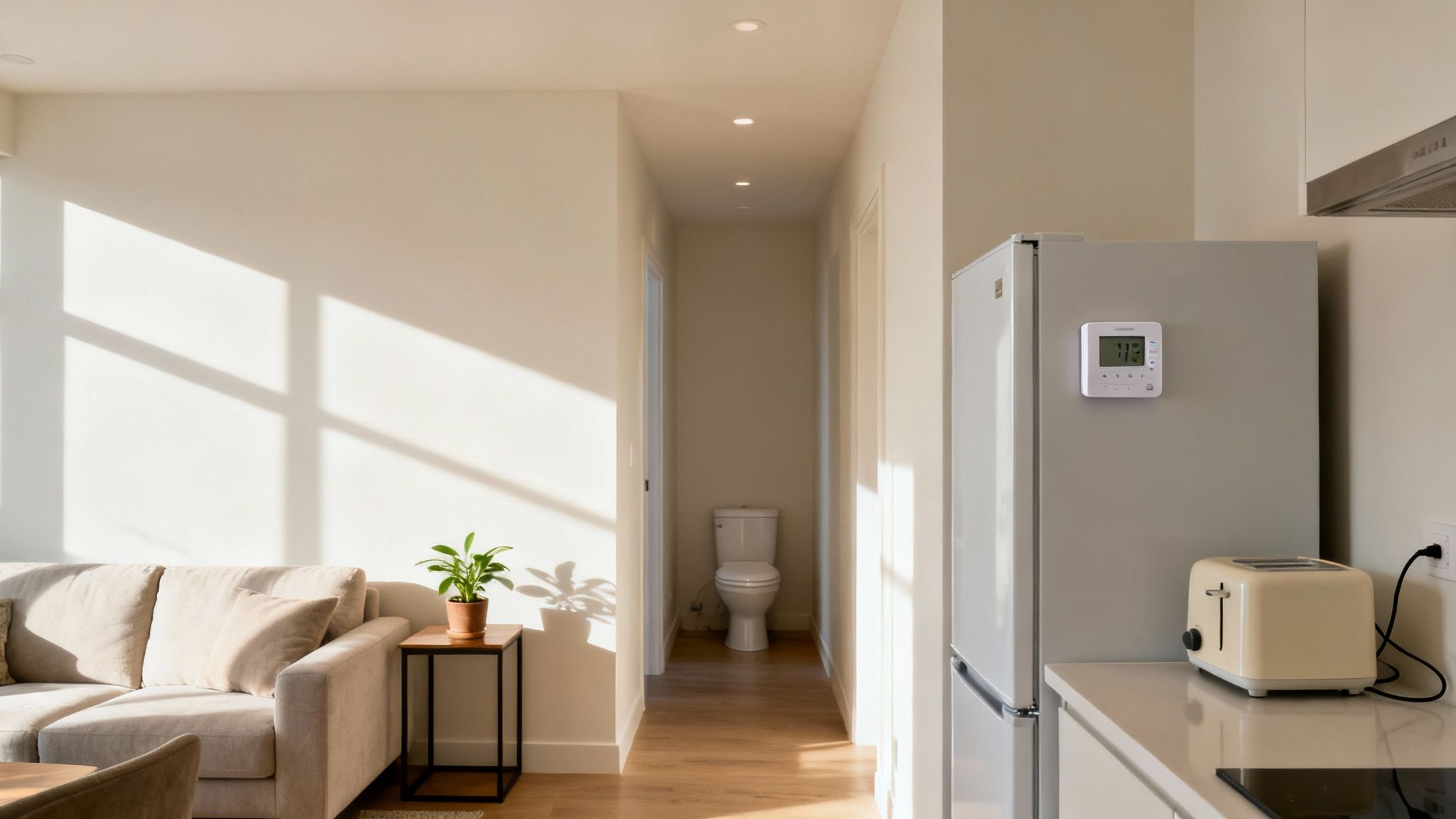
Manage Your Plumbing Systems
Water is the number one enemy of an empty home. A slow leak can cause thousands of dollars in damage before anyone notices.
For most properties, shutting off the main water valve is the safest bet. This single action prevents major damage from a burst pipe.
If your home has a fire sprinkler system, you'll need to leave the main valve open. In that case, shut off the individual water supply valves to toilets, sinks, and washing machines. A caretaker should still perform these tasks weekly:
- Flush all toilets: This keeps the bowl full and prevents sewer gases from entering. It also keeps wax seals from drying out.
- Run faucets briefly: This keeps P-traps under sinks full, which also blocks sewer gas.
- Check for moisture: A quick visual inspection under sinks and around appliances is essential.
Set Your Thermostat for Protection
Turning your HVAC system off completely is a common mistake. In the humid Monterey Bay area, this can lead to musty odors and mold.
Your goal is to maintain a stable interior environment. Set your thermostat to a moderate range to protect your home.
A setting of 55-60°F in the winter keeps pipes from freezing. Keeping it around 78-80°F in the summer controls humidity and stops mold. This small energy cost is an insurance policy against larger repairs.
Address Appliances and Electricals
Unplug non-essential electronics to save power and reduce fire risk. This includes TVs, computers, small kitchen appliances, and chargers.
Before you leave, completely empty your refrigerator and freezer. Prop the doors open slightly to prevent mildew and odors.
Final Interior Security Checks
Your final walkthrough secures the home from the inside out. Make sure every window and door is securely locked.
Next, remove all perishable food from pantries to avoid attracting pests. A clean home is far less inviting to rodents and insects.
Finally, test all smoke detectors and replace batteries. These devices are your first line of defense. Find more tips in our seasonal home maintenance checklist.
Securing Your Property Exterior and Curb Appeal
The outside of your home is its first defense. It also tells the world whether someone is home. Maintaining curb appeal is a critical part of your security strategy.

Maintain a Lived-In Landscape
An overgrown lawn is a sign that "nobody's home." This attracts unwanted attention and can lead to code violations in cities like Monterey and Salinas.
Arrange for regular landscaping service. This should include lawn care, weeding garden beds, and checking your irrigation system.
During the rainy season, proper drainage is critical. Clogged gutters can cause water to pool near your foundation. Arranging for professional gutter cleaning is a smart, preventive step.
Secure All Entry Points
Your home is only as secure as its weakest link. Walk around and check every door and window for vulnerabilities.
Every exterior door needs a high-quality deadbolt lock. Reinforce sliding glass doors with a security bar.
Next, walk the perimeter and check every window. Ensure all locks are functional.
Manage Mail and Deliveries
Nothing signals an empty house faster than a pile of mail. This is a clear invitation for trouble.
One of the most effective security measures is to stop all mail deliveries. You can place a hold through the USPS website for up to 30 days. For longer absences, forward your mail.
Even with deliveries stopped, junk mail can pile up. A trusted caretaker needs to remove these items weekly. Explore our guide on vacant property inspections and upkeep to learn more.
Create the Illusion of Occupancy
A dark house at night stands out. Use timers on several lights to create the illusion that someone is home.
Set them to turn on and off at irregular intervals in the evenings. This mimics the patterns of someone moving through the house.
Finally, think about window coverings. Close them partially, especially on the ground floor, to obstruct the view without looking suspicious.
Why a Professional Home Watch Is a Smart Investment
The best way to care for your home when it’s sitting empty is to hire a professional. There's a big difference between asking a neighbor a favor and hiring a professional home watch service.
A neighbor might do a quick drive-by, but they aren't trained to spot problems. A formal, professional approach is a smart investment in protecting your asset.

The Value of Documented Inspections
A professional service operates on a completely different level. With a dedicated caretaker, every visit is documented with detailed reports, photos, and videos.
This creates a clear record of your property's health. It also becomes critical evidence if you ever need to file an insurance claim.
Proactive Maintenance Instead of Reactive Repairs
A professional caretaker is trained to prevent problems. They are your eyes and hands on the ground, actively looking for potential issues.
This proactive approach involves tasks a neighbor won't do:
- Running plumbing fixtures to keep seals from drying out.
- Checking circuit breaker panels for tripped breakers.
- Inspecting for signs of pests in attics and crawl spaces.
- Making sure thermostats are functioning properly.
A small investment in a home watch service is a powerful defense against massive, unexpected bills.
A common misstep is relying only on smart devices. These tools can alert you to a problem, but they can't fix it. Without a consistent, qualified person there, technology alone falls short.
Immediate Emergency Response
What happens if a storm hits or a security alarm goes off? A professional property manager is your local, on-call first responder.
They can coordinate with trusted local vendors to address the issue right away. See how professional home watch services operate to understand this level of care.
Torrente Property Management’s Estate Caretaker Services are built on this principle. We provide weekly walk-throughs, maintenance logs, and visual updates. Unlike basic managers, we proactively inspect and protect your property. Learn more about our https://torrenteproperties.com/the-best-trusted-home-watch-services-in-monterey-bay/.
FAQs: Caring for an Empty Home
Here are answers to common questions from homeowners in Monterey, Carmel, and Salinas.
How often should someone check on my empty house?
For real security, your home needs a physical inspection at least once a week. This frequency is crucial for spotting new issues like small leaks or security breaches before they become major disasters. A weekly check means a thorough interior and exterior walkthrough.
Should I shut off the water when my house is vacant?
Yes, in almost every case. Turning off the main water supply is the most effective way to prevent catastrophic damage from a burst pipe or faulty appliance. The only common exception is for homes with a fire sprinkler system.
What is the biggest mistake people make with an empty home?
The most common mistake is relying on passive monitoring, like a neighbor’s glance or security cameras. A camera can alert you to a problem, but it can’t fix a broken pipe or reset a tripped breaker. Regular, hands-on inspections are essential for true property protection.
Do I need special insurance for a vacant property?
Yes, you likely do. Most standard policies have a "vacancy clause" that can deny coverage if your home is unoccupied for more than 30 to 60 days. You must contact your insurance agent to add a "vacant home" endorsement to stay fully protected.
Can a property manager help if my home is not a rental?
Absolutely. Full-service firms like Torrente Property Management offer specialized Estate Caretaker services. These programs are designed to protect and maintain non-rental properties while they are unoccupied, giving you complete peace of mind.
Your property is a valuable asset that deserves professional protection. If your property is in Monterey, Carmel, Pebble Beach, or Salinas, our trusted team is already serving your neighbors. Contact Torrente Property Management today at (831) 582-8916 to make sure your home is truly protected. Learn more at https://torrenteproperties.com.

Are Rental Property Services Worth the Cost in Monterey?
For many landlords in Monterey Bay, the math seems simple. Avoid an 8-10% management fee and keep more rental income. But when you ask, "are rental property services worth the cost?" the answer is in the hidden expenses of going it alone.
The real cost isn't a fee. It's the value of your time, the financial hole from a vacant unit, and the risk of one crippling legal mistake. In fact, professionally managed units rent 0.6 weeks faster on average, often offsetting most of the monthly fee.
The Common Question: What Am I Paying For?

Many landlords ask: “If I’m still paying for repairs and collecting rent online, what is my manager actually doing for me?” This view only focuses on the obvious expense—the management fee.
However, the data tells a different story. While 54% of investors avoid hiring a property manager due to cost, they often face higher vacancy, more legal stress, and greater tenant churn. That management fee isn't just for tasks; it's for results.
Fees Buy Results, Not Just Tasks
A professional management fee buys you expertise and a shield against expensive problems. It's the difference between reacting to middle-of-the-night emergencies and having a partner who prevents them. This is especially true here in California, where tenant laws are complex.
What this actually means is that fees aren’t just for task execution—they’re for results. You get lower vacancy, better tenants, and fewer costly surprises. It’s the difference between reacting to issues and having someone prevent them.
Before you decide to self-manage, ask yourself: are you really saving? For a deeper look, see why you might not be saving money managing your own rental.
The Key Takeaway: The debate isn't about an 8% fee versus $0. It's about a predictable cost versus the unpredictable—and often higher—costs of lost time, vacancies, and legal mistakes.
A Side-by-Side Cost Comparison
Before you manage your Monterey or Salinas property alone, it’s critical to compare the costs side-by-side.
| Factor | Self-Management (DIY) | Professional Management |
|---|---|---|
| Time Investment | High personal time commitment (marketing, showings, calls) | Minimal time required from owner |
| Vacancy Costs | Potentially longer vacancy periods due to limited marketing | Shorter vacancies from professional marketing and screening |
| Legal Risk | High exposure to errors in contracts and compliance | Reduced risk with expert handling of legal requirements |
| Tenant Quality | Varies based on screening ability; higher risk of issues | Consistently higher quality due to rigorous screening |
| Maintenance | Owner must find, vet, and coordinate all vendors 24/7 | Access to a network of trusted, local vendors |
Deconstructing Property Management Fees
When you look at rental property services, the first question is always about cost. Most owners see the monthly fee—typically 8-12% of collected rent—and wonder if it's worth it.
To answer that, you have to look past the percentage. You need to understand what you're buying. That fee is an investment in turning a stressful job into a passive income stream.
What Your Monthly Fee Actually Buys
A management fee directly translates into actions that save you time and money. These services go far beyond simple administrative tasks.
Here’s a breakdown of what that fee typically covers:
- Comprehensive Tenant Screening: We do more than a credit check. We review an applicant's rental history, background, and references to find reliable, long-term tenants.
- 24/7 Maintenance Coordination: When a pipe bursts at 2 a.m. in your Salinas rental, your manager handles it. They have a network of vetted, local vendors in places like Carmel and Monterey.
- Rent Collection and Financial Reporting: Professional managers streamline rent collection and provide detailed monthly statements. This system ensures consistent cash flow and makes tax season easier.
- Legal Compliance: Keeping up with California's changing landlord-tenant laws is a full-time job. Your fee pays for expertise to keep your property compliant and avoid costly legal missteps.
A great manager creates a positive cycle. A well-screened tenant is less likely to cause damage, and prompt maintenance keeps that great tenant from leaving. This directly benefits your bottom line.
Beyond the Standard Services
Top-tier property management offers value that isn't always on a fee sheet. At Torrente Property Management, our bilingual (English/Spanish) support is a crucial advantage in Monterey County.
This service opens up the pool of qualified tenants. It also ensures clear communication, which reduces misunderstandings and builds stronger tenant relationships.
To get a better sense of potential expenses, a property management cost estimator can be a helpful tool. To learn more about daily responsibilities, read our guide on what a property manager does.
Calculating Your Potential Return on Investment
Does professional management make financial sense? The real picture emerges when you factor in the hidden costs of doing it all yourself.
Thinking about ROI isn't just about subtracting an 8% or 10% fee. It’s about calculating the total value that fee creates. A good manager's ability to reduce vacancies and avoid legal issues often adds far more to your bottom line than their fee takes away.
Quantifying the Hidden Costs
Most DIY landlords underestimate how much a vacant property costs. Every week your Monterey rental sits empty, you're losing money. Professionally managed properties rent faster thanks to better marketing and a streamlined screening process.
Then there's the value of your own time. How much is an hour of your life worth? Multiply that by the hours spent on advertising, showings, and late-night calls. That "time cost" adds up fast.
To get a clearer picture of your potential return, it helps to start understanding service rates and ROI as a business principle. You're paying for expertise to get a better outcome.
A Quick Financial Comparison
Let's run the numbers for a typical rental in Monterey County. The table below lays out a potential annual comparison. It doesn’t take long for the hidden costs of DIY to pass a straightforward management fee.
Annual Financial Comparison: Self-Management vs. Professional Management
This breakdown assumes a Monterey rental with $3,000/month rent and an 8% professional management fee.
| Expense or Factor | Self-Managed Scenario (Annual Cost) | Professionally Managed (Annual Cost) |
|---|---|---|
| Vacancy Loss (4 weeks) | $3,000 | $1,500 (Reduced to 2 weeks) |
| Your Time Value (10 hrs/mo) | $3,600 (at $30/hr) | $0 |
| Advertising & Screening | $250 | $0 (Included) |
| Potential Legal Mistake | $5,000+ (Variable, high risk) | $0 (Minimized by expertise) |
| Management Fee | $0 | $2,880 (8% of annual rent) |
| Total Annual Cost | $6,850+ | $4,380 |
This comparison shows self-management could easily cost over $2,400 more per year. And that's before a major legal or maintenance issue.
The chart below shows where that management fee goes. It funds specialized services that protect and grow your investment.
As you can see, the fee covers critical areas like tenant screening and proactive maintenance. These services save you money and headaches in the long run. Professional management isn't just a cost; it's a strategy for better financial results.
When Professional Management Is a Clear Win

Is hiring a property manager worth the money? The value depends on your situation. For some owners, it's a strategic move that delivers an undeniable financial return.
These scenarios show when an expert partner shifts from a "maybe" to a must-do.
The Absentee Owner
If you own a rental in Monterey but live out of state, every minor issue becomes a major headache. You can’t just drive over to inspect a repair or meet a prospective tenant.
A professional manager is your local representative. They stop small problems from becoming expensive disasters. They handle emergency calls and oversee maintenance with trusted local vendors.
For an absentee owner, a management fee isn't an expense—it's an insurance policy. It guarantees your Monterey Bay asset is protected by local professionals.
The Military Family on Deployment
Military families stationed at the Naval Postgraduate School face a unique challenge. Their home is often their future residence. The need for trustworthy management is critical.
Professional management offers peace of mind. It ensures your home is secure and generating income while you serve. This allows you to focus on your mission without worrying about what’s happening back home.
The Investor Scaling Their Portfolio
Imagine you own one rental in Salinas and want to buy another. As your portfolio grows, the time needed to manage everything multiplies. Soon, you're a full-time landlord, not an investor.
This is where professional management becomes a catalyst for growth. By handing off day-to-day operations, you free up your time to find the next great investment. A management company provides the backbone you need to scale your business.
Each of these examples shows the value of property management goes beyond a fee. It's about reducing risk and reclaiming your time. To learn more, explore what makes a good property management company.
Frequently Asked Questions (FAQs)
What does the monthly management fee cover?
The monthly fee covers all day-to-day work. This includes collecting rent, handling tenant communication, coordinating 24/7 maintenance, and ensuring your property is compliant with all laws.
Are repair costs included in the management fee?
No, the property owner pays for the actual cost of repairs. The management fee covers the service of coordinating that work, which often saves you money and time by using our vetted local vendors.
Will my property rent faster with a manager?
Yes, in our experience. We use strategic marketing, a large applicant pool, and an efficient screening system. Professionally managed units rent 0.6 weeks faster on average, which reduces lost income.
Do I save money by managing my Monterey property myself?
While you avoid the fee, you face hidden costs like longer vacancies or legal mistakes. You must weigh the predictable fee against the value of your time and the financial risk of one costly error.
Is it worth it if I live out of state or am deployed?
For absentee owners and military families, professional management is essential. A local manager is your eyes and ears on the ground, protecting your significant investment in Monterey Bay while you are away.
Still not sure if professional rental management is worth it for your property in Monterey or Salinas? Reach out to Torrente for a side-by-side ROI breakdown—no obligation, just clarity. Contact Torrente Property Management today at (831) 582-8916 or visit us at https://torrenteproperties.com.