
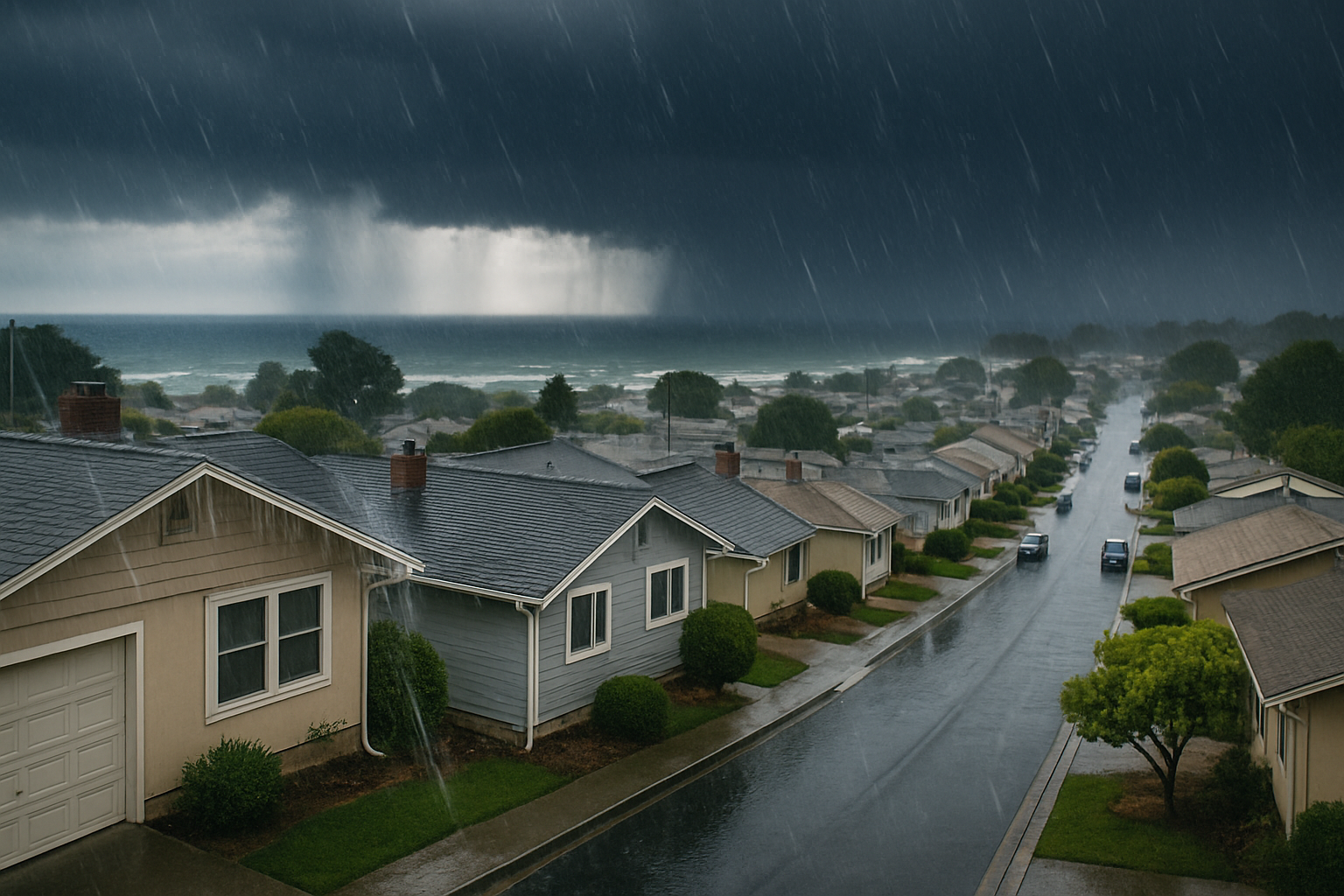
Is Your Monterey Bay Rental Property Ready for a Super El Niño Winter?
When a Super El Niño pattern develops in the Pacific, Monterey Bay doesn't get a normal wet season — it gets a sustained battering. The hills above Salinas flood. Drainage systems in older Pacific Grove neighborhoods back up. Roofs that have been leaking slowly for two years start failing all at once.
If you own a rental property on the Central Coast and you're not local, that scenario plays out at 2am on a Tuesday — and your tenant is the one calling. What happens next depends almost entirely on what you did, or didn't do, before the first storm hit.
This isn't about worst-case panic. It's about looking at your property through the lens of what a wet El Niño winter actually does to rental homes in this region, and deciding what's worth fixing before October turns into February.
What a Super El Niño Actually Means for Monterey Bay
El Niño is a recurring Pacific Ocean warming pattern that shifts storm tracks southward. For Northern and Central California, that typically means drier-than-normal winters. But a Super El Niño — one with unusually strong sea surface temperature anomalies — reverses that pattern for the Central Coast.
Monterey Bay sits at an inflection point in California's geography. When strong El Niño conditions steer the jet stream directly at the coast, the region can see 150–200% of normal annual rainfall compressed into a few storm cycles between December and March. The Santa Lucia Range forces that moisture upward rapidly, which intensifies rainfall totals in Carmel Valley, Seaside, and the hillside neighborhoods above Salinas.
What that looks like on the ground:
- Salinas River flooding affecting properties near Boronda and the Alisal area
- Storm drain overload in flat Marina and Seaside neighborhoods
- Hillside erosion and runoff impacting properties in Carmel Highlands and Pebble Beach
- Coastal surge and spray affecting waterfront and near-coast homes in Pacific Grove and Monterey
None of this is rare. The 1997–98 El Niño caused over $550 million in damage statewide, with Monterey County among the hardest-hit regions. A property that looked fine through the drought years can show its weaknesses very quickly when three inches of rain falls in 48 hours.
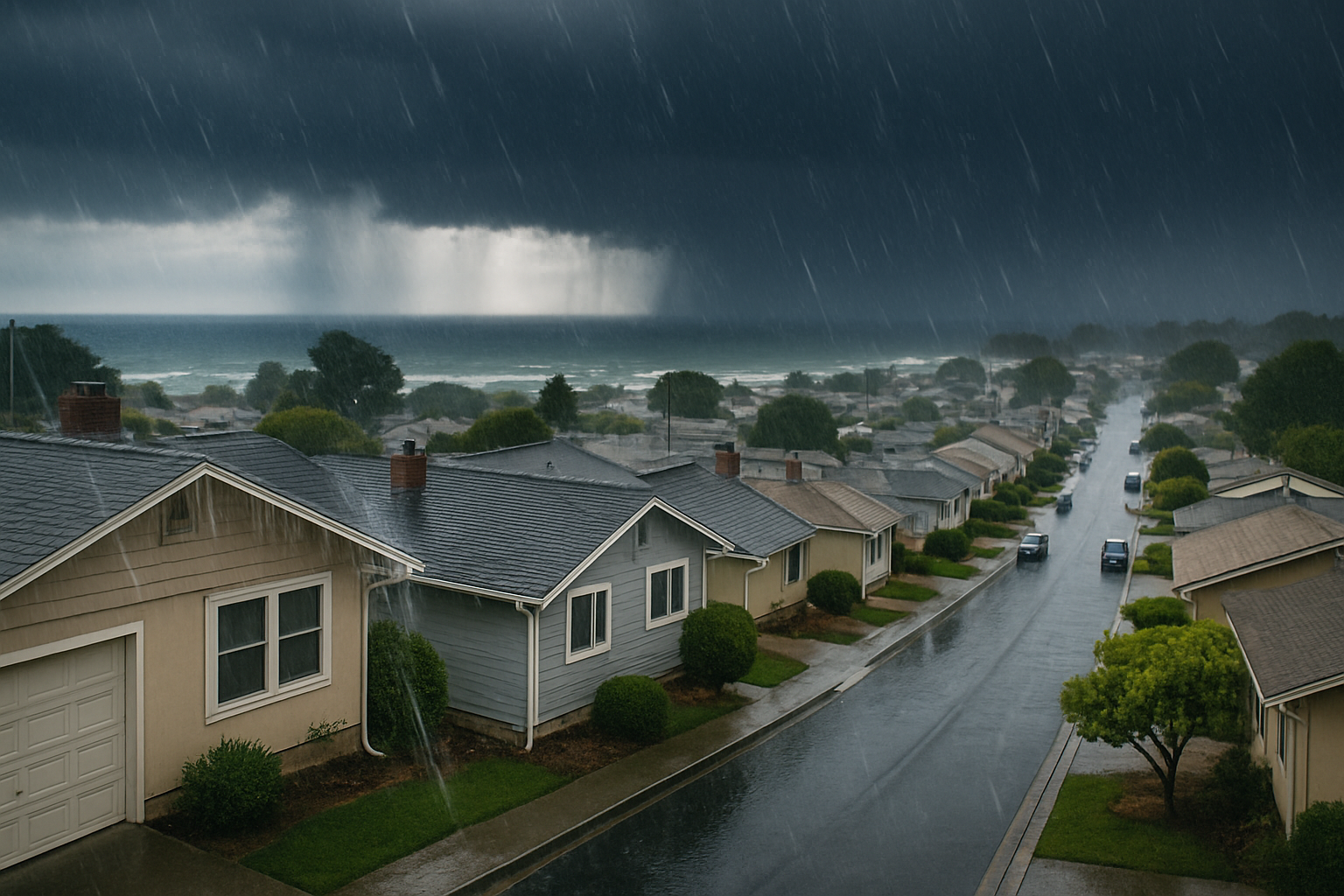
The Most Common Storm Damage in Monterey County Rentals
After a significant rain event, property managers and contractors across Monterey County see the same failure points repeat themselves. Most of them are predictable. And most of them were preventable.
Roof leaks are the most frequent call. Monterey Bay's coastal climate is hard on roofing materials — the salt air degrades flashing and sealants faster than inland areas. A roof that has another two years of normal life can fail in its first heavy storm if the flashing around a chimney or vent is already compromised.
Gutter and drainage failures come next. Gutters packed with debris from Monterey cypress and pine needles are essentially useless in a downpour. Water overflows at the fascia, soaks the exterior wall below, and begins working its way inside — often without anyone noticing until the drywall is already damaged.
The less obvious ones:
- Foundation seepage in older Salinas and Seaside homes with marginal grading that sends water toward the foundation rather than away from it
- Window and door seal failure in homes that haven't had their weatherstripping checked in years
- Crawl space flooding in properties with inadequate vapor barriers or blocked crawl space vents
- Water intrusion at chimneys — common in Carmel and Pacific Grove where older homes have aging mortar joints
Every one of these problems has a warning sign that shows up during a dry-weather property inspection. The issue is whether anyone actually looks.
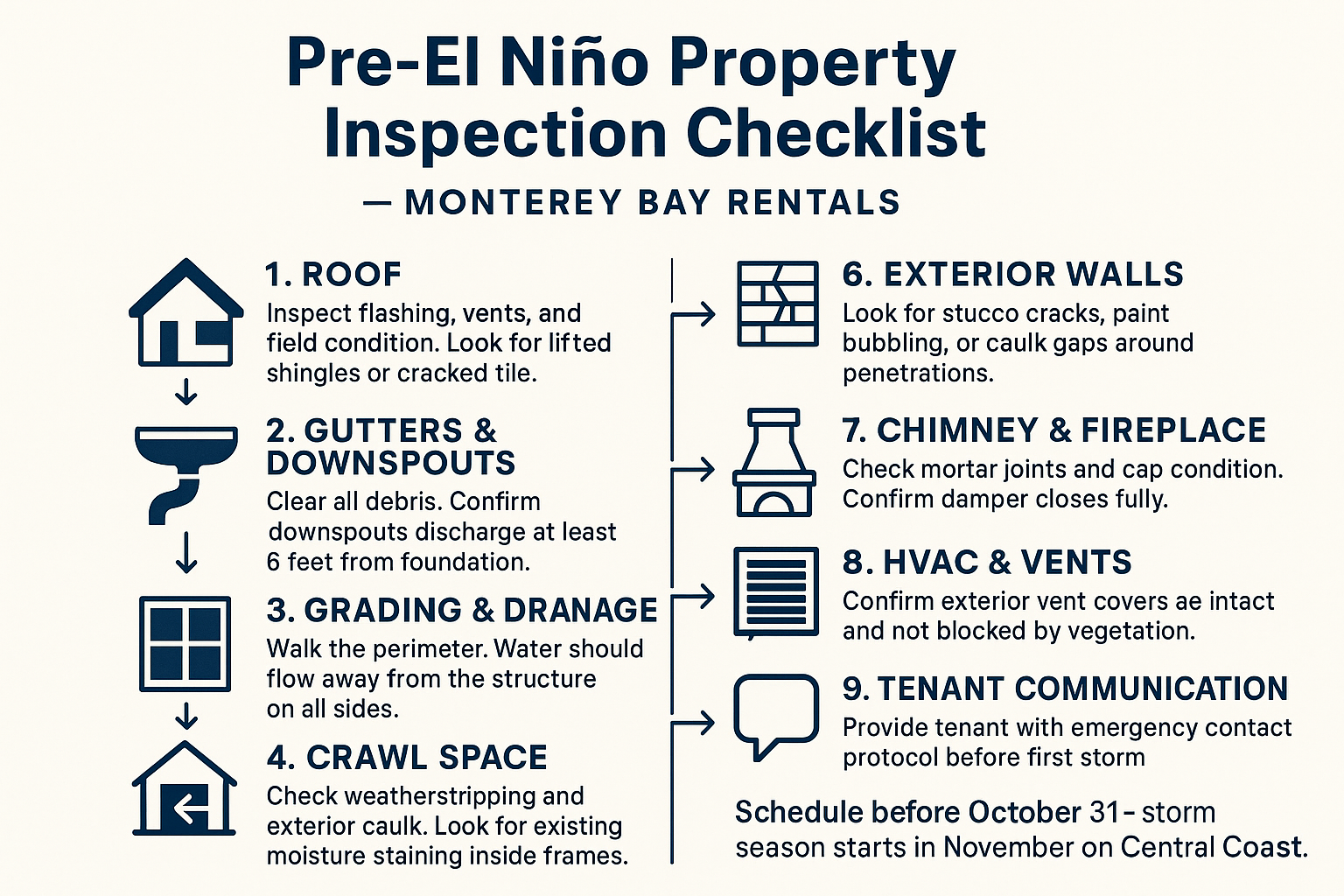
Pre-Storm Property Inspection: What Gets Checked
A proper pre-winter inspection covers specific systems in a specific order. Here's what a thorough walkthrough should include before El Niño season arrives.
Why Deferred Maintenance Gets Very Expensive in a Wet Year
Most rental property owners know there are things on the property that need attention. A gutter that hangs slightly off-pitch. A bathroom caulk line that's starting to separate. A crack in the stucco above the garage door that's been there since last year. In a dry year, these stay on the to-do list without causing much harm.
El Niño doesn't give you that grace period.
A slow drain that's been moving poorly all summer becomes a backed-up crawl space after two days of heavy rain. That hairline stucco crack lets water in during the first big storm, and by February you're looking at damaged insulation and the beginning of a mold situation. Deferred maintenance items don't just cost more to fix after storm damage — they often trigger secondary damage that multiplies the original repair cost by three to five times.
A roof repair that would have cost $800 before the storm can turn into a $4,000–$6,000 emergency patch job plus interior water damage remediation. In Carmel and Pebble Beach, where labor costs run higher than the rest of the county, those numbers climb further.
If you're managing your property from out of state, you may not even know the damage has happened until your tenant calls — or until it shows up on your next inspection report. As we've written about before, the hidden costs of managing a Monterey home from out of state go well beyond management fees. Storm season is where those costs tend to surface all at once.
Deferred Maintenance vs. Emergency Repair Costs — Monterey County Estimates
Here's a rough comparison of what common pre-storm fixes cost versus what the same problems cost after water damage has occurred. Costs reflect general contractor pricing in the Monterey Bay area as of 2024–2025.
| Issue | Pre-Storm Fix | Post-Storm Emergency Cost |
|---|---|---|
| Roof flashing repair | $300–$600 | $1,500–$4,500 + interior damage |
| Gutter cleaning & reattachment | $150–$300 | $600–$2,000 fascia/soffit repair |
| Stucco crack sealing | $200–$500 | $1,200–$3,500 water intrusion repair |
| Crawl space vapor barrier | $800–$1,500 | $3,000–$8,000 mold remediation |
| Window weatherstripping | $100–$250 | $500–$2,000 frame and drywall damage |
| Grading correction | $400–$900 | $2,500–$6,000+ foundation moisture repair |
Why Absentee Owners Face the Highest Risk
If you live in Monterey and own a rental two blocks away, a storm emergency is inconvenient. If you live in Phoenix, Portland, or San Jose and own a rental in Seaside, a storm emergency is a full logistical crisis that unfolds without you.
Tenant leases in California require landlords to maintain habitable conditions. That obligation doesn't pause because you're out of state or because it's midnight. When a roof fails in a heavy storm, your tenant has a right to expect a response — and if that response doesn't come, you have potential habitability liability exposure on top of the repair bill.
The problem isn't just legal. It's practical. Emergency contractors prioritize local clients and property managers with established vendor relationships. An owner calling from out of state at 3am, without an existing vendor relationship, is going to wait longer, pay more, and have less visibility into what's actually being done.
If you own a vacant or seasonal property, the risk is different but just as real. A roof leak in an unoccupied home can go undetected for weeks. By the time someone checks on it, the interior damage is far worse than it would have been with early intervention. We've covered what that looks like in detail — what can go wrong in an empty house is worth reading before the rainy season starts.
Having a local property manager with vendor relationships and scheduled inspections means the gap between storm damage and response is measured in hours, not days. That difference often determines whether a repair costs $500 or $5,000.
Frequently Asked Questions About El Niño Winter Prep for Rental Properties
How do I know if my Monterey County rental property is actually at risk this winter?
The clearest indicators are age and maintenance history. If your property is over 20 years old and hasn't had a roof inspection, gutter service, or exterior caulking check in the last two years, it has risk. Properties in low-lying areas of Salinas, flat sections of Marina, and hillside neighborhoods in Carmel and Pacific Grove face additional drainage and runoff risk. A pre-storm inspection will tell you specifically where you stand.
What's the difference between a regular wet year and a Super El Niño for this region?
A regular wet winter in Monterey Bay might bring 20–25 inches of rainfall spread across five months. A strong El Niño year can deliver that same total in two to three concentrated storm cycles, often with high wind. It's the intensity and concentration that cause damage — drainage systems and aging roofs that handle normal rain can't keep up with that volume arriving in 48-hour windows.
My tenant says everything looks fine. Isn't that good enough?
Tenants notice what affects them directly — water on the floor, a draft from a window, a drip from the ceiling. They usually don't check gutters, inspect flashing, or look under the crawl space. A tenant reporting 'no problems' isn't the same as a property that's been inspected by someone who knows what to look for before a storm.
Can I just schedule a handyman to do a pre-storm check?
You can, but a general handyman will focus on what you specifically ask them to check. A property manager doing a structured inspection works from a defined checklist, documents conditions with photos, and flags items you might not think to ask about — like grading issues, crawl space conditions, or window seal failures that aren't visible from inside the home.
Is El Niño covered by standard landlord insurance?
Storm damage from rain and wind is generally covered under standard landlord property insurance, but flood damage from rising water is not — that requires separate flood insurance. Properties near the Salinas River or in low-elevation areas of Marina and Seaside should review their policies before storm season. Water intrusion from a failed roof or window seal is typically covered; water that enters from ground-level flooding usually isn't.
How often should someone be checking on my rental property during a wet winter?
For occupied rentals, a post-storm check within 24–48 hours of a major storm event is a reasonable standard — especially in a heavy El Niño year. For vacant or seasonal properties, the frequency should be higher. We've written a full breakdown of how often someone should check on a vacant home in Monterey Bay that's worth reviewing if you have an unoccupied property heading into winter.
Want Someone Local to Walk Your Property Before the Rain Hits?
Torrente Properties works with landlords and property owners across Monterey County — from Salinas and Seaside to Carmel and Pacific Grove — who want eyes on their property before storm season, not after. If you'd like to talk through what a pre-winter inspection or ongoing management looks like for your rental, reach out to our team at (831) 582-8916 or through the contact form at torrenteproperties.com.

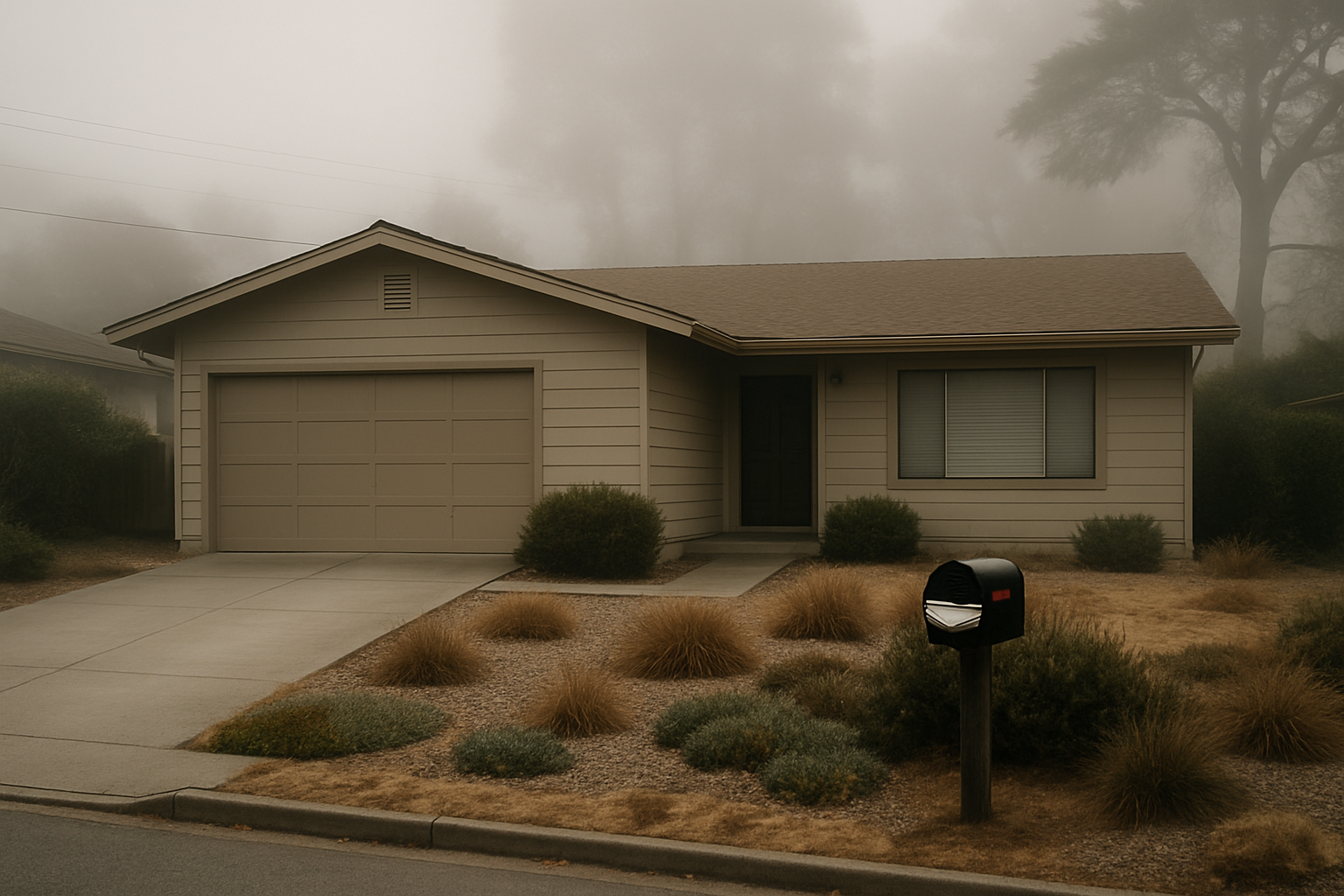
What Can Go Wrong in an Empty House — and Who's Responsible
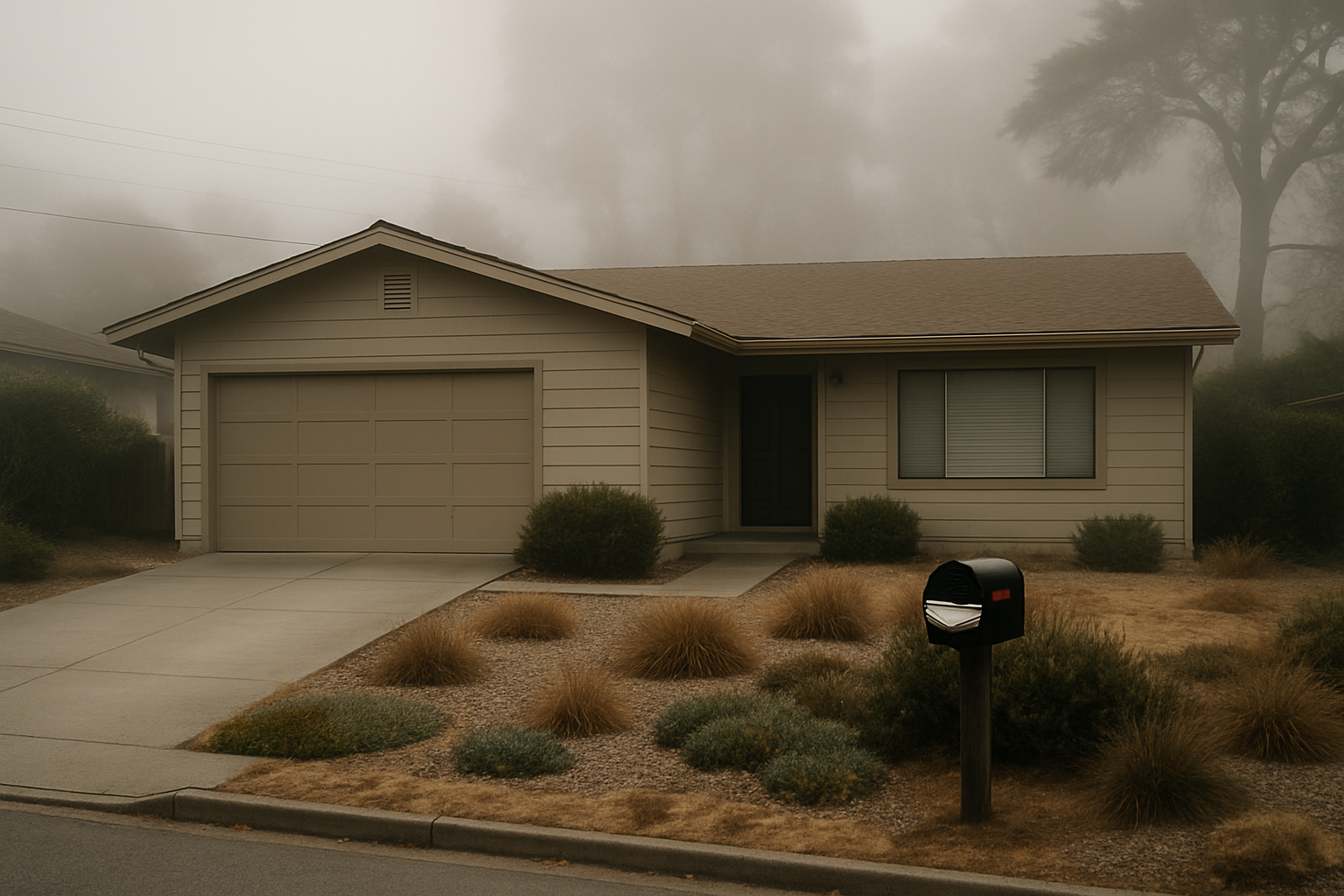
Most property owners think an empty house is a safe house. No tenants, no wear and tear, no complaints. But a vacant home on the Monterey Peninsula or in Salinas can deteriorate faster — and cost more — than a fully occupied one.
The Monterey Bay's marine air is hard on buildings. Moisture finds gaps in rooflines, around windows, and under doors. A slow drip under a sink that a tenant would notice in a day can go undetected for weeks in a vacant home, quietly rotting the subfloor.
This article covers the two things that matter most when a home sits empty: what actually goes wrong, and who is financially and legally on the hook when it does.
The Damage That Builds Up When No One Is Watching
Water is the number-one enemy of an empty house in Monterey County. A small roof leak, a failed supply line, or a dripping water heater can go unnoticed for 30, 60, even 90 days if no one is checking. By the time the owner finds out — often because a neighbor called, or because they flew in from out of state — the damage is already deep.
A basic water damage remediation job in the Monterey area typically runs $3,500 to $12,000 depending on how long the moisture sat. If mold has set in, that number climbs fast.
But water isn't the only problem. Here's what we see happen to vacant homes regularly:
- Pest intrusion — roof rats and mice move in quickly once a home stops being disturbed. Chewed wiring is an electrical hazard and often not covered by standard insurance.
- Vandalism and break-ins — a dark, quiet house with no activity is an invitation. This is a real issue in parts of Seaside and certain Salinas neighborhoods.
- HVAC failure — systems that sit idle for months can develop issues that only surface when turned back on. A failed capacitor in summer heat can mean a $400 repair or a full unit replacement.
- Landscape overgrowth — Carmel and Pacific Grove have strict property maintenance codes. Overgrown hedges and dead grass can generate code complaints and even fines.
- Plumbing dry-out — P-traps in sinks and toilets can dry out over time, allowing sewer gas to enter the home. Easy to fix if caught early; a real problem if the home is being shown to prospective tenants.
None of these problems announce themselves. They accumulate while the owner is living their life somewhere else.
Who Is Actually Responsible When Something Goes Wrong
This is the question most owners don't ask until they're already in a dispute with their insurance company.
California law and most homeowner insurance policies treat vacancy very differently from occupancy. Standard HO-3 policies — the most common type — typically include a vacancy clause that suspends or limits coverage after 30 to 60 consecutive days of vacancy. The exact window depends on your carrier and policy language.
That means if a pipe bursts on day 45 and your policy has a 30-day vacancy clause, your claim may be denied entirely — even if you've been paying premiums for years without filing a claim.
Owners who inherit property in Salinas or Carmel, or who relocate and can't immediately sell or rent, often don't realize their coverage has quietly lapsed. Some find out only after filing a claim. At that point, the financial responsibility falls entirely on them.
If the property has a tenant, the picture shifts somewhat. A tenant who causes damage is potentially liable for it — but collecting from a tenant is a legal process that takes time and doesn't guarantee recovery. And if the damage happened because the owner failed to maintain the property, the liability can reverse entirely.
The honest answer to "who's responsible" is almost always: the owner, unless they've taken steps to protect themselves. Those steps include maintaining proper vacant property insurance, keeping documentation of regular inspections, and having a written record of who is responsible for what.
If you're managing a property from a distance, what happens to your Monterey property when you're 500 miles away walks through how quickly problems compound without someone on the ground.
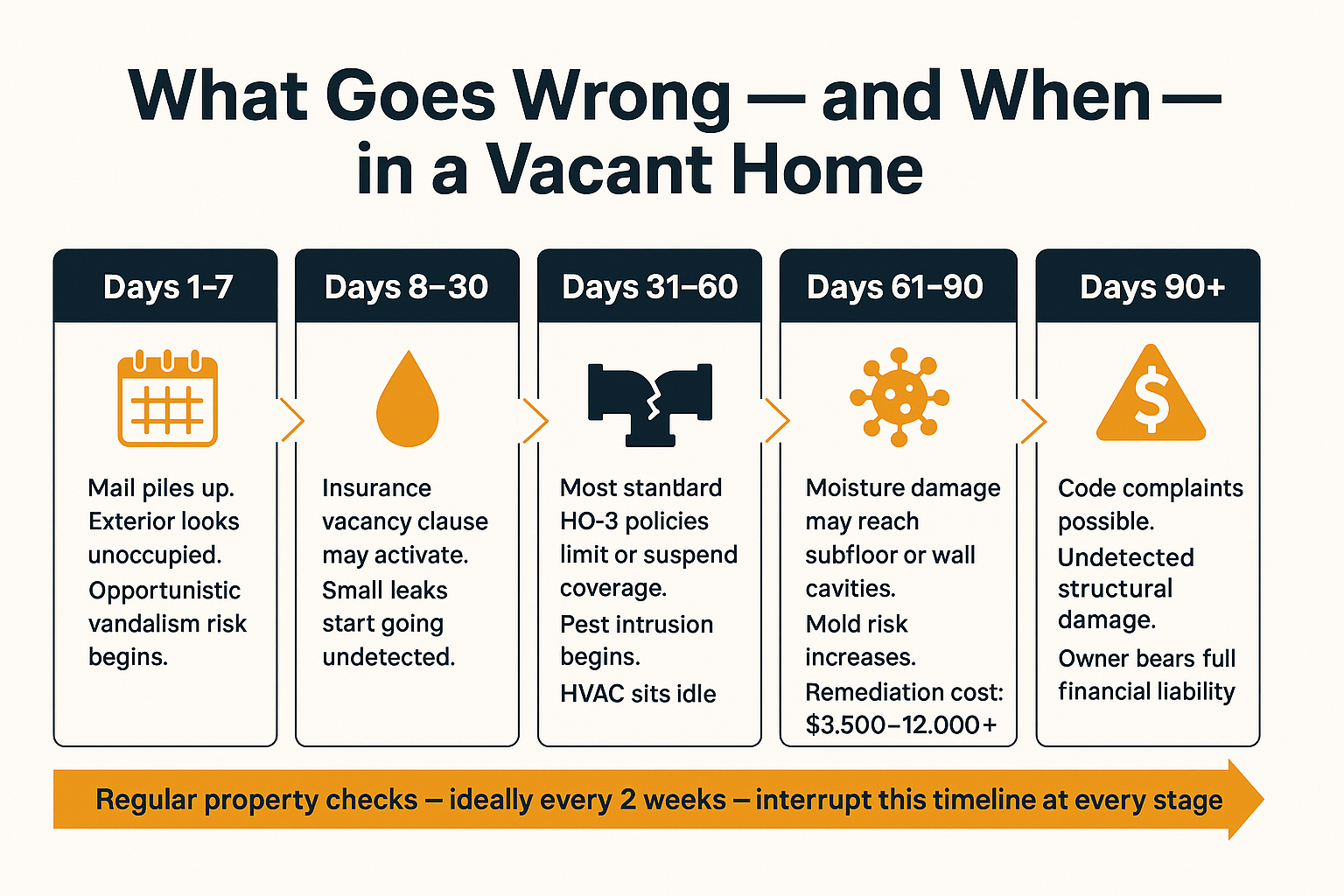
The Vacant Home Risk Timeline
This shows how risk and potential cost increase the longer a home sits unmonitored.
The Insurance Gap Most Owners Don't Know About
Let's be specific about the insurance issue because it's the one that surprises owners the most.
A standard California homeowner policy is written with the assumption that someone lives in the home. The moment a home becomes vacant, insurers consider it a higher-risk property — and most policies reflect that.
Here's what the vacancy clause typically does:
- Suspends coverage for vandalism and malicious mischief — one of the most common claims on vacant homes
- Limits or denies claims for water damage caused by undetected leaks
- May void glass breakage coverage
- Can affect liability coverage if someone is injured on the property
The fix is a vacant home endorsement or a standalone vacant property policy. These run roughly $800 to $2,500 per year in California depending on the property value, location, and how long it will be vacant. That's real money, but it's a fraction of what a single uncovered water claim costs.
Owners of second homes in Pebble Beach or Carmel-by-the-Sea are often surprised that their high-value policy still has this gap. Policy language matters more than premium size.
One thing that can help preserve your standard coverage — or reduce your vacant policy premium — is documented evidence of regular property monitoring. Some insurers will modify their vacancy terms if you can show scheduled inspections are happening. How Carmel homeowners are protecting properties without living in them covers some of the practical approaches owners use.
Common Vacant Home Problems: What They Cost and Who Pays
These are real-world cost ranges for issues we see in vacant Monterey County properties, along with how insurance typically responds.
| Problem | Typical Cost in Monterey County | Insurance Response (Standard Policy) |
|---|---|---|
| Water damage from undetected leak | $3,500 – $12,000+ | Often denied if home vacant 30–60+ days |
| Mold remediation | $5,000 – $25,000 | Frequently excluded; vacancy clause applies |
| Vandalism / break-in | $800 – $5,000 | Vandalism coverage typically suspended during vacancy |
| Pest damage (rodents, termites) | $1,500 – $8,000 | Rarely covered; considered maintenance issue |
| HVAC failure | $400 – $6,000 | Covered if mechanical failure; excluded if neglect |
| Code violation fines (landscape, maintenance) | $100 – $500/month | Not insurable; owner's direct liability |
How Regular Monitoring Changes the Equation
The reason problems compound in empty homes isn't that they're empty — it's that no one is catching issues early.
A leak found in week one is a plumber call and a $200 repair. The same leak found in week six is a remediation project. That's the whole story.
How often someone should check on a vacant home in the Monterey Bay area gets into the specifics, but the general answer is every one to two weeks at minimum for a vacant property — more often during the rainy season from November through March when roof and window issues are most likely to surface.
A check-in isn't just a walk-around. It should include:
- Looking under sinks and around water heaters for moisture
- Running faucets briefly to keep P-traps wet and check water pressure
- Checking the exterior for signs of entry attempts or vandalism
- Verifying that mail isn't accumulating visibly
- Noting any changes to the roof, gutters, or foundation areas
- Confirming utilities are functioning as expected
Owners who live in San Jose, Los Angeles, or out of state entirely often try to rely on neighbors for this. And neighbors are kind — but they're not accountable. They'll notice if a window is broken, but they won't know what to look for inside, and they won't document it in writing.
If you're managing a seasonal second home on the Monterey Peninsula, our caretaker services guide for seasonal homes breaks down what a formal home watch arrangement actually involves.
Frequently Asked Questions About Vacant Home Risk in Monterey County
How long can a home sit vacant before my homeowner's insurance stops covering it?
Most standard policies in California have a vacancy clause that kicks in after 30 to 60 days, depending on the carrier. After that point, coverage for vandalism, water damage, and other common claims may be suspended or denied. Read your policy's definitions carefully — 'unoccupied' and 'vacant' often mean different things legally, and that distinction matters for claims.
My neighbor said they'd keep an eye on my Carmel property while I'm gone. Is that enough?
Probably not for insurance or legal purposes. A neighbor's check-in is informal and undocumented. If you need to show a pattern of monitoring for an insurance claim — or to defend yourself in a liability situation — you need written records with dates, findings, and photos. A professional home watch service provides exactly that.
If my vacant property gets vandalized in Seaside, am I responsible for the repair costs?
If your policy's vandalism coverage is suspended due to vacancy, yes — the cost falls on you. Vacant property policies or endorsements can restore that coverage. Given that vandalism claims on vacant homes in Seaside and parts of Salinas are not uncommon, this gap is worth addressing before it's relevant.
What's the biggest mistake owners of inherited properties make?
Assuming their coverage automatically transferred or continued from the previous owner. When a property is inherited in California, the homeowner's policy doesn't transfer. Many families in this situation have no valid policy on the home at all during probate — sometimes for months. Getting vacant property coverage in place immediately is one of the first things to sort out.
Does Torrente Property Management handle vacant homes, or only rental properties?
We handle both. Our home watch and property caretaker services are specifically designed for vacant, seasonal, and second homes — not just occupied rentals. We do scheduled property inspections, utility oversight, vendor coordination, and written documentation for homeowners who are away for extended periods. You can read more about what that service involves on our caretaker services page.
Have a Property Sitting Empty in Monterey County?
If your home in Carmel, Pacific Grove, Seaside, or anywhere on the Peninsula is sitting vacant — even temporarily — it's worth a conversation about what monitoring makes sense. Torrente Property Management works with owners of vacant, seasonal, and inherited properties across Monterey County to keep homes protected and documented. You can reach our team at (831) 582-8916 or through the contact form at torrenteproperties.com.
How Often Should Someone Check on a Vacant Home in Monterey Bay?
A lot of homeowners assume a vacant house is a safe house. No tenants means no problems, right? But on the Monterey Peninsula, an empty home is quietly being tested every single day — by salt air, shifting weather, insects, moisture, and sometimes people who notice a property sitting dark for weeks at a time.
Whether you own a second home in Pacific Grove, a seasonal retreat in Carmel, or a property that's sitting between tenants in Seaside, the same question comes up: how often does someone actually need to be walking through that front door? The answer depends on a few real factors — and some of them might surprise you.
This article covers the two things that matter most: how frequently inspections should happen, and what those inspections actually need to include to catch problems before they become expensive.
Why the Monterey Bay Climate Changes the Math
Most generic advice about vacant homes was written for somewhere else. The Monterey Bay coastline has its own set of conditions that accelerate damage in ways that don't apply to, say, a home sitting empty in Fresno.
The coastal marine layer brings persistent moisture — even in summer. That moisture works its way into crawl spaces, window seals, and subfloor framing over time. A home that looks fine from the street can have active mold starting behind a bathroom wall after just a few weeks of no ventilation.
Salt air corrosion is another factor that moves faster than people expect. Metal fixtures, HVAC components, and exposed framing near the coast degrade more quickly than their inland counterparts. In Pebble Beach and Carmel, where homes often sit closer to the water, this corrosion cycle can shorten the life of mechanical systems by years if the home isn't being actively monitored and maintained.
And then there's the seasonal pattern. Monterey County gets most of its rain between November and March. A small roof issue that was harmless in August can cause thousands of dollars in water intrusion damage by January if no one caught it in October.
The bottom line: the Monterey Bay environment punishes neglect faster than most owners expect, especially when no one is generating heat, airflow, or routine wear-and-tear that would make a small problem obvious.
What Your Homeowner's Insurance Policy Actually Requires
This is the part most owners don't read until they're filing a claim — and then they find out too late.
Many standard homeowner's insurance policies include a vacancy clause that limits or voids coverage once a home has been unoccupied for 30 to 60 consecutive days. The specific threshold varies by insurer, but 30 days is common. After that cutoff, claims related to water damage, vandalism, or liability may be denied outright — even if you've been paying your premium without interruption.
Some policies require you to notify your insurer when a home becomes vacant and purchase a separate vacancy endorsement or rider. Those riders typically run $500 to $1,500 per year depending on the home's value and location, but they often come with their own requirements — including documented check-ins at defined intervals, sometimes as frequently as every 7 days.
If you own a home in Carmel or Pacific Grove and you're spending winters elsewhere, it's worth pulling out your policy and looking for the word "vacancy" before you assume you're covered. A quick call to your agent to ask specifically about the unoccupied home rules is worth an hour of your time.
For a broader look at what distant ownership actually costs when things aren't being watched, The Hidden Costs of Managing a Monterey Home From Out of State walks through the financial picture most people don't build into their plans.
Vacant Home Check-In Frequency: What Different Situations Require
The right inspection schedule depends on your specific situation. Here's a practical breakdown by ownership type and risk level.
| Situation | Recommended Frequency | Key Reason |
|---|---|---|
| Seasonal home, owner away 3–6 months | Every 7 days | Insurance requirements, moisture risk |
| Home between tenants (30–60 days vacant) | Every 10–14 days | Liability coverage, pest and weather exposure |
| Inherited or estate property | Every 7–10 days | Unknown maintenance history, legal exposure |
| Military deployment / owner relocated | Every 7 days | Extended absence, no local contacts |
| Renovation or repair period (contractors present) | Every 5–7 days | Site security, permit compliance, progress verification |
| Vacant less than 30 days | Every 14 days minimum | Most policies still active, lower but real risk |
What a Professional Vacant Home Inspection Actually Covers
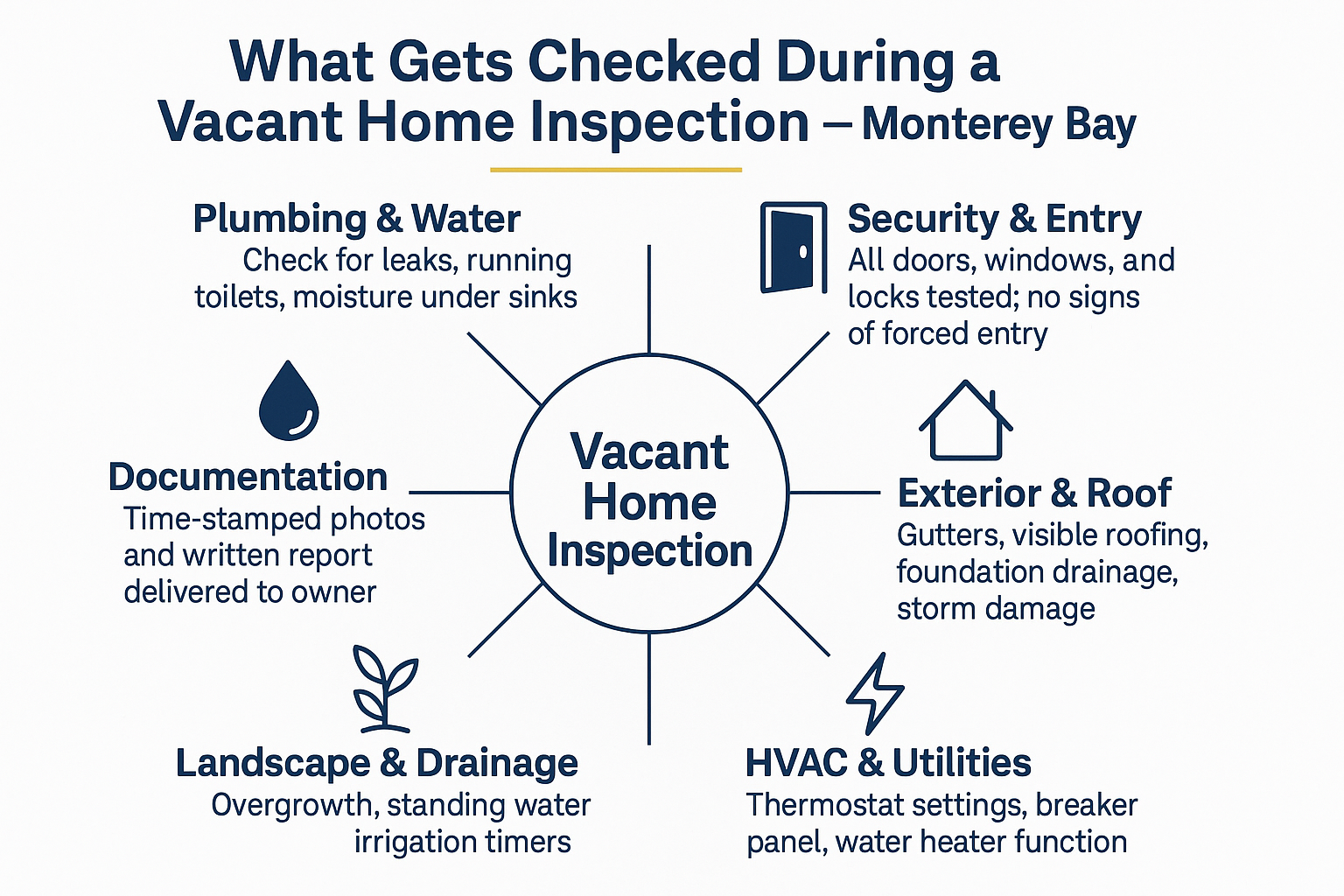
A real check-in is more than a walk around the outside. This shows what a thorough inspection covers and why each item matters.
What Actually Happens During a Proper Check-In
A drive-by doesn't count. Glancing at the front of the house from a car tells you almost nothing about what's happening inside or around the perimeter.
A real vacant home inspection means someone physically enters the home, walks every room, and looks at specific systems with purpose. The goal is to catch the early signs of problems — not to confirm that everything looks fine from the driveway.
Here's what a thorough check-in should cover:
- Interior moisture check — under sinks, in bathrooms, around water heaters, and in crawl spaces if accessible
- Plumbing function — running water briefly to test traps and confirm no leaks or unusual smells
- HVAC status — confirming the thermostat is set appropriately (usually 55–65°F in winter to prevent pipe stress) and the system is running
- Doors, windows, and locks — every point of entry tested, no signs of tampering or weather damage
- Roof and gutters visible from the exterior — checking for debris buildup, sagging, or storm damage after rain events
- Landscaping and drainage — standing water near the foundation is an early warning sign for moisture intrusion
- Signs of pest activity — droppings, mud tubes, or entry points along the exterior
- Photo documentation — time-stamped images sent to the owner after each visit
That last point matters more than people think. If a claim ever comes up — with an insurer, a contractor, or a future tenant — dated photographic records of the home's condition are exactly what you need. Verbal reports don't hold up the same way.
For owners who are managing a Carmel property from a distance and wondering what a professional caretaking relationship actually looks like, How Carmel Homeowners Are Protecting Properties Without Living in Them covers the practical side of that arrangement.
The Hidden Problems That a Vacant Home Accumulates Quietly
Most major vacant-home damage doesn't announce itself. It builds up slowly while no one is watching, then presents as an emergency.
Mold is the most common example. A slow drip under a bathroom sink can grow into a significant mold colony in three to four weeks behind cabinetry. By the time it becomes visible, you're often looking at remediation costs starting at $2,000 to $5,000 — and sometimes much more if it's reached drywall or subfloor.
Pest intrusion follows a similar pattern. Rodents can establish nesting inside a vacant home within days of finding an entry point, especially in fall when they're seeking warmth. In Salinas and Marina, where agricultural land borders residential neighborhoods, this is a real and recurring issue — not a theoretical one.
Vandalism and informal occupation are less common on the Peninsula but not unheard of. A home that shows clear signs of regular human attention — fresh tire tracks, varied trash pickup schedules, lights cycling — is meaningfully less likely to attract unwanted attention than one that looks frozen in time.
And for owners thinking about what happens when a property sits between tenants, What Happens to Your Monterey Property When You're 500 Miles Away? gets into specific scenarios that distant owners rarely anticipate until they're already dealing with one.
If you're managing a seasonal home and also thinking about the caretaking side of things more broadly, the Caretaker Services for Seasonal Homes: Monterey Bay Guide covers the full scope of what professional oversight looks like for properties in this market.
Frequently Asked Questions About Vacant Home Inspections in Monterey Bay
Can I just ask a neighbor to keep an eye on the house?
You can, and a good neighbor adds real value as an extra set of eyes. But a neighbor isn't going to enter the home, check under sinks, document what they see, or catch a slow moisture problem developing behind a wall. Neighbor check-ins work as a supplement — not as the primary inspection plan. And if something goes wrong, your insurer will likely want proof of formal, documented check-ins.
How much does a professional home watch service cost in Monterey County?
Rates vary by frequency and scope, but most professional home watch or caretaker services in the Monterey Bay area run $75 to $150 per visit for a thorough interior and exterior inspection with documentation. Monthly programs with weekly visits typically run $250 to $500 per month depending on the property size and what's included. That's a fraction of what a single mold remediation or water intrusion repair costs.
Does my insurance require documented check-ins, or just that someone visits?
Most vacancy endorsements that require check-ins specify written documentation — not just a visit. Time-stamped photos and a written log of findings are the standard. Verbal confirmation from a neighbor or family member typically won't satisfy a claim adjuster if something goes wrong. Read your specific policy, or call your agent and ask directly: 'What documentation do I need to maintain coverage on a vacant home?'
What's the difference between a home watch service and a property manager for a vacant home?
A property manager's focus is typically on an occupied or rented home — tenant relations, rent collection, leases, and ongoing management. A home watch or caretaker service is designed specifically for vacant, seasonal, or transitional properties where the primary goal is monitoring, documenting, and maintaining the home between occupancies. Some property management firms offer both under one roof, which can simplify things considerably if you're also planning to rent the property eventually.
My Carmel home is vacant for six months every year. Is once a month enough?
For a coastal property vacant for six months, once a month is not enough — and most insurance policies covering vacant homes would agree. Weekly to biweekly inspections are the standard for extended vacancy on the Monterey Peninsula. Six months gives the marine layer, seasonal storms, pests, and potential intruders a lot of opportunity between monthly visits. The cost of more frequent check-ins is genuinely small compared to what a single undetected problem can cost.
Want Someone Local Handling This for You?
If you own a vacant, seasonal, or transitional home anywhere in Monterey County — from Carmel to Salinas to Pacific Grove — Torrente Property Management offers professional home watch and caretaking services built specifically for owners who aren't on-site. Our team provides documented check-ins, photo reports, and hands-on coordination so you're never left guessing about what's happening at your property. Reach us at (831) 582-8916 or through the contact form at torrenteproperties.com.

Is Your Carmel Rental Actually Being Managed — or Just Collected On?
A lot of Carmel rental owners think their property is being managed because the rent shows up every month. But rent showing up is not the same thing as your property being protected, your tenant being properly screened, or your investment being actively watched.
Carmel is not a typical rental market. Properties here — whether on a quiet street off Junipero or tucked near the Carmel Mission — often rent for $3,500 to $6,500 per month. The stakes are high. A missed inspection or a slow maintenance response can quietly cost you thousands in deferred damage.
This article breaks down the difference between passive rent collection and actual management, so you can honestly assess whether what you have is working — or just appearing to work.
What Rent Collection Looks Like vs. What Management Actually Involves
Rent collection means someone has access to your tenant's bank account or payment portal and moves money to yours each month. That's a transaction, not a service.
Real property management is everything that happens before, during, and after that payment — the work that determines whether your property holds its value, your tenant stays long-term, and you're not blindsided by a $12,000 repair that could have been caught at $800.
Here's what a genuinely managed Carmel rental includes that passive collection does not:
- Scheduled walk-through inspections — not just when the tenant complains
- Proactive vendor coordination — licensed contractors who know Monterey County permit requirements
- Lease enforcement — following up on lease violations, not hoping the tenant self-corrects
- Move-in and move-out documentation — detailed condition reports that protect you legally
- Monthly financial statements — itemized, not just a deposit with no explanation
- Owner communication — actual updates, not silence until something breaks
If you're not seeing most of those things, you're paying management fees for a service that resembles a billing agent more than a property manager. As we explain in The Difference Between Listing Your House and Actually Managing It, getting a tenant placed is only the beginning of the job.

The Specific Risks of Passive Management in the Carmel Market
Carmel properties have some characteristics that make passive management especially risky. The coastal climate — fog, salt air, and heavy moisture — is harder on building materials than inland areas. Window seals fail faster. Wood siding and decking deteriorate in ways that aren't visible from a curb check.
If no one is walking through the property every few months, small problems accumulate. A slow drain becomes a corroded pipe. A soft spot on the deck becomes a liability issue, particularly relevant now that California's SB 721 exterior elevated element inspection requirements apply to multifamily properties — with inspection deadlines that owners need to be actively tracking.
Beyond physical condition, there's the tenant relationship. Properties that are never visited tend to drift — tenants add pets that weren't approved, make small modifications, or fall behind on lease terms that no one is enforcing. By the time you find out, you're looking at a longer, more expensive correction.
And then there's the financial picture. Many out-of-area Carmel landlords don't realize how much they're losing to management inertia — not dramatic losses, but a steady drain. The Hidden Costs of Managing a Monterey Home From Out of State outlines what that math actually looks like for owners who aren't physically present to catch things early.
Rent Collection vs. Property Management: Side-by-Side
This breakdown shows what distinguishes real hands-on management from passive rent collection. If your current arrangement looks more like the left column, it's worth asking why.
| Activity | Rent Collection Only | Full Property Management |
|---|---|---|
| Tenant screening | Basic credit check, maybe | Credit, background, income verification, rental history |
| Property inspections | Rarely or never | Scheduled — typically every 3-6 months |
| Maintenance response | Reactive when tenant calls | 24/7 coordination with vetted vendors |
| Lease enforcement | None or minimal | Active monitoring and documented follow-up |
| Financial reporting | Monthly deposit only | Itemized statement with receipts and owner access |
| Move-in/move-out | Key handoff | Full documented condition report with photos |
| Owner communication | When something goes wrong | Regular updates and proactive reporting |
| California compliance | Not tracked | Monitored — AB 1482, security deposit laws, local codes |
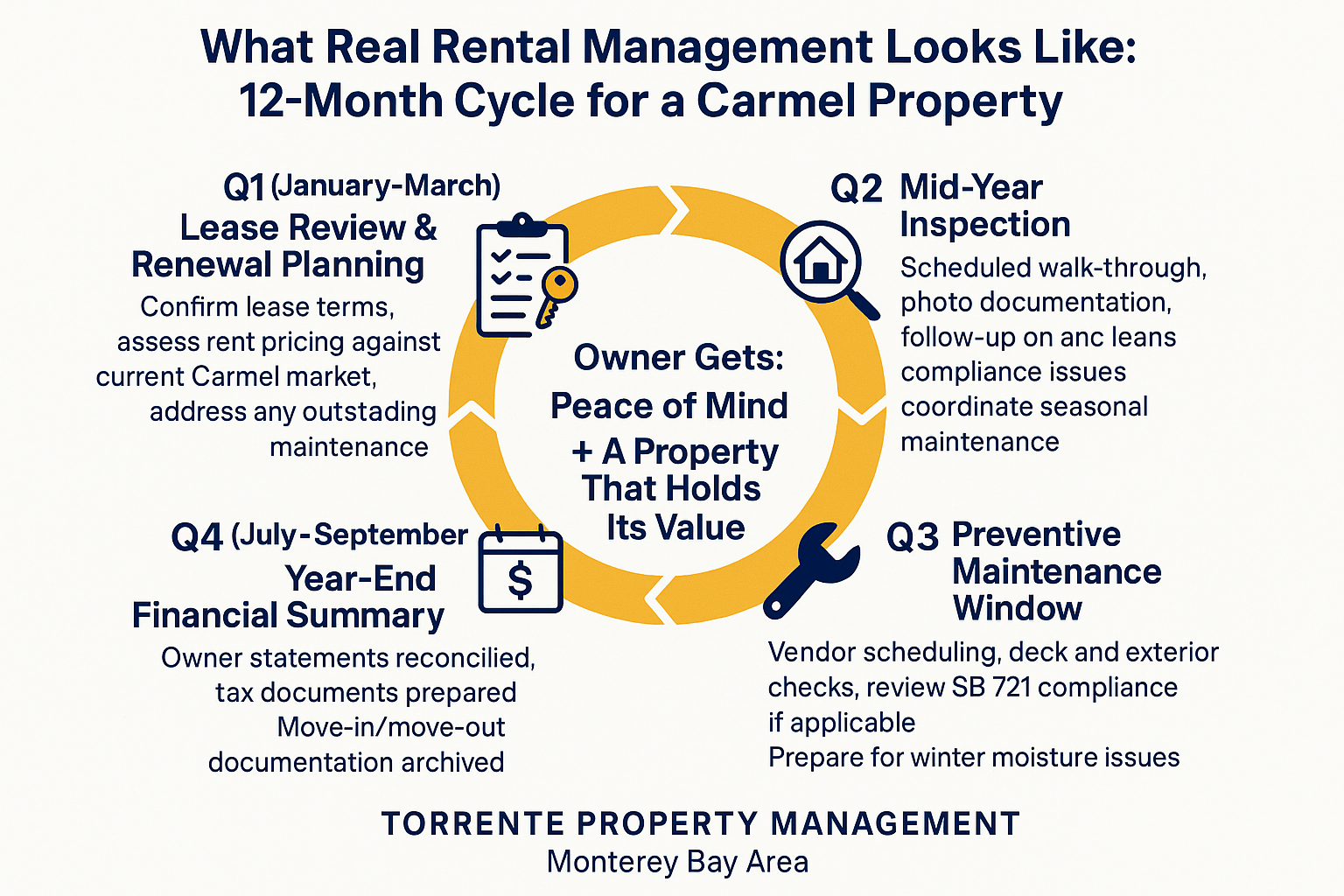
What a Well-Managed Carmel Rental Looks Like Over 12 Months
This infographic maps the full annual management cycle for a Carmel rental — showing what should happen each quarter if your property is actually being managed.
How to Tell If Your Current Management Is Actually Working
If you're not sure where your arrangement falls, there are a few honest questions worth asking yourself.
When was the last time someone physically walked through your Carmel property? If the answer is more than six months ago — or you genuinely don't know — that's a gap. Inspections aren't optional in a high-value coastal market; they're how you catch the problems that don't show up in a rent portal.
Do you receive itemized monthly statements? Not just a deposit confirmation, but a line-by-line breakdown showing what was collected, what was spent on maintenance, and what was disbursed to you. If your accounting is a mystery, that's a flag.
Who placed your current tenant, and how were they screened? Full screening in the Carmel and Monterey area should include income verification (typically 3x monthly rent as a minimum threshold), a full credit report, prior landlord references, and a background check. If any of those were skipped, you have exposure you may not know about yet.
How quickly do maintenance issues get resolved? Slow maintenance doesn't just frustrate tenants — it creates conditions that lead to turnover. And turnover in Carmel, where vacancy rates are low but re-leasing costs are real, can run $1,500 to $3,000 or more when you factor in cleaning, repairs, and re-marketing. What Makes Some Rental Properties Consistently Attract Reliable Tenants? covers how the day-to-day management quality directly affects who stays and who leaves.
A Note for Out-of-Area Carmel Owners
A significant portion of Carmel rental owners don't live locally. Some are in the Bay Area. Others are in Southern California or out of state entirely. And many have second homes on the Peninsula that sit vacant for parts of the year.
For that group, the distance itself creates a specific vulnerability. You can't do a drive-by. You're entirely dependent on your management partner to tell you what's happening — which means that if they're not looking, you genuinely don't know.
If your Carmel property is vacant for extended periods, management needs look different. That's where property caretaker services — scheduled inspections, utility monitoring, security coordination, and maintenance oversight for vacant homes — fill the gap that a standard lease-focused manager won't. We cover that side of ownership in detail for Carmel homeowners protecting properties without living in them.
The short version: distance is manageable, but only if someone local is paying attention on your behalf.
Frequently Asked Questions About Carmel Rental Management
What percentage does a property manager typically charge in the Carmel area?
In the Monterey Bay area, monthly management fees typically run 8% to 12% of collected rent, depending on the scope of services. On a Carmel rental at $4,500 per month, that's roughly $360 to $540 per month. Some managers also charge a separate leasing fee — often equal to one month's rent — when a new tenant is placed. Ask for a full fee schedule before you sign anything.
How often should a property manager inspect my Carmel rental?
A reasonable standard is once every 3 to 6 months for an occupied rental, with full photo documentation at move-in and move-out. The coastal climate in Carmel accelerates certain types of wear — moisture damage, wood deterioration, window seal failure — so more frequent checks are genuinely warranted here compared to drier inland markets.
My property manager collects rent on time. Isn't that enough?
On-time rent collection means your tenant is paying — not that your property is in good condition, your lease is being followed, or your investment is protected. The value of real management shows up when something goes wrong: a lease violation, a maintenance emergency, a tenant who wants to leave early. If those situations aren't being handled proactively, you'll find out the hard way.
Does California's new security deposit law affect Carmel landlords?
Yes. As of July 1, 2024, California limits security deposits to one month's rent for most residential rentals — regardless of what a lease says or what was previously collected. If your lease still references a higher deposit amount, it may not be enforceable. A good local manager tracks these changes and keeps your lease documents current.
What's the difference between property management and a home watch or caretaker service?
Property management is for occupied rentals — it covers tenant relations, rent collection, lease enforcement, and maintenance. A caretaker or home watch service is for vacant or seasonal properties — regular inspections, utility checks, security coordination, and catching problems before they become expensive. Some owners need one; some need both. If your Carmel property sits empty for months at a time, you likely need a caretaker service even if there's no tenant in place.
Want a Straight Answer About How Your Carmel Property Is Really Being Handled?
Torrente Property Management has been working with Monterey County property owners for over 25 years — and we're happy to give you an honest read on your current situation, no pressure attached. If you own a rental or vacant property in Carmel, Pacific Grove, Monterey, or anywhere across the Monterey Peninsula, reach out to our team directly at (831) 582-8916 or through the contact form at torrenteproperties.com.

How Carmel Homeowners Are Protecting Properties Without Living in Them
Carmel-by-the-Sea has one of the highest concentrations of second homes and seasonal residences on the entire California coast. Owners live in San Francisco, Los Angeles, Arizona, or further out — and they leave behind properties that cost them real money every month whether anyone is living in them or not.
A vacant home in Carmel isn't just sitting quietly. Moisture and salt air from Stillwater Cove and the surrounding coastline get into crawl spaces. Tree branches from those iconic Monterey cypress trees drop onto roofs. Irrigation lines fail. And when something goes wrong, there's no one nearby to catch it before it turns into a $4,000 repair instead of a $200 fix.
This article covers the two most practical ways Carmel property owners are managing this problem from a distance — and what each approach actually involves in the field.
What Home Watch Services Actually Do in Carmel
A home watch service is not a security guard and not a property manager. It's a scheduled, documented inspection program for a home that's sitting vacant or lightly occupied.
In Carmel and Pebble Beach, most home watch programs run on a weekly or bi-weekly schedule. Each visit typically takes 30 to 60 minutes and covers a specific checklist. A good caretaker isn't just walking through to make sure the lights work — they're looking for things that signal a developing problem before it becomes a visible one.
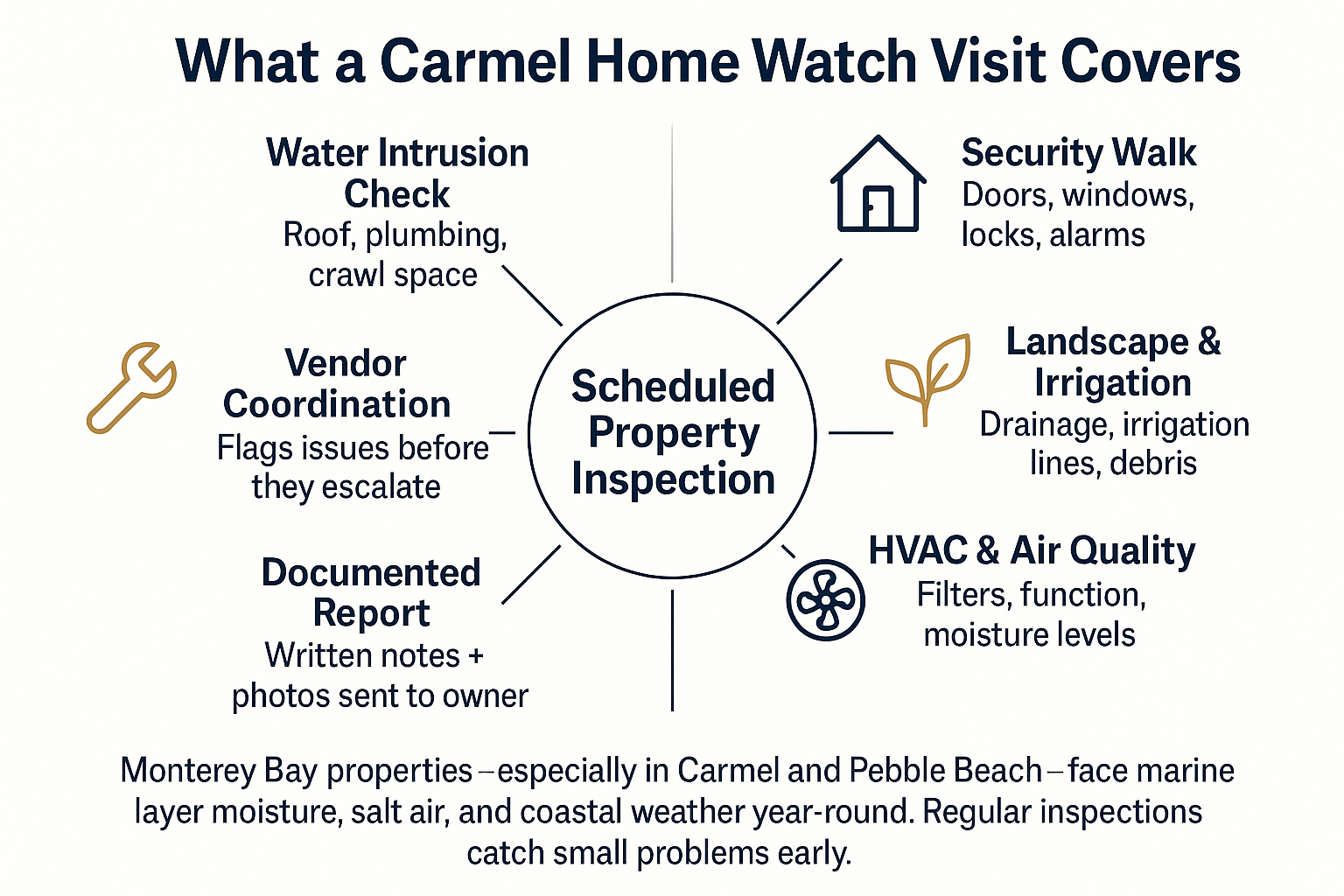
A standard inspection visit in this market usually covers:
- Interior walk-through checking for water intrusion, roof leaks, or plumbing drips
- HVAC system function and filter condition
- Smoke and CO detector status
- Exterior check of the roof line, gutters, and drainage areas
- Landscape condition and irrigation system function
- Security — windows, doors, and any motion-sensor or alarm systems
- Mail and package accumulation, which signals to opportunistic thieves that no one's home
Owners receive a written report after each visit, ideally with photos. That documentation trail matters — not just for peace of mind, but for insurance claims if something does go wrong.
For context on what goes unnoticed without this kind of regular oversight, our caretaker services guide for Monterey Bay seasonal homes covers the most common problems we find during inspections.

The Specific Risks Carmel Properties Face When Vacant
Carmel's physical environment is beautiful, but it's hard on houses. The marine layer rolls in almost every night from May through September. Moisture levels that would be unusual in inland climates are completely normal here, and they accelerate wood rot, mold growth, and corrosion on plumbing fixtures and HVAC components.
Carmel also has a large inventory of older homes — many built in the 1920s through 1950s — with original or aging infrastructure. A home that's been in a family for decades may have plumbing that hasn't been seriously evaluated in years. When no one is running water regularly, p-traps dry out, sewer gas backs up, and small drips that would have been noticed immediately go undetected for weeks.
Beyond the physical structure, there's a regulatory layer worth knowing. The City of Carmel-by-the-Sea prohibits short-term rentals of under 30 days, so owners can't offset carrying costs with weekend bookings the way they might in other markets. That means more vacant stretches — and more time for small problems to compound.
Property owners managing homes from out of state face a compounding version of all of this. If you're curious what that distance actually costs in dollars and stress, this breakdown of hidden costs for out-of-state Monterey homeowners is worth reading before you decide how to structure your oversight.
Home Watch vs. Full Property Management: Which One Fits?
These two services serve different situations. Here's a plain-language comparison to help Carmel owners decide which one matches their actual needs.
| Home Watch / Caretaker | Full Property Management | |
|---|---|---|
| Best for | Vacant or seasonal homes with no tenants | Rented homes with active tenants |
| Visit frequency | Weekly or bi-weekly | As needed — plus move-in/out, routine inspections |
| What's included | Inspections, documentation, vendor coordination | Leasing, rent collection, maintenance, legal compliance |
| Tenant involvement | None | Full tenant screening, communication, and management |
| Owner reporting | Written report after each visit | Monthly financial statements, year-end summaries |
| Typical monthly cost in Carmel market | $150–$350/month | 8–12% of monthly rent collected |
| Right fit when... | You visit seasonally and want eyes on the property | You want passive income and no landlord responsibilities |
What a Carmel Home Watch Visit Actually Covers
This breakdown shows what a trained caretaker checks on each scheduled visit — and why each item matters for a property sitting vacant on the Monterey Peninsula.
When a Rented Carmel Property Still Needs Caretaker-Level Attention
Some Carmel owners rent their properties long-term but still feel like something is falling through the cracks. They have tenants, they're collecting rent — but they're not sure what condition the home is actually in.
Having a tenant doesn't eliminate the need for structured oversight. It changes the nature of it. Tenants report the things that bother them — a broken appliance, a heater that won't ignite. They don't typically report slow gutter drainage, a small roof bubble forming after a rainstorm, or a fence post that's starting to lean.
For rented properties in Carmel and Pacific Grove, the right solution is usually full property management that includes routine inspections built into the service, not just response to tenant complaints. That's a different level of engagement than most national management companies provide.
If you're weighing whether a property manager actually adds value beyond handling calls, this article on whether property managers really increase profit or just maintain the property addresses that question directly.
And if you're currently self-managing a Carmel or Monterey home from out of state, this piece on what actually happens to your property when you're 500 miles away covers the operational gaps that tend to show up over time.
What Carmel Owners Should Set Up Before Leaving for the Season
Whether you're using a home watch service, a property manager, or still figuring out your approach, there are things worth doing before you leave that significantly reduce your risk exposure.
These aren't complicated, but they're easy to skip when you're focused on travel logistics:
- Shut off the main water supply or install a smart water shutoff that alerts you to leaks remotely — especially important in older Carmel homes with aging copper or galvanized plumbing
- Set your thermostat between 58–65°F year-round; the coast doesn't get freezing temperatures, but unventilated indoor moisture at 50°F creates the same conditions that grow mold
- Give a trusted local contact actual access — not just a key hanging on a hook somewhere, but someone who knows the property, knows who to call, and has your insurance information
- Notify your homeowner's insurance carrier that the property will be vacant for an extended period; many policies have vacancy clauses that can void coverage after 30 or 60 days unoccupied
- Document the current condition with a room-by-room photo walkthrough before you leave — this takes 20 minutes and has saved owners thousands of dollars in disputed claims
A local property caretaker can handle all of this coordination on your behalf and serve as that trusted local contact — which is the core reason owners in this market hire one.
Frequently Asked Questions About Protecting Vacant Carmel Properties
How much does a home watch service cost in Carmel?
In the Carmel and Pebble Beach market, most home watch programs run between $150 and $350 per month depending on visit frequency, property size, and scope. Weekly visits with full photo documentation sit at the higher end. Some caretakers charge per visit instead — typically $75 to $150 per inspection. It's a small number relative to the carrying costs of most Carmel properties, and compared to the cost of a single undetected water leak, the math usually isn't close.
Can I rent my Carmel home short-term while I'm away?
No. The City of Carmel-by-the-Sea prohibits short-term rentals under 30 days. If you want to generate rental income from your Carmel property, long-term leasing (typically 12-month leases) is the route that's both legal and manageable with the right team in place.
What's the difference between a home watch service and just asking a neighbor to check in?
A neighbor check-in is better than nothing, but it's not the same thing. A professional home watch provider works from a documented checklist, delivers a written report after every visit, carries liability insurance, and knows what to look for in a coastal property specifically. They also have vendor relationships to dispatch help immediately when something needs fixing. A neighbor can call you if they see smoke — a home watch provider catches the slow drip behind your water heater before it becomes smoke.
Does my homeowner's insurance cover a vacant home?
Many standard homeowner's policies have vacancy clauses that limit or void coverage after the property has been unoccupied for 30 to 60 days. The specific terms vary by carrier. Before leaving your Carmel home vacant for a season, call your insurance agent and ask directly whether you need to add a vacancy endorsement or rider. A home watch program with documented visits can sometimes satisfy insurer requirements for 'active oversight' — ask your carrier what they need.
Do property managers in Carmel also handle vacant second homes, or just rentals?
It depends on the firm. Many property management companies only work with actively rented properties — that's their model. Torrente Property Management handles both: full management for rented homes and dedicated caretaker and home watch services for vacant, seasonal, and second homes. If your situation is somewhere in between — vacant now but possibly rented in the future — it's worth working with a firm that can handle both without handing you off to a separate provider.
Ready to Have Local Eyes on Your Carmel Property?
If you own a second home, seasonal residence, or rental property in Carmel, Pebble Beach, Pacific Grove, or anywhere in Monterey County and you're managing it from a distance, Torrente Properties offers hands-on home watch, caretaker, and full property management services built for exactly this situation. Reach our team directly at (831) 582-8916 or through the contact form at torrenteproperties.com.

The Hidden Costs of Managing a Monterey Home From Out of State
Most out-of-state landlords do the math on their Monterey property and it looks fine on paper. Monthly rent coming in, mortgage going out, something left over. But that math almost always leaves out the costs that don't show up until something goes wrong — and something always goes wrong eventually.
Monterey County is one of the most expensive rental markets on the Central Coast. Rents are strong, but so are the stakes. A missed maintenance call, a compliance misstep, or a bad tenant situation can turn a profitable rental into a money-losing headache fast — especially when you're managing it from Denver or Dallas.
This article breaks down the real costs of remote self-management — not the obvious ones, but the ones that quietly chip away at what you thought you were earning.
The Emergency Trip You Didn't Budget For
When a water heater fails at a rental in Monterey and you're sitting in Phoenix, you have two choices: find a local vendor you trust to handle it without supervision, or get on a plane. Most first-time remote landlords don't have that vendor network yet, so they fly.
A last-minute round-trip to Monterey Regional Airport from most major out-of-state cities runs $400 to $900. Add a rental car, two nights at a hotel near the peninsula, and your time — and a water heater replacement that should have cost $1,200 suddenly costs you $2,500 or more out of pocket.
This isn't an edge case. It's one of the most common hidden costs remote landlords describe after their first year. And it's rarely a one-time thing. Properties generate emergencies on their own schedule, not yours.
Even when you skip the trip and try to coordinate remotely, unmanaged repairs often take longer, and California law requires landlords to address habitability issues promptly. Delayed repairs in Monterey can expose you to rent withholding claims under California Civil Code 1942 — which is a much bigger problem than the repair itself.
If you want to understand what happens to a property when you're not nearby to catch problems early, what happens to your Monterey property when you're 500 miles away goes deeper on exactly that.

California Compliance Costs That Catch Out-of-State Owners Off Guard
California has some of the most landlord-specific regulations in the country, and Monterey County adds its own layer on top of state law. Owners who live here stay current because they're in it every day. Owners in other states often don't find out about a requirement until they're already out of compliance.
A few of the most common compliance gaps for remote owners right now:
- Security deposit cap: As of July 1, 2024, California capped security deposits at one month's rent for most residential properties. Owners who collected two months before this law changed and haven't adjusted are holding deposits incorrectly.
- Salinas Residential Rental Registration: Rental properties in Salinas must be registered with the city. The registration fee is relatively low, but failing to register can result in fines and complications during eviction proceedings.
- AB 1482 rent increase limits: Most single-family rentals and multifamily properties in Monterey County that are more than 15 years old fall under California's statewide rent cap. Raising rent above the annual limit — currently CPI + 5%, capped at 10% — exposes you to legal liability.
- SB 721 balcony inspections: If you own a multifamily property in Monterey with exterior elevated elements — decks, balconies, stairways — inspections were required by January 1, 2025. Missing this deadline carries real liability if something fails.
None of these are obscure rules. But when you're managing a property from out of state and not plugged into local real estate news, they're easy to miss. And the cost of catching up after the fact is almost always higher than the cost of staying current.
For a broader look at what remote landlords often overlook, what landlords often overlook when choosing a property management company covers some of these blind spots in more detail.
What Remote Self-Management Actually Costs Versus What Owners Expect
These are real cost categories remote Monterey landlords encounter, with honest ranges based on current local conditions. Many of these never appear in a landlord's initial pro forma.
| Cost Category | What Owners Expect | What It Often Costs |
|---|---|---|
| Emergency travel (per trip) | Nothing — "I'll handle it remotely" | $600–$2,500 depending on origin city |
| Compliance fine (deposit/registration) | $0 | $500–$2,000+ depending on violation |
| Deferred maintenance repair | $300–$500 | $1,500–$5,000 after delayed action |
| Vacancy from slow re-leasing | 1–2 weeks | 4–8 weeks if priced or marketed poorly |
| Bad tenant placement cost | $0 upfront | $3,000–$8,000 in lost rent or damages |
| Vendor markup (no local relationships) | Market rate | 10–25% above market on some trades |
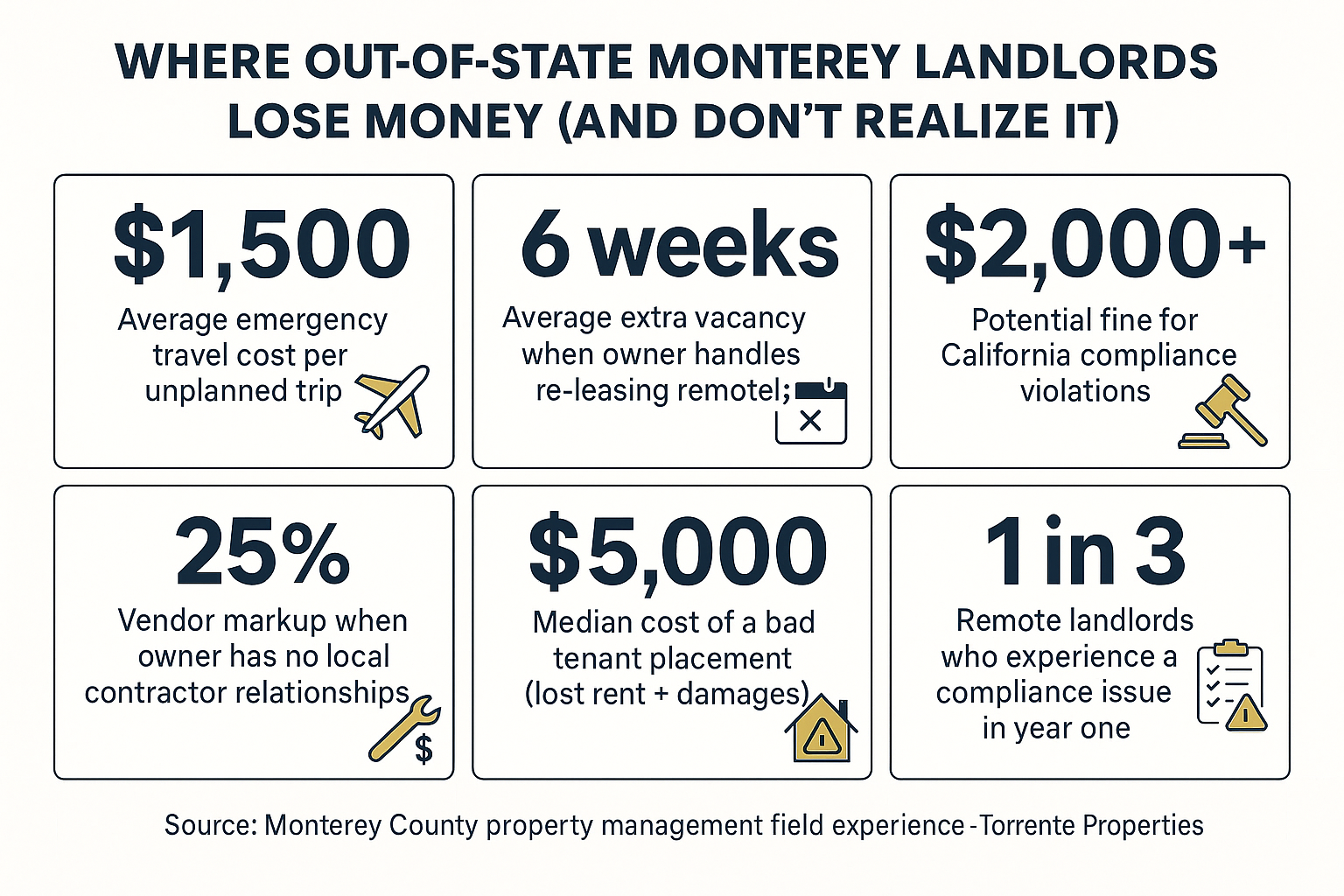
The Real Cost Breakdown for Out-of-State Monterey Landlords
This infographic shows how hidden costs stack up for remote property owners over the course of a typical year — organized by category so you can see where money quietly leaks out.
The Slow Leak: Vacancy and Below-Market Rent
Emergency costs are dramatic. But the slower losses often do more damage over time — and they're almost invisible until you run the numbers at year end.
Vacancy is the clearest example. A Monterey rental sitting empty for six weeks instead of two costs you roughly a month's rent in lost income — anywhere from $2,000 to $4,500 depending on the property and location. That loss happens when a property is priced wrong, listed on only one platform, or shown infrequently because the owner can't be there to open the door.
Below-market rents are just as expensive, and more common than people think. Owners who set rent once and don't adjust it annually — because they're not tracking the local market from out of state — often leave $150 to $400 per month on the table. Over a two-year lease, that's $3,600 to $9,600 you never collected.
This isn't a criticism of landlords who try to manage their own properties. It's a real structural disadvantage of operating from a distance. A landlord in Salinas or Pacific Grove can see what comparable units are renting for because they're living it. An owner in another state is working from data that's already a month or two old.
The difference between listing your house and actually managing it does a good job of explaining why these two things require very different skill sets — and why conflating them is where a lot of owners run into trouble.
What Seasonal and Second-Home Owners Face Specifically
Not every out-of-state owner is a traditional landlord. A significant number of Monterey Peninsula property owners have second homes or seasonal properties that sit vacant for months at a time — and managing those remotely carries a different set of risks.
Vacant homes on the coast are exposed to moisture intrusion, pest activity, and weathering in ways that occupied homes aren't. A small roof leak that a tenant would notice and report within days can go undetected for weeks in a vacant property — and by the time the owner visits, what was a $400 repair has turned into a $6,000 remediation.
For seasonal homeowners specifically, there's also the issue of security. Pebble Beach and Carmel properties have been targeted for break-ins during extended owner absences, and a home that clearly hasn't been checked on in months is a more visible target than one with regular activity.
This is where scheduled property inspections and home watch services fill a real gap. Regular walkthroughs, utility monitoring, and maintenance coordination can catch problems when they're still small — which is the entire point. Caretaker services for seasonal homes on the Monterey Bay outlines what that kind of service actually covers if you're not sure what to look for.
Frequently Asked Questions About Managing a Monterey Property From Out of State
How much does it actually cost to self-manage a Monterey rental from out of state?
It varies a lot depending on how the year goes. In a smooth year with no vacancies or emergencies, you might spend very little. But most remote owners encounter at least one emergency trip, one compliance issue, or one extended vacancy in any given two-year window. When those happen, the out-of-pocket costs typically run $3,000 to $10,000 — often more than what professional management would have cost over the same period.
Do I really need to worry about California rental law if I only own one property?
Yes. California's tenant protection laws apply regardless of how many properties you own. AB 1482 rent caps, the one-month security deposit limit, just-cause eviction requirements, and habitability standards all apply to single-family rentals in Monterey County. Ignorance of the law isn't a defense — and the penalties for violations can be significant.
Is it legal to manage my own rental property in California if I live out of state?
Yes, it's legal. But California does require that landlords be reachable and responsive — and some local ordinances like Salinas' rental registration program require accurate contact information on file. The legal part isn't the problem. The practical part is.
What's the biggest mistake out-of-state Monterey landlords make?
Underestimating how fast small problems become large ones when no one is watching the property regularly. A slow drain, a small water stain, an HVAC filter that hasn't been changed — these are things a tenant might not mention and an absentee owner won't see. By the time something forces attention, the repair is usually much bigger than it had to be.
My property is vacant right now, not rented. Does any of this still apply to me?
Vacant properties carry their own risks — moisture, pest intrusion, security vulnerabilities, and deferred maintenance that compounds without anyone noticing. Seasonal and vacant homes on the Monterey Peninsula are especially vulnerable to marine air and weather-related damage. Regular inspections and a local point of contact are worth it even when no tenant is in place.
Want a Clear Picture of What Your Monterey Property Is Actually Costing You?
Torrente Properties works with property owners across Monterey County — including many who manage from out of state and are realizing the math doesn't add up the way they expected. If you own a rental or vacant home in Monterey, Pacific Grove, Salinas, Carmel, or anywhere on the peninsula, our team can walk you through what local management actually looks like and what it would cost. Reach us by phone at (831) 582-8916 or through the contact form at torrenteproperties.com.

What Happens to Your Monterey Property When You're 500 Miles Away?
You bought property on the Monterey Peninsula — maybe a rental in Seaside, a second home in Pacific Grove, or a house in Salinas you inherited and couldn't quite bring yourself to sell. Now you live in Sacramento, Phoenix, or Portland, and there's a quiet anxiety that comes with not knowing what's happening on the other end of that investment.
That anxiety isn't irrational. Monterey County's rental market moves fast, maintenance issues don't wait for your next visit, and California's landlord-tenant laws change regularly. Most of what goes wrong for out-of-area owners doesn't happen dramatically — it happens gradually, quietly, while you're 500 miles away dealing with your actual life.
This article walks through the two things that matter most: what really breaks down when you're not nearby, and what a realistic management plan looks like for properties along the Central Coast.
The Problems That Start Small and Get Expensive
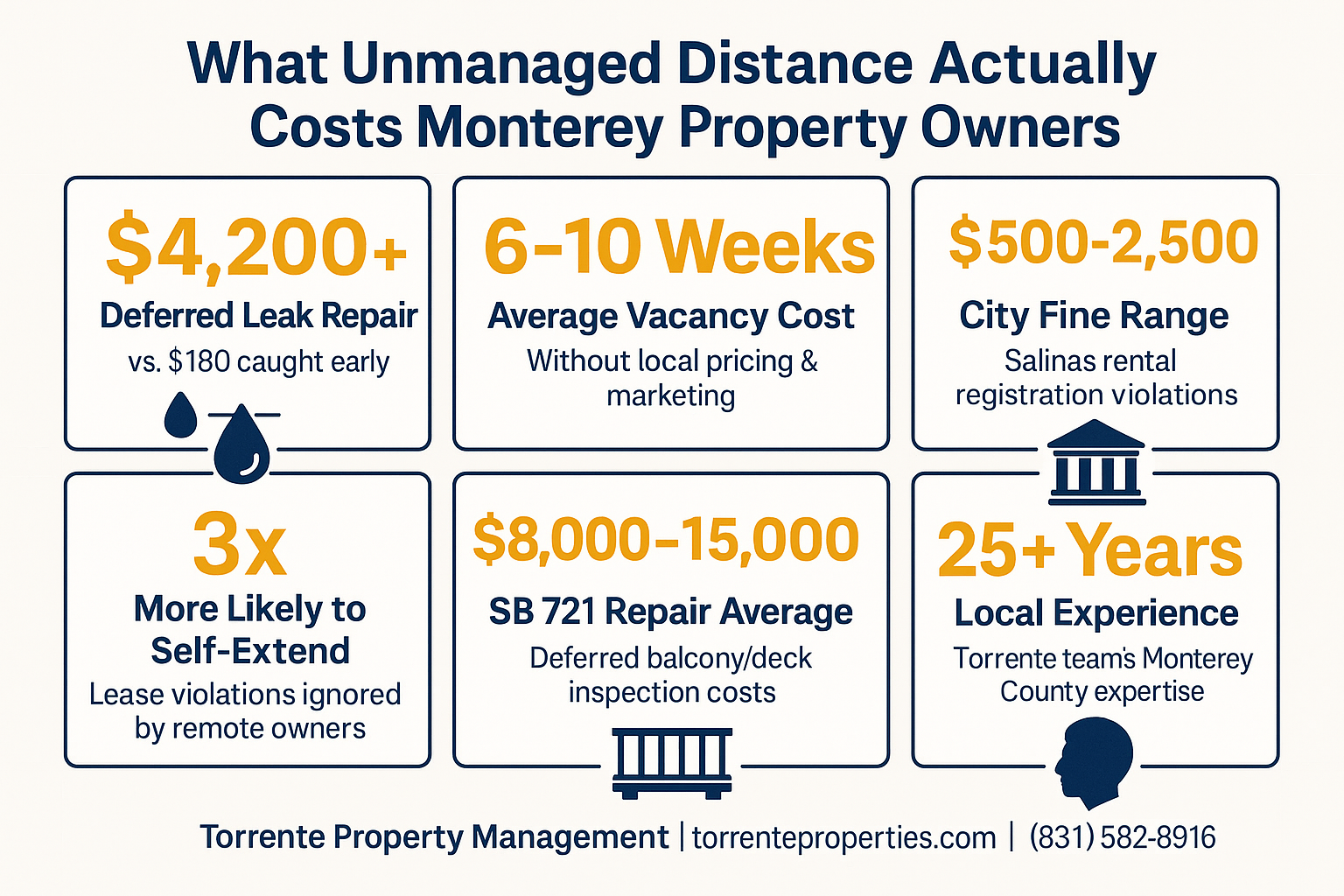
The most common story we hear from new clients goes something like this: a tenant reported a small leak under the bathroom sink six weeks ago. The owner said they'd handle it on their next visit. By the time anyone looked at it, the subfloor had rotted through and the repair cost $4,200 instead of the $180 it would have been at first call.
Distance doesn't cause deferred maintenance — it just removes the accountability that keeps it from happening. When you're local, you notice the peeling paint, the dripping faucet, the gate that won't latch. When you're in another state, you only find out when the tenant gets frustrated enough to tell you, or when something fails completely.
The same pattern plays out with tenant behavior. A tenant who knows the owner is a four-hour flight away will often feel less observed. That's not a character judgment — it's just human nature. Without regular inspections, small lease violations (unauthorized pets, unapproved occupants, neglected landscaping) become established patterns that are much harder to address legally once they've gone on for months.
In Salinas especially, where multi-unit properties are common and tenant turnover can be higher, renting out your house without a local presence changes the entire dynamic of what you can reasonably expect to catch and correct.
The practical risks of unmanaged distance include:
- Unreported maintenance that compounds into structural damage
- Lease violations that go undetected for months
- Missed inspections that put you out of compliance with local programs
- Vendor overcharging when there's no local eye on the work
- Late rent that drags on because no one is following up consistently

What California Law Requires — Whether You're Here or Not
California doesn't care where you live. Your obligations as a landlord apply regardless of your zip code, and Monterey County has several compliance layers that catch out-of-area owners off guard.
Security deposits are capped at one month's rent as of July 1, 2024, under a law that changed long-standing rules many landlords still think are current. If you collected two months' deposit from a tenant before that date and haven't adjusted your practices for new leases, you may be exposed.
Salinas landlords also have to contend with the city's Residential Rental Registration program, which requires landlords to register their rental units and pay annual fees. Failure to register can result in fines and complicate any future eviction proceedings. It's the kind of administrative detail that's easy to stay current on when you're local — and easy to miss when you're not.
For properties with balconies or exterior elevated elements in multifamily buildings, SB 721 sets inspection deadlines that many owners still haven't addressed. If your Monterey or Salinas apartment building has any exterior stairway, deck, or balcony, there are licensed inspector requirements and repair timelines that carry real legal weight.
Understanding what a property manager actually handles day-to-day goes well beyond rent collection — it includes staying current on exactly these kinds of regulatory requirements so you don't find out about a violation through a fine notice.
The Real Cost of Unmanaged Distance
This breakdown shows how quickly deferred problems and missed compliance steps add up for out-of-area owners in Monterey County.
Vacant and Seasonal Homes Face a Different Set of Risks
Not every out-of-area owner has a tenant. Many people own seasonal homes on the Monterey Peninsula — places they visit in summer or over the holidays — and those properties sit vacant for months at a time. Vacancy carries its own specific risks that are easy to underestimate.
A home that looks occupied is a harder target for vandalism and break-ins. A home that's clearly vacant — mail piling up, overgrown landscaping, lights never on — signals opportunity. In coastal areas like Pebble Beach and Carmel, where second homes are common, this isn't a theoretical concern.
Beyond security, vacant homes develop problems that tenanted homes rarely do. Water heaters that sit idle can corrode. HVAC systems that don't cycle regularly can fail. Roof issues go unnoticed for entire seasons. Pest intrusions start in the crawl space and are well established before anyone finds them.
For owners in this situation, a scheduled property inspection program — sometimes called home watch or caretaker services — provides the regular eyes-on presence that prevents these silent problems. This typically means bi-weekly or monthly visits to check the property inside and out, coordinate any needed maintenance, and confirm that utilities and systems are functioning. It's a fundamentally different service than tenant management, but equally important for the right property type.
Rented vs. Vacant: What Can Go Wrong and When
The risks look different depending on whether your Monterey County property is occupied or sitting empty. Here's a practical comparison of the most common issues by property type.
| Risk Category | Rented Property | Vacant/Seasonal Property |
|---|---|---|
| Maintenance Detection | Tenant may report — or may not for weeks | No one to notice until next visit |
| Lease Compliance | Violations can go unobserved without inspections | N/A — no tenant |
| Security | Occupied appearance deters break-ins | Visible vacancy increases risk |
| Regulatory Compliance | Registration, deposit rules, habitability laws | Utility oversight, municipal codes |
| Cost of Delayed Action | Lease violation harder to remedy after months | Structural damage accumulates silently |
| Ideal Solution | Full-service property management | Caretaker / home watch program |
What a Realistic Management Plan Actually Looks Like
A lot of out-of-area owners assume they can handle things with a combination of a handyman they trust and a neighbor who keeps an eye out. That setup works until it doesn't — and it usually stops working at the worst possible time.
A real management plan for a distant property owner covers three layers that a handyman-and-neighbor arrangement almost never does:
1. Proactive tenant screening and lease management. The single biggest driver of long-term rental income is tenant quality. A thorough screening process — credit, background, rental history, income verification — done before move-in prevents the majority of problems that happen during tenancy. What makes some rental properties consistently attract reliable tenants starts with who you put in the property, not what you do afterward.
2. Scheduled property inspections. Move-in and move-out inspections are standard. But regular mid-tenancy inspections — typically every 3 to 6 months — are what actually catch lease violations and maintenance issues before they become legal or financial problems. Most self-managing out-of-area owners skip these entirely because they're not physically present to do them.
3. Vendor relationships and financial oversight. A local property manager with established vendor relationships gets faster service and better pricing than a remote owner calling around from out of state. In Monterey County, where skilled tradespeople are in high demand, that access matters. Monthly owner statements and year-end financial summaries also give you a clear picture of your property's performance without having to piece it together from bank records.
For owners who are evaluating whether professional management makes financial sense, do property managers really increase profit breaks down the numbers in plain terms worth reading before you decide.
Frequently Asked Questions About Managing Monterey Property From a Distance
How often should someone inspect a rental property in Monterey County?
At minimum, a move-in inspection, a mid-tenancy inspection every 3 to 6 months, and a move-out inspection. In Salinas, where the city's rental registration program may also trigger compliance checks, more frequent inspections are worth it. For vacant or seasonal homes, bi-weekly or monthly walkthroughs are standard practice to catch issues early.
Do I need to be registered as a landlord in Salinas even if I only own one unit?
Yes. Salinas' Residential Rental Registration program applies to residential rental units in the city regardless of how many you own. There's an annual registration fee and failure to comply can complicate future eviction proceedings. If you're unsure whether your property is registered, that's worth checking immediately.
My tenant handles small repairs themselves and deducts from rent. Is that legal in California?
California law does allow a limited form of 'repair and deduct' — but only under specific conditions, and the deduction is capped at one month's rent. This is a situation where having a proper lease, a clear maintenance reporting process, and a local point of contact prevents most of the ambiguity. Verbal arrangements with tenants around maintenance deductions create legal exposure for the owner.
What's the difference between a property manager and a home watch or caretaker service?
A property manager handles everything related to a tenant — leasing, rent collection, maintenance coordination, compliance, and lease enforcement. A home watch or caretaker service is for vacant or seasonal properties with no tenant. It focuses on regular inspections, utility oversight, security monitoring coordination, and flagging maintenance issues before they get serious. Some firms offer both — which is useful if your property situation changes seasonally.
Can I manage my Monterey rental from out of state without hiring anyone?
Technically, yes. Practically, most owners who try it find that response times suffer, vendor relationships are hard to build remotely, and California's regulatory requirements are difficult to stay current on from a distance. The risk isn't that it's impossible — it's that the gaps compound quietly until something forces your attention.
Ready to Stop Worrying About What You Can't See?
If you own a rental or second home in Monterey, Salinas, Pacific Grove, Seaside, or anywhere along the Central Coast, Torrente Property Management offers the kind of local, hands-on oversight that out-of-area owners genuinely rely on. Our team is based here, knows these neighborhoods, and treats every property we manage with the same attention we'd give our own. Reach us at (831) 582-8916 or through the contact form at torrenteproperties.com — we're happy to talk through your specific situation.
The Difference Between Listing Your House and Actually Managing It
A lot of property owners in Monterey County assume that once they find a tenant and collect the first month's rent, the hard part is over. It isn't. Getting a house listed and filled is a one-time event. Managing that same house is a job that runs every day — whether you're across town in Salinas or across the country in another state.
These two things get confused all the time, and the confusion costs landlords real money. We've seen owners in Pacific Grove and Marina come to us after a rough year of self-managing — not because they couldn't find tenants, but because nobody told them what came after.
This article breaks down where the listing ends and where the actual management begins. If you're weighing whether to handle this yourself or bring in professional help, understanding that line is the most useful place to start.
What the Listing Phase Actually Covers
The listing phase is finite. It starts when you decide to rent and ends when a signed lease is in hand and a qualified tenant has moved in. Done right, it takes two to four weeks in most Monterey County markets.
Here's what's included in a solid listing process:
- Property preparation — cleaning, minor repairs, touch-up paint, and anything that affects first impressions or rental price
- Rental pricing analysis — setting a rate that's competitive for the neighborhood, not just a number you picked from Zillow
- Professional photos and listings — distributed across platforms where Monterey County renters actually search
- Showings and applicant screening — credit checks, background checks, income verification, and rental history review
- Lease drafting and execution — a California-compliant lease that protects you legally from day one
That's a meaningful amount of work, and getting any part of it wrong has consequences. A tenant who looked good on paper but wasn't properly screened, or a lease missing required California disclosures, can turn into an expensive problem. But once that work is done, it's done. What comes next is a different category entirely.
Some landlords understand this well. Others discover it the hard way — usually around month three.
Where Management Starts — and What It Actually Requires
The day after move-in is when property management begins. And unlike the listing phase, it doesn't have an end date.
Management means being responsible for the property in an ongoing, often unpredictable way. For landlords who live out of the area, that responsibility can feel heavy fast. A pipe bursts on a Friday night in Seaside. The tenant calls. Someone has to answer, find a licensed plumber, authorize the work, and document the cost — that night.
The day-to-day management workload includes:
- Rent collection and late payment follow-through — including knowing when and how to issue a legal pay-or-quit notice under California law
- Maintenance coordination — fielding requests, vetting vendors, getting work done at fair prices, and keeping records
- Routine and move-out inspections — documenting property condition with the kind of detail that holds up if there's ever a dispute over a security deposit
- Monthly owner financial statements — tracking income, expenses, and what you actually cleared after repairs and fees
- Compliance tracking — California rental law changes frequently; the one-month security deposit cap that took effect July 1, 2024 caught some self-managing landlords off guard
- Vendor oversight — making sure the landscaper shows up, the HVAC filter gets changed, and small issues don't become expensive ones
None of this is glamorous. And most of it doesn't show up in the listing phase at all. Understanding what a property manager really handles makes the scope clearer than most owners expect before they get into it.
Listing vs. Management: What Each Phase Covers
Here's a side-by-side look at where one phase ends and the other begins — and which one most people underestimate.
| Task | Listing Phase | Ongoing Management |
|---|---|---|
| Rental pricing analysis | ✓ Yes | Periodic only |
| Property photos and marketing | ✓ Yes | As needed |
| Tenant screening and placement | ✓ Yes | On turnover |
| Lease drafting | ✓ Yes | On renewal/turnover |
| Rent collection | — | ✓ Every month |
| Maintenance coordination | — | ✓ Ongoing |
| Routine inspections | Move-in only | ✓ Scheduled |
| Financial reporting | — | ✓ Monthly |
| Compliance monitoring | — | ✓ Ongoing |
| Vendor management | — | ✓ Ongoing |
| Emergency response (24/7) | — | ✓ Year-round |
The Property Owner's Timeline: From Listing to Long-Term Management
This timeline shows the two distinct phases of rental ownership and what falls inside each one — helpful for owners deciding where they need support.
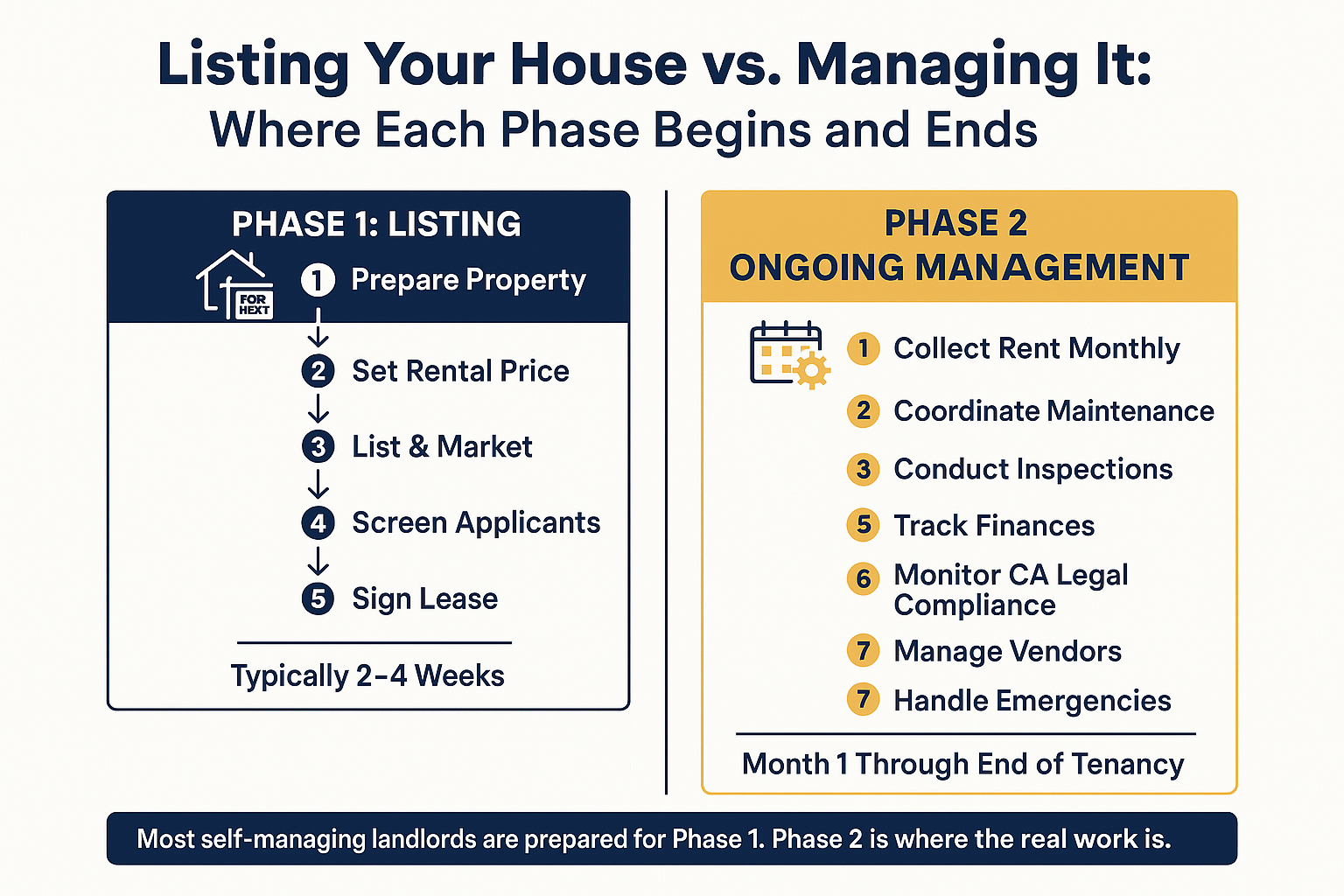
Why Monterey County Makes Management Harder Than Most Markets
California landlord-tenant law is already more complex than most states. But Monterey County adds its own layers that catch owners off guard — especially those who moved away and are managing remotely.
Salinas has a Residential Rental Registration program that requires landlords to register rental units with the city. Missing that registration isn't just an oversight — it can affect your ability to enforce a lease. The City of Monterey prohibits short-term rentals under 30 days entirely. And multifamily property owners across the county are working against inspection deadlines tied to AB 2579 and SB 721, which require exterior elevated elements like balconies and decks to be inspected by a licensed professional on a set schedule.
For a landlord managing a Salinas property from out of state, keeping up with these local requirements while also handling day-to-day management isn't just inconvenient — it's genuinely risky. Missing a compliance deadline can mean fines, delays, or worse.
This is also why comparing a flat-fee online listing service to a full-service local property manager isn't a fair comparison. One hands you a tenant. The other keeps you on the right side of California law for as long as that tenant is in your property.
The Decision Most Landlords Face Eventually
At some point, most rental property owners in Monterey County face the same question: is the time and stress of self-managing worth it compared to what professional management costs?
For some owners — especially those who live nearby, have just one property, and genuinely enjoy the work — self-managing can make sense. But for owners who are retired, relocated, out of state, or simply don't want a second job, the math often looks different than expected.
Full-service property management in Monterey County typically runs between 8% and 12% of monthly rent collected. On a home renting for $2,800/month in Salinas, that's roughly $224–$336/month. In exchange, you're handing off the 3 a.m. phone calls, the tenant disputes, the vendor coordination, and the compliance tracking.
What that fee doesn't account for is what a good manager saves you: a faster vacancy fill, a more carefully screened tenant who stays longer, and maintenance issues caught early before they turn into a $4,000 repair. Whether professional management actually increases your bottom line depends on your situation — but the costs of getting management wrong are real and specific.
Owners who inherit a property in Carmel or Pacific Grove and suddenly become accidental landlords tend to underestimate both the time commitment and the local knowledge required. How the housing market has pushed more homeowners into landlord roles has made this a more common situation than it used to be.
Frequently Asked Questions About Listing vs. Managing a Rental Property
Can I just hire someone to find a tenant and then manage the property myself?
Yes, and some landlords do this successfully — especially if they live nearby and have some experience. But be aware that whoever places your tenant may not be available to help when problems come up later. If you go this route, make sure your lease is California-compliant and that you understand Salinas or Monterey's local rental registration requirements before your tenant moves in.
What happens when a tenant stops paying rent? Who handles that?
If you're self-managing, you do. That means issuing a 3-day pay-or-quit notice in the correct legal format, following California's specific timeline, and potentially initiating an unlawful detainer action if the tenant doesn't comply. A property manager handles this entire process on your behalf — including the paperwork and, if necessary, coordinating with a real estate attorney.
Is the security deposit cap new in California?
Yes. As of July 1, 2024, California law limits security deposits to one month's rent for most residential tenancies, regardless of whether the unit is furnished. Previously, landlords could collect up to two months. If you haven't updated your lease language since then, it's worth reviewing.
What's the difference between a property manager and a caretaker service?
A property manager handles occupied rental properties — tenants, rent collection, maintenance, and compliance. A caretaker service is for vacant or seasonal homes where there's no tenant but the property still needs someone checking on it regularly. Torrente Properties offers both, which is relatively uncommon and makes a real difference for seasonal residents and second-home owners on the Monterey Peninsula.
How do I know if a property management company is actually doing the work they say they are?
Ask specifically about monthly financial statements, inspection frequency, and how they handle maintenance requests. A good manager can show you documented records — not just a summary. Referencing their standing with local organizations like the Monterey County Association of Realtors is also a reasonable way to evaluate legitimacy. What landlords often overlook when choosing a property management company is a useful read if you're comparing options.
Ready to Know Exactly What Your Property Needs?
If you own a rental in Monterey County — whether it's occupied, vacant, or somewhere in between — Torrente Properties can give you a clear picture of what's actually involved in managing it well. Our team has been working with Monterey Bay property owners for over 25 years, and we're happy to talk through your situation without pressure or obligation. Call us at (831) 582-8916 or reach out through the contact form at torrenteproperties.com.
Renting Out Your Salinas House? Here's What Changes When You're Not Around
A lot of Salinas homeowners become landlords the same way — a job relocation, a move closer to family, or just the decision that selling didn't make sense right now. So the house stays, a tenant moves in, and suddenly you're managing a property in Monterey County from Sacramento, or Phoenix, or somewhere overseas.
What most people don't anticipate is how much the distance changes the math. The tasks that were easy when you were five minutes away — checking on a noise complaint, approving a repair, confirming the landscaping got done — become real logistical problems when you're three time zones out.
This article focuses on two things that actually matter most when you're renting out a Salinas home from a distance: California's legal requirements that now apply to you as a landlord, and the practical reality of managing maintenance and tenant issues remotely. If you're about to make this transition, both deserve more thought than most first-time landlords give them.
California Landlord Law Doesn't Care Where You Live
Being out of the area doesn't change your obligations under California law — it just makes them harder to stay on top of.
The most significant recent change for Salinas landlords: California's security deposit cap dropped to one month's rent for all residential rentals as of July 1, 2024 (AB 12). It doesn't matter whether the property is furnished, unfurnished, or how many units you own. If you collected two months at any point and haven't adjusted your practices, you're already out of compliance.
Salinas adds another layer with its Residential Rental Registration program, which requires landlords to register rental properties with the city. If you've moved away and let that registration lapse, or never set one up properly, that's a compliance gap that can create problems when you eventually try to resolve a tenant dispute or sell.
Beyond those two, California law generally requires:
- Written notice of entry at least 24 hours in advance for non-emergency situations
- Habitability standards that must be maintained regardless of how far away you are
- Repairs completed within a reasonable timeframe — courts have interpreted this as quickly as a few days for serious issues
- Proper security deposit accounting within 21 days of a tenant moving out, with itemized deductions
The problem with managing these from a distance isn't that the rules are complicated — most are straightforward. The problem is that a delayed response to any of them, because you didn't see the email or couldn't coordinate a vendor in time, can turn a minor compliance issue into a legal one. You can read more about what Salinas landlords often overlook before getting started — a lot of it applies directly to single-family rentals too.
What Remote Maintenance Coordination Actually Looks Like
Maintenance is where most out-of-area Salinas landlords run into the most friction — and the most unexpected costs.
When you're local, you can walk the property yourself, get a second opinion from a neighbor, or call three plumbers and pick the one who can come Tuesday. When you're remote, you're almost entirely dependent on who you have in your vendor network and how fast they respond.
Here's what tends to go sideways without a system in place:
- A tenant reports a water heater issue on a Friday evening. You don't see the message until Saturday morning. By Sunday, they're without hot water — which is a habitability issue under California law.
- A slow roof leak gets reported but not treated as urgent. Six weeks later, the ceiling shows visible damage and the repair cost has doubled.
- A vendor does work you didn't authorize at a price you didn't agree to, because the tenant let them in and the job was done before you could respond.
None of these situations are unusual. They happen regularly to self-managing landlords who are out of the area, even ones who are genuinely trying to stay on top of things.
The cost difference between catching a plumbing issue early versus late can be $200 versus $2,000. In Salinas, where aging housing stock is common in neighborhoods like the East Market Street corridor and older sections of North Salinas, deferred maintenance tends to compound faster than owners expect.
Having a reliable local vendor network — plumbers, electricians, HVAC techs, and a general handyman — takes years to build. And coordinating them from out of state, while also holding down a job or managing family obligations, is a significant time commitment that most people underestimate before they try it. If you're weighing what hands-on management actually involves, this breakdown of what a property manager really handles day-to-day is worth reading before you decide.
Self-Managing vs. Professional Management: The Remote Landlord Comparison
This is a practical look at how the two approaches differ specifically when you're managing from out of the area — not a general comparison.
| Scenario | Self-Managing Remotely | With a Local Property Manager |
|---|---|---|
| Tenant reports a leak on Friday night | You see it Saturday; vendor search starts Monday | On-call coordination begins immediately |
| Salinas rental registration renewal | Your responsibility to track and file | Handled as part of ongoing compliance management |
| Security deposit return (21-day deadline) | You manage itemization, math, and mailing | Handled with documentation trail |
| Routine property inspection | Requires a trip or trust in a neighbor | Scheduled and documented with photos |
| AB 12 deposit compliance (July 2024 change) | Your responsibility to know and apply | Built into lease drafting from the start |
| Tenant communication response time | Depends on your schedule and time zone | Local team responds during business hours |
The Remote Landlord's Risk Timeline
This shows how quickly a small, unaddressed issue can escalate when you're managing a Salinas rental from out of the area.
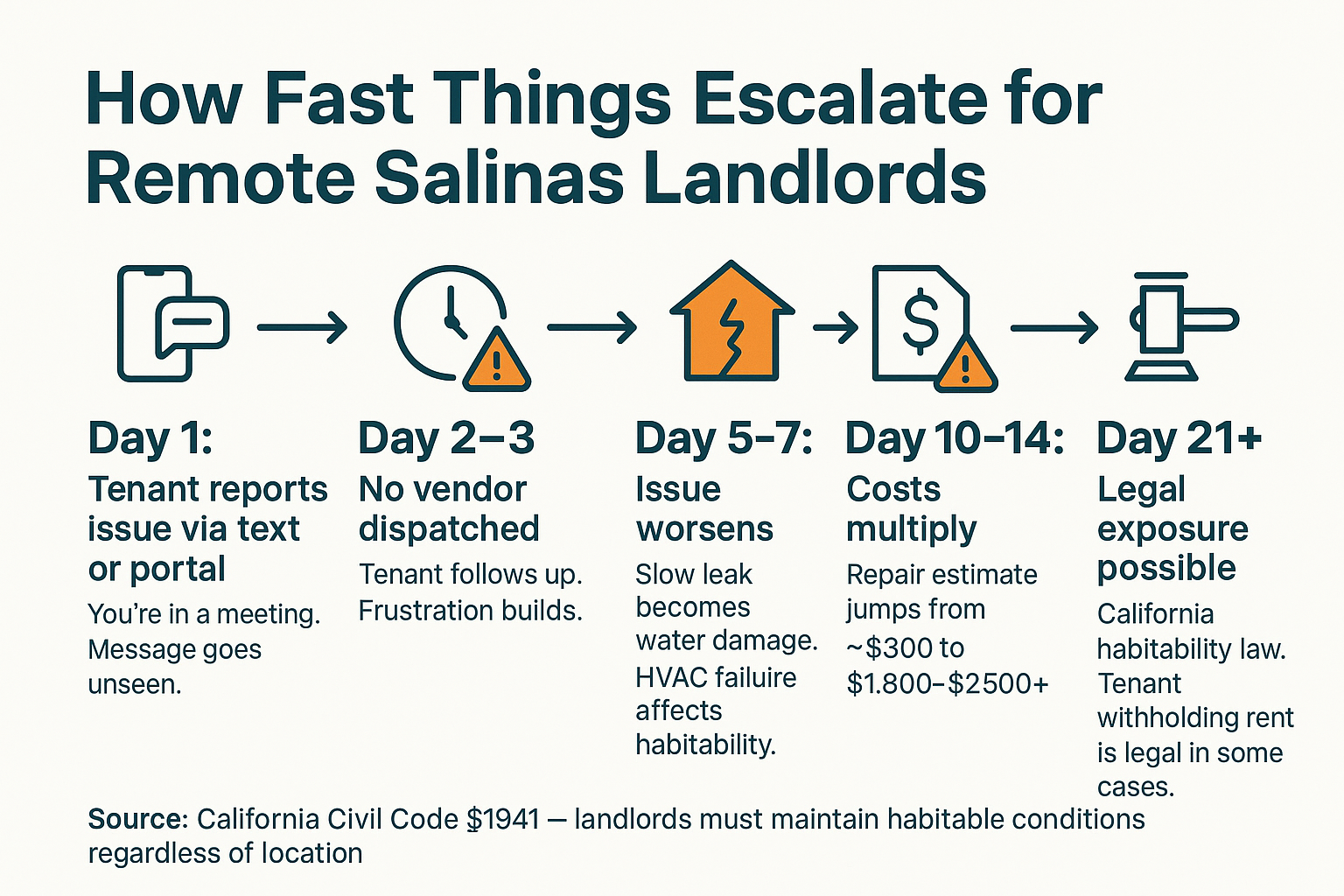
The Tenant Screening Decision You Make Before You Leave
One of the decisions that has the most long-term impact on your experience as a remote landlord is one you make before you're even gone: who you place in the property.
A well-screened tenant in a Salinas rental significantly reduces the number of problems you'll deal with from a distance. A tenant who pays on time, reports issues promptly, and treats the property with basic care changes your workload from reactive to almost passive.
But tenant screening done poorly — or rushed because you wanted the vacancy filled before your move date — tends to follow you for the entire length of that lease.
Here's what a thorough screening process should actually include:
- Full credit report review, not just a score — look at payment history and any prior evictions
- Income verification at a minimum of 2.5–3x the monthly rent (a common threshold in Monterey County)
- Rental history with actual calls to prior landlords, not just references the applicant provides
- Background check through a compliant tenant screening service
In Salinas, where the rental market sees consistent demand from agricultural workers, healthcare employees from Natividad Medical Center, and families relocating from more expensive parts of the Bay Area, there's no shortage of applicants. The temptation to move quickly on a promising-looking application is real — but the cost of a bad placement when you're managing from out of state is much higher than a few extra weeks of vacancy.
For a detailed look at what separates good tenant placement from fast vacancy fills, this piece on how property managers prioritize tenant quality covers the differences clearly.
Frequently Asked Questions About Renting Out a Salinas Home Remotely
Do I have to register my Salinas rental property if I live out of state?
Yes. Salinas's Residential Rental Registration program applies to the property, not to where you live. If you're renting out a home in Salinas, you're expected to register it with the city. The registration requirement doesn't go away because you've relocated.
How much can I charge for a security deposit in California now?
As of July 1, 2024, California limits security deposits to one month's rent for residential properties — regardless of whether the unit is furnished or unfurnished, and regardless of how many units you own. The old two-month rule for furnished units no longer applies.
What happens if a tenant has a maintenance emergency and I can't respond in time?
California Civil Code §1941 requires landlords to maintain habitable conditions. If a serious repair — no heat, no hot water, a significant leak — goes unaddressed for too long, tenants may have legal grounds to withhold rent or arrange repairs themselves and deduct the cost. The threshold is subjective, but courts tend to side with tenants on habitability issues when the landlord is unreachable or slow to act.
Is it legal for me to manage my own rental property from out of state?
Yes, it's legal. There's no California requirement that a landlord live locally or hire a property manager. But the legal obligations — response times, notice requirements, deposit accounting — apply equally whether you're in Salinas or in another state.
If I hire a property manager, what does it actually cost in Salinas?
Management fees for residential properties in the Salinas and Monterey County area typically run 8–12% of monthly rent collected, depending on the company and the scope of services. Some companies charge separately for lease renewals, inspections, or maintenance coordination. On a home renting for $2,800/month, that's roughly $224–$336/month — an amount most landlords recover quickly through fewer vacancy days, better tenant placement, and avoided repair escalations. For more context on whether the cost pencils out, this breakdown of whether property managers actually increase profit is worth reading.
Managing a Salinas Rental From a Distance? Let's Talk.
Our team has worked with Monterey County property owners for over 25 years — including plenty of landlords who inherited a property, relocated for work, or simply reached the point where self-managing from out of state stopped making sense. If you're renting out a Salinas home and want to talk through what professional management would actually look like for your specific situation, we're easy to reach at (831) 582-8916 or through the contact form at torrenteproperties.com.

When Does a Salinas Apartment Actually Need a Property Manager?
Most Salinas landlords don't hire a property manager because they think they can't afford one. Then they spend a year chasing late rent, fielding 11pm maintenance calls, and trying to decode California's AB 1482 rent cap rules — and they recalculate.
The honest answer to when a Salinas apartment needs a property manager isn't a unit count or a dollar figure. It's about what self-managing is actually costing you, and whether that cost is visible or hidden.
This article breaks down the two situations where professional management goes from optional to genuinely necessary — and what the numbers actually look like in Monterey County's rental market.
What Self-Managing a Salinas Apartment Actually Costs You
Most landlords who self-manage think of property management fees as the cost they're avoiding. But that framing leaves out what they're spending instead.
In Salinas, a self-managing landlord typically deals with:
- Tenant screening — credit pulls, rental history calls, employment verification, and cross-checking against eviction databases
- Legal compliance — staying current with California's Tenant Protection Act, AB 1482 rent caps, and Salinas' Residential Rental Registration program
- Maintenance coordination — finding licensed, insured contractors at fair prices, following up on work orders, and being available when something breaks on a Saturday
- Rent collection and accounting — tracking payments, issuing late notices within legal timeframes, and producing records at tax time
- Move-out inspections and deposit accounting — California's security deposit law is strict, and mistakes here lead to small claims court
A landlord managing one four-unit building might spend 10 to 15 hours per month on these tasks during a stable period — and significantly more during a turnover. At any professional's billing rate, that's real money.
And the hidden cost nobody talks about: one bad tenant placement in Salinas can cost $8,000 to $15,000 when you add up lost rent, legal fees, and unit rehabilitation after an eviction. Understanding what Salinas landlords wish they'd known earlier makes clear that most of those expensive lessons involve decisions made at the leasing stage.

The Distance Problem: When Geography Makes Self-Management Impractical
If you own a rental near the Natividad Medical Center corridor or along North Main Street in Salinas and you live more than 30 minutes away, you're already operating at a disadvantage.
California law requires that landlords either live within 25 miles of the rental property or designate a local agent for service of process. That's not optional. And it's just the beginning of what distance complicates.
Here's what remote self-management looks like in practice:
- A tenant reports a water heater failure on a Friday evening. You're in San Jose. You need a licensed plumber in Salinas within a few hours — or you're looking at habitability liability.
- Your unit turns over in October. You need someone to walk the property, document condition, supervise cleaning, and get it relisted before the slower winter rental season costs you a month of vacancy.
- A neighbor reports a noise complaint. The city contacts you. You need to respond and document — fast.
None of this works well from a distance without a local representative. Professional managers in Monterey County typically charge 8% to 10% of monthly rent for ongoing management, plus a leasing fee of roughly one month's rent at placement. On a Salinas two-bedroom renting for $1,800/month, that's about $144 to $180 per month in management fees — a straightforward trade for someone who can't be on-site when problems happen.
For landlords managing from out of state or dealing with a property they inherited, that math is usually obvious. For someone who lives in Monterey or Pacific Grove and thinks they're close enough to handle it themselves, the real test is whether they have the time and the local contractor relationships to respond reliably. Most don't.
Self-Managing vs. Professional Management: A Side-by-Side Look
This comparison covers the most common decision points Salinas landlords face when weighing self-management against hiring a property manager.
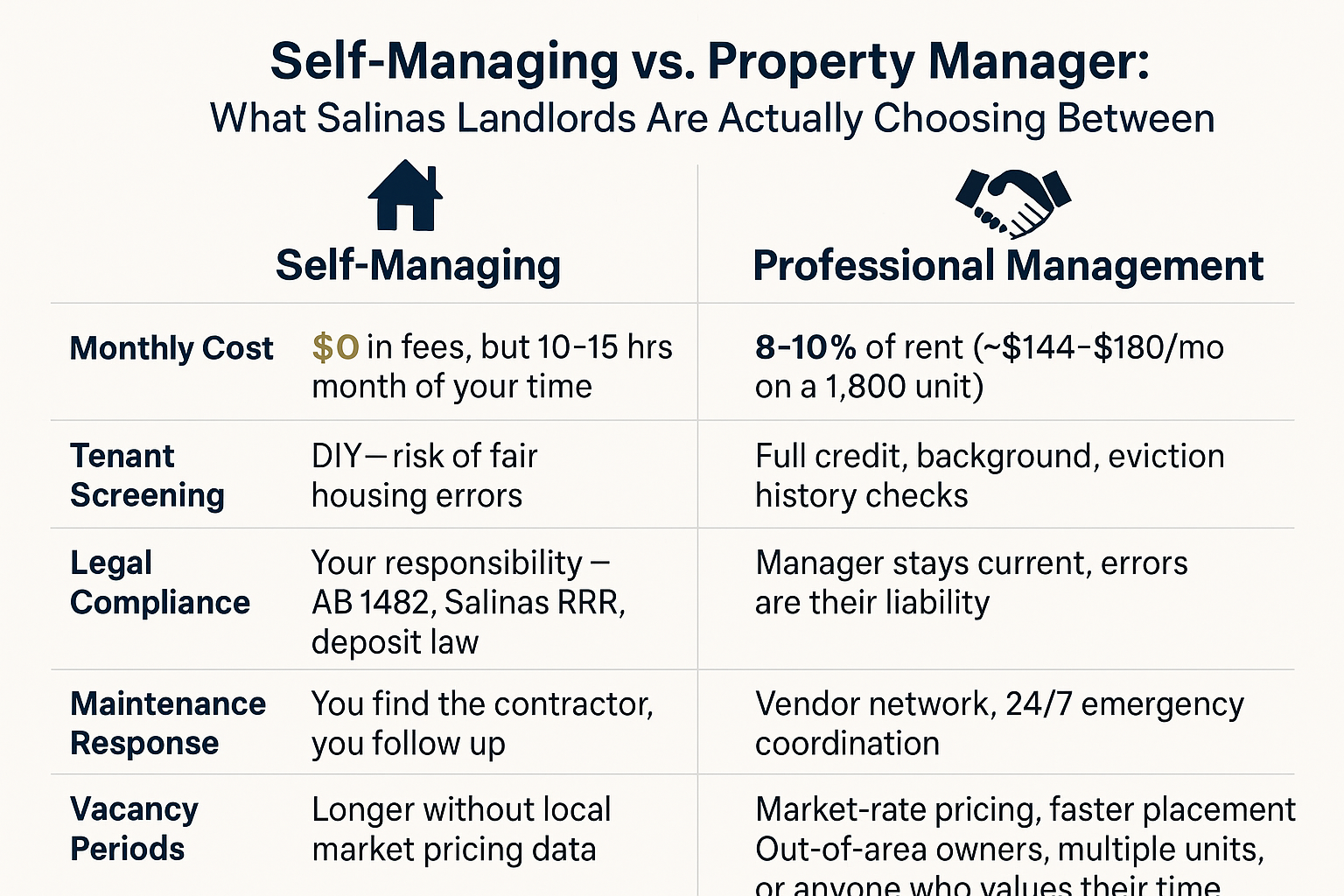
When California Law Starts Requiring More Than Most Landlords Expect
California is one of the most landlord-regulated states in the country, and Salinas adds its own layer on top.
The Salinas Residential Rental Registration (RRR) program requires most rental units to be registered with the city. That's a straightforward compliance step — but it's easy to miss if you're not plugged into local rental housing news. Non-compliance creates exposure you don't want.
Then there's the state-level complexity:
- AB 1482 caps annual rent increases at 5% plus local CPI (or 10%, whichever is lower) for most Salinas apartments built before 2007. Getting this wrong — even by accident — exposes you to tenant legal action.
- California's security deposit law, updated effective July 1, 2024, caps deposits at one month's rent for most residential rentals. Landlords who haven't updated their lease templates are already out of compliance.
- SB 721 requires exterior elevated element inspections (balconies, walkways, stairways) for multifamily buildings with three or more units — with an initial compliance deadline that many Salinas property owners are still catching up on.
None of this is optional, and none of it is intuitive. A property manager who works in Salinas every day stays current on these changes as a matter of course. A self-managing landlord has to actively track legislation, update leases annually, and know when to call an attorney.
For landlords managing apartment properties in Salinas with multiple units, one compliance mistake can affect every tenant in the building simultaneously. The exposure multiplies with unit count.
Salinas Rental Compliance Checklist: What Landlords Are Responsible For
These are the active compliance obligations for residential rental owners in Salinas and under California state law as of 2025. Gaps in any of these areas create legal exposure.
| Requirement | Who It Applies To | Key Deadline / Detail |
|---|---|---|
| Salinas Residential Rental Registration | Most Salinas rental units | Annual registration with the City of Salinas |
| AB 1482 Rent Cap Compliance | Most units built before 2007 | Max increase: 5% + CPI or 10%, whichever is lower |
| Security Deposit Cap (1 month) | Nearly all residential rentals | Effective July 1, 2024 — leases must reflect this |
| SB 721 Balcony Inspection | Buildings with 3+ units | Initial inspection required by state deadline; consult licensed inspector |
| Local Agent Designation | Landlords living 25+ miles from property | Required by California law — must be on file |
| Move-Out Deposit Itemization | All landlords | Must be delivered within 21 days of move-out with receipts |
The Unit Count Question: Does It Actually Matter?
A common rule of thumb says you need a property manager once you hit four or more units. That's a reasonable starting point, but it's not the whole picture.
A landlord with a single four-plex near Sherwood Park in Salinas can absolutely self-manage — if they're local, have solid contractor relationships, and are willing to treat it like a part-time job. Some do it well for years.
But a landlord with one duplex who lives in the Bay Area, works full-time, and has never written a California-compliant lease is more exposed than someone managing eight units who has been doing this for two decades.
The real triggers are:
- Distance from the property — anything over a 30-minute drive makes consistent self-management difficult
- Your availability during business hours — maintenance vendors, city inspectors, and tenant issues don't schedule themselves around your job
- Your familiarity with California tenant law — not knowing the rules isn't a defense when a tenant files a complaint
- Whether a turnover or vacancy would genuinely hurt you financially — if you need that rent to cover a mortgage, an extended vacancy from a slow DIY re-lease is a real risk
Landlords asking whether hiring a property manager in Salinas is actually worth it usually find that the math tips decisively once they factor in their own time and the cost of one bad placement.
Frequently Asked Questions About Salinas Apartment Property Management
How much does a property manager charge for a Salinas apartment?
Most Salinas property managers charge 8% to 10% of monthly rent for ongoing management. On top of that, expect a leasing fee — typically one month's rent — when the manager places a new tenant. On a two-bedroom renting at $1,800/month, ongoing management runs roughly $144 to $180 per month. Some firms charge flat fees instead; compare what's included before focusing on the percentage alone.
Do I legally need a property manager if I live out of state?
Not exactly — but California law requires a local agent for service of process if you live more than 25 miles from your rental property. That local agent can be a property manager, an attorney, or another designee. If you're managing from out of state without one, you're technically non-compliant and could face problems if a legal notice needs to be served.
What is the Salinas Residential Rental Registration program?
Salinas requires most residential rental property owners to register their units with the city through the Residential Rental Registration (RRR) program. It's an annual registration process — not an inspection-based program like Santa Cruz's, but it still requires landlords to stay current. Failure to register can result in fines and complications if you ever need to pursue an eviction through the court system.
Can a property manager help me if I inherited a rental in Salinas?
Yes, and this is one of the most common situations we see. Inherited properties often come with existing tenants, deferred maintenance, and outdated lease agreements. A good local manager can assess the property's current condition, review existing leases for compliance, and get the property operating correctly — often without displacing current tenants. Understanding how some landlords end up owning rentals without planning to is a useful read for families in this situation.
What happens if I get the security deposit wrong under the new California law?
As of July 1, 2024, California limits security deposits to one month's rent for most residential rentals. If you collected more than that under an old lease template, you may need to return the excess. And if you fail to return deposits (minus documented deductions) within 21 days of move-out with proper itemization, tenants can sue for up to twice the deposit amount in small claims court. It's one of the more common — and avoidable — mistakes self-managing landlords make.
Does it make sense to hire a property manager for just one unit?
It depends on your situation more than the unit count. If you live far away, work full-time, or simply don't want to deal with the legal and logistical demands of being a landlord, professional management makes sense for a single unit. The management fee on one unit is real money, but so is the time you'd spend — and the exposure you'd carry — managing it yourself without deep knowledge of California rental law.
Not Sure Where You Stand? Let's Talk Through It.
If you own a rental in Salinas, Monterey, or anywhere in Monterey County and you're trying to figure out whether self-managing still makes sense, Torrente Property Management is glad to have that conversation with you — no pressure, just a clear-eyed look at your situation. Reach us at (831) 582-8916 or through the contact form at torrenteproperties.com.