
What Property Management Really Costs in Salinas
The first question almost every Salinas landlord asks me is: what's your monthly fee? The second question, usually in the same breath, is: what else are you going to charge me on top of that? I don't blame anyone for asking both at once. Fee stacking is real, and the property management industry has not done a great job of making its pricing easy to read.
What I want to do here is walk through each line item in a typical property management fee structure, not to pitch any particular company, but so you actually know what you're looking at when you compare options. Salinas has its own market dynamics and its own compliance layer that affects what professional management is really worth, and I think that context matters before any owner signs anything.
If you've been self-managing and are now running the numbers on handing things off, this is the breakdown I'd want you to have before that conversation.
The Monthly Management Fee: What the Percentage Actually Means
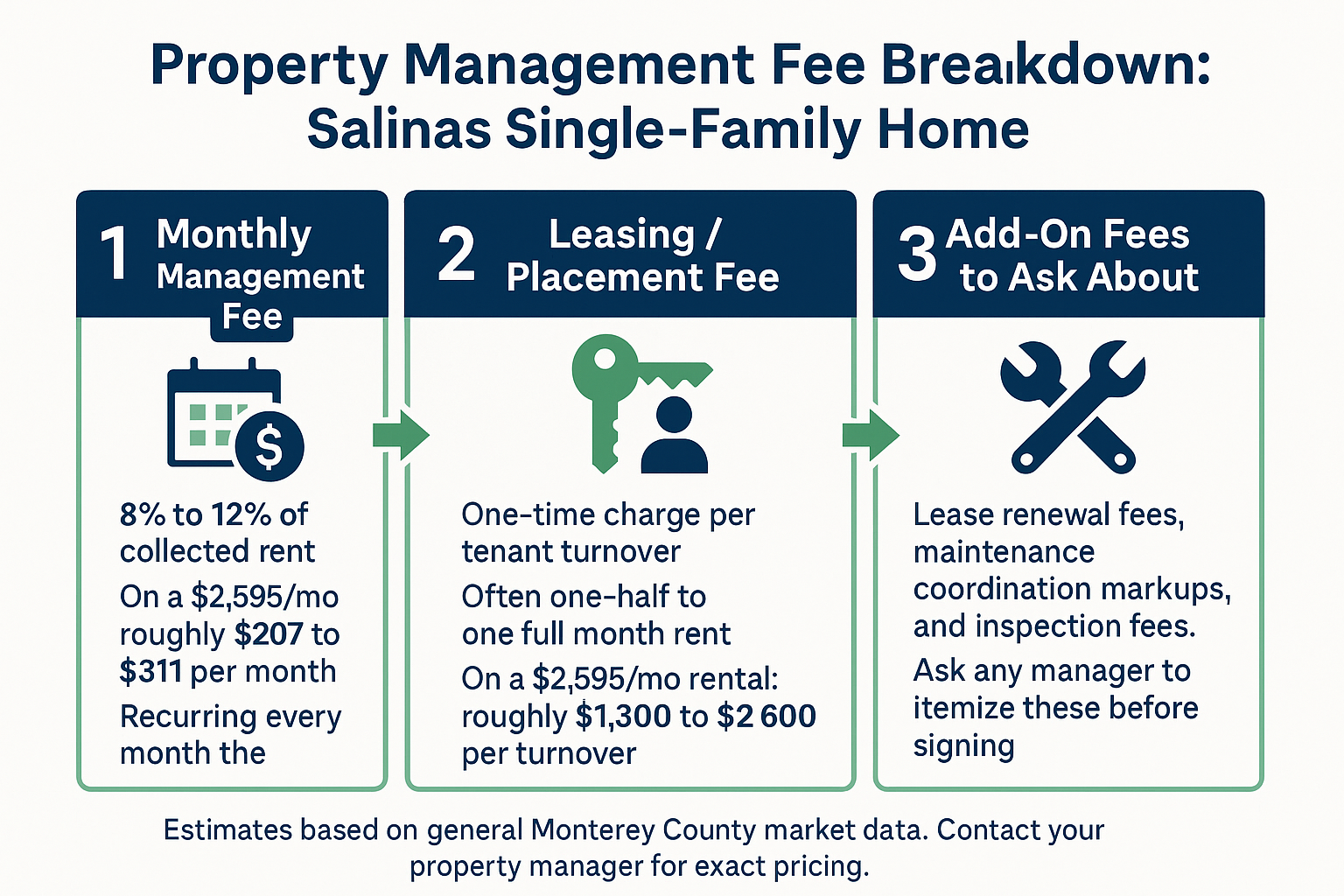
The monthly management fee is the number most owners focus on, and it's usually expressed as a percentage of collected rent. In the Salinas and broader Monterey County market, that percentage generally falls somewhere in the 8% to 12% range, though it can vary based on the type of property, the number of units, and how much hands-on coordination the manager actually provides.
Here's where the math gets more concrete. Based on current market data, average rents for a single-family home in Salinas run around $2,595 per month. At 8%, the monthly management fee on that property comes out to roughly $207. At 10%, it's about $260. At 12%, you're around $311. The spread between the low end and high end is real, but it's less than $100 a month on a typical Salinas home, not the dramatic difference it can feel like on paper.
I've spoken with plenty of owners who anchor on that spread and treat the lower percentage as the smarter financial choice. What that calculation usually misses is everything that does, or doesn't, happen for that fee. A manager charging 8% who doesn't track lease expirations, misses a habitability issue, or lets a unit sit vacant for six extra weeks costs more than a manager charging 10% who stays on top of all three. The monthly fee is just the starting point.
The Leasing Fee: The Charge Most Owners Forget to Ask About
The monthly management fee is recurring, but the leasing or tenant placement fee is a one-time charge that hits every time a unit turns over. This is the fee that covers advertising the property, conducting showings, screening applicants, and getting a qualified tenant under lease. In the Monterey County market, this fee is often structured as one-half to one full month's rent, though the exact amount varies by company and scope of service.
On a Salinas property renting at $2,595, that means the leasing fee could fall anywhere from roughly $1,300 to $2,600 per turnover. If your tenant stays for three years, that fee gets spread across 36 months and feels almost invisible. If you cycle through tenants every 12 months, it becomes a meaningful annual expense.
This is why what a real tenant screening process looks like matters as much as the placement fee itself. A manager who places a well-screened tenant who stays for two or three years is saving you money in a way that a cheaper placement service almost never accounts for. Turnover is one of the highest costs in rental property ownership, and it rarely shows up as a line item.
Some owners call us asking whether they can hire just tenant placement without ongoing management, and yes, that option exists in the market. But before going that route, it's worth thinking through what happens after the tenant moves in. Who handles a maintenance call at 10pm? Who notices that the lease renewal deadline is approaching? Who fields the habitability complaint? The placement fee saves money up front; the gap in oversight often closes that gap and then some.
How Property Management Fees Stack Up on a Typical Salinas Rental
This breakdown shows the three main fee categories a Salinas landlord should expect, based on a single-family home renting at approximately $2,595 per month.
Add-On Fees: The Line Items Worth Asking About Directly
Beyond the monthly percentage and the leasing fee, some management agreements include additional charges. These are not automatically red flags, some of them reflect real work, but you should know to ask about them before you sign.
Common add-ons in this market include:
- Lease renewal fees, a flat charge (sometimes one-half month's rent or a fixed dollar amount) each time an existing tenant renews
- Maintenance coordination markups, a percentage added to vendor invoices when the manager coordinates repairs on your behalf
- Routine inspection fees, charged for scheduled property walkthroughs beyond move-in and move-out
- Setup or onboarding fees, a one-time charge when you first bring a property under management
None of these are hidden if the management agreement discloses them clearly. The problem is that owners who focus only on the monthly percentage don't always read far enough down to find them. Ask any manager you're evaluating to walk you through their full agreement line by line, and ask specifically whether they add a markup to vendor invoices. The answers will tell you a lot about how they operate.
If you're coming from self-managing and want to understand what a full handoff actually looks like, this breakdown of handing off a rental you've been managing yourself is a good place to start.
Salinas Property Management Fee Comparison at a Glance
These are estimated ranges based on general Monterey County market context for a single-family home at approximately $2,595 per month. Actual fees vary by company, always get a written breakdown before committing.
| Fee Type | Typical Structure | Estimated Range (at $2,595/mo rent) |
|---|---|---|
| Monthly Management Fee | Percentage of collected rent | $207 - $311/month (8% - 12%) |
| Leasing / Placement Fee | One-time per tenant turnover | $1,300 - $2,600 per turnover |
| Lease Renewal Fee | Flat fee or percentage | Varies, ask upfront |
| Maintenance Coordination Markup | Percentage added to vendor invoice | Varies by company, 10% - 15% common |
| Setup / Onboarding Fee | One-time flat fee | Varies, not all companies charge this |
The Salinas Compliance Layer That Changes the Math
There's a cost angle specific to Salinas that most fee comparisons completely ignore: the city's Residential Rental Registration program. Salinas requires landlords to register rental units and pay annual fees. Owners who miss registration deadlines or fail to keep their documentation current can face fines.
A professional manager who tracks these deadlines as routine business is, in practice, saving you money every year, not adding to the bill. The cost of one missed registration cycle, one compliance notice, or one habitability complaint that turns into a formal complaint with the city can easily run well past what you'd pay in management fees for several months.
For a detailed look at what the registration program actually requires, this guide to the Salinas rental registration program breaks it down. And the compliance picture doesn't stop at registration. California's security deposit cap, effective July 1, 2024, limits deposits to one month's rent for unfurnished units. An owner who collects a larger deposit without knowing the law can face a claim that erases any fee savings in a single dispute.
I'm not raising these issues to alarm anyone. I raise them because "affordable" means something different when you account for what self-managing actually exposes you to. A $65 per month difference in management fees is noise compared to a $3,000 to $5,000 legal bill from one avoidable eviction or deposit dispute. That's not a hypothetical, it's the range we hear about regularly from owners who call after something has already gone sideways.
What Your Rent Rate Has to Do With Your Fee Cost
One thing owners almost always ask alongside the fee question is: what will my property actually rent for? The two questions are more connected than they might seem.
Pricing a Salinas rental incorrectly, even by $150 to $200 per month, has real consequences. Underprice it and you leave $1,800 to $2,400 per year on the table. Overprice it and you sit vacant while the market passes you by, losing more in empty weeks than you'd ever save in management fees.
An accurate market rent analysis is not a bonus feature, it's one of the first things a good manager does, and it offsets a meaningful portion of the monthly fee before month one is even over. How Monterey Bay rental prices actually get set explains the pricing process in detail, including why owners who rely on Zillow estimates or neighbor comparisons often end up on the wrong side of the number.
If you're an out-of-area owner or a first-time landlord trying to figure out whether the rent math works at all, that article is worth reading before you finalize anything. And if you want to understand the broader picture of what remote ownership actually looks like day-to-day, managing a Monterey Bay rental from out of the area covers the real logistics.
Frequently Asked Questions About Property Management Costs in Salinas
Can I hire a property manager just to place a tenant and skip the ongoing management?
Yes, tenant placement-only services exist in this market. You pay the leasing fee, the manager finds and screens a tenant, and then you take over. The tradeoff is that you're responsible for everything that happens after move-in, maintenance, rent collection, lease renewals, compliance, and any issues that come up at midnight. For owners who are experienced, local, and hands-on, that can work. For owners who are out of the area or new to landlording in California, the gap in ongoing oversight tends to create costs that outrun the savings pretty quickly.
What's the real cost difference between a 7% and 10% monthly management fee in Salinas?
On a home renting around $2,595 per month, the difference between 7% and 10% is roughly $65 to $75 per month. Over a full year, that's less than $900. One avoidable eviction, one missed habitability complaint, or one security deposit dispute can cost $3,000 to $5,000 or more in legal fees and lost rent. The monthly percentage is worth comparing, but it shouldn't be the only number you're looking at.
Does the Salinas rental registration fee come out of my pocket or does the property manager handle it?
The registration fee is the owner's legal obligation, so the cost itself comes from you either way. What a property manager handles is the tracking, filing, and deadline management, so you don't miss a renewal cycle and end up with a compliance fine on top of the registration fee. Owners who self-manage and aren't aware of the program's requirements sometimes find out about missed deadlines the hard way.
Are maintenance costs separate from the management fee?
Yes. The management fee covers oversight and coordination, not the cost of the repairs themselves. Vendor invoices for plumbing, electrical, HVAC, and other maintenance are typically billed directly to the owner. Some management agreements also include a coordination markup, a percentage added to vendor invoices for arranging and overseeing the work. Ask any manager you're evaluating whether they charge a markup and what the percentage is.
How do I know if the management fee I'm being quoted is fair for Salinas?
Ask for the full written agreement, not just the headline percentage. The monthly fee, leasing fee, renewal fee, maintenance markup, and any setup charges should all be in writing before you sign. Then compare the total annual cost across a realistic scenario, one tenant turnover per lease period, not just the monthly number. A manager with a slightly higher monthly rate but lower leasing fees and no markups may cost you less over a full year than the one with the lowest advertised percentage.
Want a Straight Answer on What Management Would Cost for Your Property?
If you own a rental in Salinas, Monterey, Seaside, or anywhere across Monterey County and want to know what management actually costs for your specific property, not a range, but a real number, our team is happy to walk through it with you. We've been managing residential properties across this market for over 25 years, and we give straightforward answers. Reach us at (831) 582-8916 or through the contact form at torrenteproperties.com.


Renting Out Your Monterey Bay Home From a Distance: What Really Works
The anxiety is real, and it makes sense. You have a home in Monterey Bay, maybe a townhouse near the Presidio, a condo in Marina, a house in East Garrison, and you are about to leave. You are not sure whether to rent it or sell it, and if you do rent it, you have no idea what that actually looks like once you are in another state.
I work with owners in this exact situation on a regular basis. Some are military families leaving Naval Postgraduate School. Some are relocating for work and cannot sell at a price that makes financial sense in this rate environment. Some inherited a property and are trying to figure out what to do with it from three time zones away. What they all have in common is that they are not passive investors, they are people making a high-stakes decision under time pressure.
This article walks through the three things that actually determine whether remote rental ownership works: getting the property ready before you leave, finding and placing the right tenant, and sustaining everything from a distance after you go. Most owners focus on the first and forget about the other two until something goes wrong.
Phase One: Getting the Property Ready Before You Leave
This is the phase most owners understand, at least in concept. The property needs to be clean, functional, and competitive with what else is available in the local market. But what that actually requires is more specific than most people expect.
The Monterey Bay rental market is not forgiving of deferred maintenance. Tenants in Salinas, Seaside, and Marina have options, and a property with a water-stained ceiling, a temperamental water heater, or a front yard that needs attention will sit vacant longer than a well-prepped one. Vacancy in this market costs real money, even a few extra weeks without rent adds up fast.
The prep work that actually moves the needle tends to fall into a few categories:
- Fresh interior paint in neutral tones (this is the single highest-return prep task in almost every rental I have seen)
- Functional appliances, California law now requires a working stove and refrigerator in residential rentals, so this is not optional
- Clean carpets or finished floors, with no visible damage
- Smoke and carbon monoxide detectors installed in required locations per California code
- Landscaping cleaned up and exterior pressure-washed if needed
- Any deferred maintenance addressed before listing, not after a tenant complains
If you are still nearby when this work happens, you can oversee it yourself. But if you are already gone, you need someone on the ground to coordinate vendors, verify the work was done right, and do a pre-listing walkthrough. Getting a Monterey Bay rental ready involves more moving parts than most first-time landlords anticipate, and those parts do not coordinate themselves.

Phase Two: The Leasing Window, The Part Owners Underestimate Most
This is the phase I see catch people off guard more than any other. Owners spend time thinking about rent-ready prep and then assume the tenant placement piece is mostly paperwork. It is not.
Placing a qualified tenant requires someone physically present in the market. Showings have to happen in person. Move-in inspections have to be documented with photos. Lease signing and key handoff require coordination. If you are in Texas or Washington state when all of this is happening, none of it works without a local representative who can move quickly.
Setting the right rent price is also something that goes wrong more often than it should. Owners sometimes anchor to a number they read online, or what a neighbor got two years ago, or what they feel the property is worth emotionally. The actual market rental rate in Seaside is different from Pacific Grove, which is different from Salinas, and the rate shifts seasonally. Pricing too high extends your vacancy. Pricing too low leaves money on the table permanently, because that lease sets your baseline for the year.
One owner who reached out to us was preparing to leave East Garrison and had not yet decided whether to rent or sell. He needed a realistic rent estimate before he could make that call. That is exactly the right question to ask first, and it requires someone with current, local market data, not a Zillow estimate. How Monterey Bay rental prices actually get set explains what goes into that analysis and why owners who guess tend to guess wrong.
Tenant screening during this window is also where mistakes get made that owners live with for a year or more. A thorough screening process covers:
- Full credit report review
- Nationwide criminal background check
- Eviction history search
- Income and employment verification (standard benchmark is gross income at 2.5 to 3 times monthly rent)
- Rental history and prior landlord references
What a real tenant screening process looks like goes deeper on each of these steps, and why cutting corners on any one of them tends to cost more than it saves.
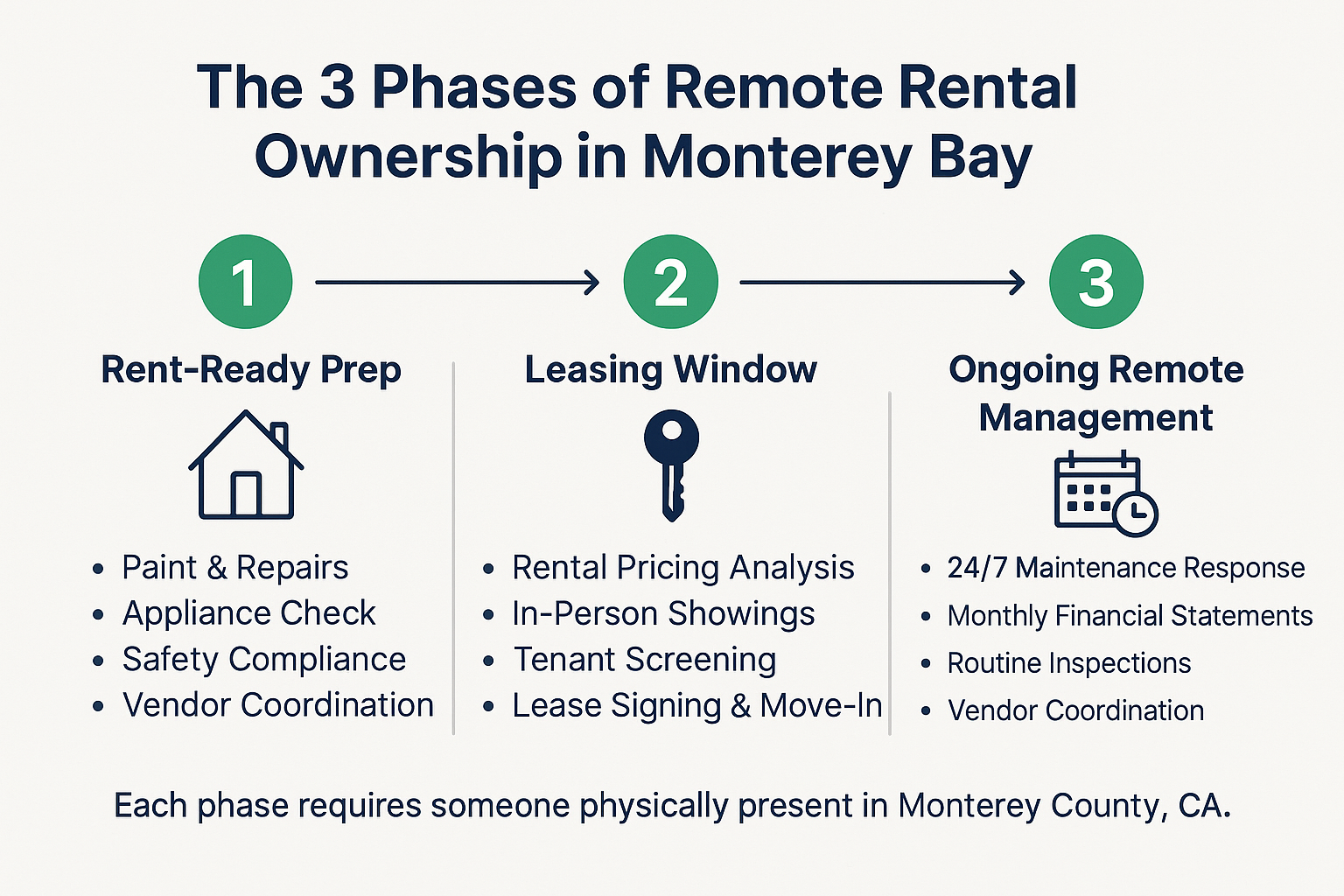
The Three Phases of Remote Rental Ownership
Most out-of-area owners think about rental management as one continuous job. In practice, it breaks into three distinct phases, each with its own requirements and failure points.
Phase Three: Maintenance From a Distance, Where Remote Ownership Most Often Breaks Down
Once a tenant is in place and you are a few hundred or a few thousand miles away, the day-to-day reality of ownership shows up fast. And the place it shows up most painfully is maintenance.
The Monterey Bay contractor market is tight. Good licensed plumbers, electricians, and HVAC techs stay booked. During summer, trades are stretched. After significant rainfall, and we see real water intrusion events across Seaside, Marina, and the Salinas Valley every wet season, emergency service calls spike across the whole peninsula simultaneously. An owner trying to find a licensed plumber on a Sunday from Houston is solving a fundamentally different problem than a local manager who already has standing relationships with trusted vendors and can get someone out the same day.
This is not a small distinction. A slow response to a water leak can turn a $400 repair into a $4,000 remediation. The California Department of Consumer Affairs notes that unlicensed contractor work creates real liability exposure for property owners, which means it matters not just who responds, but who they are.
Beyond emergencies, routine maintenance coordination requires local knowledge:
- Knowing which vendors are reliable and which overpromise
- Following up to confirm work was actually completed and done correctly
- Documenting repairs in a way that protects you legally if a dispute arises
- Flagging small issues during inspections before they become expensive
For owners with vacant properties, second homes, or properties between tenants, what can go wrong in an empty house is a genuinely important read, because vacancy risk is different from occupied-property risk and often gets no attention until there is a problem.
Financial Reporting: What Out-of-Area Owners Actually Need
Rent hitting your bank account is not the same as understanding your investment. I hear from out-of-area owners regularly who have been receiving monthly deposits for years and have no idea what their actual net income is after maintenance, vacancy, and fees.
What a proper owner reporting setup looks like in practice:
- Monthly statements that break out gross rent collected, management fees, individual maintenance expenses with descriptions, and any other disbursements
- Year-end summaries in a format that makes tax filing straightforward, owners should not be reconstructing the year from bank statements
- Income projections before a property is listed, so the owner can evaluate whether renting makes financial sense compared to selling
- Owner portal access so you can pull documents, review payment history, and check on maintenance requests without making a phone call
Several owners who contacted us before they had even listed their property specifically asked for income forecasts and year-end summaries. That is a smart question. Knowing what the property will realistically generate, after all costs, is the foundation of any good decision about whether to rent, how long to hold, or when to reinvest in improvements.
For a plain-language breakdown of what professional management actually costs and what that gets you, what property management costs in the Monterey Bay area lays it out clearly.
And if you have been managing on your own and are considering the transition, how to hand off a rental you have been managing yourself walks through what that process actually looks like.
Remote Ownership: What You Can Handle Yourself vs. What Requires a Local Presence
This is not an exhaustive list, but it reflects the division most out-of-area owners run into when they try to self-manage from a distance.
| Task | Manageable Remotely? | Why It Matters Locally |
|---|---|---|
| Rent collection and payment tracking | Yes, with an online portal | Automated systems handle the mechanics, late fee rules vary by California law |
| Setting the right rental price | Rarely | Monterey Bay submarkets shift; Salinas and Pacific Grove are not the same market |
| Conducting in-person showings | No | Tenants expect to walk the property; virtual-only tours reduce applicant quality |
| Tenant screening and lease execution | Partially | Credit checks can run online; lease signing and move-in inspection require physical presence |
| Emergency maintenance response | No | Contractor relationships and same-day response require a local network |
| Routine property inspections | No | Photo-documented walkthrough reports require someone on the ground |
| Year-end financial summaries | Yes | Can be delivered digitally, quality depends on how well monthly records were kept |
| Coordinating repairs after storm damage | No | Monterey County weather events (especially El Nino winters) require fast local response |
A Note on the Reluctant Landlord
There is a specific type of owner I want to speak to directly, because I see this situation more and more. You bought your home when rates were lower. Selling now does not make financial sense. So you are renting instead, not because you set out to be a landlord, but because the math left you with no better option.
This is different from investing. You have a relationship with that property. You may plan to come back to it someday. The thought of a stranger living there, and something going wrong, is not abstract anxiety, it is a reasonable concern based on what you know can happen.
What I would tell you is this: professional management is not just a transaction service. It is a way to protect your relationship with a property you care about. Regular inspections, documented condition reports, responsive maintenance, and careful tenant placement all add up to a property that comes back to you in the same shape you left it, or better.
For owners in that position, when self-managing your rental stops making sense addresses the decision honestly, without pushing you toward any particular answer.
Frequently Asked Questions About Managing a Monterey Bay Rental Remotely
How do I know what my Monterey Bay property will actually rent for before I leave?
A reliable rental price estimate comes from current, local comparable data, active listings in your specific neighborhood, recent lease comps, and seasonal demand patterns. Online estimates like Zillow's Rent Zestimate can be a starting point but are often off by $200 or more in submarkets like East Garrison, the Dunes in Marina, or central Salinas. A local property manager who is actively leasing in your area can give you a realistic range and explain what prep work, if any, would move that number up.
Can I manage a Monterey Bay rental myself from out of state?
Technically yes, some parts of it. Rent collection, owner accounting, and document storage can all be handled digitally. But showings, move-in inspections, emergency maintenance response, and routine property inspections require a physical presence. Most remote self-managers hit a wall the first time there is a maintenance emergency or a tenant dispute, and that is usually when they call us.
What happens to my property between tenants if I'm not local?
Vacancy is one of the riskier periods for a property. Without regular inspections, small problems, a slow leak, a pest entry point, storm damage, can go unnoticed for weeks. If you are out of the area, you need someone making regular, documented visits to the property during any vacancy. Our Seasonal Property Maintenance Program handles this with quarterly exterior and interior checks and photo-documented reports sent directly to the owner.
Is there a California law that affects my security deposit as a landlord?
Yes. As of July 1, 2024, California limits security deposits to one month's rent for most residential rentals, down from two months for unfurnished units. This is now the law statewide regardless of city. It affects how much protection you have upfront if a tenant causes damage, which makes thorough move-in documentation and careful screening even more important.
What does a monthly owner statement actually tell me?
A well-prepared monthly statement breaks out your gross rent collected, the management fee deducted, every maintenance expense with a description of what the work was, any other fees or payments made on your behalf, and your net owner disbursement for the month. It should be clear enough that you can hand it to your accountant at year-end without any additional explanation. If your current reporting is just a deposit confirmation, that is not enough information to evaluate your investment.
I'm a military homeowner with PCS orders, what should I do with my Monterey Bay property?
This situation comes up often in the Monterey area given the Naval Postgraduate School and other installations. The Servicemembers Civil Relief Act has provisions that may affect your lease obligations as a departing tenant, but as a property owner, your main priorities are pricing the property correctly, placing a vetted tenant before you leave, and having a local manager in place who can handle everything from maintenance to lease renewals while you are at your next duty station. PCS orders and your Monterey Bay home covers this situation in more detail.
Ready to Talk Through Your Situation Before You Leave?
If you are preparing to move out of the Monterey Bay area and are not sure whether renting makes sense, what your property would realistically bring, or what professional management actually involves, we are happy to walk through it with you, no pressure, just a real conversation. Our team serves owners across Monterey, Salinas, Pacific Grove, Seaside, Marina, and Carmel, and we know this market well enough to give you honest answers. Reach us at (831) 582-8916 or through the contact form at torrenteproperties.com.

How to Hand Off a Rental You Have Been Managing Yourself
Most landlords who reach out to us have already been managing on their own for one to three years. They handled the lease themselves, collected rent by check or Venmo, texted with the tenant when something broke, and assumed it would stay manageable. Then something shifted, a maintenance issue they couldn't coordinate from a distance, a tenant situation that got uncomfortable, or just the slow accumulation of small decisions that never stop coming.
The question I hear most often is not whether to make the switch. It's how. Owners in Salinas, Seaside, Marina, and across Monterey County want to know what actually needs to happen before a property manager can step in, especially when there's already a tenant in place.
This guide walks through that process in plain terms. No guesswork, no vague advice. Just the real steps, in order.
Step 1: Gather Your Documentation Before Anyone Shows Up
The first thing a property manager needs is a clear picture of what they're walking into. Before any agreement is signed or any tenant is contacted, you'll want to pull together:
- The current lease, the full signed document, including any addenda or side agreements
- Tenant contact information, phone number, email, and emergency contact if you have it
- Rent payment history, ideally a written record, even if it's a simple spreadsheet of dates and amounts
- Security deposit records, the amount collected, where it's held, and what bank account or trust account it sits in
- Any open maintenance issues, things the tenant has mentioned or that you know need attention
If you've been collecting rent informally, cash, peer-to-peer payment apps, or handshake arrangements, that's worth being upfront about. It doesn't disqualify you from making the switch, but it means there are a few extra steps to establish a clean baseline before management begins.
Owners who have clear records from the start tend to have much smoother transitions. The documentation gap is almost always what slows things down, not the tenant, not the property itself.
Step 2: Understand What California Law Requires When Management Changes
This step surprises a lot of self-managing landlords. When you bring on a property manager in California, it's not just a handshake agreement between you and the management company. There are legal requirements that protect the tenant too.
Under California law, two things have to happen:
- The tenant must be notified in writing of the change in management and the name and contact information of the new entity they should pay rent to
- The security deposit must be transferred to the incoming property manager, either placed in their trust account or formally documented as held by the owner on their behalf
The California Department of Consumer Affairs landlord/tenant guide outlines these obligations clearly. Skipping either step creates legal exposure, and it also sets a bad tone with a tenant who may already be uncertain about the change.
For properties in Salinas, there's an additional layer: if your property is registered under the Salinas Residential Rental Registration program, the registration should reflect current ownership and management contact information. An experienced local manager will know to check that.
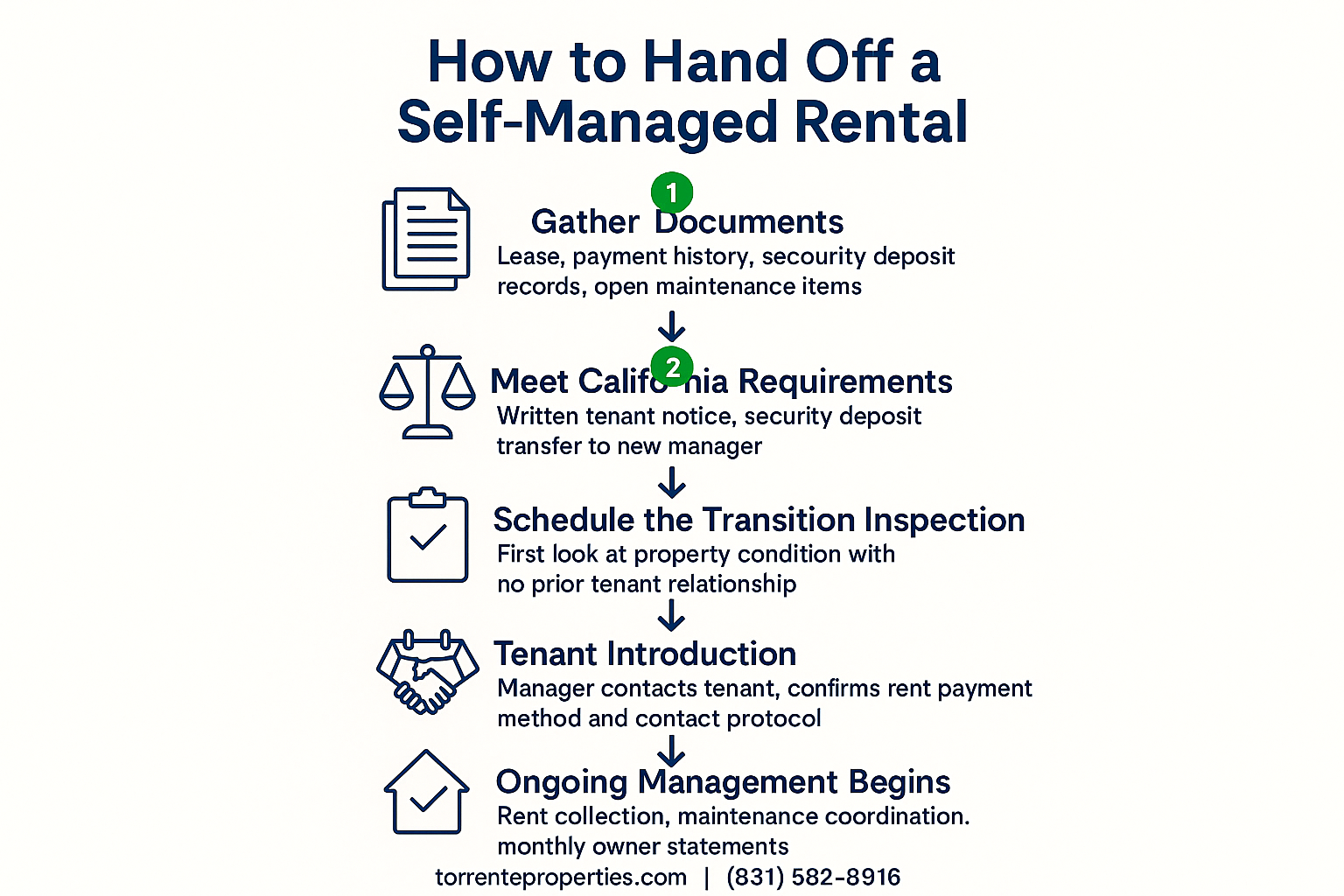
The Self-Management Handoff at a Glance
Here's a quick look at the full transition sequence from self-managing landlord to professionally managed rental.

Step 3: The Transition Inspection, Expect to Learn Something
One of the most valuable parts of the handoff is also the one owners least expect: the property inspection.
When a manager who has no prior relationship with your tenant walks through the property, they often surface issues that have been quietly sitting there. Tenants who communicate directly with an owner they know personally sometimes avoid mentioning small problems, a slow drain, a window that sticks, a water stain on the ceiling, because they don't want to cause friction or seem demanding.
A property manager asking those same questions in a routine, professional inspection gets different answers. And a fresh set of eyes catches things that neither party mentioned.
For owners in Salinas, Seaside, or Marina who live out of the area, that inspection is often the first current, objective look at their property's condition in months, sometimes longer. What they find is rarely catastrophic, but deferred maintenance has a way of compounding quietly. Catching it early is almost always less expensive than catching it late.
This is also a good moment to review what actually needs to happen to get a Monterey Bay rental in shape, even for a property that already has a tenant in place.
Step 4: What Happens to the Existing Tenant
This is the part that makes a lot of self-managing landlords nervous: they've built a real relationship with their tenant, and they don't want the transition to damage that.
The good news is that the tenant doesn't have to move, doesn't get re-screened, and doesn't lose any of their existing rights. Here's how it typically works:
- The current lease stays in place until its natural expiration or renewal date
- The property manager reaches out to introduce themselves and confirms the new process for rent payments and maintenance requests
- The tenant benefits from having a clear, professional point of contact, someone they can reach 24/7 for emergencies instead of texting a landlord at midnight
The lease review is where things get more nuanced. Even a lease from 2024 may be missing required disclosures tied to changes in California law that took effect in 2025 or 2026. Those gaps don't have to be fixed mid-tenancy, but they do need to be corrected at renewal. If you want to understand what your rental lease may be missing under current California law, that's worth reading before the next renewal comes up.
For owners who have been managing remotely, the handoff also means they stop being the person a tenant calls when the heater goes out at 10 p.m. That shift alone is significant.
Self-Management vs. Professional Management: What Changes at Handoff
Here's a side-by-side look at what shifts when a self-managing landlord transitions to professional management, and what stays the same.
| Area | Self-Managing | After Handoff |
|---|---|---|
| Rent Collection | Owner collects directly, check, app, or cash | Manager collects through owner/tenant portal, deposits to owner |
| Maintenance Calls | Tenant calls or texts owner directly | Tenant contacts manager; 24/7 emergency line in place |
| Lease Compliance | Owner's responsibility to track law changes | Manager reviews lease at renewal, flags required updates |
| Security Deposit | Held by owner, often in personal account | Transferred to manager's trust account per California law |
| Property Inspections | Varies, often infrequent or owner-initiated | Scheduled move-in/move-out and routine inspections with photo records |
| Financial Reporting | Owner tracks manually | Monthly owner statements generated through management portal |
| Existing Tenant | No change in tenancy | No change in tenancy, lease stays, tenant is notified of new contact |
The Part Nobody Talks About: What the Transition Actually Feels Like
I've watched a lot of owners go through this process. The practical steps are manageable. What catches people off guard is how much mental weight they'd been carrying without fully realizing it.
Handling late-night maintenance calls, fielding tenant concerns directly, tracking rent payments manually, and staying current on California rental law changes, none of those tasks feel enormous on their own. But they accumulate. And for owners who are 50 or older, managing from out of the area, or dealing with an inherited property they never planned to have, that weight can quietly become exhausting.
One of our long-term clients who owns several properties in Salinas described it well: their review mentioned that 'everything runs smoothly', which sounds simple, but for someone who spent years troubleshooting on their own, smooth is everything. And one owner specifically shared this about working with our team: 'Ashley has been very thorough with taking care of multiple rental properties in Salinas. It's refreshing knowing we have that piece of mind...', Hilda M.
That word, refreshing, comes up a lot. Not because management is magic, but because having a consistent, local, professional team carrying those daily decisions is a genuinely different experience than carrying them yourself.
If you're wondering whether you've reached that point, this breakdown of when self-managing stops making sense is worth a few minutes of your time.
Frequently Asked Questions About Switching From Self-Management
Do I have to wait until my tenant moves out to make the switch?
No. The transition can happen with a tenant in place. The lease stays active, and the tenant is simply notified in writing that a new management company is handling things going forward. The handoff timing is a conversation between you and the property manager, it doesn't require a vacancy.
What if I've been collecting rent informally and don't have good records?
That's more common than people expect, and it's not a dealbreaker. It does mean there are a few extra steps to establish a clean starting point, confirming the deposit amount, documenting what's been paid, and getting the tenant's information on file properly. A property manager can walk you through exactly what's needed. The goal is a clean baseline before ongoing management begins.
What happens to my security deposit when I bring on a manager?
Under California law, the security deposit needs to be transferred to the incoming manager, typically placed in their trust account. The tenant must also be notified in writing of where their deposit is being held. This is a required step, not optional, and a licensed property manager will handle the documentation for you.
Will the property manager raise my tenant's rent right away?
Not automatically. Rent adjustments are something you discuss with your manager, and they're subject to California's rent increase rules, including AB 1482 protections that cap annual increases for many properties at 5% plus local CPI, or 10% total, whichever is lower. If you want to understand how rent changes work in 2026, this guide for Monterey Bay landlords covers it.
How much does professional property management cost in Monterey County?
Management fees vary depending on property type, location, and the scope of services. Generally speaking, monthly management fees for residential properties in Monterey County tend to fall somewhere in the range of 8% to 12% of collected rent, though that varies. There are often separate fees for leasing, inspections, and other services. For a specific quote based on your property, this breakdown of what property management costs in the Monterey Bay area is a good starting point.
What if my lease has outdated language or is missing required disclosures?
California rental law changes regularly, and leases from even a year or two ago may be missing required disclosures. The property manager will review the lease during the transition and flag anything that needs to be corrected at renewal. Mid-tenancy changes require tenant agreement, so most corrections happen at the renewal stage, not immediately.
Ready to Hand Off the Day-to-Day?
If you've been managing your own rental in Monterey County and you're ready to understand what a transition actually looks like for your specific situation, we're glad to walk through it with you. Whether you have a tenant in place, a property that needs some attention first, or just a lot of questions, our team is here to give you a straight answer. Reach us at (831) 582-8916 or through the contact form at torrenteproperties.com.

Renting Your Home Furnished in the Monterey Bay Area: What Landlords Should Know
Over the past several months, I've fielded the same question from multiple owners across Monterey Bay: does renting furnished actually pay off? One owner in Marina was preparing to leave in two to three months and wanted to rent a furnished studio. Another was targeting Naval Postgraduate School students in Monterey. A third had a fully remodeled condo and wanted to know whether adding furniture would justify a higher rent.
The honest answer is that it depends, and not in a vague way. The premium varies considerably by neighborhood, property size, and the quality of what you leave inside. A furnished one-bedroom in Seaside draws a different pool of tenants at a different price point than a furnished condo near downtown Monterey.
Before you decide to leave your furniture behind, there are three things worth understanding clearly: whether the premium is real in your specific submarket, what the California security deposit cap means for your contents, and why your documentation has to be airtight before the tenant moves in.
Does Furnished Actually Mean More Money in Monterey Bay?
Sometimes yes, sometimes the math is closer than people expect. Furnished units in Monterey Bay tend to draw a specific kind of tenant: someone on a temporary assignment, a military member at the Naval Postgraduate School or the Defense Language Institute, or a professional who relocated for work and hasn't found a permanent home yet. These tenants are often reliable payers, but they also want shorter lease terms or a clear end date built in.
In submarkets with high military and government presence, like Monterey and parts of Seaside, furnished units can realistically see 15 to 30 percent higher monthly rents compared to an unfurnished equivalent, depending on condition and what's included. But that range reflects general market context, not a guarantee for your specific property. I've seen furnished units sit longer than unfurnished ones when the furniture was dated or the location wasn't well matched to the transient tenant pool.
For owners in Marina, Salinas, or Pacific Grove, the furnished premium tends to be smaller and harder to predict. How Monterey Bay rental prices actually get set is worth reading before you set any number, furnished or not. Accurate pricing is the single biggest factor in how fast your unit leases.
One thing owners consistently underestimate: furnished doesn't just mean more rent, it also means more wear. A couch takes abuse. Mattresses get stained. Small appliances disappear or break. If those items belong to you, they're your replacement cost.

The Security Deposit Problem Nobody Mentions Upfront
California tightened the security deposit cap on July 1, 2024. For most residential landlords, the limit is now one month's rent, regardless of whether the unit is furnished or unfurnished. That cap has not changed to account for the higher value of contents inside a furnished unit.
Think about what that means in practice. If you're renting a furnished home with a leather sofa, a bedroom set, a dining table, and appliances, you might have $8,000 to $15,000 or more in personal property inside that unit. Your deposit might cover $2,500 or $3,000. If a tenant causes serious damage to multiple pieces of furniture, you are absorbing the difference.
This doesn't mean furnished rentals are a bad idea. It means you need to go in with clear eyes. A few things that matter here:
- Only leave furniture you can afford to lose or replace. Heirloom pieces and high-end items don't belong in a rental.
- Photograph every item at move-in, with timestamps.
- Document condition in writing with a signed inventory addendum before the tenant takes possession.
- Price the rent to account for replacement risk over the likely tenancy period.
I've seen owners get surprised at move-out when a claim falls apart because there was no documentation. Without a signed, itemized inventory at move-in, deductions are almost impossible to defend, in California or anywhere else. The California Courts Self-Help Guide on security deposits outlines what landlords can and cannot deduct, and the rules favor documented evidence over memory.
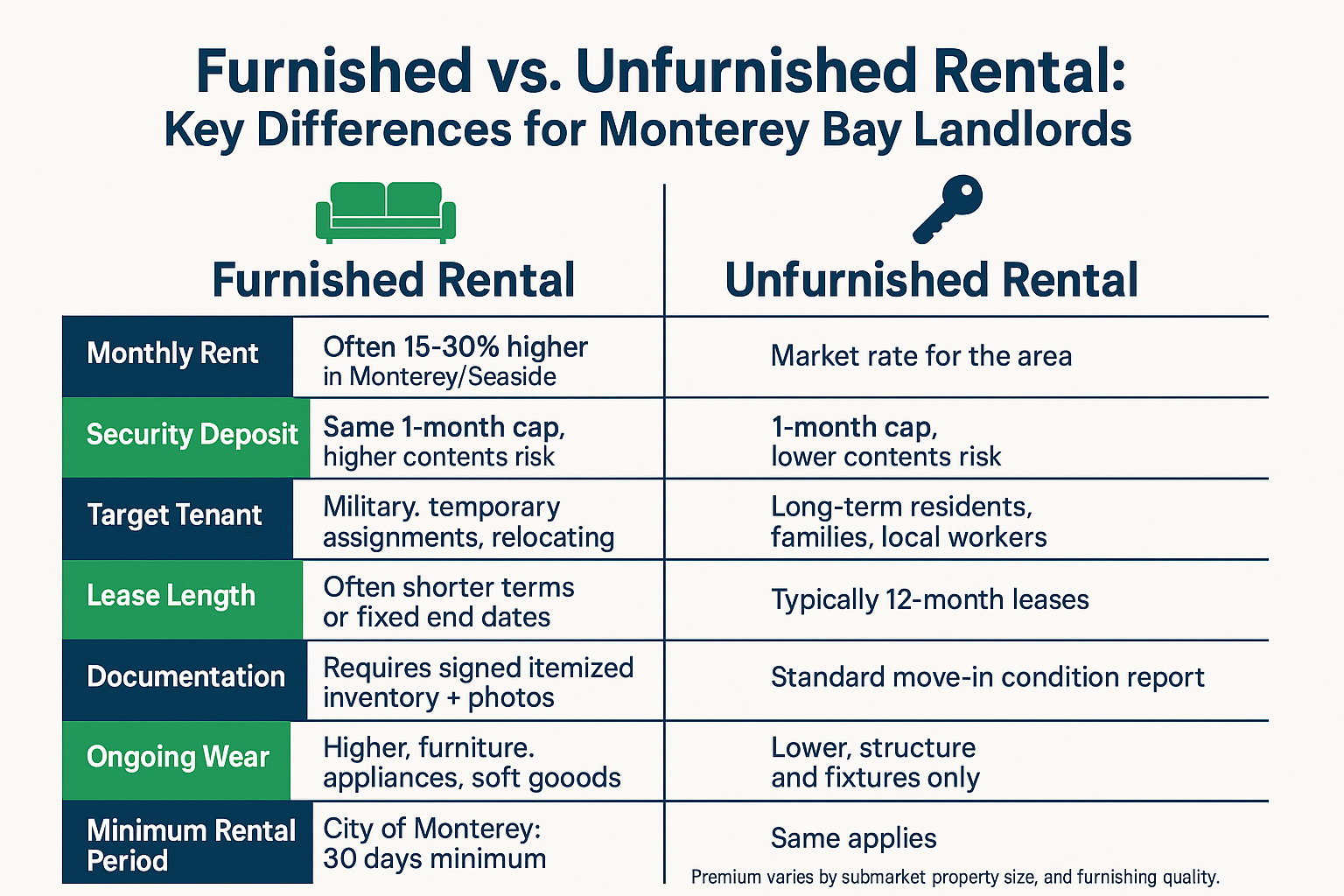
Furnished vs. Unfurnished Rental: What Changes for Monterey Bay Owners
This side-by-side comparison covers the key differences owners should weigh before deciding whether to rent their Monterey Bay home furnished.
Documentation Before You Leave Is Non-Negotiable
This point matters more for owners who are renting furnished because they're relocating, which describes a large share of the owners I talk to. If you're moving out of the area before your tenant moves in, you will not be there to observe anything firsthand. Every piece of protection you have will come from the paperwork you created before you left.
The baseline for a furnished rental should include:
- A complete itemized inventory listing every piece of furniture, every appliance, and every notable item by room
- Condition notes for each item (scratches, existing wear, age)
- Timestamped photographs of every room and every significant piece of furniture
- A signed inventory addendum attached to the lease, acknowledged by the tenant at move-in
Without all four, you're relying on goodwill at move-out. That's a bad position.
For owners leaving in a compressed timeline, this feels like a lot. But it's the kind of thing that takes a few hours upfront and saves a real argument two years later. Getting a Monterey Bay rental ready before tenant move-in covers the broader preparation process, including compliance items that also need to be in order before anyone occupies the unit.
One thing that often gets missed: the City of Monterey prohibits rentals under 30 days, so if you're thinking of a furnished rental there, you're looking at traditional tenants on monthly or annual terms, not anything resembling a vacation rental. That shapes who you're marketing to and what lease structure makes sense.
Furnished Rental Documentation Checklist
These are the documents and records I recommend every furnished rental owner have in place before the tenant takes possession.
| Document / Record | What It Covers | Why It Matters |
|---|---|---|
| Signed Lease Agreement | Rent amount, term, furnishing terms, tenant obligations | Establishes the legal relationship and any special furnished-unit clauses |
| Itemized Inventory Addendum | Every piece of furniture, appliance, and fixture by room | Required to support any deduction claim at move-out |
| Timestamped Move-In Photos | Visual condition of all rooms and items at occupancy | Backs up written condition notes in any dispute |
| Appliance Age and Condition Notes | Age, brand, and current condition of each appliance | Establishes baseline for wear vs. damage at move-out |
| Signed Tenant Acknowledgment | Tenant confirms inventory and condition at move-in | Prevents 'I never saw that' claims later |
Staying on Top of Condition When You're Not Around
Furniture and soft goods deteriorate faster than a building does. A broken appliance, a water stain on an upholstered chair, or a damaged mattress doesn't get reported by a tenant who either doesn't notice or doesn't want to cause friction. If you're managing from out of the area, you may not know about it until move-out, when it's too late to address it under the tenancy.
This is the same reason out-of-area owners benefit from regular in-person property checks, whether their home is rented or sitting empty. Out-of-area owners managing a Monterey Bay rental covers the practical logistics of remote ownership in more detail, including what things tend to go wrong when no one is physically checking.
For owners with furnished vacation or seasonal homes, similar logic applies. Even when a property is vacant, contents can be affected by humidity, pests, water intrusion, or deferred maintenance. Owning a second home on the Monterey Peninsula while you're not there is worth reading if your situation involves extended absences rather than an active tenancy.
Regular inspections, documented with photos and condition notes, are the only way to stay ahead of deterioration in a furnished rental. Without them, you're making decisions at move-out with incomplete information.
Frequently Asked Questions About Renting a Furnished Home in Monterey Bay
How much more rent can I realistically expect for a furnished unit in Monterey?
It varies by property type and location. In areas with strong military and government tenant demand, like central Monterey and parts of Seaside, furnished units have historically rented for 15 to 30 percent more than equivalent unfurnished units. But that's a general range, not a promise for your specific address. Condition of the furnishings, unit size, and how well the property matches the furnished-tenant profile all affect the actual number.
Does the security deposit cap apply differently for furnished rentals?
No. Since July 1, 2024, California's security deposit cap is one month's rent for most residential landlords, and that cap does not change based on whether the unit is furnished. You're taking on more contents risk with a furnished unit without any additional deposit protection. This is why keeping furniture values reasonable and documentation thorough is so important.
Can I rent my Monterey home for just a few weeks at a time to corporate tenants?
Not in the City of Monterey. The City of Monterey prohibits rentals under 30 days, which rules out anything resembling a short-term or corporate-week arrangement. If you're in Monterey, you're looking at month-to-month or longer-term tenancies. Other Monterey Bay cities have different rules, so it's worth confirming the local requirements for wherever your property sits.
What furniture should I leave versus take with me?
Leave items that are in solid condition, easy to replace, and not personally valuable. A good quality sofa, a dining set, and a basic bedroom setup are reasonable. High-end furniture, family heirlooms, or anything you would be upset to replace should come with you. Assume everything you leave will show wear after a tenancy, and price the rent accordingly.
Is a furnished rental a good fit for military tenants from NPS or DLI?
Often yes. Military members and defense contractors on temporary assignments are among the most consistent furnished-rental tenants in Monterey Bay. They tend to be reliable payers and often prefer furnished units because they're moving with limited household goods. The tradeoff is that they typically want defined end dates or short initial terms, so owners need to decide upfront whether they're comfortable with that flexibility or prefer a longer commitment.
Do I need a separate addendum for the furniture inventory, or does the lease cover it?
A standard lease won't capture the level of detail you need. A signed inventory addendum, listing every item by room with condition notes, is separate from the lease itself and should be signed by the tenant at move-in. Without it, you have almost no basis for deducting damage to specific items at move-out.
Have Questions About Renting Your Monterey Bay Home Furnished?
If you're weighing whether to rent furnished, figuring out how to price it, or trying to get your documentation right before you leave the area, we're happy to talk through your specific situation. Our team works with landlords across Monterey, Salinas, Pacific Grove, Seaside, and Marina every day, and furnished rentals come up often enough that we've seen most of what can go right and wrong. Reach us at (831) 582-8916 or through the contact form at torrenteproperties.com.
What Property Management Actually Costs in the Monterey Bay Area
The question I hear most often from first-time landlords is some version of: 'What do you charge?' It shows up in our contact form, on phone calls, and in every first conversation with a property owner who is just starting to research management companies. And honestly, that question makes complete sense, most people have no idea how property management fees are structured before they start looking.
What surprises me is how rarely anyone gets a straight, useful answer. A lot of firms list a percentage on their website and leave it there. But that number alone doesn't tell you what you're actually paying for, what's not included, or how fees add up across the first year of management.
This is my attempt to answer the fee question honestly, using what I've seen working with landlords across Monterey, Salinas, Seaside, and the broader Monterey Bay area. I'll cover how the two main fee types work, what affects the number you'll be quoted, and what to actually compare when you're evaluating firms.
How Are Property Management Fees Structured?
Almost every property management firm charges fees in two separate layers, and understanding both matters.
The first is the monthly management fee. This is an ongoing charge, usually calculated as a percentage of the rent collected each month. In California, this percentage generally falls somewhere in a range that varies depending on the market, the property type, and what the firm actually does for that fee. Because the Monterey Bay area carries higher prevailing rents than many California markets, even a modest percentage translates into a real dollar amount per month.
The second is the leasing or tenant placement fee. This is a one-time charge when a new tenant is placed. It compensates the management company for the time and cost of marketing the property, screening applicants, showing the unit, and executing the lease. Many firms charge the equivalent of half a month's rent to one full month's rent for this service.
The leasing fee is the one that catches new landlords off guard most often. I've spoken with owners who asked only about the monthly rate, then were surprised when their first statement showed a placement charge. Asking about both upfront is the right move.
For context on what the full process of getting a rental ready and leased actually involves, Getting a Monterey Bay Rental Ready: What Actually Has to Happen walks through the preparation side in detail.
What Factors Actually Move the Fee Up or Down?
Fee percentages are not one-size-fits-all, even within the same market. Several things affect where a quote lands:
- Property type. Single-family homes and smaller portfolios often sit at a higher percentage than large apartment complexes. The reason is simple: the fixed overhead per unit is greater when a manager is running one property versus twenty.
- Furnished versus unfurnished rentals. A furnished unit involves more coordination, inventory tracking, more frequent turnover prep, and sometimes more detailed inspections. Several owners who have contacted us about furnished condos in Monterey and Marina have asked specifically whether this changes the fee structure. It often does.
- Utility arrangements. Properties with shared or sub-metered utilities, or where the owner pays certain utilities directly, add a layer of billing and oversight. That complexity gets factored into how a scope of work is built.
- Portfolio size. An owner with several units in Salinas may be quoted differently than someone placing a single home in Carmel for the first time. Volume and relationship history both play a role.
- Scope of services included. This is the biggest variable of all, and I'll come back to it.
The bottom line is that a percentage alone means nothing without knowing what work that percentage covers. A firm quoting a lower monthly rate that excludes routine inspections, after-hours emergency response, or detailed financial reporting is not the same offering as a slightly higher rate that includes all of that.
The Two Layers of Property Management Fees at a Glance
This infographic breaks down the two main fee categories and the key factors that affect where your quote lands.
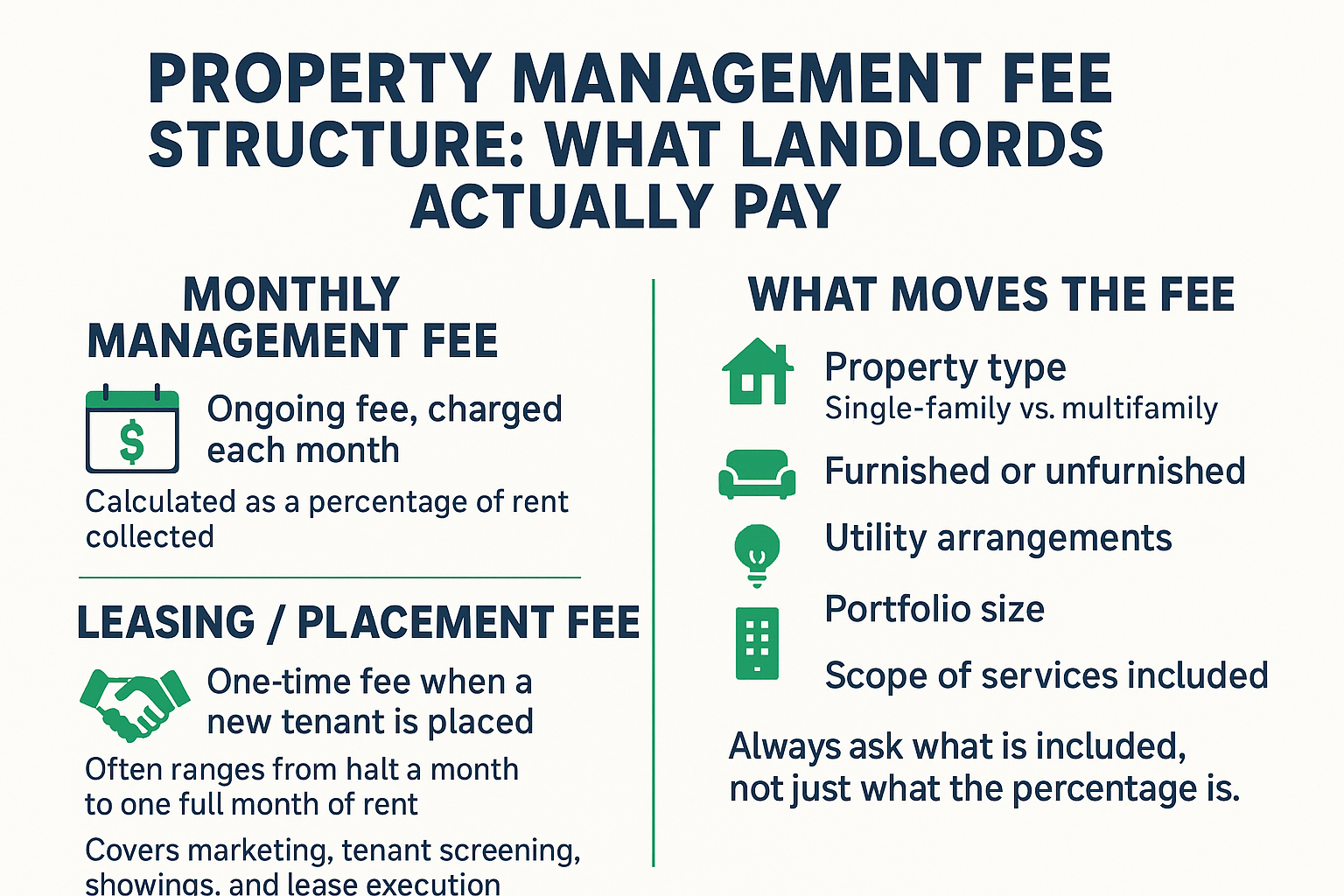
Monthly vs. Leasing Fee: What Each One Covers
Here is a quick reference for how the two main fee types differ in timing, purpose, and what they typically include.
| Fee Type | When It's Charged | What It Generally Covers |
|---|---|---|
| Monthly Management Fee | Every month rent is collected | Rent collection, maintenance coordination, inspections, financial statements, tenant communication, owner portal access |
| Leasing / Placement Fee | Once per new tenant placement | Property marketing, rental pricing analysis, showings, credit and background screening, lease drafting and execution |
| Additional Fees (varies by firm) | Situational | Lease renewal fees, maintenance coordination markups, early termination fees, ask upfront what applies |
The Real Comparison Is About Scope, Not Just Price
When owners start comparing management companies, the instinct is to line up the percentages and pick the lowest one. I understand that instinct. But it leads to bad decisions more often than good ones.
The right question is: what does each firm actually do for that fee?
A management company that charges a lower monthly rate but does not include routine property inspections, after-hours emergency calls, or detailed monthly financial statements is not offering a lower-cost version of the same thing. It's a different product. And the gaps tend to show up at the worst times, like when a pipe bursts at 11 p.m. or when you need documentation for an insurance claim.
Reviews from our clients consistently mention responsiveness and follow-through on maintenance as reasons they stay with us year after year. One long-term client who owns several properties in Salinas specifically described the peace of mind that comes from knowing everything is handled. That kind of operational consistency has real costs behind it, and firms with thinner fee structures are often not delivering it.
If you're evaluating firms and want to understand what full-service management actually looks like in practice, When Self-Managing Your Rental Stops Making Sense is a good place to start. And for out-of-area owners trying to understand the true cost of going it alone, The Hidden Costs of Managing a Monterey Home From Out of State lays out what those gaps actually cost.
A Note on Vacant and Seasonal Properties
Not every property owner needs full rental management. Some of the inquiries we receive come from seasonal homeowners in Carmel or Pebble Beach who are not renting their property at all, they just need someone to check on it regularly while they're away.
For those situations, caretaker and home watch services are a separate service category with their own pricing structure. The scope is different: scheduled property inspections, exterior monitoring, utility checks, landscaping coordination, and detailed reports to the owner. It's not tied to rent collection because there's no tenant.
For anyone wondering what can actually go wrong in a vacant property and why regular inspections matter, What Can Go Wrong in an Empty House, and Who's Responsible covers the real risks in plain terms. And How Often Should Someone Check on a Vacant Home in Monterey Bay? gets into the practical question of frequency.
The point is that 'what does property management cost' has a different answer depending on what you're actually asking for. A vacant home in Pacific Grove needs a different service than a rented four-unit building in Salinas, and the fee structure reflects that.
Frequently Asked Questions About Property Management Fees
What is your management fee?
This is the most common first question we get, and the honest answer is: it depends on the property and scope of work. We don't post a flat percentage on the website because a furnished studio in Marina, a single-family home in Seaside, and a four-unit building in Salinas all involve different levels of work. The best way to get an accurate number is to contact us directly so we can understand your specific situation.
Is the leasing fee separate from the monthly management fee?
Yes, and this is the piece that surprises most new landlords. The leasing fee is a one-time charge when a new tenant is placed. The monthly management fee is an ongoing charge for day-to-day management. They are two separate costs, and any firm you evaluate should be willing to explain both clearly before you sign anything.
Do fees change if the property is furnished?
Potentially, yes. Furnished rentals involve more coordination, inventory tracking, move-in and move-out documentation, and sometimes more frequent unit prep between tenants. Several owners who have come to us about furnished condos in Monterey and Marina have asked exactly this question. It's worth discussing during your initial conversation with any management company.
Are there fees when the property is vacant?
This varies by firm. Some charge a reduced fee or no management fee during vacancy periods. Others charge a flat monthly amount regardless. Ask this question directly, and also ask whether the company will actively work to minimize vacancy time through accurate pricing and responsive marketing. For background on how rental prices actually get set in this market, How Monterey Bay Rental Prices Actually Get Set is worth reading.
What other fees should I ask about?
Beyond the monthly and leasing fees, some firms charge separately for lease renewals, maintenance coordination markups, or early termination. Ask each company you speak with for a complete list of every fee that could appear on your owner statement, not just the headline rate. California's Department of Real Estate requires property managers to be licensed brokers, so checking a firm's license status is also a reasonable due-diligence step.
How do I know if I'm getting a fair deal?
Compare scope, not just price. Ask each firm what is included in the monthly fee: routine inspections, after-hours emergency response, financial reporting, tenant communication, portal access. A lower percentage that excludes those things is not a better deal, it's fewer services. The real test is what happens when something goes wrong at midnight or when you need a clear monthly statement to review your property's performance.
Ready to Get a Real Answer on What Management Would Cost for Your Property?
If you own a rental or vacant property anywhere in Monterey County, whether that's a single-family home in Salinas, a condo in Pacific Grove, or a seasonal property in Carmel, we're happy to have a straightforward conversation about what management actually looks like for your specific situation and what it would cost. You can reach our team at (831) 582-8916 or send us a message through the contact form at torrenteproperties.com.

Your Rental Unit Now Has to Have a Stove and Fridge. Here's What That Means.
For most of the time I've been working with landlords in Monterey County, appliances were a handshake deal. Some owners included them, some didn't, and both approaches were legally fine. That changed on January 1, 2026.
Assembly Bill 628 moved working stoves and refrigerators into California's legal definition of a habitable rental unit. It is no longer a courtesy or a marketing decision, it is a compliance requirement. And if you own rental property in Salinas, Seaside, Marina, or anywhere else in Monterey County, the timing of when this applies to you depends on your lease situation right now.
This article walks through what the law actually requires, the one narrow carve-out that exists, and why the appliance recall provision is the piece most out-of-area owners are going to miss.
What AB 628 Actually Changed, and When It Applies to Your Lease
Before AB 628, California's habitability standards required things like weatherproofing, plumbing, heating, and working electrical systems. Appliances were not on that list. Landlords could rent a unit without a stove or fridge and remain fully compliant, as long as the tenant knew upfront.
That gray area is gone. A working stove and a working refrigerator are now legally required components of a habitable unit under California Civil Code. For a fuller breakdown of how California habitability law changed in 2026, the key threshold is simple: the obligation attaches to any lease that is entered into, amended, or extended on or after January 1, 2026.
If you have a tenant mid-lease and nothing has changed, you may not be obligated yet, but the moment that lease renews or you sign any kind of amendment, the requirement kicks in. I've already spoken with several Salinas landlords who assumed their older leases were untouched by this law. Most of them have renewals coming up in 2026, and they need to be ready.
The California Apartment Association's 2026 compliance update confirmed the law's scope and introduced a new Refrigerator Request Addendum form for situations where a tenant voluntarily provides their own appliance. That form matters, more on that below.

The Written Carve-Out, and Why Verbal Agreements Don't Work Anymore
There is one way out of the appliance requirement: a mutual written agreement between the landlord and tenant stating that the tenant will supply their own refrigerator or stove. But the agreement has to be documented in the lease itself, with specific language that makes the arrangement clear.
Verbal understandings don't count. An email from three years ago doesn't count. If it isn't in the signed lease with language that satisfies AB 628, the landlord is still on the hook.
I've seen this exact situation come up with older multifamily units in Salinas and some aging single-family rentals in Seaside. The prior arrangement was informal, owner bought the house without appliances, tenant moved in knowing that, and everyone was fine with it for years. When that lease renews now, the landlord either needs to provide the appliances or get a properly documented waiver into the new lease before signing.
If you're not sure whether your current lease language satisfies the new requirement, reviewing it before the next renewal is the right move. This is exactly the kind of detail that gets missed when owners are managing from out of the area, something I write about in more depth in how out-of-area owners actually manage a Monterey Bay rental.
AB 628 at a Glance: What Monterey County Landlords Need to Know
Here is a quick reference for the key obligations and deadlines under AB 628.
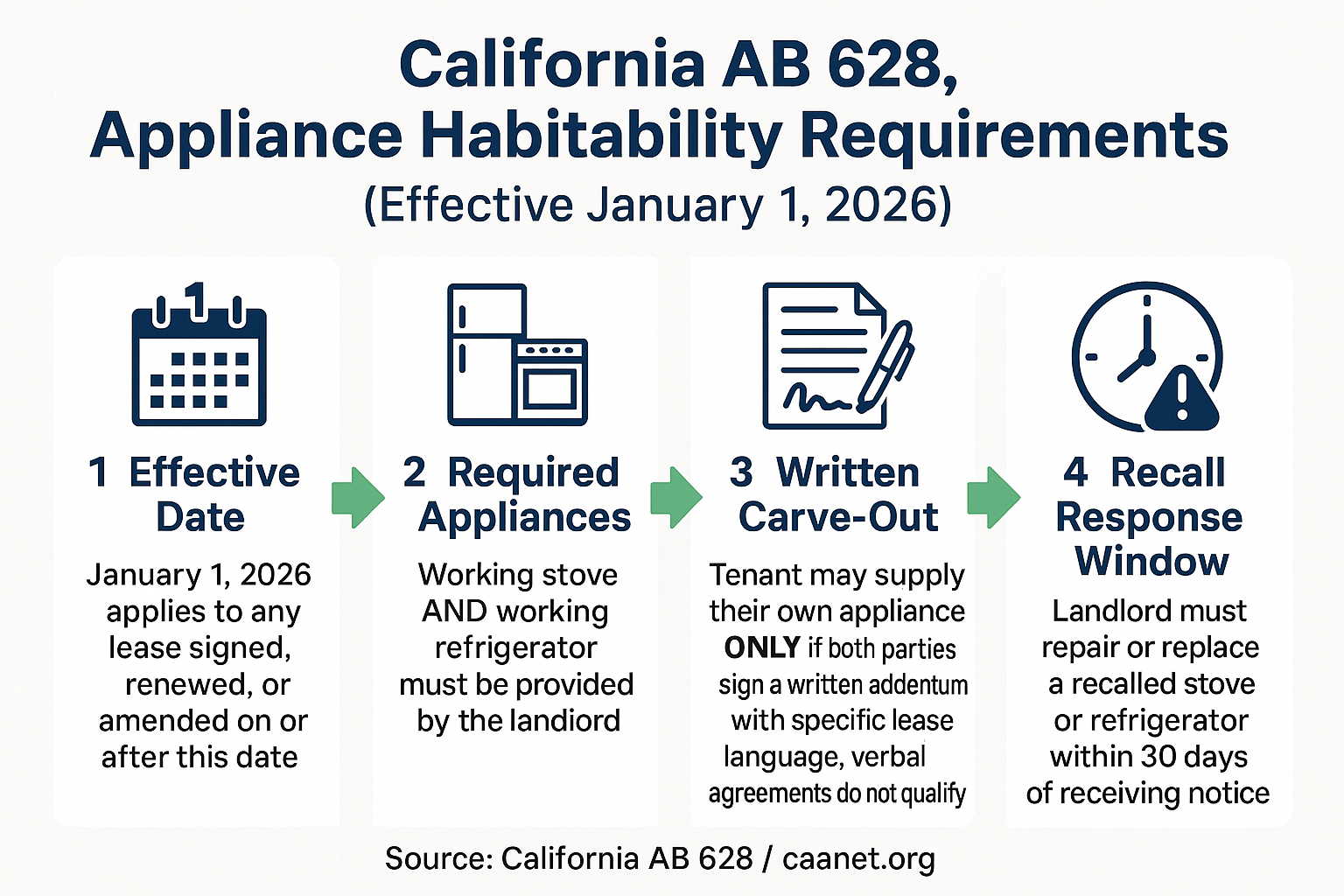
The 30-Day Recall Rule Is the Part Most Remote Owners Will Miss
This is the provision I think about most when I work with owners who live outside the area. AB 628 requires landlords to repair or replace a recalled stove or refrigerator within 30 days of receiving notice of the recall.
Appliance recalls are not rare. Manufacturers issue them regularly for gas range ignition failures, refrigerator compressor issues, fire risks, and other defects. If a notice goes to the rental unit address and the tenant doesn't forward it, or goes to an old owner address, the 30-day clock can start without the owner even knowing.
For a landlord in the East Bay or out of state managing a Salinas rental remotely, 30 days is a short window. Finding a licensed appliance technician or coordinating a replacement, ordering the unit, and scheduling delivery can eat up most of that time even when things move quickly.
What this practically means: appliance maintenance should now be tracked as a compliance item, not just a service request. A tenant living in a unit where the stove or refrigerator fails has grounds to raise a habitability claim if the landlord doesn't act. That is a much more serious situation than a maintenance complaint used to be. If you want to understand how habitability failures interact with broader landlord obligations in California, the section on raising rent in 2026 has useful context on how compliance gaps can affect your options as a landlord.
AB 628 Quick Reference: Before and After the Law
This table summarizes what changed for California landlords on January 1, 2026.
| Situation | Before January 1, 2026 | After January 1, 2026 |
|---|---|---|
| Renting a unit without a stove or fridge | Permitted, no habitability violation | Not permitted unless written waiver is in the lease |
| Tenant supplies their own appliance | Informal agreement acceptable | Requires signed written addendum with specific lease language |
| Appliance recall received | No mandatory repair timeline | Landlord must repair or replace within 30 days of notice |
| Mid-lease with existing tenant | Not affected yet | Obligation attaches at next renewal or lease amendment |
| Appliance failure during tenancy | Maintenance request, not a legal obligation | Must be repaired, landlord has habitability liability if ignored |
What This Means for Older Rentals in Salinas, Seaside, and Marina
The owners most likely to run into AB 628 problems mid-tenancy are those with older rental stock. Aging single-family homes in Seaside, older multifamily units in Salinas, and 1970s-era apartments in Marina often have appliances that are well past their expected lifespan.
When a 15-year-old refrigerator gives out in the middle of July, it was always a problem. Now it is also a habitability issue with a legal time clock attached. The tenant doesn't have to be flexible while the owner researches options.
For owners managing properties from a distance, I think the honest answer is that this law raises the bar for how closely you need to track appliance condition. It is one more reason that regular inspections, not just responding when something breaks, matter more than they used to. Our Seasonal Property Maintenance Program is built around exactly that kind of proactive tracking, including appliance condition checks during quarterly walkthroughs.
And if you have been self-managing a property while weighing whether to bring in help, appliance compliance is a reasonable moment to take stock of what you are tracking on your own, and what might be slipping through. When self-managing stops making sense is a useful read if you are at that point.
Frequently Asked Questions About AB 628 and Rental Appliances in California
Does AB 628 apply to leases that were already signed before January 1, 2026?
If the lease has not been renewed or amended since January 1, 2026, the requirement has not attached yet. But the moment the lease renews, even a standard annual renewal, the new law applies. Owners with long-term tenants should not assume their older lease insulates them indefinitely.
What counts as a 'working' stove or refrigerator under the law?
The appliance needs to be functional, burners that heat, a refrigerator that maintains safe food storage temperatures. A unit with a broken burner or a fridge that runs warm is not compliant. The standard is basic functionality, not brand new or cosmetically perfect.
Can I just raise the rent to cover the cost of adding appliances?
Rent increases are governed by separate rules, and in some Monterey County cities those rules are more restrictive than others. Adding appliances is a cost you may absorb or build into pricing going forward, but it cannot be treated as a standalone justification for an immediate mid-lease rent increase in most situations. The article on raising rent in 2026 covers what the current rules actually allow.
What if a tenant damages the stove or refrigerator, am I still required to replace it?
Tenant-caused damage is different from normal wear and the landlord's habitability obligation. If a tenant breaks an appliance through misuse, that is a cost that can be charged back to the tenant through the security deposit or other means. But the unit still needs a working appliance, you cannot leave the unit without one while the dispute is sorted out.
I own a fourplex in Salinas. Does this law apply to all my units?
Yes. AB 628 applies to residential rental units regardless of the property type, single-family homes, condos, duplexes, and multifamily buildings are all covered. For multifamily owners in Salinas who are also navigating the city's Rental Registration Program, it is worth confirming that appliance compliance is reflected in your unit records.
Questions About How AB 628 Applies to Your Rental?
If you own rental property in Monterey County and you are not sure whether your current leases and appliances meet the new standard, we are happy to talk through your situation. Our team works with owners across Salinas, Seaside, Marina, Pacific Grove, and the broader Monterey Bay area every day, including many who manage their properties from out of state. Reach us at (831) 582-8916 or through the contact form at torrenteproperties.com.
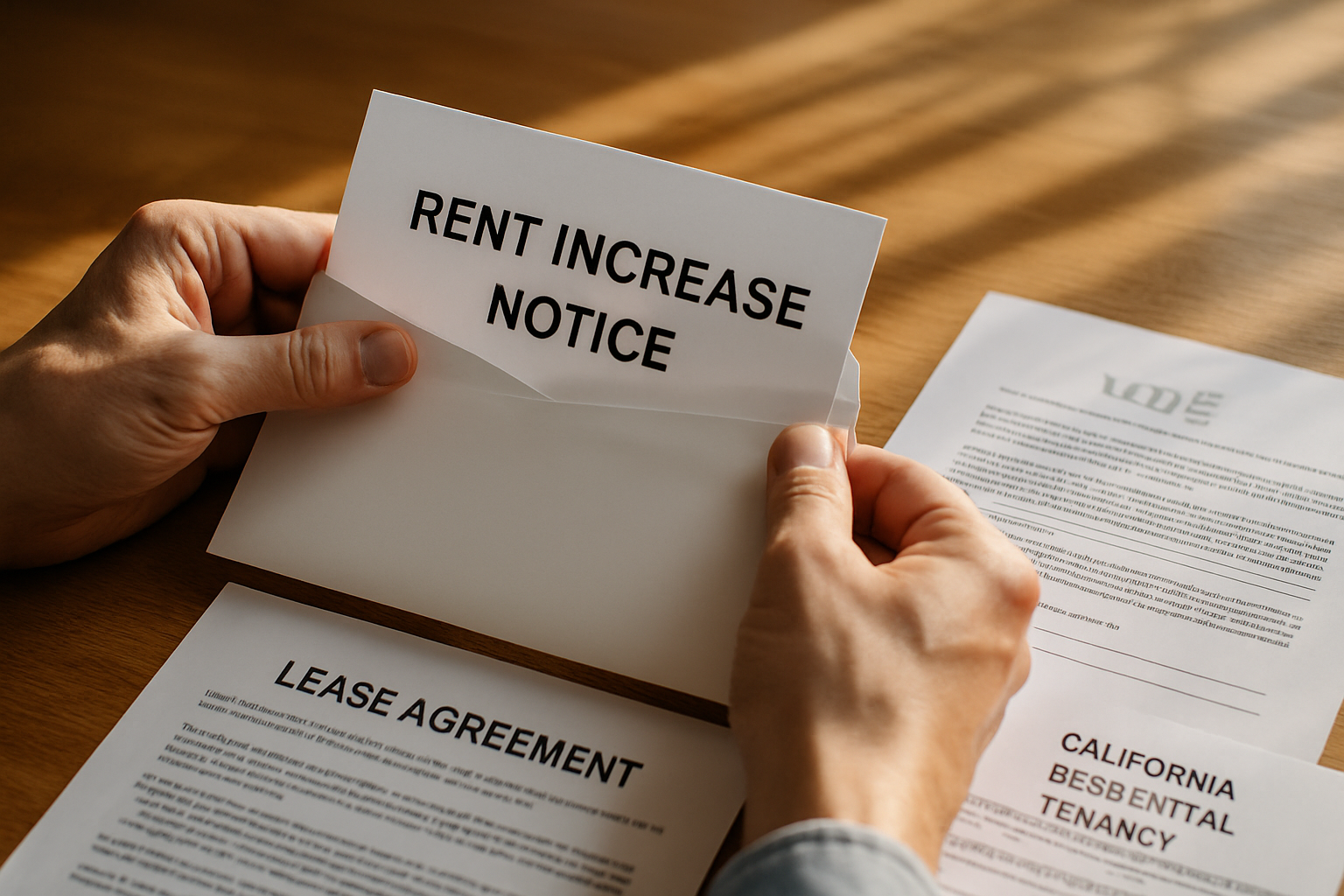
Raising Rent in 2026: What Monterey Bay Landlords Need to Know
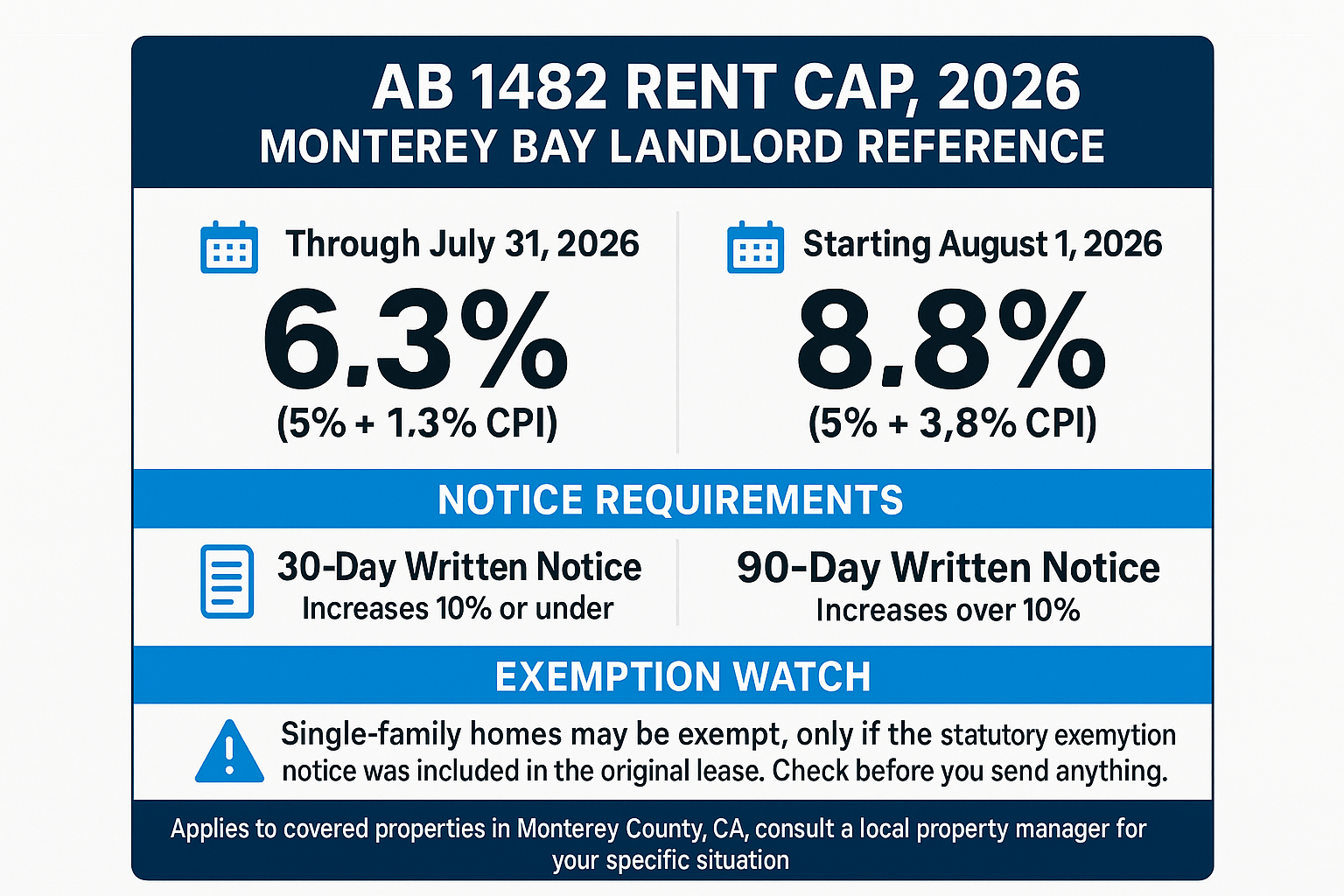
If you own a rental in Salinas, Seaside, Marina, or anywhere else in Monterey County and you're thinking about raising rent this year, there's one date you need to know: August 1, 2026. That's when the AB 1482 rent cap resets, and the allowable increase jumps from 6.3% to 8.8%. Which side of that line you're on when you send your notice makes a real difference in how much you can legally charge.
I've worked through this with a lot of property owners lately, and the questions I hear most often are: Does this law even apply to my property? Can I make up for the years I didn't raise rent? And exactly what does the notice have to say? Those are the right questions, and this article answers them directly.
Before anything goes out to your tenant, you need to understand what applies to your property, what the numbers actually allow, and what happens if the notice isn't done right. Getting it wrong isn't just a paperwork problem. It can expose you to legal liability or make any future eviction much harder to pursue.
The August 1 Line, and Why the Math Changes
AB 1482 is California's statewide rent cap law. For most covered properties in the Bay Area and Central Coast region, it limits annual rent increases to 5% plus the regional Consumer Price Index, with a ceiling of 10%. The CPI component resets every August 1 using updated regional data.
For the period running through July 31, 2026, the allowable cap is 6.3%, that's 5% plus a 1.3% CPI figure. Starting August 1, 2026, the cap rises to 8.8%, because the April 2026 CPI came in at 3.8%. According to Marin County's published AB 1482 rent increase schedule, this reset schedule applies consistently across the region each year.
What this means practically: if your notice goes out before August 1, you're working with 6.3%. If it goes out on or after August 1, you have room for up to 8.8%. Using the wrong figure in either direction creates legal exposure. A notice that exceeds the applicable cap may be challengeable, and in a market like Salinas, where the city's Residential Rental Registration program adds another layer of local compliance, that's not a risk worth taking.
For owners who've been watching costs go up but holding rent steady, the August window may be worth planning around. A couple of percentage points on a $2,400 monthly rental is real money over the course of a year.
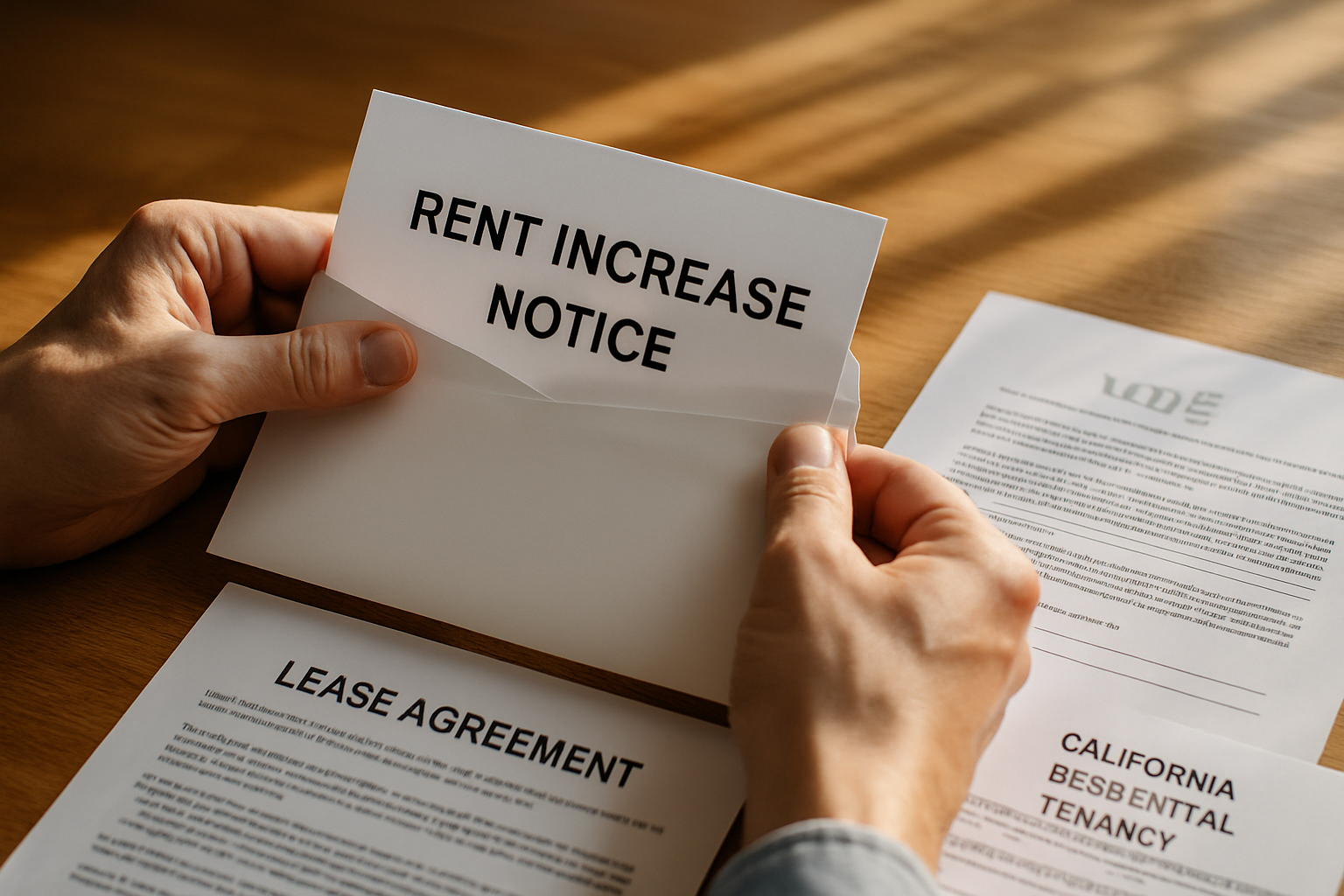
Does AB 1482 Even Cover Your Property?
This is where I see the most confusion, especially among owners who've held a property for years, inherited a rental, or recently converted a primary residence into a rental in Seaside or Marina.
AB 1482 does not apply to every property. Common exemptions include:
- Single-family homes and condos owned by individual people (not LLCs, REITs, or corporations)
- Properties built within the last 15 years
- Certain subsidized housing types
But here's what trips people up on the single-family exemption: the lease must have included the required statutory exemption notice at signing. If that language was never in the lease, the exemption doesn't apply, even if the home itself would otherwise qualify. I've seen this catch owners who had a verbal handshake arrangement years ago or who inherited a property and never updated the paperwork.
If you're not certain whether your lease contains the right language, that's worth checking before you send any increase notice. And if your property is covered by AB 1482, you also need to know that the just-cause eviction protections apply to the same covered properties once a tenant has lived there 12 months or more. The rent cap and the eviction rules travel together. Understanding which category your property falls into is step one, before any other math happens.
For a closer look at how local landlords in Salinas navigate compliance questions like this, our guide on what Salinas landlords actually need from a property manager covers some of this territory in practical terms.
AB 1482 Rent Cap at a Glance: 2026 Monterey Bay Reference
This reference covers the key numbers and rules Monterey Bay landlords need before sending a rent increase notice in 2026.
The Myth of Banking Skipped Increases
One of the most common misconceptions I hear from out-of-area owners goes something like this: "I haven't raised rent in three years, so I should be able to catch up now, right?"
No. That's not how California law works.
AB 1482 does not allow you to accumulate unused increases from prior years and apply them all at once. Each increase is evaluated independently against the cap for the 12-month window in which it applies. If you didn't raise rent in 2023 or 2024, those allowable percentages don't roll forward.
For landlords who have had the same tenant in a Salinas or Monterey property for several years and are now trying to get closer to market rate, this is genuinely costly to misunderstand. The path forward is a legally compliant increase now, at the current allowable rate, with proper notice. Not a catch-up lump sum.
If you're also unsure what your property should be renting for in the current market, how Monterey Bay rental prices actually get set is a useful starting point before deciding how much to raise rent.
2026 Rent Increase Quick Reference for Monterey Bay Owners
Use this as a fast reference when planning your rent increase notice. Always confirm your property's specific coverage before sending anything.
| Situation | Allowable Increase | Notice Required |
|---|---|---|
| Covered property, notice sent before Aug 1, 2026 | Up to 6.3% | 30 days (written) |
| Covered property, notice sent Aug 1, 2026 or later | Up to 8.8% | 30 days (written) |
| Any increase over 10% | Not permitted under AB 1482 for covered properties | 90 days (written) if applicable |
| Exempt SFH with proper exemption notice in lease | No statutory cap, market rate | 30 days (written) for increases 10% or under |
| Exempt SFH without exemption notice in lease | Likely covered by AB 1482 cap | Treat as covered property |
The Notice Itself, What Has to Be in Writing
California law is explicit here, and I want to be direct about it: a phone call, a text, or an email is not a valid rent increase notice. It has to be in writing, delivered properly.
The rules by increase size:
- 10% or less increase: A 30-day written notice is required
- Over 10% increase: A 90-day written notice is required (though AB 1482 generally prevents going above 10% for covered properties, so the 90-day rule applies mainly to exempt properties)
For owners with rentals in Salinas, there's one more step: check whether your unit is registered under the city's Residential Rental Registration program, and confirm whether any local requirements layer on top of state notice rules before you send anything. I'd also point owners to our breakdown of the Salinas Rental Registration program if you haven't read through what that program requires in 2026.
And because it bears repeating: verbal communication is not enough. I've seen disputes arise from owners who had a good-faith conversation with a long-term tenant, assumed everyone was on the same page, and then found out the hard way that the increase wasn't legally enforceable without written documentation. The writing requirement protects both sides.
Frequently Asked Questions About Raising Rent in California 2026
My tenant has lived in my Seaside rental for four years. Does AB 1482 apply?
It depends on the property type and the lease paperwork, not the length of tenancy. If your property is covered by AB 1482, the rent cap applies regardless of how long the tenant has been there. And if the tenant has been there more than 12 months, the just-cause eviction protections also apply, even on properties that are otherwise exempt from the rent cap. Check your lease for the statutory exemption language before assuming either way.
I inherited a rental in Salinas and have no idea what the original lease said. What do I do?
Start by getting a copy of the existing lease and reviewing it carefully. If it doesn't include the required AB 1482 exemption notice, treat the property as covered by the rent cap until you can get legal clarity. Properties that qualify for exemption but are missing the notice language lose that protection. This is exactly the kind of paperwork gap that catches accidental landlords off guard.
Can I raise rent on a furnished rental the same way as an unfurnished one?
The AB 1482 caps apply to the total rent amount, furnished or unfurnished. The law doesn't separate the furniture value from the rent. So yes, the same increase limits and notice requirements apply.
What if I haven't raised rent in several years, can I go above the cap to make up the difference?
No. California law does not allow you to carry over or accumulate unused increases from prior years. Each increase is capped at the allowable rate for the 12-month period in which it is applied. The only legal path is raising rent at the current allowable rate with proper notice, then planning future increases from there.
I own a single-family home in Pacific Grove. Am I automatically exempt from the rent cap?
Probably, but only if the lease included the required statutory exemption notice when it was signed. If that language is missing, you likely don't have the exemption. It's worth reviewing the lease before assuming you're outside the law's reach.
Does the August 1 rate change apply automatically, or do I have to do something to get the higher cap?
The reset is automatic on August 1 each year based on updated CPI data. You don't need to file anything. But the rate that applies to your specific notice is determined by when the notice is sent, not when the increase takes effect. If you send a notice in late July that takes effect in September, the 6.3% cap applies, not 8.8%.
Not Sure Which Rules Apply to Your Property?
Sorting through AB 1482 coverage, exemption notices, and notice timing is genuinely complicated, especially for owners who are managing from out of the area or dealing with a rental they didn't plan to have. Our team at Torrente Property Management has worked with landlords across Monterey, Salinas, Seaside, Pacific Grove, and beyond on exactly these questions. If you'd like to talk through your situation, reach us at (831) 582-8916 or through the contact form at torrenteproperties.com.

How Out-of-Area Owners Actually Manage a Monterey Bay Rental
The question I hear most often from out-of-area owners isn't 'can I manage this from a distance?' It's 'what does that actually look like in practice?' And that distinction matters, because a general description of 'remote property management' doesn't prepare anyone for what running a rental in Seaside, Salinas, or Marina feels like when you're living in Sacramento, Seattle, or San Antonio.
What I've seen, working with landlords across Monterey County for over two decades, is that the owners who struggle are almost never the ones with bad properties. They're the ones without a real local system, no clear communication rhythm, no defined process for maintenance decisions, and no meaningful financial reporting. Distance doesn't create problems on its own. The absence of structure does.
This article focuses on the three things that actually determine whether remote ownership works: how you stay informed, how maintenance gets handled, and what your monthly financials should actually tell you. I'm also going to address something most owners conflate, the rent-or-sell question versus the how-do-I-manage-it question, because answering one doesn't answer the other.
The Rent-or-Sell Question Is Separate From the Management Question
A homeowner in East Garrison reached out not long ago, preparing to relocate and asking for a realistic rent estimate so they could 'decide whether it makes more sense to rent or sell.' That's one of the most honest questions an owner can ask, and it's actually two separate decisions that most people treat as one.
The rent-or-sell question is financial: what will the property realistically generate as a rental, what are the carrying costs, and does holding it make sense given your tax situation, equity position, and long-term goals? Getting a rental price analysis is the starting point for that conversation, but it's not the whole conversation.
The management question is operational: if you decide to rent, what does your oversight structure look like? These two questions need different information and different conversations. Owners who skip the second one, who decide to rent without thinking through how they'll actually manage it from a distance, tend to be the ones calling us six months later after something has gone wrong.
If you're weighing this decision after a job relocation or military orders, this breakdown for owners leaving the Monterey Bay area covers the specific factors worth thinking through before you commit to either path.
What a Real Local Oversight System Looks Like
The most common thing remote landlords underestimate is how fast small problems compound when nobody is watching. A slow drip under a kitchen sink in Seaside can become a mold problem inside six weeks if the only person who might notice is a tenant who doesn't want to bother anyone.
A real oversight system has three layers that work together:
1. Communication, How and how often you get information
Good management means you're not waiting for something to go wrong to hear from your management team. You should receive:
- Monthly owner statements with income, expenses, and maintenance activity
- Inspection reports with photos at move-in, move-out, and at scheduled intervals
- Immediate notification when something urgent comes up, not a summary two weeks later
The cadence matters as much as the content. An owner in Pacific Grove or Prunedale shouldn't be wondering what's happening at their property. They should know.
2. Maintenance, Who decides, who acts, who verifies
This is where most remote arrangements break down. The question isn't just 'who coordinates repairs?' It's who decides whether a repair is urgent, who selects the vendor, and, critically, who verifies the work was actually done right.
A management team without a local vendor network will default to whoever answers the phone fastest, which isn't always the best call for your property or your wallet. Our team works with vendors we know personally across Monterey, Salinas, Marina, and Seaside, which means we're not guessing when a plumber shows up.
3. Financial oversight, What your statement should actually tell you
I'll cover this in depth in the next section, because most owners have never seen a real property management statement, and don't know what to ask for.

What a Monthly Owner Statement Should Actually Tell You
Most remote owners have never seen a real property management financial statement. They assume a rent deposit plus an occasional repair bill is sufficient reporting. It isn't.
A well-structured monthly owner statement should include:
- Gross rent collected for the period
- Management fees and any leasing or placement fees charged that month
- Individual line items for every maintenance expense, not a lump-sum 'repairs' figure
- Vendor name and work description for each maintenance charge
- Net proceeds distributed to the owner, with a running balance
- Any reserves held and what they're earmarked for
What a statement should not do is obscure expenses inside vague categories. If you can't tell from your monthly report who was paid, for what, and when, that's a gap worth asking about.
The flip side is equally important: a detailed statement isn't a replacement for physical oversight. Numbers tell you what was spent. They don't tell you whether the repair was done correctly, whether the property is being maintained between incidents, or whether a small issue is being caught before it becomes expensive. The hidden costs of managing a Monterey home from out of state are often the ones that don't show up in any statement at all, until the damage is already done.
Owners managing from the Bay Area or further often describe peace of mind as the actual product they're buying. One multi-property owner in Salinas put it plainly in a review: 'It's refreshing knowing we have that peace of mind.' That framing is honest. The real value of a trustworthy local team isn't just the task list, it's the mental bandwidth you get back when you know someone with local knowledge is physically present and accountable.
Three Layers of Remote Rental Management
Here's how the three core functions of remote property management connect, and what each one actually requires to work.
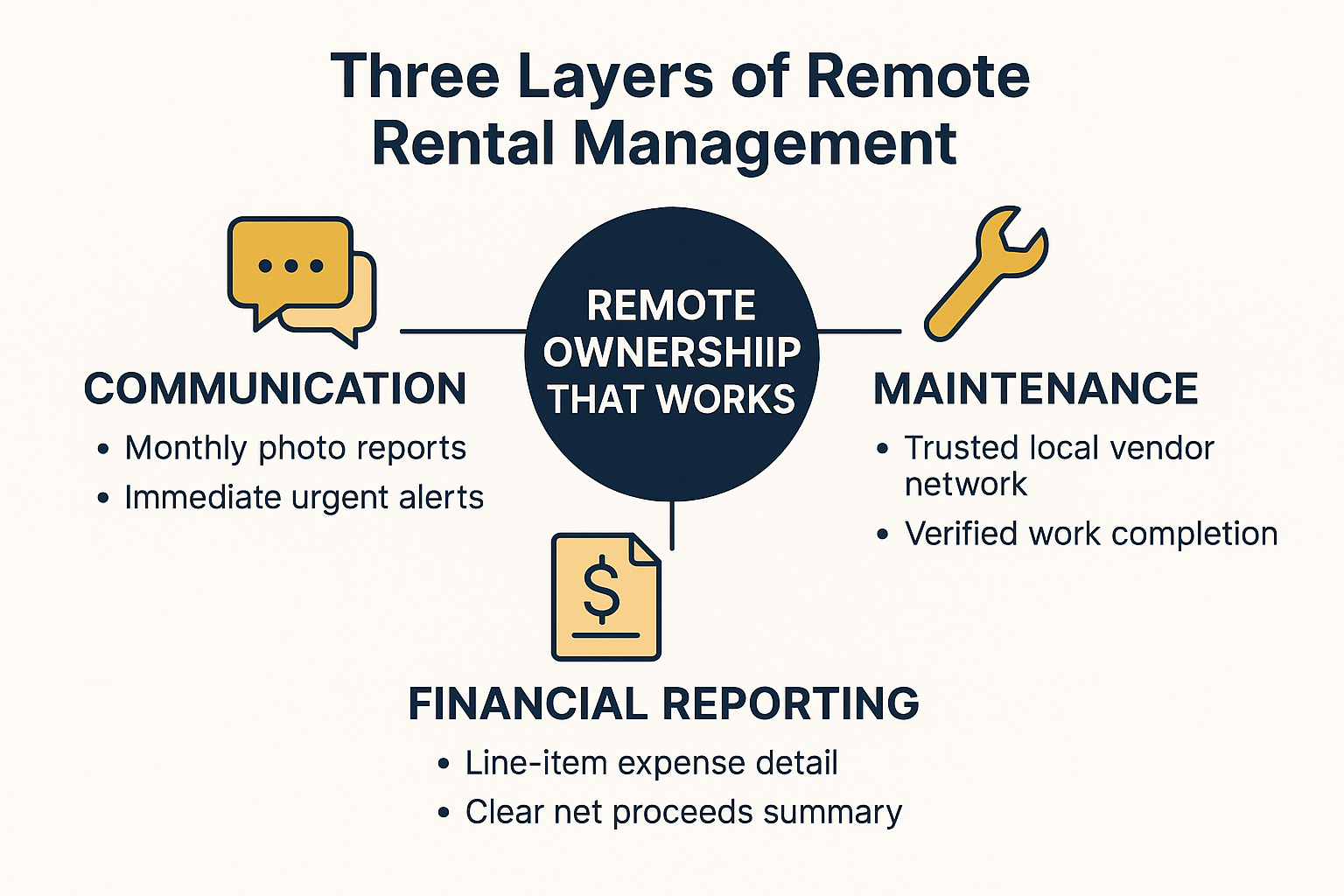
California Compliance: What Out-of-Area Owners Don't See Coming
California rental law doesn't pause because you moved away. And the rules aren't uniform across Monterey County, each city has its own layer on top of state requirements.
A few of the compliance realities that catch remote owners off guard most often:
- Salinas landlords must register rental units through the city's Residential Rental Registration program. Owners who've relocated and assumed their property would 'run itself' frequently discover this requirement after the fact, and ignorance of a local ordinance doesn't excuse non-compliance.
- Monterey, Pacific Grove, and Seaside each have local rules around habitability notices, allowable rent increases, and tenant protections that differ in their specifics. A lease that works in one city isn't automatically compliant in another.
- California's security deposit cap, which dropped to one month's rent effective July 1, 2024, changed the math for landlords who had been collecting two months. Owners who haven't updated their lease terms may be holding deposits they're no longer legally entitled to. Your lease terms may have changed in other ways too, 2026 brought additional landlord obligations worth knowing.
- Multifamily owners in the region also need to be aware of exterior elevated element inspection requirements under SB 721, which affects properties with decks, balconies, or elevated walkways.
The California Department of Consumer Affairs publishes a general landlord-tenant handbook, but it won't capture city-specific local ordinances. That's where local expertise makes a real difference. A management team that operates only in the region knows the specific rules in the cities where your property sits.
How Remote Ownership Risk Changes by Management Structure
This table shows how common remote ownership risks shift depending on whether you're self-managing from a distance, using minimal oversight, or working with a full local management structure.
| Risk Area | Self-Managing Remotely | Full Local Management |
|---|---|---|
| Slow leak or water intrusion | May go undetected for weeks or months | Caught during routine or seasonal inspection |
| Local compliance (e.g., Salinas registration) | Owner must track and manage independently | Handled as part of ongoing management |
| Maintenance vendor selection | Owner calls blindly or relies on tenant referrals | Known, vetted local vendors with work verification |
| Tenant screening | Owner reviews applications without local market context | Full credit, background, and rental history screening |
| Monthly financial clarity | Owner tracks deposits and receipts manually | Itemized statements with every expense documented |
| California law changes | Owner must monitor independently | Local team tracks and applies updates as they occur |
The Real Cost of Peace of Mind, and What It's Measured Against
Property management fees in California vary by market, property type, and scope of services. In the Monterey Bay area, full-service residential management typically runs somewhere in the range of 8% to 12% of monthly rent collected, though the actual number depends on factors like unit count, property condition, and what's included in the agreement. Some firms charge separately for leasing, inspections, and maintenance coordination on top of a base rate. Others bundle it. Asking exactly what's included, and what triggers an additional charge, is the right question before you sign anything.
What I'd encourage remote owners to weigh that cost against is the realistic alternative. A water intrusion event that goes undetected for six weeks in a Monterey or Salinas property can mean mold remediation costs that run into the thousands, sometimes far beyond. A bad tenant placement in a market you don't know well can mean months of lost rent plus legal costs. What can go wrong in an empty house is a longer list than most owners expect before they've experienced it.
The owners I've worked with who are most at peace with remote ownership aren't the ones paying the lowest fees. They're the ones who know exactly what's happening at their property, and aren't spending mental energy worrying about what they don't know.
Frequently Asked Questions About Managing a Monterey Bay Rental Remotely
How often should a property manager actually visit my rental property?
It depends on whether the property is occupied or vacant, but for occupied rentals, at minimum twice a year is a reasonable floor, move-in, move-out, and at least one mid-tenancy inspection. Vacant or seasonal properties need more frequent eyes on them. Our Seasonal Property Maintenance Program does quarterly inspections with photo documentation specifically for owners who aren't local. For general guidance on check-in frequency, this breakdown is worth reading.
Do I need to tell my insurance company I'm renting out the property?
Yes, and this is one of the things that trips up accidental landlords most often. A standard homeowner's policy typically doesn't cover a rental property. You'll want to talk to your insurance agent about converting to a landlord or dwelling policy, and make sure you do it before a tenant moves in, not after something goes wrong.
What's the difference between a property manager and a caretaker?
A property manager handles an occupied rental, tenants, leases, rent collection, maintenance coordination, compliance. A caretaker or home watch service is for vacant or seasonal properties where there's no tenant, but the property still needs regular eyes on it. Both involve physical inspections and maintenance coordination, but the relationship and legal structure are different. We offer both services across Monterey, Carmel, Pacific Grove, and surrounding areas.
How do I know what my Monterey Bay rental should actually rent for before I decide to hold the property?
A reliable rental price analysis looks at comparable active listings, recent lease transactions, and seasonal demand patterns in your specific area, not just Zillow estimates, which are often based on stale or thin data in smaller markets like Marina or Seaside. A local manager who works in the market daily can give you a more grounded number than any automated tool. Here's how rental pricing actually works in the Monterey Bay market if you want to understand the inputs.
Can I manage a Salinas rental remotely without registering it with the city?
No. Salinas requires landlords to register rental units through the city's Residential Rental Registration program regardless of where the owner lives. The registration requirement doesn't go away because you've relocated. Failing to register can result in fines and creates complications if you ever need to pursue an eviction or code compliance issue.
What should I look for in a property management contract before signing?
The key questions are: what's the base management fee, what triggers additional charges (leasing, inspections, maintenance markup), what's the notice period to terminate, and how are maintenance decisions made and approved. Specifically, ask whether there's a threshold, say, $200 or $300, below which the manager can authorize repairs without your approval. That threshold protects you from surprise bills and tells you a lot about how the relationship will actually work.
Ready to Know Exactly What's Happening at Your Property?
If you own a rental in Monterey County and you're managing it from a distance, or deciding whether to rent or sell before you relocate, our team at Torrente Properties is glad to talk through your specific situation. We've worked with owners across Salinas, Monterey, Pacific Grove, Seaside, Marina, Carmel, and beyond, and we know the local market in a way that a general description of 'property management' can't capture. Reach us by phone at (831) 582-8916 or through the contact form at torrenteproperties.com.

When Is Rent Actually Late in California? A Landlord's Honest Breakdown
I see this question come up constantly from landlords across Monterey County, from Salinas to Seaside, Prunedale to Pacific Grove. If rent is due on the first, when is it actually late? The answer is simpler than most people think, and also more important than most landlords realize.
California does not require a grace period for residential tenants by statute. What the law says is that the lease controls when rent is due, and if your lease says the first with no grace period written in, rent is technically late on the second. Any grace period your tenant relies on has to come from the lease itself, not from state law.
I want to give you a clear, honest breakdown of how this works in practice, what late fees are actually enforceable, and what to do when a tenant's late payments stop being a one-off situation. This is the kind of detail that separates landlords who stay out of trouble from the ones who end up in small claims court or a prolonged eviction.
What California Law Actually Says About When Rent Is Late
California Civil Code Section 1947.3 sets the foundation: landlords must offer tenants at least one way to pay rent without a transaction fee, and the lease governs when payment is due. That's the full scope of the state's involvement in the timing question. There is no Civil Code section that says tenants get three days, five days, or any days of breathing room after the due date.
So why do so many landlords assume there's a grace period? Partly because it's a common lease provision, and partly because it's been repeated so often online that it has taken on the feel of law. But it's a lease term, not a legal right.
In practice, most professionally drafted leases in California do include a grace period, typically 3 to 5 days, before a late fee kicks in. That's reasonable and standard. But the critical distinction is this: the grace period delays the late fee, not the due date. Rent is still due on the first. The lease just says the landlord won't charge a fee until the fifth, or whenever the cutoff is.
If your lease is silent on grace periods, you're within your rights to charge a late fee starting on the second. Whether that's a good idea depends on the situation, but the legal authority is there if the lease is properly drafted.

Late Fees in California: What's Enforceable and What Isn't
This is where I see landlords get into real trouble. California courts have consistently treated excessive late fees as unenforceable penalties. A late fee has to represent a reasonable estimate of the actual cost a landlord incurs when rent is paid late, things like the administrative time to follow up, possible short-term cash flow disruption, and bank processing delays. It is not a punishment.
There is no statutory dollar cap on late fees in California, but case law has created a functional ceiling. A fee in the range of 5 to 6 percent of monthly rent is generally considered defensible. Here's what that looks like in practice:
- A $2,500/month rent unit with a $125 to $150 late fee sits in a reasonable range
- A $3,000/month unit charging $150 to $180 is likely defensible
- A $500 flat fee on a $2,500 rent is roughly 20 percent, and would not survive a legal challenge if a tenant contested it
I've talked with landlords who inherited leases with high flat fees from previous owners, or who copied language from online templates without realizing the amounts were set for different markets. If you're renting in Salinas or Monterey and your lease has a late fee that feels more like a deterrent than a cost recovery tool, it's worth having someone review it before a tenant ever has reason to challenge it.
For context, rental markets in Salinas have seen rents range from roughly $1,800 to $2,800 per month for a single-family home in recent years, depending on size and condition. A defensible late fee in that range would typically fall somewhere between $90 and $170. Those numbers are market context, not legal advice, your specific lease and situation should always be reviewed by someone qualified.
California Late Rent: From Due Date to Eviction, How the Timeline Works
This flow shows the escalating steps a California landlord can take when rent goes unpaid, starting from the due date through the unlawful detainer process.
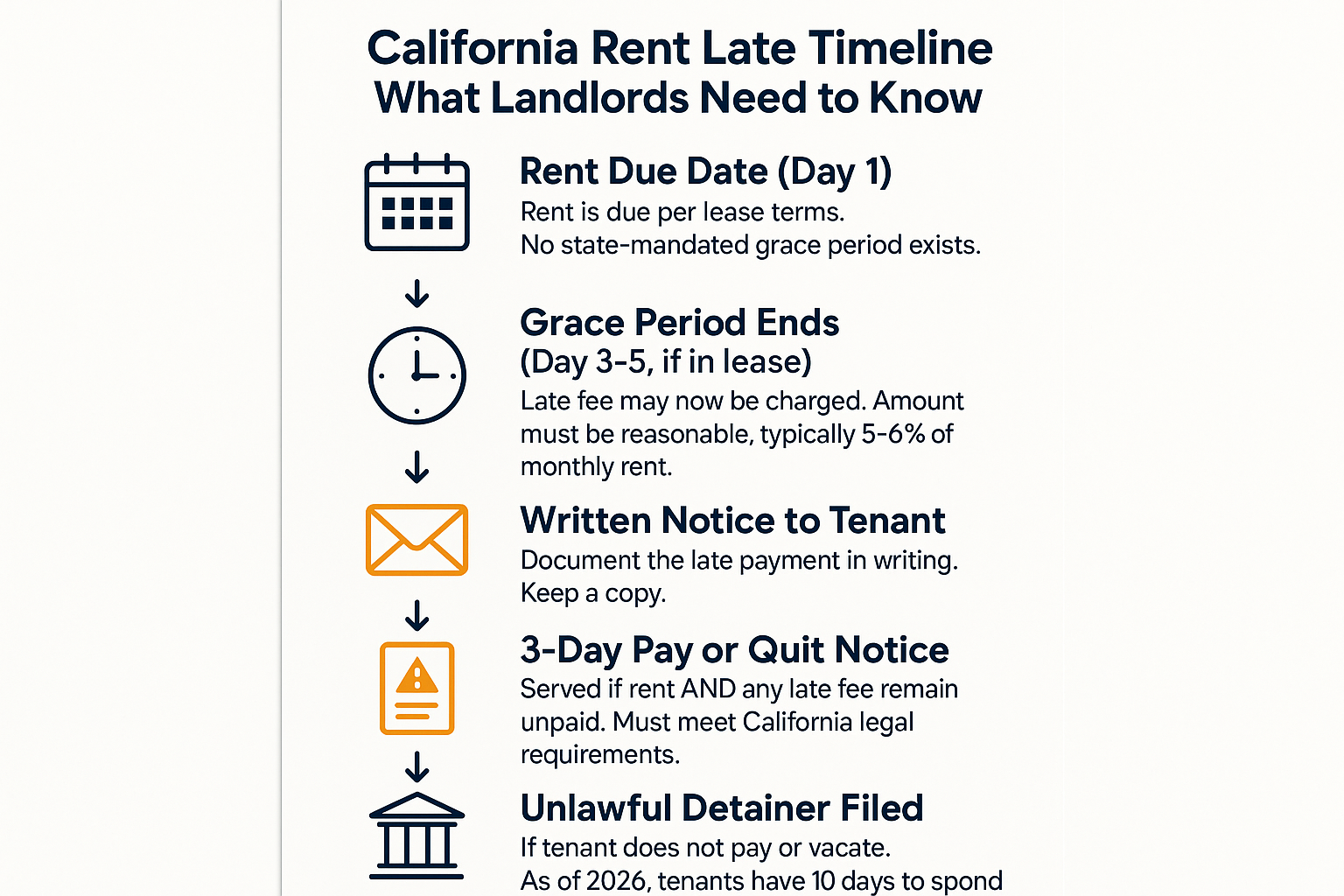
A Note for Salinas Landlords: Local Rules Layer on Top of State Law
If you own rental property in Salinas, you're operating under both California state law and the City of Salinas's local rental framework, and assuming state law is your only obligation is a mistake.
Salinas has a Residential Rental Registration program that landlords need to be enrolled in, along with a rent stabilization framework that has applied to certain covered units. If your property falls under local rent control provisions, there may be restrictions or procedural requirements around late fees that go beyond what state law addresses. The city's rules and California law don't always point in the same direction, and the intersection matters.
I'm not raising this to alarm anyone. Most Salinas landlords with newer construction or properties not covered by stabilization don't face additional late fee restrictions beyond the state framework. But if you're not certain which category your property falls into, that's exactly the kind of question worth getting a clear answer on before a tenant ever disputes a charge.
California Late Fee Quick Reference for Monterey County Landlords
These figures represent general market context and case law guidance, not legal guarantees. Use them as a starting point when reviewing your own lease language.
| Monthly Rent | 5% Late Fee | 6% Late Fee | Risk Zone (over 10%) |
|---|---|---|---|
| $1,800 | $90 | $108 | Above $180 |
| $2,200 | $110 | $132 | Above $220 |
| $2,500 | $125 | $150 | Above $250 |
| $3,000 | $150 | $180 | Above $300 |
| $3,500 | $175 | $210 | Above $350 |
When Late Rent Becomes a Pattern: What to Do Next
One of the more common situations I hear from landlords isn't a tenant who never pays, it's a tenant who paid reliably for years and has now started slipping. Several people who have reached out to us described exactly this: a tenancy that had been solid, now showing signs of strain, and an owner who wasn't sure how to respond without damaging a relationship or making a legal mistake.
If late payments are becoming consistent rather than occasional, the right approach is to escalate in clear, documented steps:
- Written communication first, put your notice in writing, even if you've already spoken by phone. A text or email that documents the late payment creates a record.
- Charge the late fee, if your lease allows it and the grace period has passed, apply the fee consistently. Inconsistent enforcement can create legal complications later.
- 3-day pay-or-quit notice, if both the rent and any applicable late fee remain unpaid after the grace period, California law allows you to serve a formal 3-Day Notice to Pay Rent or Quit. This notice must meet specific format and delivery requirements under California law.
- Unlawful detainer filing, if the tenant neither pays nor vacates after the notice period, the next step is filing an unlawful detainer action in Superior Court. One important update as of 2026: tenants now have 10 days (increased from 5) to respond after being served with an eviction complaint. That extends the timeline slightly and makes thorough documentation of every earlier step more important than ever.
Proper documentation isn't just good practice here, it's your foundation if the matter ends up before a judge. Missing a step, serving a notice incorrectly, or having an unenforceable late fee clause can slow down or derail an otherwise legitimate eviction.
For landlords managing properties from out of the area, self-managing through a difficult tenancy becomes especially hard when each step requires precise timing and paperwork. Distance makes that much more complicated than it already is.
How Lease Language Determines Everything
I've seen leases that were essentially copied from free online templates, ones that had grace periods written in without any late fee provision, or late fee amounts that were clearly punitive. In California, a judge won't enforce the punitive parts, and the tenant's attorney will find them quickly.
A well-drafted California residential lease should spell out:
- The exact due date (typically the first of the month)
- Whether a grace period exists and how many days it covers
- The specific late fee amount or calculation method
- The acceptable payment methods (required by Civil Code 1947.3)
- What happens if a check is returned
If your current lease doesn't cover these clearly, getting your rental properly prepared, including the lease documentation, before placing a new tenant is a much easier process than trying to fix problems mid-tenancy.
For owners who inherited tenants along with a property, this is even more pressing. Existing lease terms carry over, including any problematic provisions the prior owner agreed to.
The California Courts self-help resource on eviction covers the unlawful detainer process in plain language if you want to understand the full legal framework on your own time.
Frequently Asked Questions About California Rent Grace Periods and Late Fees
If rent is due on the first, what day is it actually late?
Technically, the second, unless your lease includes a grace period. California law does not give tenants automatic extra days. If your lease says rent is due on the first and doesn't mention a grace period, you can assess a late fee starting on the second. That said, most professionally written leases in California include a 3 to 5 day window before the fee kicks in.
Can I charge a $200 flat late fee on a $2,000 a month rental?
That would be 10 percent of monthly rent, which puts it in territory California courts have found difficult to defend. A fee that looks more like a penalty than a cost recovery measure can be ruled unenforceable. Something in the 5 to 6 percent range, so roughly $100 to $120 on a $2,000 rent, is a much safer position.
Does Salinas have any local rules about late fees?
Salinas has a Residential Rental Registration program and has had rent stabilization provisions that apply to certain covered units. If your property falls under those provisions, there may be local rules that layer on top of California state law. It's worth confirming your property's status rather than assuming state law is the only thing that applies.
My tenant paid on time for two years and now is consistently late. What's the right first move?
Put something in writing, even if you've already had a phone conversation. A simple written notice documenting the late payment creates the paper trail you'll need if things escalate. After that, apply the late fee consistently per your lease terms. If rent and fees remain unpaid past the grace period, a 3-Day Notice to Pay or Quit is the next formal step under California law.
How long does a tenant have to respond to an eviction filing in California now?
As of 2026, tenants have 10 days to respond after being served with an unlawful detainer complaint, up from 5 days previously. This makes careful documentation of each prior step even more important, since a longer response window gives tenants more time to identify procedural errors in the landlord's process.
What if my lease doesn't mention a late fee at all?
Without a late fee clause in the lease, you generally cannot charge one, at least not a legally defensible one. You'd need to wait until the current lease term ends and update the lease before renewing. In the meantime, your main tool for persistent nonpayment is still the 3-Day Notice to Pay or Quit, followed by unlawful detainer if needed.
Questions About Your Lease or a Late-Paying Tenant?
If you're managing a rental in Monterey County and you're not sure whether your lease is protecting you, or you're dealing with a tenant situation that's starting to feel more complicated than it should, our team is available to talk it through. We work with property owners across Salinas, Monterey, Seaside, Pacific Grove, Marina, and the surrounding area, and we've seen just about every late-rent scenario there is. Reach us at (831) 582-8916 or through the contact form at torrenteproperties.com.

PCS Orders and Your Monterey Bay Home, What Happens to the Property You Leave Behind
PCS orders have a way of arriving before you feel ready. One week you're settled into a home in Salinas or Monterey, and the next you're looking at a timeline that gives you 90 to 120 days to handle your own move, figure out what to do with your property, and keep everything from falling apart at once.
We hear from military homeowners in this exact position regularly, and many of them come to us through the Naval Postgraduate School pipeline, officers who bought a home near NPS, built some equity, and now face a decision that feels a lot harder than it should. The core question is almost always the same: sell or rent?
This article walks through the two things that actually matter most in that situation: making a clear-eyed decision about whether to rent or sell, and if you rent, getting the property ready and legally compliant before you leave the area.
The Sell vs. Rent Decision for Military Homeowners in Monterey County
This is the first question almost every departing military homeowner asks, and it deserves a real answer rather than a vague "it depends."
For many NPS families who bought between 2019 and 2022, the math on selling is genuinely uncomfortable. Homeowners who locked in rates in the 2.5% to 3.5% range and then sell face the prospect of buying at a new duty station where rates are significantly higher. Research on the mortgage rate lock-in effect suggests this dynamic kept well over a million potential home sales from happening nationally between 2022 and late 2023, and the same logic applies locally. Giving up a low-rate mortgage on a Salinas home to re-enter the market in Virginia or Hawaii at a much higher rate is a real financial penalty.
Renting, by contrast, lets you hold the asset, maintain the mortgage, and collect income that may cover or exceed your carrying costs. How Monterey Bay rental prices actually get set is a topic worth understanding before you assume what your home will rent for, Salinas and Monterey rent differently, and the difference matters to your cash flow.
That said, renting isn't the right move for everyone. A few honest questions worth asking:
- Do you want to be a landlord for the next 3 to 7 years, or indefinitely?
- Is the property in good shape, or will it need significant work before it's rentable?
- Can you handle the compliance and management responsibilities from a distance?
- Do you have reserves for an unexpected repair, a water heater, a roof issue, an HVAC failure?
If the answers to those questions are mostly yes, renting is worth serious consideration. If not, selling into even a slower market may be the cleaner exit.

Getting a Monterey or Salinas Home Rental-Ready on a PCS Timeline
Assuming you decide to rent, the clock starts immediately. Ninety to 120 days sounds like a lot of time until you're also coordinating movers, school transfers, and housing at your next duty station.
The approach I'd recommend is to treat this like a pre-deployment checklist, systematic, in priority order, nothing skipped.
Start with the property's condition:
- Walk every room and make a list of anything a tenant would flag in the first 30 days, dripping faucets, sticky doors, scuffed walls, burned-out fixtures
- Schedule an HVAC service while you're still local; a filter change and tune-up costs relatively little and removes one of the most common early tenant complaints
- Confirm that smoke and CO detectors are present, functional, and California-compliant, this is both a legal requirement and a lease condition
- Get the property professionally cleaned, inside and out, before photography
Then handle the logistics:
- Set up online rent collection before you leave, chasing rent via email from a different time zone doesn't work
- Decide on your renter's insurance requirement; most California landlords require it, and it protects both sides
- Get professional photos taken once the property is clean and staged
For a more thorough breakdown of what the prep process actually involves, getting a Monterey Bay rental ready covers the full sequence in detail.
One thing I'd flag specifically: don't skip cosmetic work in the name of saving money before you leave. A clean, well-maintained home attracts stronger applicants. One homeowner who came to us from the NPS area asked specifically about what he could do in the next few months to increase his rental value in the most economical way, the answer is almost always the same: fresh paint in neutral colors, clean carpet or refinished floors, and a clean exterior. The return on that work shows up in both the rental price and the quality of applicant.
PCS Rental Prep: A 90-Day Timeline
This timeline breaks down the key tasks a military homeowner in Monterey or Salinas should complete before their departure date.
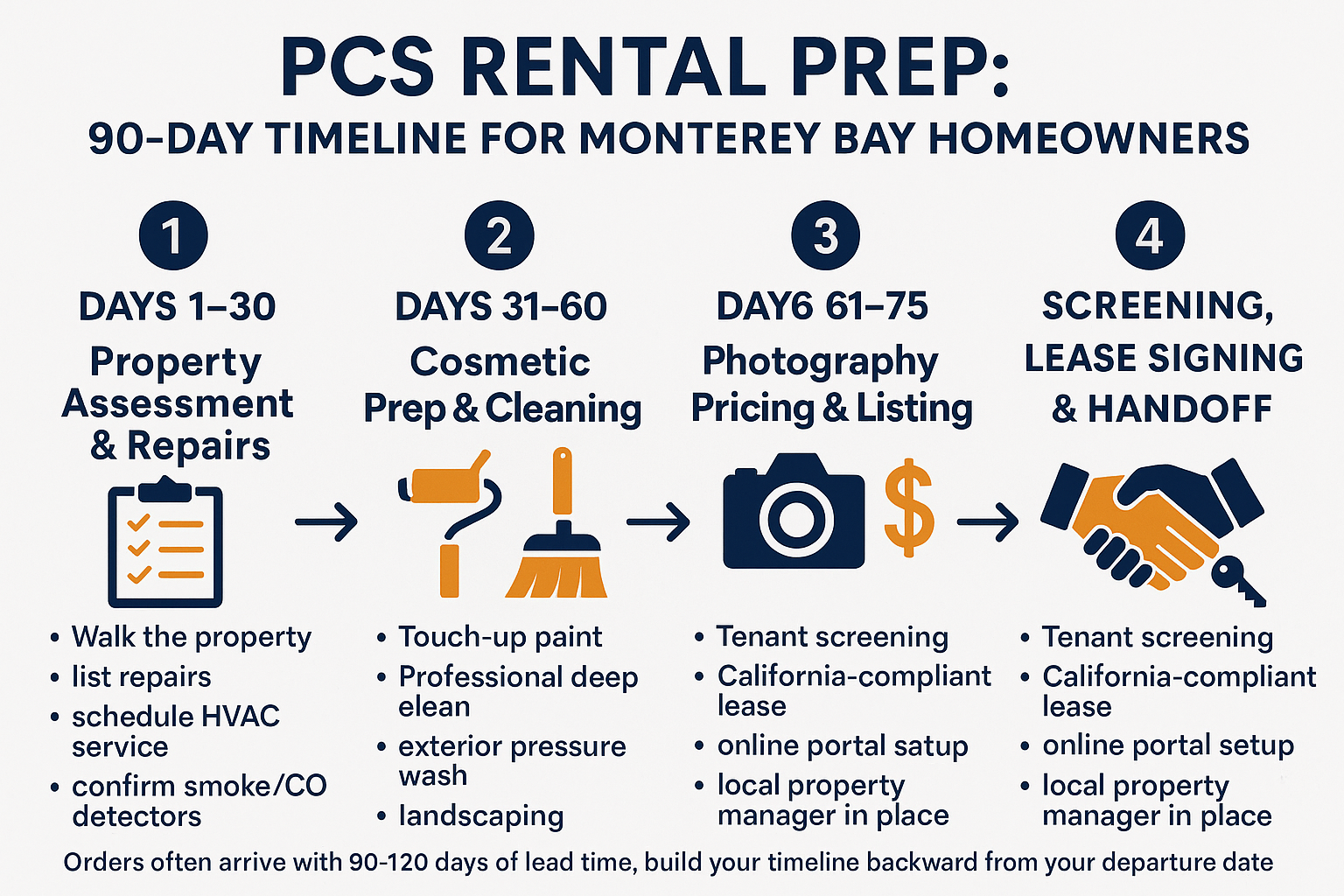
California Compliance: What Out-of-State Military Landlords Often Miss
This is where military owners from other states most often get caught off guard. California rental law is not like most other states, and being an out-of-area owner doesn't exempt you from it.
A few things you need to know before your first tenant moves in:
Security deposit cap. As of July 1, 2024, California limits security deposits to one month's rent for most residential properties, no exceptions for single-family homes or furnished units. This is a real change from prior law, and it affects how much financial cushion you have at move-in. You can read more about what the California Department of Consumer Affairs says about deposit rules, but the short version is: collect what the law allows and document the home's condition thoroughly at move-in.
AB 1482 rent caps. If your Monterey or Salinas home is more than 15 years old, AB 1482's annual rent increase cap likely applies, currently 5% plus local CPI, or 10%, whichever is lower. Many military owners don't know this exists because their home state has no equivalent.
The exemption notice. If your property qualifies for an AB 1482 exemption (most single-family homes do, if the right notice is served), the lease must include specific language notifying the tenant of that exemption. If the notice isn't there, the rent cap protections apply automatically, and you may not realize it until you try to raise rent.
Salinas rental registration. If your property is in Salinas, it must be registered under the city's Residential Rental Registration program. Salinas landlords need to understand this program before placing a tenant, non-compliance creates real exposure. This is not optional and it's not something you can handle after you've left the area.
These aren't obscure technicalities. They're the things that create legal and financial problems for owners who assumed California worked like everywhere else.
California Rules That Apply to Monterey and Salinas Landlords
These are the compliance items that most often catch out-of-area military owners off guard. Each one has real consequences if ignored.
| Rule | What It Does | Who It Affects |
|---|---|---|
| Security Deposit Cap (July 1, 2024) | Limits deposit to 1 month's rent | All residential rentals in California |
| AB 1482 Rent Cap | Caps annual increases at 5% + CPI or 10%, whichever is lower | Most properties 15+ years old |
| AB 1482 Exemption Notice | Single-family homes may be exempt, but only if proper notice is in the lease | SFH owners who qualify for exemption |
| Salinas Rental Registration | Requires city registration before renting | All Salinas rental properties |
| Smoke & CO Detector Compliance | Specific placement and type requirements under California law | All residential rentals statewide |
Managing a Monterey Bay Rental From Hawaii, Virginia, or Germany
This is the part of the equation that feels manageable in theory and gets hard fast in practice.
When you're five time zones away, or on deployment, the operational burden of being a landlord doesn't pause. A water heater fails on a Saturday night in Salinas. A tenant locks themselves out. Rent doesn't post and you need to follow up. None of those things care what your schedule looks like.
I've seen owners in this situation try to self-manage remotely, and it works, until it doesn't. The moment something goes sideways with a tenant or a maintenance issue escalates, the distance becomes a real problem. What happens to your Monterey property when you're 500 miles away walks through what that actually looks like.
What makes remote landlordship feasible is having a solid local support structure in place before you leave:
- A local property manager who has vetted vendors, not a friend doing you a favor
- Online rent collection so payment happens automatically regardless of time zones
- Clear lease language about maintenance reporting and emergency procedures
- A reserves account with enough to cover one to two months of unexpected repairs
One owner who reached out described wanting to keep her home and rent it to a family "for the foreseeable future" while asking for help with pricing, marketing, and the practical steps to get it ready. That's a completely reasonable goal, but it only works reliably with a management structure that doesn't depend on the owner being available.
When self-managing your rental stops making sense is worth reading before you commit to handling it yourself from out of state. The hidden costs of remote self-management, missed maintenance, compliance gaps, difficult tenant situations, tend to be higher than the cost of professional help. The hidden costs of managing a Monterey home from out of state breaks that down in more detail if you want the full picture.
Frequently Asked Questions About Military PCS Rentals in Monterey and Salinas
Can I rent my Salinas or Monterey home while I'm on active duty orders?
Yes. There's no California law that prevents active duty military members from renting their personal residence. You'll want to make sure your homeowner's insurance policy is updated to reflect the rental use, most standard policies don't cover tenant-occupied properties without a rider or a separate landlord policy. Check with your insurer before placing a tenant.
What should I realistically expect my Salinas or Monterey home to rent for?
Rental pricing in Monterey County varies significantly by city, neighborhood, condition, and unit size. A three-bedroom home in Salinas might rent in a different range than a comparable property in Pacific Grove or Seaside. The most reliable way to set a price is a current comparable rental analysis based on what's actually leasing in your specific area, not Zillow estimates, which are often off for this market. How Monterey Bay rental prices actually get set explains the methodology.
Do I need to register my rental property in Salinas before I leave?
Yes. The City of Salinas requires all residential rental properties to be registered under its Residential Rental Registration program. This applies whether you're local or out of the area. Failure to register can create compliance exposure and complicate your relationship with the city if any issues come up with the property.
What's the biggest mistake military owners make when leaving a rental behind?
Leaving without a real management structure in place. This means no local point of contact, no online payment system, and no vendor relationships for maintenance. The first time something breaks, and something always breaks, the owner scrambles from across the country to find a plumber or HVAC technician they've never used, pays emergency rates, and spends hours coordinating something that a local manager would have handled in one call.
Does the AB 1482 rent cap apply to my single-family home?
It might. AB 1482 applies to most California residential properties over 15 years old, including single-family homes. However, single-family homes owned by individual landlords (not corporations or REITs) can qualify for an exemption, but only if the lease includes the required written notice to the tenant. If that notice is missing, the rent cap applies automatically. This is exactly the kind of detail that gets missed by out-of-area owners who drafted their own lease.
Ready to Leave Your Monterey Bay Property in Good Hands?
If you're facing PCS orders and trying to figure out your next move for a property in Salinas, Monterey, or anywhere on the Central Coast, our team works with military homeowners through exactly this process, pricing, prep, compliance, and ongoing management from wherever your orders take you. Reach out by phone at (831) 582-8916 or through the contact form at torrenteproperties.com to talk through your situation.