

Getting a Monterey Bay Rental Ready: What Actually Has to Happen
One of the most common situations I see when an owner first reaches out is this: they've already decided on a rental price, sometimes they've already taken photos, and they want help placing a tenant. The property prep conversation hasn't happened yet. And that order — price first, fix things later — is exactly backwards from how a successful tenancy starts.
The preparation phase is where you set the financial and legal baseline for everything that follows. A property that goes to market before it's truly ready tends to sit longer, attracts applicants who expect a discount for visible deferred maintenance, and creates documentation gaps that become expensive problems after move-in. I've watched this play out enough times across Monterey County that it's not a theory — it's a pattern.
This article focuses on the parts of rental property preparation that owners most often underestimate or sequence wrong: habitability requirements that changed in 2026, safety compliance items that are easy to overlook, and the move-in documentation process that California's new one-month security deposit cap has made far more consequential than it used to be.
The Sequence Matters More Than the Individual Tasks
When I walk a property before it goes on the market, I'm not just making a to-do list. I'm thinking about sequence — what has to happen before what, and why.
The most common mistake I see is owners who want to start marketing while repairs are still pending. The reasoning makes sense on the surface: get the listing up early, find a tenant, then finish the work before they move in. But what actually happens is that applicants see the unfinished condition, form a price expectation based on it, and the owner either settles for a lower rent or starts over after losing time.
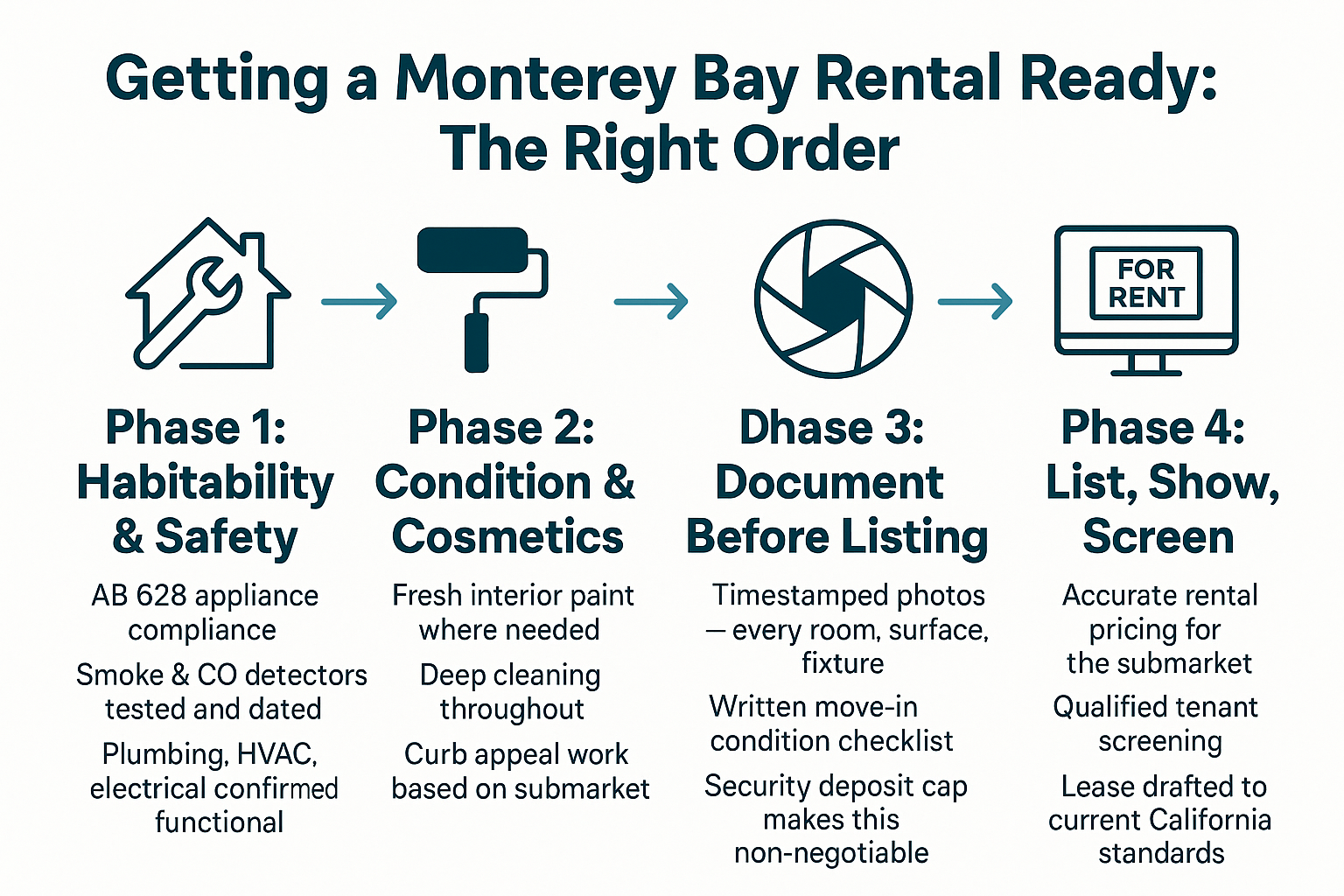
The right order looks like this:
- Address any habitability or safety issues first — these are non-negotiable before a lease can be signed
- Complete cosmetic work that directly affects the rental price in your specific submarket
- Document the finished condition with thorough, timestamped photos before marketing begins
- Then list, show, and screen
That last point about documentation matters more now than it did two years ago. Since California's security deposit cap dropped to one month's rent in July 2024, there's less financial cushion if a tenant causes damage. The move-in photo record is what determines whether a damage claim holds up — not the lease language, not verbal agreements. A thorough photo record taken before the tenant's first day is now one of the most important things an owner can do.

What California's 2026 Habitability Law Actually Changed
Starting January 1, 2026, California's definition of a habitable rental unit expanded under AB 628. The most practical change for owners preparing a property: landlords are now required to provide working stoves and refrigerators as a baseline habitability standard in most residential rentals.
This was previously a gray area. Some owners provided appliances, others didn't, and the legal line was unclear. That line is clear now.
For owners turning over a unit after a long-term tenancy — or putting a property on the market for the first time — this means appliance condition is no longer optional to evaluate. A refrigerator that technically runs but is clearly at the end of its life, or a range with two working burners out of four, creates real legal exposure before anyone signs a lease.
I'd encourage owners to walk the kitchen the way a tenant or inspector would, not the way someone who's lived in the space for years would. When you're used to a room, you stop seeing what's worn out. Fresh eyes matter here.
For a full breakdown of what the 2026 law requires, our article on California's 2026 habitability law changes covers the details that directly affect Monterey Bay landlords.
Smoke and CO Detectors: Small Cost, Serious Consequences
This is the item I see missed most often in owner-managed property preparation. It's also one of the most consequential.
California law requires:
- Working smoke detectors in each bedroom
- Smoke detectors in the hallway outside sleeping areas
- Smoke detectors on every level of the home
- Carbon monoxide detectors on every level that has a bedroom
Beyond placement, detectors must be tested and documented before a tenant takes possession. And here's the part most owners don't know: in Monterey County, a detector that's over 10 years old should be replaced regardless of whether it beeps when you press the test button. The sensor itself degrades with age. A unit that passes a button test can still fail to detect actual smoke or CO.
Replacing outdated detectors typically costs between $15 and $40 per unit depending on the model. It's one of the lowest-cost compliance items on the preparation list and one of the most skipped. I've walked properties where the detectors were original to a 1990s remodel. The owners had no idea how long they'd been there.
The California State Fire Marshal's residential detector requirements are publicly available and worth a read if you want the statutory language.
The Rental Preparation Sequence at a Glance
This overview shows the four phases of property preparation in the order they should actually happen — and what belongs in each phase.
Where to Spend and Where to Hold Back
One question I hear from owners is: what's the most economical way to get my property ready? That's exactly the right question. And the honest answer is that not every improvement pays off equally in the Monterey Bay market.
A few principles I've seen hold up consistently across Monterey County:
Fresh interior paint and deep cleaning almost always return more than they cost. A clean, freshly painted unit photographs better, shows better, and signals to applicants that the owner maintains the property. This matters everywhere from Salinas to Pacific Grove.
Landscaping and curb appeal carry more weight in Carmel and Pacific Grove, where exterior presentation is built into rental price expectations. A property on a tree-lined street in Pacific Grove that hasn't had its front beds maintained will rent below its potential even if the interior is flawless.
Kitchen and bathroom cosmetics matter more in Salinas, where competition among similarly priced units is tighter and applicants are comparing options closely. A clean, functional kitchen in a Salinas rental is a stronger differentiator than it might be in a market with less inventory.
Owners with long-term tenants vacating after five, ten, or even thirty years need to look at their property especially carefully. What feels livable to someone who's grown used to it often has water heater age issues, slow drains, failing weatherstripping, and surfaces that are technically functional but visually tired. The Monterey Bay's marine layer accelerates exterior wear — roofs, gutters, and siding here take more abuse than they would inland, and those items deserve close attention before the first showing.
For more on how submarket conditions affect what you can actually charge, how Monterey Bay rental prices get set is worth reading before you decide where to put your preparation dollars.
Preparation Tasks by Priority and Typical Cost Range
These are the preparation items that come up most consistently when we walk a property in Monterey County, organized by their likely impact and approximate cost range. Actual costs vary by property size, contractor, and condition — get a specific quote before budgeting.
| Task | Why It Matters | Typical Cost Range (Monterey County) |
|---|---|---|
| Smoke & CO detector replacement | Legal requirement; sensors degrade after 10 years | $15–$40 per unit |
| Interior paint (full unit) | Highest ROI cosmetic item; affects photos and first impression | $800–$2,500+ depending on size |
| Professional deep cleaning | Move-in condition baseline; supports documentation | $200–$600+ depending on size |
| Appliance inspection or replacement | Required under AB 628 as of January 1, 2026 | Varies; budgeted per appliance condition |
| Plumbing drain inspection | Slow drains in long-tenanted homes are common; prevents early complaints | $75–$200 for a basic assessment |
| Exterior/gutter cleaning | Marine layer accelerates moisture issues; gutter failures cause water intrusion | $150–$400 depending on roofline |
| Move-in photo documentation | Critical under one-month security deposit cap; determines damage recovery | Low cost; professional service varies |
Why the Move-In Documentation Step Is No Longer Optional
I want to come back to the security deposit issue because it's changed the risk math in a way that a lot of owners haven't fully absorbed yet.
Before July 1, 2024, California allowed landlords to collect up to two months' rent as a security deposit for unfurnished units. That changed with the new one-month cap. For a property renting at $2,800 a month in Seaside or $3,200 in Monterey, that's a meaningful reduction in the financial cushion available if a tenant causes damage.
With less deposit to draw from, the move-in condition record has become the single most important document in a tenancy. A timestamped photo record of every room, every surface, every fixture, and every appliance — taken before the tenant's first day — is what a damage claim actually rests on. If the documentation is thin or casual, a legitimate claim becomes very hard to enforce, regardless of how thorough the lease is.
Owners who skip this step or do it with a few quick phone photos are essentially reducing their own recovery rights before the tenancy even begins.
This is also why the preparation sequence matters. If you document the property before the cosmetic work is finished, you've created a record of the property in substandard condition. You need to document after everything is done and before the tenant takes possession.
For owners thinking about what else changes when you're not present to manage a property day-to-day, what changes when you're not around covers the oversight side of that equation.
Frequently Asked Questions About Rental Property Preparation in Monterey County
Does a property really need to be fully ready before I start showing it?
In most cases, yes. Applicants form price expectations based on what they see during a showing. A property with visible unfinished work — even minor things — tends to attract applicants who assume the rent should be lower to reflect the condition. You'll get better applicants and stronger offers from a property that shows as move-in ready. The exception might be a minor item you can complete between application and lease signing, but even then, document the finished condition before the tenant takes possession.
What does AB 628 actually require me to provide in terms of appliances?
As of January 1, 2026, California requires landlords to provide a working stove and refrigerator in most residential rentals as a baseline habitability standard. 'Working' means fully functional — not partially operational. A range with only some burners working, or a refrigerator that runs but doesn't maintain safe temperatures, would create legal exposure. Our 2026 habitability law guide covers the specifics in plain language.
How old is too old for a smoke detector?
Ten years is the general industry standard, and the one we apply in Monterey County. After a decade, the electrochemical sensor inside the detector degrades — meaning the unit can pass a button test but still fail to detect actual smoke. Check the manufacture date on the back of the unit. If it's more than ten years old, replace it before the property is listed.
I have a tenant who's been there for over ten years. What should I expect when they leave?
More than most owners expect. Long-tenanted properties often have accumulated deferred maintenance that's invisible until someone looks closely: slow drains, aging water heaters, weatherstripping that's been failing for years, and interior surfaces that are functional but visually worn. The Monterey Bay's marine layer is also harder on exteriors than inland climates — gutters, siding, and roofing take more abuse here. Plan for a methodical walkthrough that covers exterior, plumbing, HVAC, appliances, and safety devices before you budget for the turnover.
Does preparation actually affect what I can charge in rent?
In some submarkets more than others. Salinas has more direct competition among similar rental units, so presentation there has a measurable effect on pricing and days on market. In Carmel and Pacific Grove, curb appeal is part of the rental price expectation — properties with neglected exteriors rent below their potential even when the interiors are fine. In all markets, a clean, freshly painted property with documented move-in condition commands more confidence from qualified applicants. That's not just aesthetics — it affects who applies and whether they accept your terms.
Is there a difference between what I need to do for a first tenancy versus a turnover?
The habitability and safety standards are the same either way. The practical difference is that a first tenancy on a property you've occupied yourself often involves more deferred items — things you've adapted to over years that a tenant will notice immediately. A turnover after a long-term tenant involves understanding what wear was normal versus what the departing tenant is responsible for, which is exactly what the move-in documentation from the previous lease was supposed to establish.
Questions About Getting Your Property Ready to Rent?
Our team has been preparing rental properties across Monterey County for over 25 years — from single-family homes in Salinas to townhouses near the Naval Postgraduate School in Monterey, where military families often need move-in-ready housing on a tight timeline. If you have questions about the right preparation sequence, which repairs actually affect your rental price in your specific submarket, or what current habitability standards require, we're happy to talk it through. Reach us by phone at (831) 582-8916 or through the contact form at torrenteproperties.com.

Owning a Second Home on the Monterey Peninsula While You're Not There
A Carmel homeowner reached out to us not long ago asking for regularly scheduled home inspections during my absence from the property. That's an exact quote. She wasn't dealing with a crisis — she just knew what she didn't know: what was happening to her house while she was gone.
That's a question we hear often from seasonal owners across Carmel, Pacific Grove, and Pebble Beach. Many of them are away for four to six months at a stretch, returning in spring to find problems that didn't exist when they left in the fall. Sometimes it's a minor landscape issue. Sometimes it's a lot worse.
This article is about what actually happens to a vacant home on the Monterey Peninsula during an extended absence — and what a professional caretaker service for seasonal homes actually does to protect it.
The First Few Weeks Are When the Most Damage Happens
Most owners picture vacancy risk as something that builds slowly — a gradual decline over many months. In my experience, that's not how it works. The most consequential failures tend to happen early, and they compound fast if no one catches them.
A slow drip under a sink goes unnoticed for six weeks. The subfloor absorbs moisture. Mold begins growing inside the cabinet. What would have been a $150 plumber visit turns into a flooring and remediation job that costs far more — and your insurance company will want to know why no one caught it sooner.
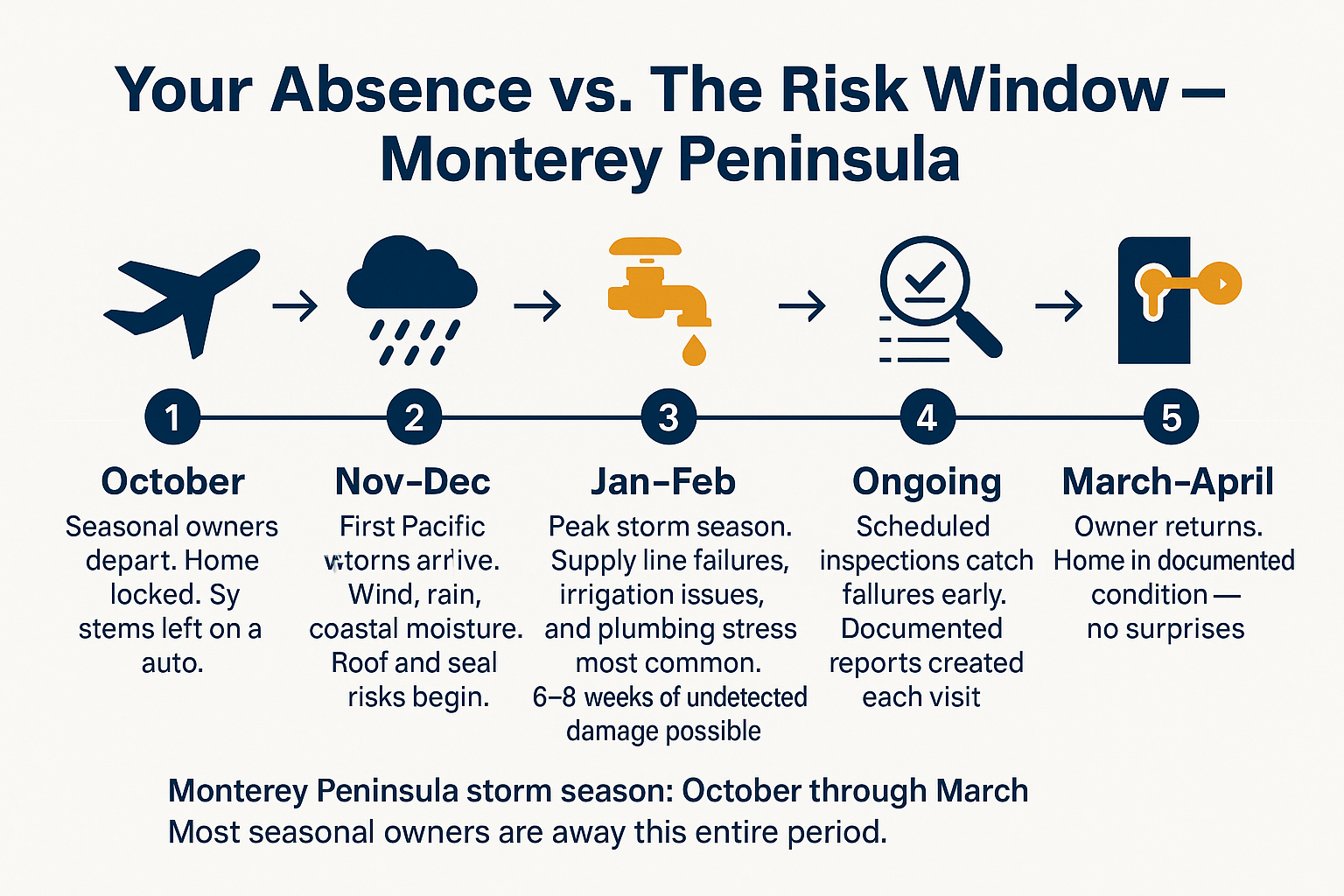
On the Monterey Peninsula specifically, the coastal environment accelerates all of this. The marine layer keeps exterior wood surfaces damp for long stretches. Wind drives moisture into roofline details and window seals. Pacific storms between October and March — exactly when most seasonal owners are away — can move tree limbs, strip flashing, and send water into places it was never meant to go.
The risks I see most often with vacant Peninsula homes:
- Water intrusion through roof, windows, or failed door seals
- Plumbing failures, including supply line leaks and drain line issues
- Irrigation system failures that cause erosion or standing water near the foundation
- Pest activity — rodents and insects move into vacant structures quickly
- Landscape overgrowth or storm damage that affects fences, drainage, or the structure itself
None of these announce themselves. They sit and get worse until someone walks through the door. If that someone is you, returning after five months away, the damage is already done.
What a Professional Home Watch Visit Actually Covers
When homeowners hear "caretaker service" or "home watch," they often picture someone walking through the front door, glancing around, and leaving. That's not what a structured inspection looks like.
A thorough visit to a vacant home covers specific, concrete items — not a general impression. Here's what we're actually checking:
- Water leaks — under sinks, at supply lines, around the water heater, and at the washing machine connection
- Running fixtures — briefly running faucets and flushing toilets to prevent stagnant water in drain lines, which can create odor and pest attraction
- HVAC function — verifying the system is cycling properly and filters aren't clogged
- Security systems — confirming sensors are active and no alerts have been triggered
- Pest indicators — checking for droppings, entry points, nesting material, or signs of recent activity
- Exterior review — roof visible from ground level, gutters, downspouts, perimeter fencing, and any storm damage
- Landscape condition — irrigation running as set, no dead vegetation creating fire risk, no overgrowth blocking drainage
- Utility parameters — confirming water, gas, and electricity are operating within normal ranges
For owners who rely on a neighbor or a housekeeper to "keep an eye on things," I'd gently push back on that. A friendly check-in isn't the same thing as a structured walk-through. And a neighbor has no obligation to escalate anything or coordinate a repair vendor when something goes wrong.
You can read more about the specific risks that develop in vacant homes — and who bears responsibility when they do — in what can go wrong in an empty house.
The Seasonal Absence Risk Window on the Monterey Peninsula
This timeline maps the most common seasonal absence period against the weather events and property risks that occur during those same months.
The Paper Trail Most Owners Don't Think About Until They Need It
One benefit of professional home watch service that almost never comes up in initial conversations — but matters a lot later — is documentation.
Every inspection visit should produce a dated report with written notes and photos. Over time, that record becomes something genuinely useful:
- Insurance claims: If damage is discovered, a documented inspection history establishes when the damage first appeared and what the property's prior condition was. Carriers look for evidence of neglect in vacant home claims. Dated photos showing clean, maintained conditions are your defense.
- Maintenance planning: When you can see that a particular roof section has shown minor granule loss across three consecutive inspection photos, you can plan a repair before it becomes an emergency replacement.
- Contractor accountability: If a vendor tells you a repair is needed because of long-term neglect, your inspection record either confirms or contradicts that assessment. Owners who rely on informal check-ins rarely have this kind of organized baseline.
The National Association of Insurance Commissioners notes that standard homeowners insurance policies often have specific vacancy clauses — some as short as 30 to 60 days — after which coverage for certain types of damage may be reduced or denied. A documented inspection program is one of the clearest ways to demonstrate that a property was being actively monitored.
For a deeper look at how inspection frequency should be set, how often someone should check on a vacant home in Monterey Bay walks through the variables that should drive that decision.
Informal Check-In vs. Professional Home Watch: What's Actually Different
Owners often assume a neighbor's visit covers the same ground as a professional inspection. Here's how the two actually compare.
| What Gets Checked | Neighbor / Housekeeper | Professional Home Watch |
|---|---|---|
| Visual walk-through | Varies — usually quick | Structured, every visit |
| Plumbing and leak check | Rarely | Standard item |
| Running fixtures to clear drain lines | Almost never | Standard item |
| HVAC verification | No | Standard item |
| Pest activity review | Unlikely | Standard item |
| Exterior and roof-line review | Occasional | Standard item |
| Irrigation and landscape status | Varies | Standard item |
| Written report with photos | No | Every visit |
| Vendor coordination if issue found | No | Yes |
| Escalation protocol for emergencies | No | Yes |
What Happens When Something Actually Goes Wrong
Detection is only half of the value. The other half is what happens after a problem is found.
An owner who's 500 miles away — or in another time zone — can't call a plumber, meet a roofer, or get three quotes for a fence repair. If the person checking on the property doesn't have vendor relationships and the authority to act, the discovery of a problem just creates a new problem: who handles it?
A professional caretaker service maintains relationships with licensed, insured local contractors. When we find something that needs attention, we can coordinate the response, get work authorized by the owner, supervise the repair, and document the outcome — all without the owner having to fly back or manage phone tag across time zones.
We've written about the hidden costs of managing a Monterey home from out of state before — and this is exactly the kind of friction those costs come from. A small unresolved issue, multiplied by the difficulty of managing it remotely, becomes expensive fast.
For owners who are also thinking about renting their Peninsula property rather than leaving it vacant, how Carmel homeowners are protecting properties without living in them covers the decision-making involved in both paths.
Frequently Asked Questions About Caretaker Services for Seasonal Homes
How often should a vacant home on the Monterey Peninsula be inspected?
It depends on the property's age, systems, and the time of year. During the October through March storm season, we generally recommend visits every two to four weeks at minimum. A newer home with modern plumbing and a recently replaced roof can tolerate longer intervals between checks than an older Carmel cottage with original wood windows and aging fixtures. The specific inspection frequency should be set based on the actual risk profile of the property — not a one-size schedule.
What's the difference between home watch and property management?
Home watch or caretaker service is specifically for vacant or seasonally unoccupied homes — there are no tenants, no rent to collect, and no lease to manage. Property management covers occupied rental properties: tenant placement, rent collection, maintenance coordination, and legal compliance. Some owners eventually decide to rent their seasonal home rather than leave it vacant, at which point the service transitions. But the two are distinct and serve different needs.
Will my homeowners insurance cover damage that occurs while my home is vacant?
Possibly — but with important limitations. Most standard homeowners policies include a vacancy clause that reduces or excludes coverage for certain damage types after the home has been unoccupied for 30 to 60 days. The exact terms vary by carrier and policy. A documented inspection program, showing the home was being actively monitored, can be critical evidence in a claim. You should review your specific policy's vacancy provisions and speak with your insurance agent before leaving for an extended period.
Can a caretaker service also handle landscaping, utilities, and vendor coordination?
Yes — this is part of what separates a professional service from a simple check-in. Coordinating with landscaping contractors, verifying that utility accounts are active and within normal parameters, and managing vendor relationships for routine maintenance are all components of a full caretaker arrangement. The Pacific Grove owner who reached out to us about a vacant building specifically asked about general landscaping and on-site inspection — those two things naturally go together because landscape neglect creates its own structural and drainage risks.
What if I only need someone to check in a few times, not on a regular schedule?
For very short absences, an informal check-in may be sufficient. But for absences of six weeks or more — especially during storm season — a structured, recurring schedule produces meaningfully better outcomes than ad hoc visits. The value of regular inspection is the ability to catch a slow-developing problem before it becomes acute. A one-time check-in two months into an absence may find a problem that's already been sitting for eight weeks.
Thinking About Who's Watching Your Property While You're Away?
If you own a seasonal or second home in Carmel, Pacific Grove, Pebble Beach, or elsewhere on the Monterey Peninsula, we're happy to talk through what a home watch arrangement would look like for your specific property. Torrente Properties has been working with Monterey County owners for over 25 years, and we understand the coastal environment and the real risks that come with extended vacancy. Reach us at (831) 582-8916 or through the contact form at torrenteproperties.com.
What a Real Tenant Screening Process Looks Like — and Why It Matters
One of the most common things I hear from owners reaching out about their properties — in Salinas, Marina, Prunedale, and Monterey — is some version of: 'I just need help finding good tenants.' I understand why they frame it that way. But finding tenants and screening tenants are two completely different activities, and mixing them up is where most self-managing landlords run into serious trouble.
Marketing a vacancy — pricing it right, writing a good listing, getting it in front of qualified renters — is how you generate applications. Screening is the documented process that determines which applicant actually moves in. One fills your inbox. The other protects your property, your income, and your legal standing for the length of the tenancy.
With California's one-month security deposit cap now in effect (as of July 1, 2024), there is less financial cushion at move-in than there used to be. That makes the screening decision more consequential, not less. Getting this step right is worth understanding in real detail — and that's what this article walks through.
What the Screening Process Actually Covers
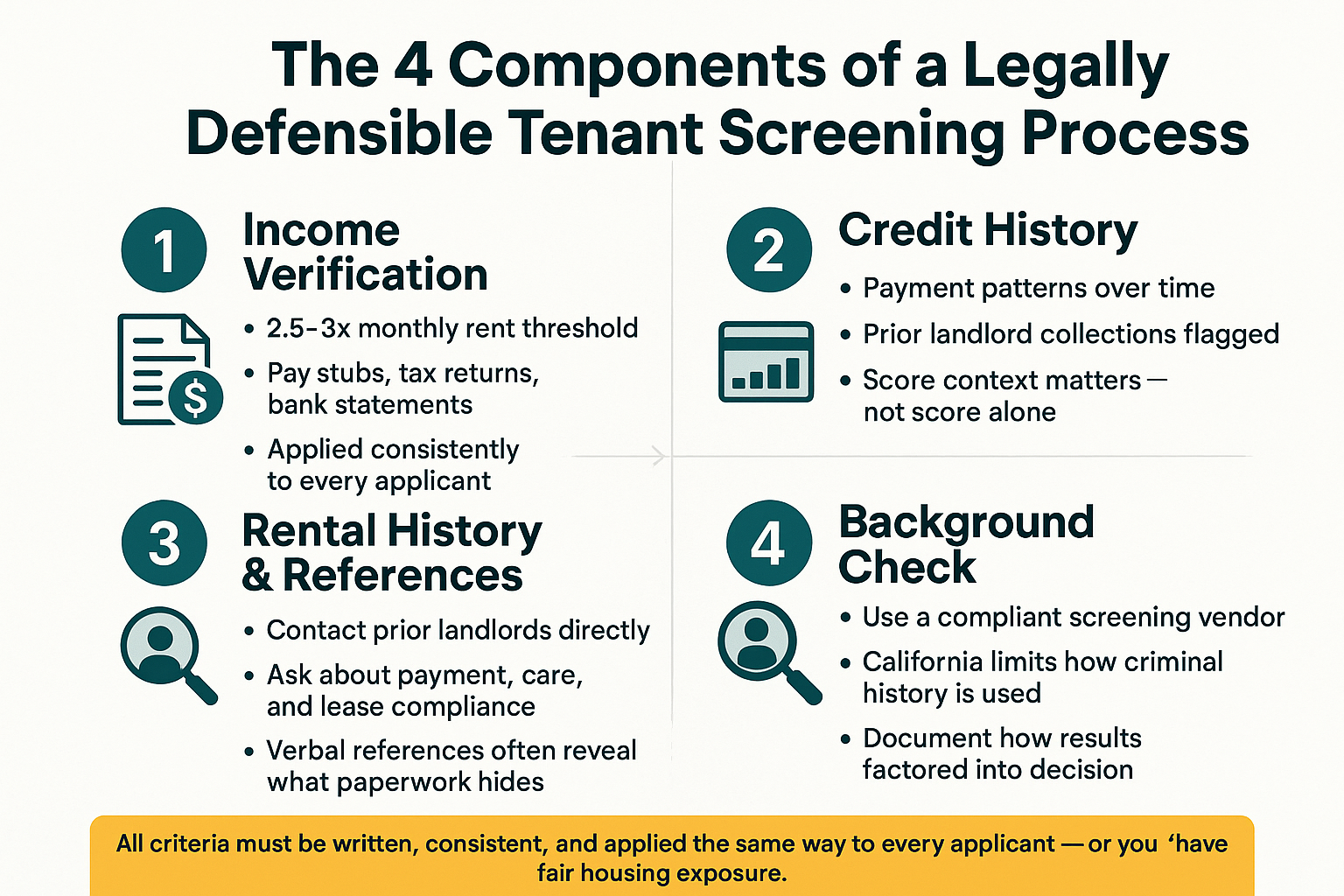
A real screening process has four components, and all four matter. Income, credit, rental history, and background — each one tells you something different about whether this person will pay on time, treat the property with care, and honor the lease.
Income verification is typically benchmarked at 2.5 to 3 times the monthly rent. For a $2,400/month rental in Salinas, that means the applicant's gross monthly income should fall somewhere between $6,000 and $7,200. Pay stubs, employer verification letters, bank statements, and tax returns are all acceptable documentation — the key is consistency. Whatever you require from one applicant, you ask of all of them.
Credit history tells you how someone handles financial obligations generally. A strong credit score is a positive signal, but I pay more attention to patterns: recent missed payments, collections from former landlords, or a history of accounts sent to collections are all worth weighing carefully.
Rental history and references are often the most honest predictor of how a tenancy will go. I want to speak with a prior landlord — not just receive a name. A 5-minute phone call can surface information that no application form captures.
Background checks round out the picture. California law limits how criminal history can be used in tenant selection, so this component requires care. But it remains a legitimate part of a complete screening file when applied consistently and documented correctly.
The word I keep coming back to is documented. Every criterion needs to be written down before you review a single application — and applied the same way to every applicant who walks in the door.
What California Law Says You Cannot Use
This is the part of screening that catches self-managing landlords off guard — and creates real legal exposure when handled casually.
California's Fair Housing Act and related state statutes prohibit using certain characteristics as screening criteria. A gut feeling from a showing is not a legal basis for denying an application. Neither are factors tied to protected classes. The characteristics that cannot factor into your screening decision include:
- Source of income — this includes Section 8 housing vouchers, which California law explicitly protects in most jurisdictions
- Familial status — whether an applicant has children
- Race, national origin, religion, sex, disability, marital status, or sexual orientation
- Immigration or citizenship status in many California contexts
The problem I see most often with self-managing landlords isn't intentional discrimination — it's undocumented decision-making. When you don't have written criteria applied consistently, any denial can look discriminatory, even when the actual reason was financial. That's a fair housing complaint waiting to happen.
If you're managing properties in Salinas, where the rental population includes a large Spanish-speaking community, this matters especially. Applicants have rights, and those rights are actively enforced. The California Department of Fair Employment and Housing provides guidance on protected characteristics and what landlords must document when taking adverse action.
For a deeper look at the compliance obligations that come with renting in Salinas specifically, the Salinas Rental Registration Program landlord guide lays out what the city currently requires of property owners.
The 4 Components of a Legally Defensible Screening Process
This infographic breaks down the four required components of a compliant California tenant screening process and what each one involves.
AB 1414 and What 'Compliant Screening' Will Require Starting January 2026
Most self-managing landlords I talk to have no idea this law exists. AB 1414, effective January 2026, adds new requirements around how tenant screening vendors handle applicant data — and it puts more responsibility on landlords who use those vendors.
If you use an off-the-shelf background check service to screen tenants, you need to verify that the vendor maintains proper data security procedures and can issue legally compliant adverse action notices. An adverse action notice is what you're required to send any applicant you deny, explaining what information contributed to that decision and where it came from.
Three things that make a screening process compliant under current and coming California requirements:
- Written screening criteria established before any applications are reviewed
- Documented adverse action notices sent to denied applicants — not just a 'we went another direction' email
- Vendor accountability — the background check service you use must be able to demonstrate data security compliance and proper breach notification procedures
Many popular consumer-facing background check apps were not built with AB 1414 compliance in mind. This is one of the reasons self-managing your rental becomes increasingly risky as California's landlord-tenant law grows more specific each year.
Common Screening Criteria: Allowed vs. Not Allowed in California
California law is specific about what can and cannot factor into a tenant screening decision. This table summarizes the key distinctions.
| Criterion | Can Be Used? | Notes |
|---|---|---|
| Income verification (2.5–3x rent) | Yes | Must be applied consistently to all applicants |
| Credit history and payment patterns | Yes | Document how results were weighed |
| Rental history and prior landlord references | Yes | Verbal confirmation of references is best practice |
| Background check results | Yes, with limits | California restricts how criminal history can factor in; consult legal counsel |
| Section 8 / housing voucher (source of income) | No | Protected under California law in most jurisdictions |
| Familial status (having children) | No | Fair Housing violation |
| National origin, race, religion, sex, disability | No | Federal and California Fair Housing law |
| Gut feeling from a showing | No | Not a documented criterion; creates liability |
Why Move-In Documentation Is Part of the Screening Decision
Screening doesn't end when you choose a tenant. The move-in process — specifically, how you document the property's condition before handing over keys — is the final layer of protection that most self-managing landlords skip entirely.
With California's deposit cap at one month's rent, you have less financial buffer than you did before July 2024. If a tenant causes damage and disputes your deductions, the documentation you created at move-in is your entire evidence base. Without it, you're arguing your word against theirs — and California's small claims process tends not to favor undocumented landlord claims.
A complete move-in package includes:
- A written room-by-room inventory noting the condition of every wall, floor, fixture, and appliance
- Timestamped photos of every room and surface — not just the kitchen and bathrooms, but closets, baseboards, and exterior areas
- Tenant signature on the move-in condition report, acknowledging the documented state of the property
This documentation is not bureaucratic paperwork for its own sake. It's the foundation that makes a legitimate deposit deduction defensible — and it's what separates a smooth move-out from a dispute that drags on for months.
If you want to understand how lease terms connect to this, our article on what California landlords need to know about lease changes in 2026 covers the updated habitability and documentation standards now in effect.
Frequently Asked Questions About Tenant Screening for Monterey Bay Landlords
Can I just run a credit check and skip the other steps?
Not if you want to be protected. Credit alone won't tell you whether someone has a history of disputes with prior landlords, whether their income is stable, or whether a previous property management company has notes on the file. A credit score is one data point. A complete screening file is what protects you when something goes wrong six months into a tenancy.
If I decide not to rent to someone, what do I have to send them?
Under California law, you're required to send an adverse action notice to any applicant you deny based on information from a consumer report — which includes credit checks and background checks. The notice must identify the consumer reporting agency you used, explain that the agency did not make the rental decision, and inform the applicant of their right to dispute the information. AB 1414 adds additional requirements around how this process is documented starting in January 2026.
Can I decline an applicant who has a Section 8 voucher?
In most California jurisdictions, no. Source of income — including housing vouchers — is a protected characteristic under state law. Declining an otherwise qualified applicant solely because they use a Section 8 voucher creates fair housing liability. If you have specific questions about how this applies to your property in Salinas, Monterey, or elsewhere in the county, a licensed property manager or real estate attorney is the right resource.
How do I know if the background check service I'm using is compliant?
Ask the vendor directly — in writing — whether they maintain data security procedures that meet California's consumer data protection requirements, and whether their adverse action notice process is compliant with AB 1414. If they can't answer clearly, that's a signal. Many consumer-facing apps were designed for convenience, not California legal compliance.
What if the tenant damages the property and disputes the deposit deduction?
This is where move-in documentation becomes everything. If you have a signed move-in report, timestamped photos, and a written inventory, you have an evidence base. Without those, a tenant's word carries just as much weight as yours in a dispute — and California's small claims process will often favor the tenant when the landlord's records are thin. The time to build that evidence is the day before move-in, not the day after move-out.
Does the screening process change for furnished rentals?
The applicant screening criteria stay the same — income, credit, rental history, background. But the move-in documentation becomes even more important when furniture and personal property are included. Every piece of furniture, appliance, and fixture should be inventoried with photos and noted in the move-in report that the tenant signs.
Screening Is the Most Consequential Decision in the Entire Tenancy
I want to say this plainly, because it gets glossed over in most landlord guides: the tenant you choose at move-in determines almost everything that follows. Whether rent arrives on time. Whether maintenance calls are reasonable or constant. Whether move-out is clean or contentious. Whether you're filing for eviction in six months or renewing a lease.
No property management system — no online portal, no inspection schedule, no lease clause — fully compensates for a poor placement decision upfront. The math is simple: a thorough screening process costs time before move-in. A bad tenant costs money, stress, and months of your life after.
For owners managing properties in Salinas, where the rental market moves quickly and competition for qualified tenants is real, understanding what a Salinas property manager is actually doing on your behalf gives a clearer picture of how this process should work in practice. And if you're weighing whether the management model itself makes sense for your situation, this look at the hidden costs of managing a Monterey home from out of state puts the full picture in financial terms.
Questions About How Screening Works for Your Property?
Our team at Torrente Properties has been placing and screening tenants across Monterey County for over 25 years — from single-family homes in Salinas to townhouses in Monterey and studios in Marina. If you have questions about how a documented screening process works, what California law currently requires, or whether your current approach is creating exposure you're not aware of, we're glad to talk it through. Reach us at (831) 582-8916 or through the contact form at torrenteproperties.com.

When Self-Managing Your Rental Stops Making Sense
Most landlords I've spoken with didn't start out planning to self-manage forever. They started because it felt like the responsible thing to do — keep fees low, stay close to the property, know exactly what's happening. And honestly, for a single nearby rental with a reliable long-term tenant, that logic isn't wrong.
But something changes. A tenant gives notice. An owner relocates to another state. A property manager who'd been handling things for years steps away unexpectedly. Suddenly what felt manageable becomes a full second job — one you didn't apply for and didn't budget time for.
I've seen this happen with properties across Salinas, Seaside, Marina, and Monterey — and the owners who reach out aren't failing. They're being realistic. Recognizing the inflection point isn't a defeat. It's good judgment.
The Real Cost of Self-Management Is Mostly Invisible
When owners calculate whether professional management is worth it, they usually compare the management fee against the rent collected. That math looks straightforward. But it leaves out the part that actually costs the most: your time.
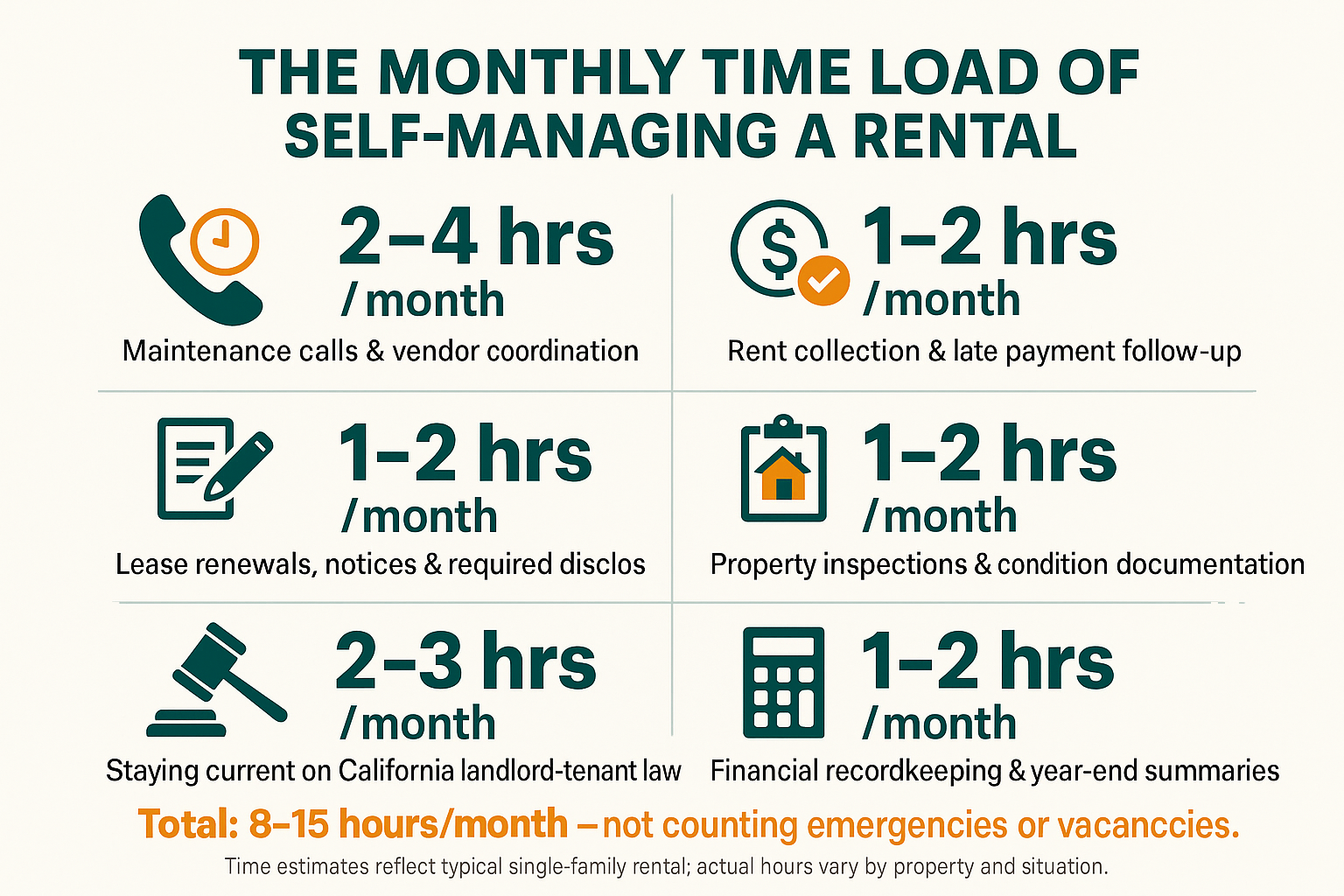
Think through what self-management actually involves on a recurring basis:
- Fielding maintenance calls — including the ones at 10pm about a broken heater
- Sourcing and coordinating vendors when something needs repair
- Tracking rent payments and following up on anything late
- Handling lease renewals, rent increase notices, and required disclosures
- Completing move-out accounting and security deposit returns within California's 21-day window
- Staying current on California law changes that affect your lease or obligations
Each of those tasks takes real time. If you're working full-time or living more than an hour from the property — and many owners I speak with are in the Bay Area, out of state, or managing properties they inherited — the hours add up fast. One owner in North Salinas described managing their rental for over two years before reaching out about professional management, noting that the process had become far more demanding than they'd anticipated. That's an honest and common story.
When you assign even a modest hourly value to that time, the fee structure of professional management starts looking very different. There's also a deeper issue: the hidden costs of managing a Monterey home from out of state go well beyond hours — deferred maintenance, missed rent increases, and compliance gaps all carry financial consequences that don't show up until they're already a problem.

Why Self-Screening Tenants Creates Legal Exposure
This one doesn't get talked about enough. When a landlord shows the property themselves and interviews applicants directly, the screening process often becomes subjective without the owner realizing it. A good feeling about someone, a shared background, a conversational impression — these aren't criteria, but they influence decisions.
California's fair housing laws are specific and enforceable. Decisions that appear to favor or exclude applicants based on protected characteristics — even unintentionally — can result in formal complaints and real liability. The protection isn't just for tenants. A documented, consistent screening process protects the owner.
A professional screening process applies the same criteria to every applicant:
- Credit history reviewed against a defined threshold
- Income verification at a set ratio to monthly rent
- Rental history checked with previous landlords
- Background screening applied uniformly
When those criteria are written down, applied consistently, and documented in a file, the owner has a defensible record. Several owners who reached out to our team asked specifically about help finding "good tenants" — which is the right instinct. But good tenants come from a good process, not from a gut feeling on a Saturday afternoon showing.
For a deeper look at what that screening process actually produces over time, what makes some rental properties consistently attract reliable tenants is worth reading.
What Self-Management Actually Costs Per Month
This breakdown shows the recurring time and task load most self-managing landlords carry — and rarely account for when comparing options.
Self-Management vs. Professional Management: What Changes
This isn't about which option is universally better — it's about which one fits your actual situation. Here's an honest side-by-side of what shifts when you hand off management.
| Task | Self-Managing Owner | Professional Manager |
|---|---|---|
| Tenant screening | Owner applies own judgment; documentation varies | Consistent written criteria applied to every applicant |
| Maintenance response | Owner sources vendors, coordinates access, follows up | Manager handles end-to-end with established vendor network |
| Late rent follow-up | Owner contacts tenant directly; can feel personal | Manager handles per lease terms, documented and neutral |
| California law compliance | Owner researches changes independently | Manager tracks AB/SB updates, security deposit rules, registration requirements |
| Lease renewals | Owner drafts or reuses prior lease | Manager prepares current, compliant lease reflecting law changes |
| After-hours emergencies | Owner receives the call | Manager's team fields and responds |
| Financial reporting | Owner maintains own records | Monthly statements and year-end summaries provided |
The Part Nobody Talks About: Psychological Weight
There's a version of this conversation that's purely financial, and I've had it many times. But the version that actually moves people to act is different. It's about being tired.
Tired of being the person a tenant calls at night. Tired of not knowing whether the property is being cared for. Tired of carrying the mental load of every unpaid bill, every maintenance request, every lease question — while also living your actual life.
One property owner who'd worked with our team described the experience simply as "peace of mind." That phrase shows up again and again from owners who've made the transition. It's not a marketing line — it's what people say when they describe what changed.
This is especially true for owners who are geographically distant, for families managing an inherited property, and for landlords who've reached a point in life where they simply want the income without the operations. Wanting that isn't laziness. It's a legitimate reason to make a change, and it's one of the most common things I hear from new clients.
For owners wondering whether professional management actually improves the financial outcome — not just the peace of mind — do property managers really increase profit, or just maintain the property addresses that question directly.
What Happens When You Already Have a Tenant in Place
One thing I hear regularly is the assumption that transitioning to professional management mid-tenancy is complicated — that it means disrupting a tenant relationship or waiting for the lease to expire. That's not how it works in practice.
A competent property manager can step in with a current tenant in place. Here's what that process typically looks like:
- Written introduction to the existing tenant explaining the management change and new contact information for rent and maintenance
- Transfer of rent collection to the management system, with clear instructions for the tenant
- Baseline property inspection to document current condition — this protects both the owner and the tenant
- Lease review to identify any terms that need to be updated, formalized, or brought into compliance with current California law
The tenant usually experiences minimal disruption. The owner gets operational relief almost immediately.
For properties in Salinas specifically, there are also registration requirements that a property manager should be handling on the owner's behalf from day one. What the Salinas Rental Registration Program requires right now is something every Salinas landlord should understand regardless of who manages the property — but it's one more thing that falls off a self-managing owner's plate when a professional steps in.
California law has also changed in ways that affect what every lease must include. Your rental lease changed in 2026 covers what landlords need to know about recent habitability law updates — the kind of compliance detail that's easy to miss when you're managing everything yourself.
Frequently Asked Questions About Switching to Property Management
How much does professional property management typically cost in Monterey County?
Management fees in California generally run somewhere between 8% and 12% of monthly rent collected, though this varies based on property type, number of units, and the scope of services included. Leasing fees — charged when a new tenant is placed — are typically separate and can range from a partial to a full month's rent depending on the company. The only way to get an accurate number for your specific property is to ask for a quote directly, since the details of what's included vary considerably.
Can I switch to a property manager if my tenant is already living in the property?
Yes — and it's more common than most owners realize. The manager introduces themselves to the tenant in writing, transfers rent collection, does a baseline inspection, and reviews the existing lease. The tenant's day-to-day experience changes very little. The owner's does.
What's the real risk of screening tenants yourself?
The main risk is inconsistency. California's fair housing protections apply to every part of the rental process, including how you evaluate and select applicants. If your screening decisions aren't based on the same documented criteria for every applicant, you're exposed — even if your intentions were good. A formal process with written standards protects you legally and tends to produce better tenants over time.
What happens to the security deposit when I transfer management?
In California, security deposits must be handled carefully during a management transition. The deposit typically transfers to the new manager, and the tenant should be notified in writing of where it's being held. Under California law, residential security deposits are now capped at one month's rent for unfurnished units as of July 1, 2024. A property manager should document the current deposit amount and confirm it's properly accounted for at the time of transfer.
I live out of state — is that a problem for getting started?
Not at all. A significant portion of the owners we work with are out of the area — in the Bay Area, out of state, or managing inherited properties from a distance. The whole point of full-service management is that you don't need to be local. Everything from lease execution to maintenance coordination to monthly financial reporting can be handled remotely on your behalf.
How do I know if my current rental price is set correctly before I hand off management?
Rental pricing in Monterey County is more nuanced than most owners expect — neighborhood, unit condition, current inventory, and seasonality all play a role. How Monterey Bay rental prices actually get set explains the factors in detail. A professional manager should conduct a current market analysis before setting or adjusting your price.
Ready to Stop Being the Person Tenants Call at 10pm?
If anything in this article sounds familiar — the hours, the distance, the accumulating weight of handling it alone — it's worth having a conversation. Our team works with property owners across Monterey County, from Salinas and Seaside to Pacific Grove, Carmel, and Marina, and we're happy to talk through your specific situation without any pressure. You can reach Torrente Properties at (831) 582-8916 or through the contact form at torrenteproperties.com.
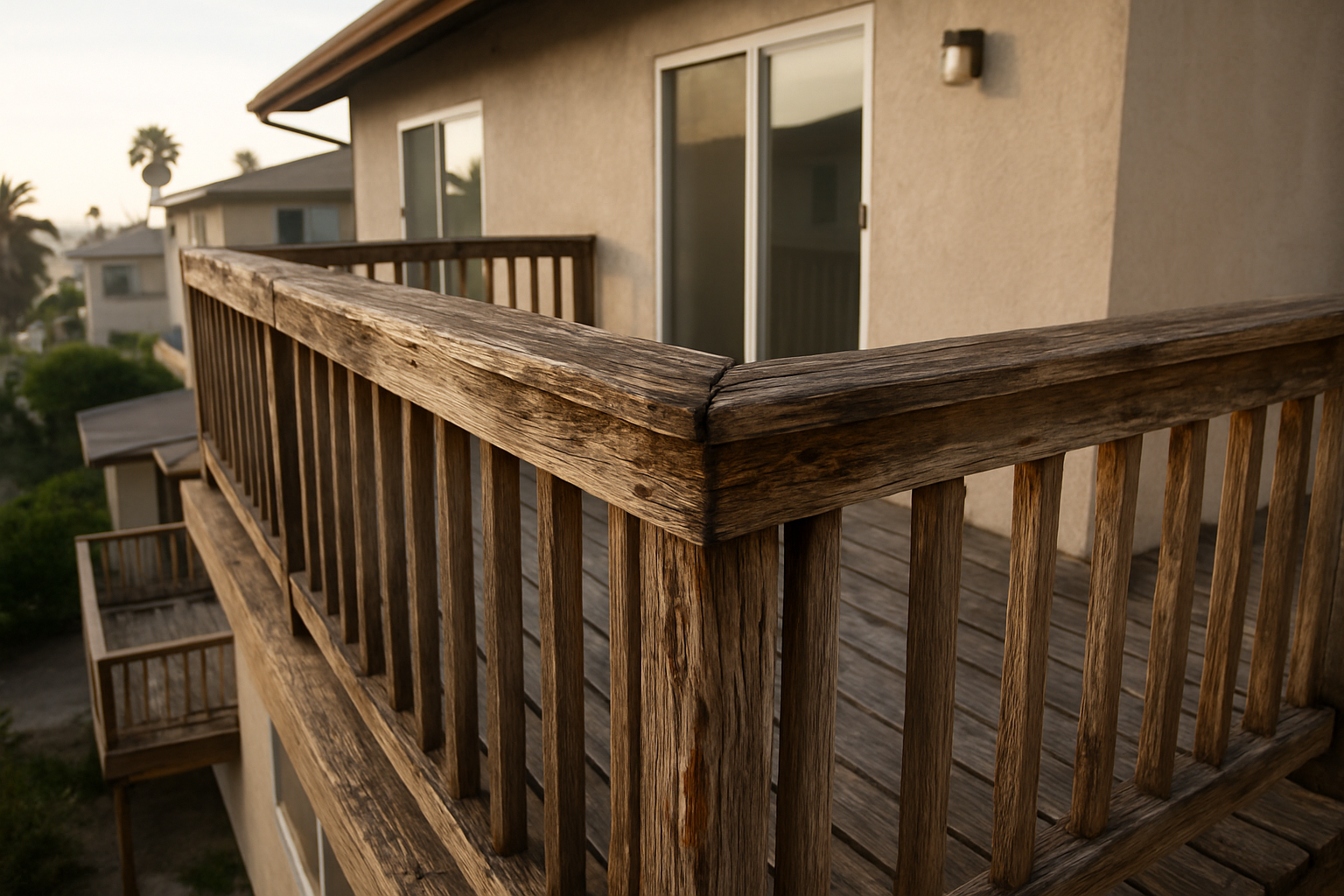
The SB 721 Deadline Has Passed — What Monterey Bay Multifamily Owners Do Now
January 1, 2026 has come and gone. If you own a multifamily rental property with three or more units anywhere in California — including Monterey, Salinas, Seaside, or Marina — the SB 721 exterior elevated element inspection deadline is no longer in front of you. It's behind you. Where you stand right now depends entirely on one thing: whether you got the inspection done or not.
I've spoken with enough Monterey Bay property owners over the years to know that out-of-area landlords are the most likely to have let this one slip. Coordinating a licensed inspector from a distance isn't simple, especially when you're already managing everything else remotely. But slipping past this deadline carries real consequences — and the law doesn't offer a grace period just because the property is in another county.
This article walks through two scenarios: what you need to do if you completed the inspection, and what you need to do if you didn't. I'll also cover what a complete SB 721 compliance file looks like, because that documentation matters more than most owners realize — for insurance, for future sales, and for liability protection if anything ever goes wrong.
Why This Law Exists — and Why It Matters More on the Coast
SB 721 didn't come out of nowhere. In June 2015, a balcony at a Berkeley apartment building collapsed during a birthday party, killing six people and injuring several others. Structural analysis found the cause wasn't age or obvious wear — it was severe wood decay from water intrusion that had been invisible from the surface. The deck looked fine. It wasn't.
The law was specifically designed to close that gap: to require professional inspection of wood-framed exterior elevated elements before the deterioration becomes visible — and before someone gets hurt.
For Monterey Peninsula owners, this isn't a hypothetical concern. Coastal weather accelerates wood degradation in ways that inland properties don't see. The combination of marine layer moisture, salt air, and seasonal rain along Highway 1 creates exactly the kind of persistent water intrusion environment that drove the Berkeley collapse. I've seen what ongoing moisture exposure can do to a property that isn't being regularly checked, and it rarely announces itself early.
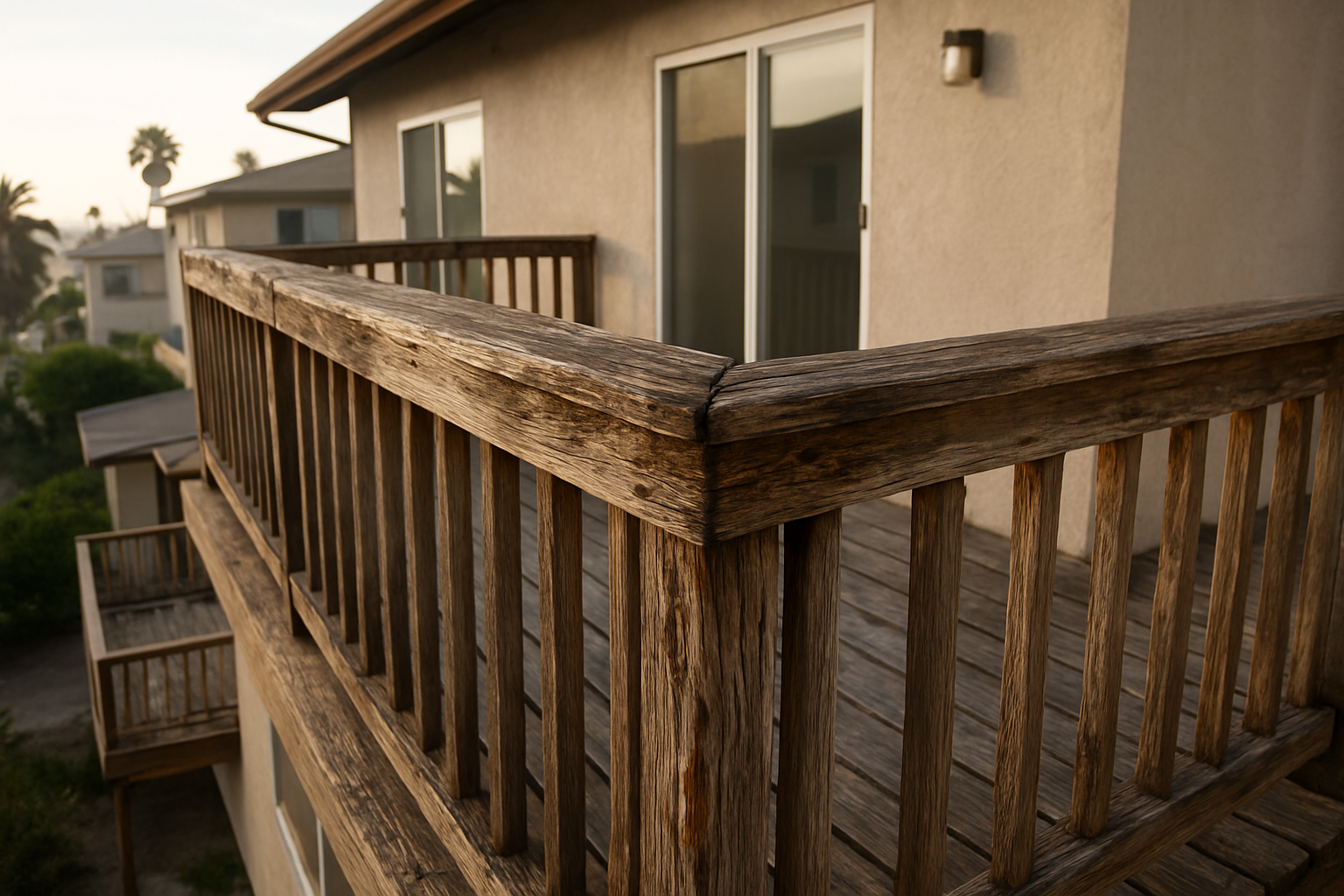
The elements SB 721 covers include:
- Balconies and decks
- Stairways and landings
- Walkways and breezeways
- Railings attached to any of the above
Any of these that are wood-framed, elevated more than six feet above grade, and part of a rental building with three or more units fall under the law.
If You Completed the Inspection: What Comes Next
Good — you met the deadline. But completing the inspection is only part of the obligation. What the inspector found determines what you need to do now.
If the report came back clean, your next required inspection is due within six years of the initial one. Put that date on your calendar and your property file now, because 2031 or 2032 will arrive faster than you expect.
If the report identified repairs, the law gives you 120 days from the date you received the inspector's findings to complete those repairs. Missing that repair deadline is where owners get into real trouble — California can impose daily fines of $100 to $500 for noncompliance, and that liability exposure compounds quickly. More importantly, if an incident occurs on an element that was flagged and not repaired, the legal exposure for the property owner is significant.
One thing worth flagging with your accountant: repair costs from an SB 721 inspection may be deductible or capitalized depending on whether the IRS classifies the work as a repair versus a capital improvement. That distinction affects how you handle the expense on your tax return, and it's not always obvious. Your accountant can help you sort that out based on the specific scope of work.
For owners managing Salinas or Monterey multifamily properties from out of the area, coordinating licensed vendors for these repairs is often the hardest part. The law requires the inspector to hold a California architect license, a structural engineer license, or a contractor's license with an A, B, or C-5 classification. Finding and scheduling someone who qualifies — and who serves the Central Coast — takes local vendor knowledge that remote owners don't always have on hand. This is exactly the kind of capital improvements coordination that falls within a property manager's scope, not because it's a sales point, but because it's a practical reality of managing from a distance.
If You Did Not Complete the Inspection: What Out-of-Compliance Means
I'll be direct here. If your multifamily property in Monterey County had exterior elevated elements covered by SB 721 and you did not complete an inspection by January 1, 2026, you are currently out of compliance with California law.
That means:
- You are subject to enforcement action by local jurisdictions
- You carry elevated liability exposure if any elevated element fails and someone is injured
- You may face complications at your next insurance renewal — carriers are increasingly asking about SB 721 compliance on multifamily properties
- Buyers and their attorneys will flag the missing inspection during due diligence if you ever list the property
The path forward is straightforward: get the inspection scheduled now. Being a few months past the deadline is better than being a year past it. Jurisdictions generally respond more favorably to owners who demonstrate good-faith effort to comply than to those who wait indefinitely.
If you've been managing this property from out of the area and couldn't find a qualified inspector, that's a solvable problem with the right local contacts. The hidden costs of managing a Monterey property from out of state often come down to exactly this kind of coordination gap — not negligence, just distance.
SB 721 Compliance Status at a Glance
Where you stand right now depends on what happened before January 1, 2026. Here's a quick reference.
| Your Situation | Current Status | What to Do Now |
|---|---|---|
| Inspection completed, report clear | Compliant — next inspection due in 6 years | File the report, calendar the next deadline |
| Inspection completed, repairs identified | Compliant on inspection; repairs due within 120 days of report | Complete repairs on schedule; document everything |
| Inspection not completed | Out of compliance | Schedule a qualified inspector immediately |
| Acquiring a multifamily property | Compliance is a due diligence item | Request inspection report and repair documentation before close |
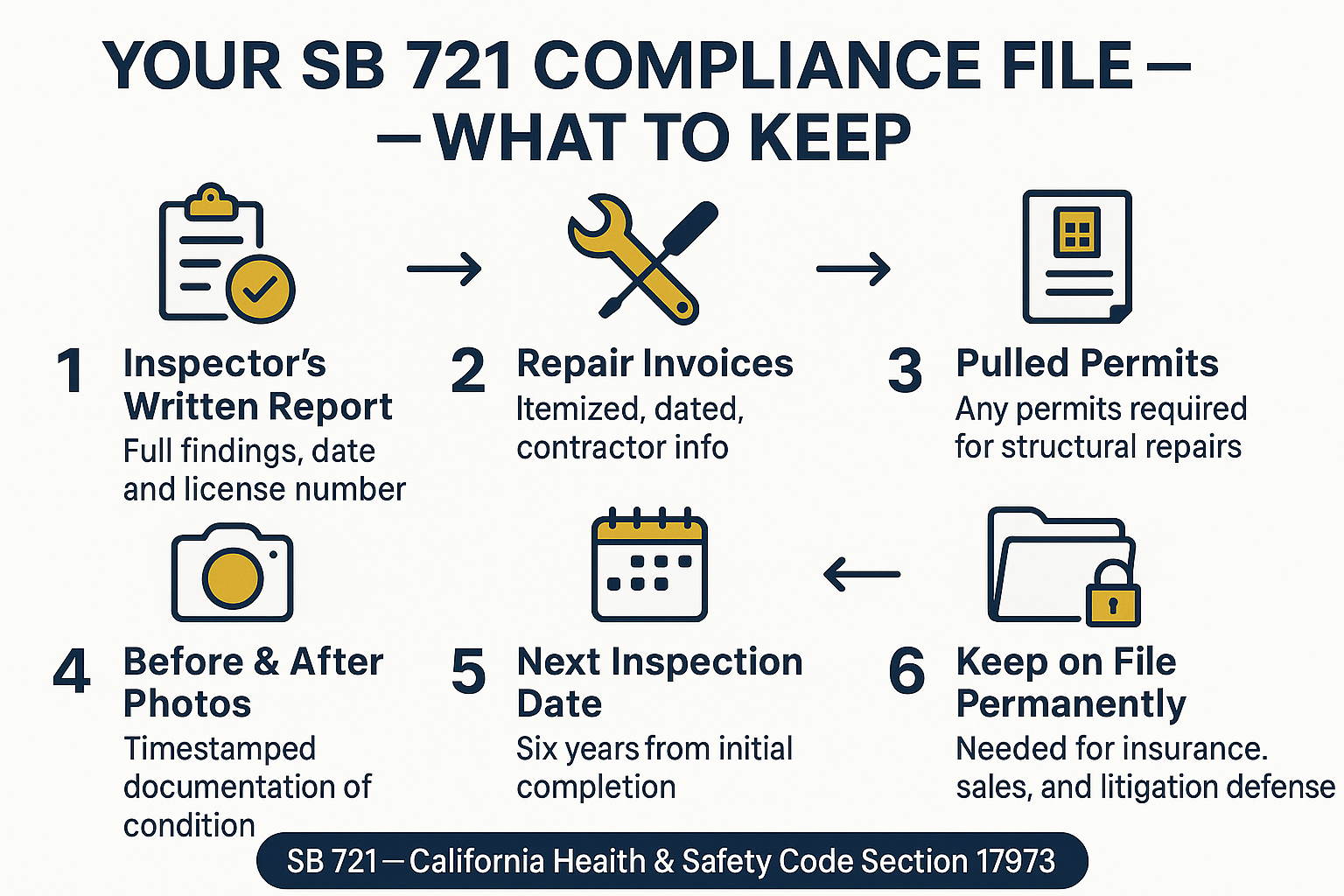
What a Complete SB 721 Compliance File Looks Like
Remote owners and investors often don't know which documents to keep. This is what a complete compliance file should contain — and why each piece matters.
SB 721 and Property Transactions: What Buyers and Sellers Need to Know
If you're planning to buy or sell a multifamily property in the Monterey Bay area, SB 721 compliance is now a due diligence line item — full stop.
For sellers, an incomplete or missing inspection will surface during the buyer's review. Sophisticated buyers and their agents are already asking for inspection reports and repair documentation as part of the disclosure package. A clean compliance file signals that the building has been maintained professionally. A gap in that file creates negotiating leverage for the buyer — or, in some cases, a reason to walk.
For buyers, requesting the SB 721 inspection report and all repair invoices, permits, and photos before closing is a reasonable and necessary step. If no inspection was done, you need to factor that into your offer — both the cost of the inspection itself and the possibility that the report will identify repairs.
The documentation that matters most:
- The original inspector's written report, including the inspector's license number and date
- Itemized invoices for any repairs performed
- Copies of any permits pulled for structural repair work
- Timestamped before-and-after photos of repaired elements
This file also matters for your insurance carrier. Multifamily property insurers are increasingly reviewing SB 721 compliance at renewal. Having a complete, organized file ready makes that conversation easier and may affect your premium.
For owners in Salinas managing multiple units — and I've worked with several who are building portfolios while keeping full-time jobs elsewhere — staying on top of compliance paperwork across multiple properties is one of the hardest parts. It's the kind of thing that falls through the cracks when no one local is watching the calendar. Related compliance requirements, like what Salinas landlords need to know about the Rental Registration program, compound the administrative load quickly.
Frequently Asked Questions About SB 721 Balcony Inspections
Does SB 721 apply to my property if I only have three units?
Yes. The law applies to any residential rental building with three or more units that has exterior elevated elements — balconies, decks, stairways, walkways, or railings — that are wood-framed and elevated six feet or more above grade. Three units is the threshold, not a gray area.
What happens if I ignore the deadline — is enforcement actually happening?
Enforcement is handled at the local jurisdiction level, and the pace varies. But the more immediate risk isn't a citation — it's liability. If an uninspected element fails and someone is injured, the fact that the law required an inspection and you didn't get one becomes a central fact in any litigation. Daily fines of $100 to $500 can also accumulate once a jurisdiction issues a notice. Getting compliant now is genuinely less expensive than waiting.
Who is qualified to do the SB 721 inspection?
California law requires the inspector to hold one of three credentials: a licensed architect, a licensed structural engineer, or a licensed contractor with an A, B, or C-5 classification. A general handyman or unlicensed inspector does not satisfy the requirement. Make sure you verify the license before scheduling.
I completed the inspection and got a repair list. How long do I have?
120 days from the date you received the inspector's written findings. If the repairs require a permit, the permit must be applied for within that window. Extensions may be available in limited circumstances, but plan to complete the work within the 120-day window to stay compliant.
I'm buying a multifamily property in Monterey — do I inherit any SB 721 liability?
Potentially, yes. If the current owner hasn't completed the inspection or left repairs unfinished, you're taking that problem on at close. Request the full compliance file — inspection report, repair invoices, permits, and photos — before you sign. If the documentation doesn't exist, treat the inspection as a cost of acquisition and factor it into your offer accordingly.
Are repair costs from SB 721 findings tax deductible?
It depends on how the IRS classifies the work. Repairs — like replacing a rotten deck board to restore the original condition — are generally deductible in the year incurred. Capital improvements — like a full balcony reconstruction that adds value or extends useful life — are typically capitalized and depreciated. The line between the two isn't always obvious, so this is a conversation worth having with your accountant before you file.
Managing a Monterey Bay Multifamily Property From a Distance?
Staying on top of SB 721 compliance, repair timelines, vendor coordination, and documentation is exactly the kind of ongoing work that's hard to do from across the state — and easy to let slide. Our team at Torrente Properties has spent more than 25 years working with property owners across Monterey County, and we handle capital improvements coordination as part of full-service management. If you have questions about where your property stands or need help getting organized, reach out by phone at (831) 582-8916 or through the contact form at torrenteproperties.com.

How Monterey Bay Rental Prices Actually Get Set — and Why Owners Often Guess Wrong
The most common question I hear from owners across Monterey, Salinas, Seaside, and Marina is some version of the same thing: "How much can I rent my property for?" Some come in with a number already in mind — usually their mortgage payment, or something a neighbor mentioned at the mailbox. Others ask for both a furnished and unfurnished estimate for the same property before we've even had a conversation about the unit's condition.
I understand why that question feels like it should have a simple answer. It doesn't. Rental pricing in Monterey County is a real-time, property-specific analysis — not a formula you can pull from a spreadsheet. The inputs shift faster than most owners realize, and getting the number wrong, even by a few hundred dollars, can cost you more than you'd expect.
This article walks through how rental prices actually get set in our market, what variables move the needle most, and why owners who guess — even educated guesses — tend to leave money on the table or pay for it in vacancy.
Averages Tell You Almost Nothing About Your Specific Unit
Consumer-facing rent indices currently show something in the range of $2,750 average rent in Monterey and around $2,595 in Salinas. Those numbers aren't meaningless, but they're also not what your unit will rent for.
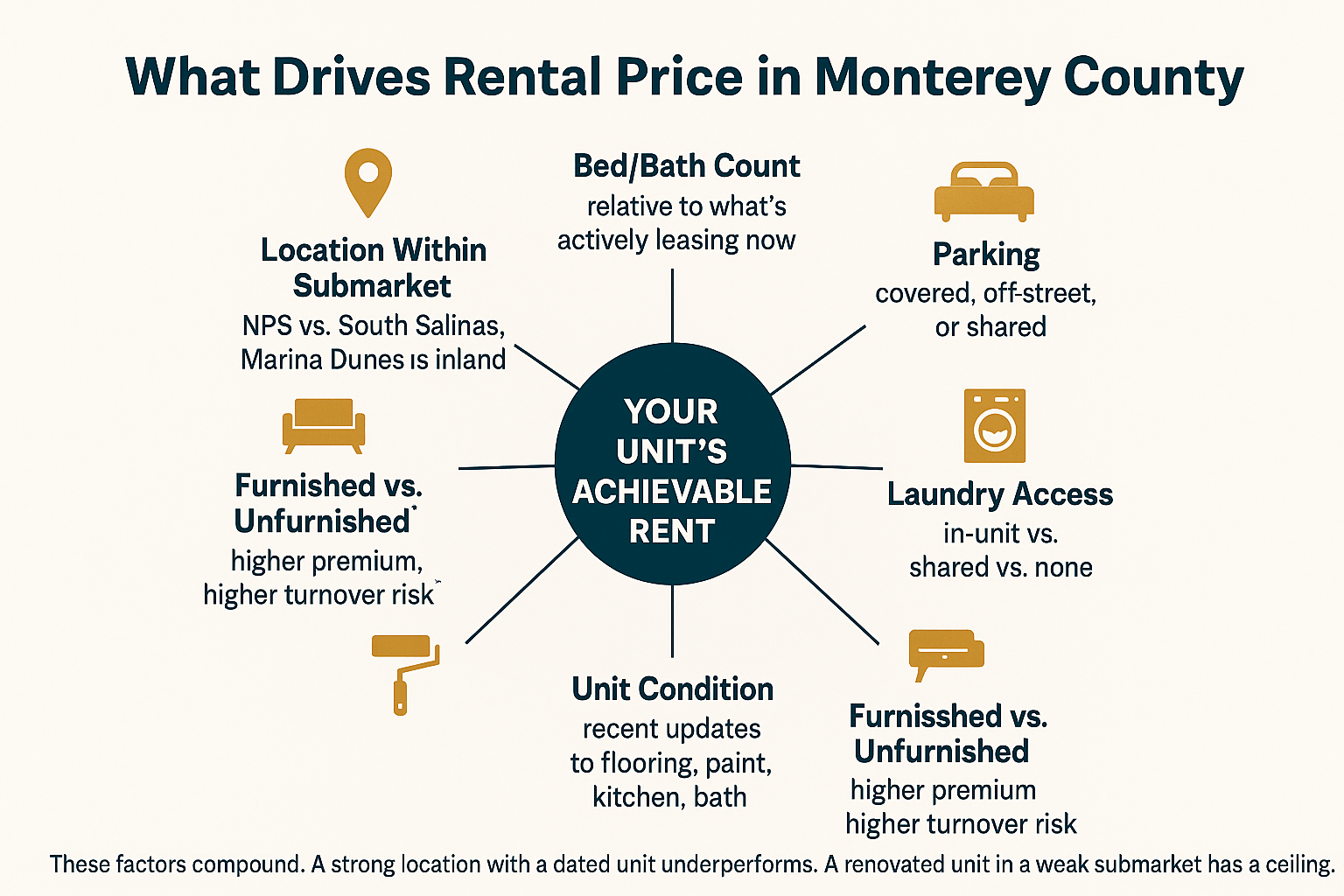
Averages blend together a renovated 3-bedroom near Salinas Valley Memorial Hospital, a dated studio in South Salinas, and a furnished condo near the Monterey Wharf. Those properties don't belong in the same number. What actually drives your price is a set of factors that compound each other:
- Location within the submarket — a property near Naval Postgraduate School attracts a different tenant pool and commands different pricing than one several miles south in the same city
- Bedroom and bathroom count relative to what's actually available and leasing right now
- Square footage compared to active comps, not just listed properties sitting on the market
- Parking — covered, off-street, or shared makes a real difference in competitive submarkets
- Laundry access — in-unit washer/dryer versus shared laundry versus none affects both price and tenant quality
- How recently the unit was updated — flooring, paint, kitchen fixtures, and bathroom condition show up in photos and in applications
I've seen a renovated 3/2 near Salinas Valley Memorial price significantly higher than a comparable unit a mile away that hadn't been touched in a decade. The gap isn't cosmetic — it shows up in who applies, how fast it rents, and what price it actually holds.
For owners thinking through what they can realistically expect before they're ready to list, understanding what landlords in Salinas wish they'd known earlier is a good place to start.

The Furnished vs. Unfurnished Question Is More Complicated Than It Looks
Several owners who've reached out to us asked specifically about furnished rentals — some in Marina, some in Monterey, a few in Prunedale. The question usually comes framed as "can I charge more if I furnish it?" The honest answer is: sometimes yes, but the tradeoffs are real.
Furnished units can command a meaningful premium over unfurnished, particularly when the property is well-located and the furnishings are in good condition. But furnished rentals also tend to attract shorter-term tenants — people in temporary housing, contractors on project assignments, relocation employees. That means higher turnover, and turnover has costs: re-leasing time, cleaning, furniture inspection, and the real possibility that your couch doesn't survive the next tenant the way it survived the last one.
There's also the ongoing management layer that owners underestimate. Furnished inventory requires tracking — what's there, what's damaged, what needs replacing at move-out. That's a separate process on top of a standard move-out inspection, and it takes time.
For a property you're leaving behind while relocating — like several owners I've spoken with who were preparing to move out of the area — furnished can make sense if the goal is a shorter lease term and you want the option to return. But for owners looking at this as a long-term income property, unfurnished with well-qualified long-term tenants usually produces steadier returns with fewer headaches.
There's no universal answer. It depends on the property, the location, your financial goals, and how long you plan to hold the asset. What I'd caution against is assuming furnished automatically means higher yield once you factor in turnover and inventory costs.
What Actually Drives Your Rental Price in Monterey County
These are the variables that move the needle on achievable rent — and how they interact with each other.
Why Overpricing a Vacancy Is a Math Problem, Not Just a Strategy Problem
I want to be direct about something I see regularly: owners who price too high because they're anchored to a number they want, not the number the market will bear. They list at that number, sit for three or four weeks without serious applications, then reduce. And now they have a listing with days-on-market history that prospective tenants can see.
In a market where Monterey County rents have shown real movement — including reported softening in late 2025 — overpricing a vacancy isn't just a minor miscalculation. Every week without a tenant is rent you never recover. No future rent increase makes up for lost weeks.
Let me make this concrete. Suppose a property is worth $2,400/month based on actual comps, but an owner lists at $2,600 hoping to capture upside. If that $200/month premium causes the unit to sit vacant for three extra weeks, the owner has already lost roughly $1,800 in uncollected rent — more than the entire annual difference the premium would have generated ($200 × 12 = $2,400, minus the $1,800 vacancy loss = net gain of about $600 for the year, assuming the tenant stays a full year and never pushes back on the higher rate).
And that calculation doesn't include the cost of utilities you're covering during vacancy, the wear on the property sitting empty, or the lower quality of applicants who tend to apply to listings that have been sitting.
For owners who want to understand the full picture of what vacancy really costs, the hidden costs of managing a Monterey home from out of state covers some of these dynamics in more detail.
Overpricing Math: What a 3-Week Vacancy Actually Costs
This table shows how different pricing gaps translate to vacancy losses versus annual premium gains — assuming a 12-month tenancy.
| Monthly Overpricing | 3-Week Vacancy Loss | Annual Premium (12 months) | Net Annual Gain |
|---|---|---|---|
| $100/month | ~$900 | $1,200 | ~$300 |
| $200/month | ~$1,800 | $2,400 | ~$600 |
| $300/month | ~$2,700 | $3,600 | ~$900 |
| $400/month | ~$3,600 | $4,800 | ~$1,200 |
What You Do Before Listing Affects What You Can Charge
One of the most overlooked factors in setting rental price is the condition of the unit before it hits the market. I've talked with owners who had detailed renovation plans they wanted to execute before listing, and others who simply asked: "What can I do in the next few months to increase rental value without spending a lot?" That's exactly the right question.
The improvements that actually move the needle on rent and leasing speed tend to be inexpensive and cosmetic:
- Fresh interior paint — neutral, clean, and consistent throughout the unit
- Clean or replaced flooring — tired carpet is one of the fastest ways to lose good applicants
- Functioning fixtures — leaky faucets, broken blinds, and burnt-out lighting read as neglect to prospective tenants
- Clean appliances and clean grout — photos matter more than most owners realize
What generally doesn't move the rental price needle in proportion to cost: full kitchen remodels, bathroom gut renovations, or high-end landscaping. Those may add long-term property value, but they rarely translate to a rent increase that justifies the spend in the near term.
Presentation also affects who applies. A unit that photographs well and shows clean attracts more qualified applicants — and more applicants means more selection. What makes some rental properties consistently attract reliable tenants covers this in more depth.
For owners managing the Salinas market specifically, the Salinas Rental Registration Program is also worth reviewing before you list — compliance requirements affect your timeline and your legal standing as a landlord.
Frequently Asked Questions About Setting Rental Prices in Monterey Bay
Can I just use Zillow or Rentometer to figure out what to charge?
Those tools give you a general range, but they're built on aggregated data that often lags the actual market by weeks or months. They also can't account for what's actively leasing right now at the submarket level — a street in the Marina Dunes rents differently than a street five blocks inland. They're a starting point, not a pricing decision.
My neighbor rents a similar house for $2,800. Shouldn't I be able to get the same?
Maybe — but "similar" is doing a lot of work in that sentence. Bedroom count, parking, laundry, unit condition, and the specific location within the neighborhood all affect price. And you don't know what your neighbor's tenant is actually paying versus what was asked. A real comp analysis looks at recently leased properties, not asking prices or neighbor estimates.
Does furnishing my property always result in higher rent?
Not always, and not always net-positive when you factor in turnover. Furnished units can command a premium, but they also tend to attract shorter-term tenants who move on sooner. More turnover means more vacancy, more cleaning, more inventory management, and more re-leasing costs. For some properties and owners, furnished makes sense. For others, a well-priced unfurnished unit with a stable long-term tenant is the better income outcome.
How long is too long for a rental to sit on the market before I should adjust the price?
In a healthy Monterey County market, a well-priced unit in good condition should generate serious inquiries within the first one to two weeks. If you're past three weeks with no qualified applications, the price is almost certainly the issue — not the marketing. The longer you wait to adjust, the more days-on-market history accumulates, which signals to applicants that something is wrong with the property.
I want to rent my property for enough to cover my mortgage. Is that realistic?
It depends entirely on when you bought and what you paid. In some cases, yes — especially if the property has been held for a while and the mortgage is lower than current market rents. But the market doesn't care what your mortgage payment is. If current comps don't support your number, pricing above market to cover costs will likely just produce a longer vacancy, which costs more than the shortfall would have.
Want a Real Rental Estimate for Your Property?
If you own a property in Monterey, Salinas, Seaside, Marina, Pacific Grove, or anywhere else in Monterey County and you're trying to figure out what it would actually rent for — not a ballpark, but a number grounded in current local comps — our team is available to walk through it with you. Torrente Properties can be reached at (831) 582-8916 or through the contact form at torrenteproperties.com.

Salinas Landlords: What the Rental Registration Program Requires Right Now
If you own rental property in Salinas and you're not 100% sure your units are currently registered with the city, you're not alone. I talk to landlords every week — many of them managing from out of the area — who are completely unaware the Salinas Residential Rental Registration program even exists, let alone that fees were recently restructured or that the entire ordinance framework could change after November 2026.
This isn't a technicality you can sort out later. The City of Salinas has been explicit that registration compliance is the foundation of its landlord-tenant oversight system, and enforcement has been updated alongside the new fee structure. Missing a renewal or letting your information go stale can create real legal exposure.
What follows is a straightforward breakdown of what the program currently requires, what changed with the 2026 fee reduction, and what the upcoming ballot measure actually means for your obligations — starting today.
What the Salinas Rental Registration Program Actually Requires
The Salinas Residential Rental Registration program requires landlords to register every rental unit in the city and keep that registration current on an annual basis. It applies to residential rental properties — single-family homes, duplexes, apartment buildings, and similar housing — within city limits.
At its core, the program requires three things:
- Register each unit with the city, including accurate owner and contact information
- Pay annual fees for each registered unit
- Keep your information current — if you sell, change your mailing address, or alter how the property is managed, the city expects that to be reflected in the registry
That third point is where I see the most problems from owners who are self-managing from a distance. People move, phone numbers change, a property gets transferred to a trust — and the registration just sits there with outdated information. The city's enforcement strategy is built partly around accurate data, so stale records aren't a minor clerical issue.
If you're managing a Salinas property from San Jose, Los Angeles, or anywhere outside Monterey County, staying on top of annual renewal cycles without a local point of contact is genuinely difficult. I've seen landlords miss renewals simply because the notice went to an old address. As we've written about before, what changes when you're not around affects a lot more than just maintenance calls.
The 2026 Fee Reduction — and What You're Paying Now
As of January 2026, the City of Salinas reduced its rental registration fees by approximately 35% after a city audit found a surplus of nearly $1 million in the program fund. That's a meaningful shift, and most landlords I've spoken with this year haven't heard about it yet.
The current fee structure looks like this:
- Rental registry fee: $29 per unit
- Rent program fee: $112 per unit
For a landlord with a single-family home, that's $141 total annually. For someone managing a 4-unit building — like several owners who've reached out to us recently — that's $564 per year. The fees are real, but they're not the financial burden they once were.
What concerns me more than the fees themselves is the enforcement posture the city paired with this reduction. When a city conducts an audit, restructures its fee schedule, and publicly describes an updated enforcement strategy all in the same breath, that signals increased scrutiny — not less. The fee went down; the attention to compliance did not.
For context on what a single compliance misstep can cost compared to annual registration fees, it's worth reading our breakdown of the hidden costs of managing a Monterey home from out of state — the math applies equally to Salinas.

The November 2026 Ballot Measure — What It Means Right Now
In September 2025, the Salinas City Council voted 5-2 to place a measure on the November 2026 General Election ballot that would repeal the entire rental ordinance framework — including the registration program and related rent stabilization policies.
I want to be direct about what that means and what it doesn't mean.
What it does not mean: the ordinances are not suspended, paused, or weakened today. Every requirement in the current registration program is fully in effect and enforceable right now. If the ballot measure fails in November, nothing changes. If it passes, the changes would take effect after the election is certified — which means we're likely talking about early 2027 at the earliest before anything shifts.
What it does mean: Salinas landlords are operating under rules that may look substantially different by mid-2027. That matters for how you structure leases, how you plan rent increases, and how you think about long-term compliance obligations.
The smartest thing you can do between now and November 2026 is stay current. Register your units, pay your fees, keep your contact information accurate, and watch how the vote plays out. Letting compliance lapse on the assumption the ordinance might go away is a gamble I wouldn't take — especially given the city's stated enforcement posture.
Salinas Rental Compliance: Two Layers, One Property
Salinas landlords are operating under both city-level registration requirements and California's statewide tenant protection framework simultaneously. This diagram shows how those two layers interact.
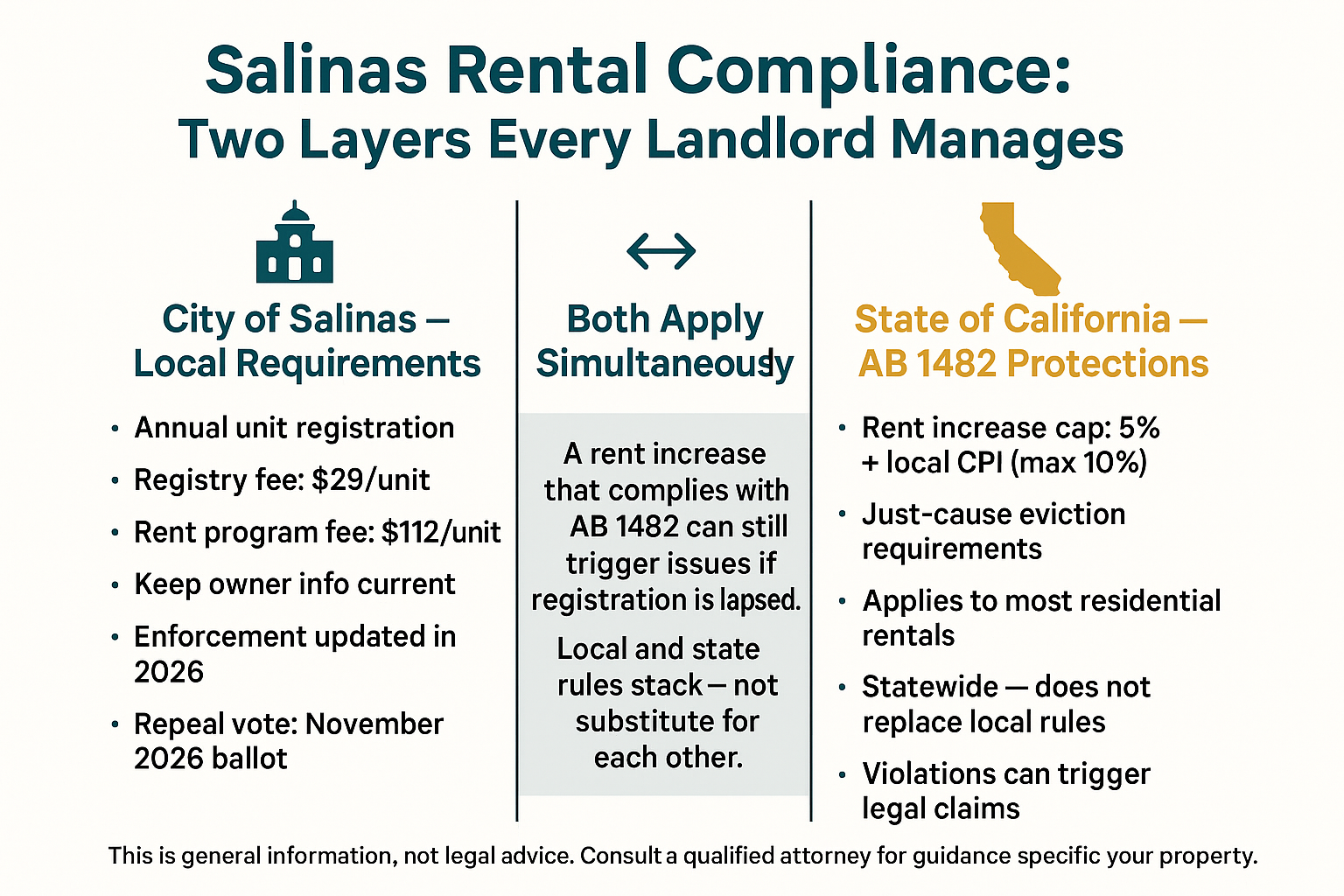
The State Layer: AB 1482 Runs Alongside the City Program
The Salinas registration program doesn't exist in isolation. California's AB 1482 — the Tenant Protection Act — adds a second layer of compliance that every Salinas landlord is navigating at the same time.
Under AB 1482, most residential rentals in California are subject to:
- Annual rent increase caps of 5% plus local CPI, with a hard ceiling of 10%
- Just-cause eviction requirements, meaning you can't remove a tenant without a qualifying reason after they've been in the unit 12 months
These are statewide rules. They don't replace Salinas's local program — they stack on top of it. A rent increase that technically falls within the AB 1482 cap can still create legal exposure if your unit isn't properly registered, because an unregistered landlord has a weaker position in any dispute.
This is the part of the compliance picture that most landlords I talk to aren't thinking about. They ask about fees and services. They're not thinking about what happens if a tenant challenges a rent increase and the landlord's registration is lapsed or incomplete. A single procedural error in this environment can easily generate legal costs that exceed a full year of property management fees — and that's before any attorney gets involved.
For a deeper look at how California's 2026 habitability and lease changes intersect with these obligations, our guide to AB 628 and what it means for California landlords is worth reading alongside this one.
Salinas Rental Registration: Current Fee Structure at a Glance
These are the fees in effect as of January 2026, following the city's fee reduction. Annual totals will vary based on the number of units you own.
| Fee Type | Amount Per Unit | Annual Total (4 Units) |
|---|---|---|
| Rental Registry Fee | $29 | $116 |
| Rent Program Fee | $112 | $448 |
| Combined Annual Total | $141 per unit | $564 for 4 units |
| Prior Fee Structure (pre-2026) | Approximately 35% higher | — |
Who's Most at Risk of Falling Out of Compliance
In my experience working with property owners across Salinas, Monterey, Seaside, and the broader Monterey Bay area, the landlords most likely to have compliance gaps are not negligent people. They're busy people — often living in the Bay Area, Southern California, or out of state — who bought a rental property years ago, got it set up, and have been in a kind of maintenance mode ever since.
The profile I see most often:
- Out-of-area owners who aren't monitoring Salinas city announcements or local policy changes
- Accidental landlords who inherited a property or couldn't sell and started renting without going deep on local requirements
- Self-managing landlords who handle everything themselves and have no local contact watching for renewal notices or fee changes
The January 2026 fee reduction is a perfect example. It's genuinely good news for landlords — but most of the Salinas property owners who've reached out to us recently had no idea it happened. If you're not plugged into local news and city communications, information like that just doesn't reach you.
If any of this sounds familiar, what Salinas landlords actually need from a property manager gets into the specific gaps that show up most often — and how having a local set of eyes on your property changes the picture.
Frequently Asked Questions About the Salinas Rental Registration Program
Do I have to register every unit separately, or just the property address?
You register each individual unit. If you own a 4-unit building, that's four registrations and four sets of fees. The $29 registry fee and $112 rent program fee apply per unit, not per property.
What happens if my unit isn't registered or my registration has lapsed?
The city has enforcement mechanisms in place, and the consequences go beyond a fine. An unregistered landlord is in a weaker legal position if a tenant raises a rent dispute, challenges an eviction, or files a complaint with the city. The exposure can easily exceed the cost of staying current on fees. I always frame it this way: the registration fee is the cheapest part of compliance.
If the November 2026 ballot measure passes, do I still need to register my units?
Until the vote is certified and any repeal takes effect — which would likely be early 2027 at the earliest — every current requirement stays fully in force. Letting registration lapse now based on a ballot measure that hasn't passed is a real risk. Stay current through the vote and adjust when there's something definitive to adjust to.
Does the Salinas registration program affect how much I can raise rent?
The registration program and California's AB 1482 rent increase cap are separate rules that run at the same time. AB 1482 limits most residential rent increases to 5% plus local CPI, with a 10% maximum ceiling. The city's registration program is about tracking and oversight — but the two layers interact. A landlord who isn't registered has less standing if any aspect of their tenancy gets disputed.
I own a property in Salinas but I live out of state. How do I keep up with changes like this?
This is the most common situation I hear about. The honest answer is that staying current from a distance requires either a reliable local contact or a property manager who monitors city communications on your behalf. Annual renewal notices, fee changes, new ordinances — those don't travel well across state lines when you're self-managing. It's one of the most practical reasons landlords in your situation end up working with a local management team.
Want a Local Set of Eyes on Your Salinas Property?
Our team at Torrente Properties works with landlords across Salinas, Monterey, Seaside, Pacific Grove, and the broader Monterey Bay area — including many owners who are managing from a distance and need someone on the ground who knows the local rules. If you have questions about your registration status, the upcoming ballot measure, or what it would look like to hand off management to a local team, we're happy to talk through your specific situation. Reach us at (831) 582-8916 or through the contact form at torrenteproperties.com.

Your Rental Lease Changed in 2026 — Here's What California Landlords Need to Know
If you renewed a lease in Salinas, re-rented a unit in Seaside, or are preparing to place a tenant in a Monterey townhouse this year, your legal obligations just changed — and most landlords haven't caught up yet.
California Assembly Bill 628 took effect January 1, 2026, adding working stoves and refrigerators to the legal definition of a habitable dwelling. That sounds like a minor update. But a unit without a functioning stove or refrigerator can now be classified as legally uninhabitable, which opens the door to habitability claims, rent withholding arguments, and serious complications if you ever need to pursue an eviction.
And AB 628 didn't arrive alone. The same legislative cycle brought a wave of other changes — to security deposit returns, eviction notice requirements, and a new tenant defense tied to Social Security benefit delays. This article walks through what matters most for property owners in Monterey County and what to do before your next lease renewal.
What AB 628 Actually Says — and Where Owners Get It Wrong
Before 2026, California's habitability standards under Civil Code Section 1941.1 required things like working plumbing, heating, and weatherproofing. Appliances weren't part of that framework. AB 628 changed that by adding functioning stoves and refrigerators to the required conditions for a unit to be considered livable.
The law applies to any lease that is entered into, amended, or renewed on or after January 1, 2026. If your tenant signed a new lease in March 2026 or you issued a lease renewal this spring, you're covered by this law — regardless of when the property was originally built or previously leased.
Here's where owners frequently miss the nuance:
- Tenant-supplied refrigerators are allowed, but only if both parties agree in writing at lease signing, and that written agreement must explicitly state the landlord bears no maintenance or replacement responsibility. A verbal understanding doesn't protect you.
- Recall obligations are real. If a covered appliance — stove or refrigerator — is subject to a manufacturer recall, the landlord has 30 days to repair or replace it. This isn't optional.
- The exemption mechanics matter. An owner who assumes a tenant's fridge relieves them of responsibility — without a proper written waiver in the lease — is exposed if that appliance fails and the tenant asserts a habitability claim.
For Salinas landlords managing multiple units, this adds another layer of pre-lease documentation to track across a portfolio. Getting it wrong on one unit can create ripple effects.

The Pre-Lease Appliance Checklist Every Landlord Needs Right Now
The practical question isn't whether AB 628 applies to your property — if you're signing or renewing leases in 2026, it almost certainly does. The question is what to do before the tenant moves in.
Here's a simple checklist to run through before every lease in 2026:
- Confirm the stove is present and functional. Test all burners and the oven. Note any issues in writing before lease signing.
- Confirm the refrigerator is present and functional. Check temperature, seals, and any visible defects.
- Photograph both appliances at move-in with timestamps. These photos are your baseline if a habitability dispute arises later.
- Decide the arrangement clearly in the lease. Is the landlord providing the appliances, or is the tenant supplying their own? If the tenant is bringing their own refrigerator, the lease must include a written waiver of landlord responsibility for that appliance.
- Check for active recalls on any appliances you're providing. The CPSC recall database (cpsc.gov) is searchable by brand and model number.
This documentation baseline is the single most important protection you have. If a tenant later claims uninhabitability — or withholds rent citing a broken refrigerator — your move-in records are what either validates or undermines your position.
Owners who are renting out a Salinas property for the first time often underestimate how much the paper trail matters. AB 628 makes that documentation non-negotiable.
AB 628 at a Glance: What Changes for California Landlords in 2026
This infographic summarizes the key requirements of AB 628 and how they apply to lease decisions before and after January 1, 2026.
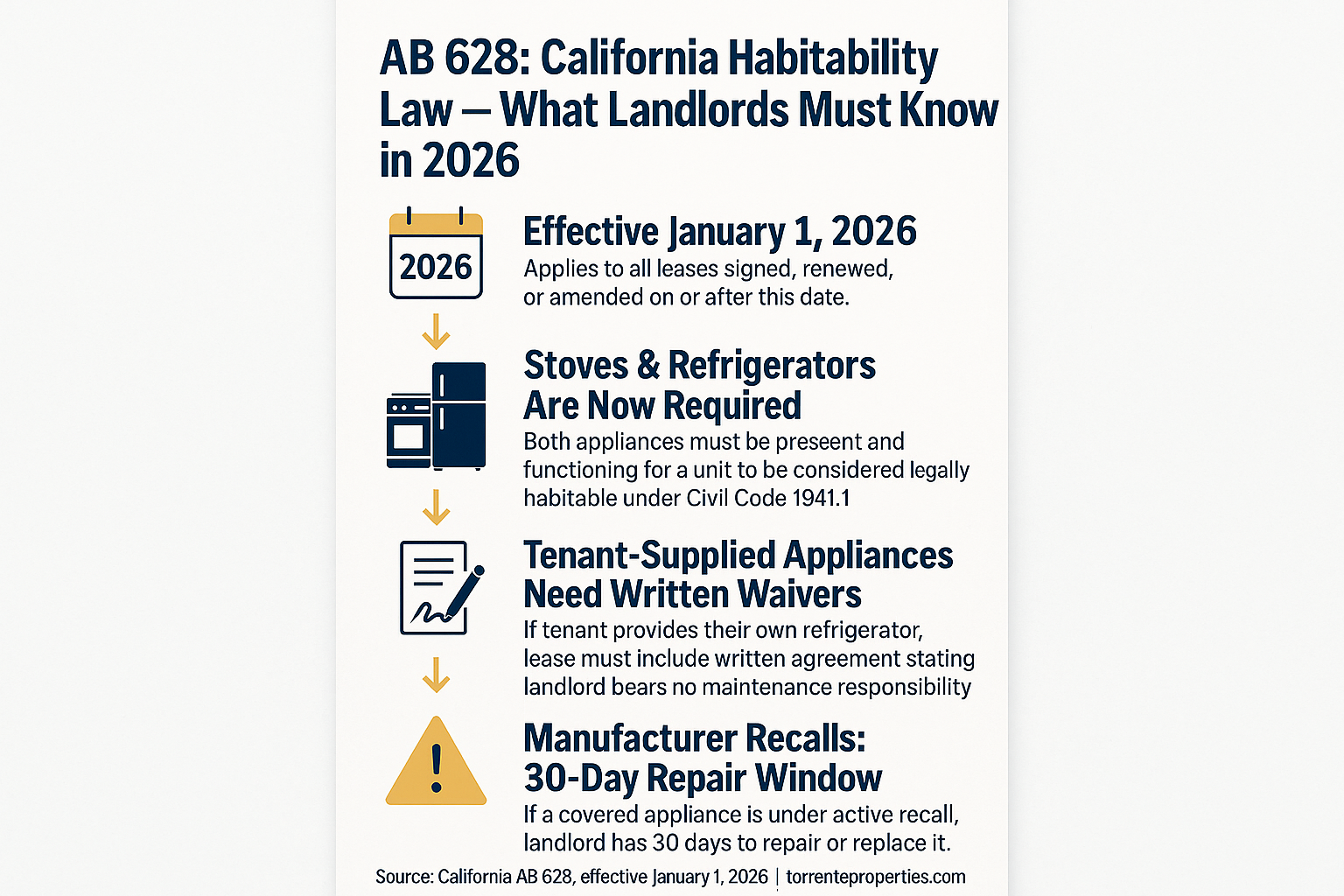
AB 628 Is Part of a Bigger Wave — And the Other Changes Matter Too
AB 628 is the most immediately actionable change for landlords preparing leases right now. But it's one piece of a broader set of 2026 compliance shifts that, taken together, represent real legal exposure for owners who aren't tracking them.
AB 414 updated the rules around security deposit returns. Tenants can now request electronic refunds, and the law clarifies how itemized deductions must be broken out when multiple tenants share a unit. If you're used to issuing a single check and a one-line statement, that approach may no longer meet the legal standard.
AB 747 added required information to proof-of-service documents for eviction notices. This is the kind of procedural change that gets landlords into trouble — not because they did anything wrong substantively, but because a defective notice can derail an otherwise valid eviction case.
And perhaps the most significant addition for income property owners: a new Social Security hardship defense, effective January 1, 2026, allows tenants whose benefits have been delayed or interrupted to assert that as a defense in an unlawful detainer case. Courts can stay the eviction up to six months while the situation is evaluated. For a landlord in Monterey or Seaside managing a single-family rental, a six-month delay in regaining possession of a property is a serious financial consequence — not a technicality.
None of these changes individually is unmanageable. But owners who aren't tracking them collectively are operating with real exposure. California's landlord-tenant framework in 2026 rewards landlords who stay current on compliance — and it penalizes those who don't, often at the worst possible moment.
For a broader picture of what's shifted in the local rental market this year, this 2026 guide to Monterey property management covers the operating environment in more detail.
2026 California Landlord Law Changes: Quick Reference
Here's a side-by-side summary of the four key changes that took effect January 1, 2026, and what each one means in practice for landlords in Monterey County.
| Law | What Changed | What It Means for You |
|---|---|---|
| AB 628 | Stoves and refrigerators added to habitability definition | Both appliances must be present and functional in any lease signed or renewed in 2026 |
| AB 628 (exemption) | Tenant may supply their own refrigerator with written waiver | Oral agreements don't protect you — the waiver must be in the lease document itself |
| AB 414 | Electronic security deposit returns; itemized deductions for shared units | Deposit accounting must now break out each tenant's share when multiple people are on the lease |
| AB 747 | Additional required info on eviction proof-of-service documents | A procedurally defective notice can derail a valid eviction — format matters now more than before |
| Social Security Hardship Defense | Tenants can assert benefit delays as a defense in unlawful detainer cases | Courts may stay an eviction up to 6 months — significant risk for owners of single-unit properties |
Why Distance Makes AB 628 Compliance Harder
Many of the property owners across the Monterey Peninsula — seasonal residents in Carmel, out-of-area investors with units in Marina, military families managing a Pacific Grove home during a deployment — aren't on the ground when something breaks.
Under California's general habitability standards, appliance failures must be addressed within a reasonable time after the landlord receives notice. That's always been true. But AB 628 raises the stakes by making a non-functioning stove or refrigerator a potential habitability violation rather than just a maintenance issue.
Here's what the gap looks like in practice: a tenant submits a maintenance request on a Monday. A local property manager sees it the same day and dispatches a vendor. An out-of-area owner gets an email — if the tenant sends one — and starts making calls from out of state, trying to find a repair person they've never worked with in a market they're not in.
By the time that second scenario resolves, the delay itself has become part of the problem. A tenant who has been without a functioning refrigerator for ten days while their landlord arranges a repair from Sacramento has a much stronger habitability argument than one whose issue was addressed in 48 hours.
For owners who manage remotely, the hidden costs of managing a Monterey property from out of state go beyond management fees — compliance failures that stem from delayed response are some of the most expensive mistakes a landlord can make. And for seasonal homeowners who leave properties vacant during parts of the year, the caretaker and property watch services available for Monterey Bay homes are a practical way to maintain eyes on the ground year-round.
Frequently Asked Questions About AB 628 and California Habitability Law
Does AB 628 apply to leases that were already signed before 2026?
If the original lease was signed before January 1, 2026 and has not been amended or renewed since, AB 628 does not retroactively apply. But the moment you issue a new lease, process a renewal, or make a formal amendment — even something as routine as adding a tenant to the existing agreement — the updated law applies.
What if my tenant already owns a refrigerator and wants to bring it themselves?
That's allowed, but the arrangement has to be documented correctly. Both parties must agree in writing at lease signing, and the written agreement must explicitly state that the landlord bears no responsibility for maintenance or replacement of that appliance. A verbal agreement or a general clause about tenant-supplied furnishings won't be sufficient protection if a dispute arises.
What counts as 'not functional' under AB 628? Does a refrigerator have to be completely dead, or does a minor issue qualify?
The law doesn't define a bright-line standard for 'functional,' which is part of what makes this tricky. A refrigerator that doesn't maintain safe food temperatures — typically below 40°F — is clearly non-functional. Minor cosmetic issues or a slow ice maker probably wouldn't rise to the level of a habitability claim. But anything affecting the appliance's core purpose is worth addressing promptly and documenting.
I have a 4-unit property in Salinas. Does the new Social Security hardship defense really mean I could wait six months to regain possession?
It can. The defense allows a tenant whose Social Security benefits have been delayed or interrupted to raise that fact in an unlawful detainer proceeding, and a court has the discretion to stay the eviction for up to six months while the situation is evaluated. Whether a court grants the stay — and for how long — will depend on the specific circumstances. But for a single-unit owner or a small multi-family landlord, this is a real timeline risk that's worth understanding before it becomes relevant.
How does AB 414 change the security deposit return process for properties with multiple tenants?
AB 414 clarifies that when multiple tenants share a unit, the itemized accounting for the security deposit must break out each tenant's share of any deductions. Issuing a single combined statement that doesn't address individual tenants may no longer meet the legal standard. Tenants can also now request that the refund be sent electronically rather than by check.
I'm planning to lease my house in Monterey before moving out of the area. What do I actually need to do before handing over the keys?
Before signing a lease in 2026, confirm that your stove and refrigerator are present and fully functioning, photograph both appliances with timestamps, and make sure your lease documents reflect the correct arrangement — whether you're providing the appliances or the tenant is. If there's any ambiguity about who owns or is responsible for the refrigerator, resolve it in writing before the lease is signed, not after. And if you're going to be managing the property from a distance, have a plan for how maintenance requests will be received and acted on quickly — because under California law, 'reasonable time' for repairs is measured from when you receive notice, not when it's convenient to respond.
Questions About How These Changes Affect Your Property?
If you own a rental in Monterey County — whether it's a single-family home in Seaside, a multi-unit in Salinas, or a seasonal property in Carmel — and you're unsure how the 2026 lease changes apply to your situation, Torrente Properties is available to talk it through. Our team has been navigating California landlord-tenant law in this market for over 25 years, and we're happy to help you understand what your next lease needs to reflect. Reach us at (831) 582-8916 or through the contact form at torrenteproperties.com.
What Salinas Landlords Actually Need From a Property Manager
There's a moment most Salinas landlords recognize — when the phone calls, the maintenance issues, and the paperwork start to feel like a second job. One multi-unit owner who contacted our team put it directly: managing everything on my own has become increasingly demanding as she worked to grow her portfolio. That's not a complaint. That's an inflection point.
Salinas is one of the most active rental markets on California's Central Coast, with an average rent sitting around $2,595 for a single-family home. But strong rental demand doesn't automatically make self-management easier. It just raises the stakes when something goes wrong — a vacancy that lingers two months too long, a tenant who slips through screening, or a compliance requirement you didn't know existed.
This article focuses on the three things that matter most to Salinas rental owners right now: knowing what your property should actually rent for, understanding what compliance requires in 2026, and knowing what a mid-tenancy transition to professional management looks like. If you're searching for Salinas property management, those are the real questions worth answering first.
Why Rental Pricing in Salinas Is a Local Skill, Not a Formula
One of the most common situations we hear from Salinas owners is that they want to know what their property would realistically rent for before they commit to anything. That's exactly the right question — and it's one that doesn't have a clean online answer.
Pricing a Salinas rental requires knowing the neighborhood, the unit's condition, and what comparable listings are doing right now. North Salinas and South Salinas carry meaningfully different rental ranges for the same bedroom count. A three-bedroom in a well-kept North Salinas neighborhood will price differently than an identical floor plan near downtown — even if both are in good condition.
Beyond location, a few factors consistently move the number:
- Bedroom count — three-bedroom homes are the most in-demand unit type in most Salinas zip codes
- Condition and recent updates — fresh flooring, updated kitchens, and clean curb appeal command a premium
- Furnished vs. unfurnished — furnished rentals can command higher monthly rents but attract a different tenant pool and have different wear-and-tear considerations
- Current comparable listings — the rental market shifts seasonally, so last year's price isn't necessarily this year's price
Owners who price based on what they need to cover their mortgage — rather than what the market will actually bear — tend to either leave money on the table or sit with a vacancy that costs them more than a lower rent would have. A professional manager runs this analysis before a vacancy is listed, not after it's been sitting for six weeks.
For more on what goes into pricing and positioning a Salinas rental, Salinas Property Management: 2026 Guide & Tips covers the current market in depth.
Salinas Compliance in 2026: What the Rules Actually Require Right Now
Salinas has its own regulatory layer that sits on top of California's statewide landlord-tenant law — and it's in an unusually uncertain moment.
The city's Residential Rental Registration program requires landlords to register their units annually and pay associated fees. As of January 2026, those fees were reduced roughly 35% after the city discovered it had accumulated nearly a $1 million surplus. The current fees are approximately $29 per unit for registration and $112 for the rent program fee — but those numbers are worth confirming directly with the city, as program details can change.
More significantly: in September 2025, the Salinas City Council voted to place a repeal of the entire rental ordinance framework on the November 2026 General Election ballot. That means Salinas landlords are managing under rules that could change materially in late 2026 — and no one knows yet which direction voters will go.
What does that mean practically?
- Registration is still required today — non-compliance carries real penalties, and the surplus discovery doesn't suspend the obligation
- The outcome of the 2026 ballot measure is genuinely uncertain — owners shouldn't assume the program disappears or that it stays exactly as-is
- Lease terms, rent adjustment provisions, and tenant protections may all be affected depending on what voters decide
For owners managing in Salinas without local guidance, this is the kind of detail that gets missed. A manager with deep local roots watches these changes in real time and adjusts how leases are drafted and how properties are administered accordingly.
If you're newer to owning Salinas rentals and want more grounding in the compliance landscape, What Salinas Landlords Wish They Knew Before Renting Their First Property is worth reading before your next lease cycle.
Salinas Rental Registration at a Glance (2026)
Here's a quick summary of where the Salinas Residential Rental Registration program stands right now and what landlords need to know before the rules potentially change.
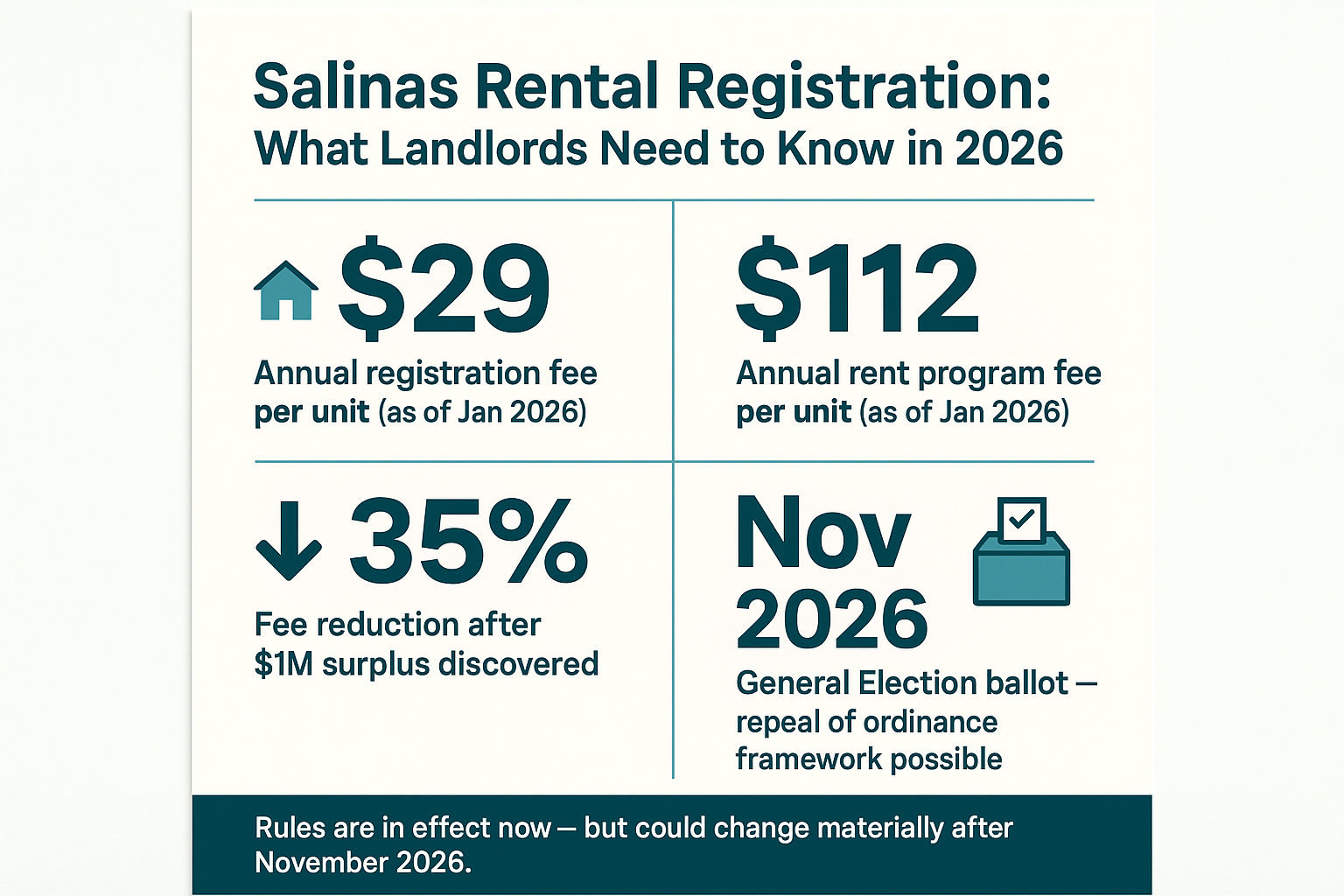
What Happens When You Already Have a Tenant and Want to Hand Things Over
A large share of Salinas owners who reach out to a property manager aren't starting from zero. Many already have a tenant in place — sometimes one who's been there for years — and they're trying to figure out whether a mid-tenancy transition is even possible without disrupting the relationship.
One caller described over two years of self-managing a North Salinas single-family home and wanting to understand the cost and process of bringing in professional management with a current tenant still living there. That situation is more common than most owners expect, and it's less disruptive than most fear.
Here's what typically happens in the first 30 days of a mid-tenancy handover:
- Notice is sent to the tenant introducing the management company as the new point of contact for rent, maintenance, and communication
- Existing lease documents are reviewed for any terms that conflict with current California law or that need to be updated at the next renewal
- A property inspection is scheduled to establish a baseline condition record
- Rent payment instructions are updated so rent flows through the new system from the next due date forward
- Owner financial reporting begins — monthly statements, not quarterly check-ins
Most tenants adapt quickly. They often prefer having a dedicated point of contact over texting an owner directly. And for owners, the relief is immediate — one person to call, one portal to check, one statement to review each month.
If you're weighing whether this is worth doing at all, Do Property Managers Really Increase Profit, or Just Maintain the Property? breaks down the economics honestly.
Self-Management vs. Full-Service Management: What Changes Day-to-Day
This isn't about which option is better in the abstract — it's about what each one actually looks like in practice for a Salinas rental owner.
| Task | Self-Managing Owner | Full-Service Manager |
|---|---|---|
| Rental pricing before listing | Owner estimates based on gut or Zillow | Market analysis using current Salinas comparables by submarket |
| Tenant screening | Owner reviews applications, may miss red flags | Full credit, background, income, and rental history verification |
| Lease compliance | Owner tracks state and city rules independently | Lease drafted and updated to reflect current CA law and Salinas requirements |
| Maintenance coordination | Owner fields calls, finds vendors, follows up | 24/7 emergency coordination, vendor relationships, documented follow-through |
| Financial reporting | Owner tracks income/expenses manually | Monthly owner statements, year-end summaries, payment of owner obligations |
| Regulatory changes | Owner monitors city council actions independently | Manager tracks Salinas ordinance changes and adjusts as rules evolve |
Why Local Knowledge and Language Capability Are Harder to Replicate Than Software
A lot of property management companies offer an online portal. That's table stakes in 2026 — it doesn't tell you anything meaningful about how a property will actually be managed.
What's harder to replicate is 25 years of working the Salinas and Monterey County market — knowing which vendors show up when they say they will, which neighborhoods are trending in rental demand, and what a reasonable repair cost actually looks like versus what a vendor is hoping to charge.
In Salinas specifically, bilingual English/Spanish management isn't a minor feature. A large portion of the rental population in Salinas is Spanish-speaking, and that affects everything from how a lease gets explained to a new tenant, to how a maintenance issue gets reported and resolved. When communication breaks down because of language, small problems become expensive ones.
Owners who've worked with large out-of-area property management companies often describe the same experience: a portal that works fine, and a management team that doesn't know their neighborhood, their tenant base, or the local compliance environment. What Landlords Often Overlook When Choosing a Property Management Company gets into this in more detail — it's worth reading before you make a final decision.
And if you're managing multiple Salinas units and want a clearer picture of what apartment-level management looks like specifically, Master Apartment Property Management Salinas is a useful companion read.
Frequently Asked Questions About Salinas Property Management
How much does property management cost in Salinas?
Management fees vary based on the number of units, the scope of services, and the company you choose. In Monterey County generally, monthly management fees often fall somewhere in a percentage range of gross monthly rent, with additional fees for tenant placement and lease renewals. Because pricing depends heavily on your specific property and situation, it's worth getting a direct quote rather than assuming a number from a general source.
Do I have to register my rental property with the City of Salinas?
Yes — as of 2026, Salinas requires landlords to register rental units annually under the city's Residential Rental Registration program. Current fees are approximately $29 per unit for registration and $112 for the rent program fee, though those numbers were reduced in January 2026 and should be confirmed with the city directly. The program's future is uncertain: a repeal measure is on the November 2026 General Election ballot, but the rules are in effect right now and non-compliance carries penalties.
Can I switch to a property manager if my tenant is already living there?
Yes, and it's more straightforward than most owners expect. A manager typically sends a formal notice introducing themselves as the new point of contact, reviews the existing lease, schedules a baseline property inspection, and transitions rent collection — all within the first 30 days. Most tenants adapt quickly and often prefer having a dedicated management contact over reaching the owner directly.
How do I know what rent to charge for my Salinas property?
There's no single answer — pricing depends on your specific neighborhood within Salinas (North vs. South carry different ranges), bedroom count, condition, furnishing status, and what comparable properties are actively renting for right now. A professional manager pulls current market data and runs a pricing analysis before the property is listed, not after it's been sitting vacant.
Does it matter whether a property manager speaks Spanish in Salinas?
In Salinas, yes — it matters more than most owners initially realize. A significant portion of tenants in Salinas are Spanish-speaking, and clear bilingual communication affects lease clarity, maintenance reporting, and how quickly problems get resolved. Language barriers tend to slow down the kind of routine communication that keeps small issues from becoming expensive ones.
Ready to Talk Through What Your Salinas Property Actually Needs?
Torrente Properties has managed residential rentals across Salinas and Monterey County for over 25 years — including mid-tenancy transitions, multi-unit portfolios, and properties where the owner lives hours away. If you'd like to talk through your specific situation, our team is reachable by phone at (831) 582-8916 or through the contact form at torrenteproperties.com. No pressure — just a real conversation with someone who knows this market.

What Salinas Landlords Wish They Knew Before Renting Their First Property
Most people who become landlords in Salinas don't plan on it. They inherited a house, relocated for work, or decided to hold onto a property instead of selling in a slow market. Then reality hits — and it usually hits fast.
Salinas is one of Monterey County's most active rental markets, with demand driven by agriculture workers, families, and service industry employees who make up the backbone of the local economy. But that demand doesn't make self-managing easy. California's landlord-tenant laws are among the most tenant-protective in the country, and Salinas has its own local rules layered on top.
The landlords who struggle most aren't bad at managing property — they just didn't know what they were getting into. These are the things they wish someone had told them before they handed over the first key.
California Law Changed in 2024 — And It Affects Every Salinas Landlord
As of July 1, 2024, California capped residential security deposits at one month's rent for most landlords. If you were counting on collecting first month, last month, and a full security deposit upfront, that plan no longer works for most properties.
This matters a lot in Salinas, where a typical two-bedroom rental runs $1,800–$2,200 per month. Under the old rules, a landlord might collect $4,000–$6,000 at move-in as a financial buffer. Now the maximum security deposit is capped at one month — meaning your buffer for damages, unpaid rent, or cleaning is significantly smaller.
The one exception: landlords who own two or fewer residential properties and fewer than four total rental units may still collect up to two months' rent as a deposit. But you need to verify your situation carefully, because misapplying this exception creates legal exposure.
Beyond the deposit cap, California law controls:
- How and when you can raise rent on qualifying properties (AB 1482)
- Legally required notice periods before entry
- The specific conditions under which you can terminate a tenancy
- How security deposit itemizations must be documented and returned
Ignoring any of these — even accidentally — can result in penalties that cost far more than whatever you saved by skipping professional guidance.
Salinas Has Its Own Rental Registration Requirement
State law is just the baseline. The City of Salinas operates a Residential Rental Registration program that requires landlords to register rental properties with the city. This applies to single-family homes, duplexes, and multi-unit buildings.
Failing to register doesn't just mean a fine. In some cases, it can affect your ability to collect rent or pursue eviction proceedings. It's the kind of administrative detail that seems minor until it becomes a serious problem.
If you're an out-of-area owner managing a Salinas property remotely, this is especially easy to miss. The city sends notices to the property address — not necessarily to you — and renewal deadlines come around without much fanfare.
This is one reason renting out your Salinas house when you're not around creates problems that don't exist when you're local. Local oversight matters for compliance, not just maintenance.

Tenant Screening Is Where Most First-Time Landlords Make Their Biggest Mistake
Choosing a tenant feels simple until you've done it wrong once. The cost of a bad placement — unpaid rent, property damage, a contested eviction — can easily run $8,000–$15,000 when you add up lost rent during vacancy, legal fees, repairs, and re-leasing costs.
In Salinas, the rental pool is competitive and moves fast. That creates pressure to fill a vacancy quickly, and that pressure is exactly where landlords cut corners on screening.
A solid screening process includes:
- Full credit report review (not just a score)
- Verified employment or income documentation at 2.5–3x monthly rent
- Rental history check with actual calls to previous landlords — not just references the applicant provides
- Criminal background check through a compliant, FCRA-authorized service
- Consistent written criteria applied the same way to every applicant
That last point is not optional. California's Fair Housing Act and Unruh Civil Rights Act set strict rules on which criteria you can use and how you must apply them. If you reject one applicant for a reason you didn't apply consistently to others, you're exposed.
The written criteria piece is something many landlords overlook when evaluating management options — documentation protects you if a rejected applicant ever files a complaint.
Good screening also means understanding Salinas's tenant base. A large portion of renters work in agriculture or food processing — stable employment, but often paid in ways that require extra documentation. A rigid income verification process that doesn't account for this will cost you qualified tenants.
The Real Cost of One Bad Tenant Placement in Salinas
This breakdown shows what a single bad tenancy can actually cost a Salinas landlord when everything goes wrong.
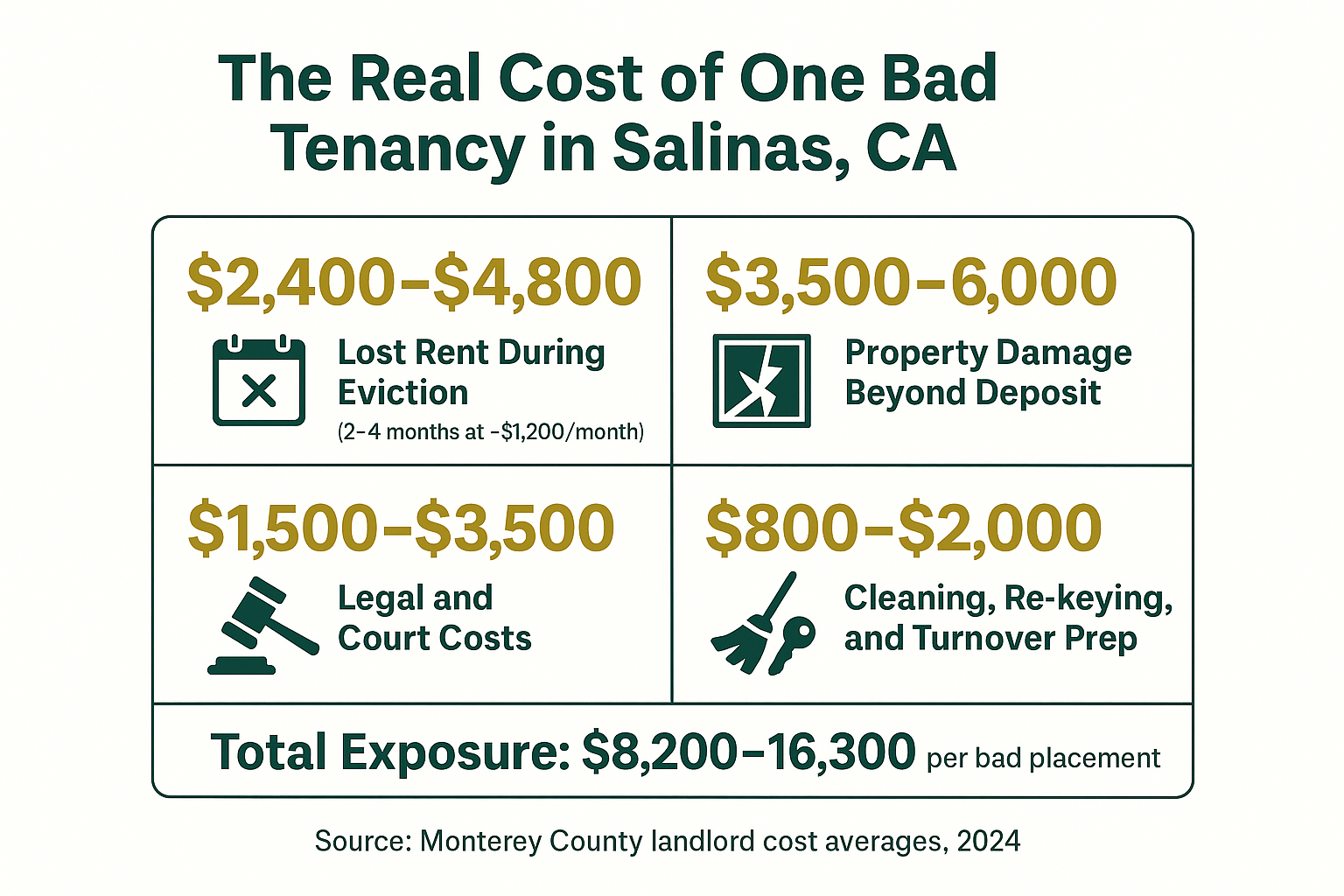
What the Lease Actually Needs to Cover
A lease you downloaded from the internet is not a California-compliant lease. California requires specific disclosures, addenda, and clauses that generic templates simply don't include — and missing them can void provisions you actually need.
For Salinas rentals specifically, a well-drafted lease should address:
- Mold and ventilation disclosures (required under California Civil Code § 1941.7)
- Pest control responsibilities — especially relevant in older Salinas housing stock
- Lead paint disclosures for properties built before 1978 (federal requirement)
- Rent increase notice requirements under AB 1482 if your property is covered
- Entry notice — California requires 24 hours written notice for non-emergency entry
- Maintenance request procedures and tenant obligations to report problems promptly
The lease also needs to spell out what happens at move-out — specifically how and when the security deposit will be returned, and what documentation you'll use to support any deductions.
California gives landlords 21 days after move-out to return the deposit or provide an itemized accounting with receipts. Miss that deadline and you can lose the right to make deductions entirely, even for legitimate damage.
Salinas Landlord Compliance Quick Reference
These are the key rules and deadlines Salinas landlords need to track. Local requirements stack on top of state law — knowing both matters.
| Requirement | What It Covers | Key Detail |
|---|---|---|
| Security Deposit Cap | Maximum deposit allowed at move-in | 1 month's rent for most landlords (2 months if you own ≤2 properties, <4 units total) |
| Salinas Rental Registration | City registration of all residential rentals | Required before renting; annual renewal; fines for non-compliance |
| AB 1482 Rent Control | Annual rent increase limits on qualifying properties | Cap of 5% + local CPI, or 10% max; exemptions apply for newer construction |
| Security Deposit Return | Deadline to return deposit or provide itemization | 21 calendar days after move-out with itemized statement and receipts |
| Entry Notice | Minimum notice before landlord enters | 24 hours written notice required; exceptions for emergencies only |
| Mold Disclosure | Required disclosure at lease signing | Must disclose known mold; tenant has right to habitable conditions |
Maintenance Isn't Optional — and Deferred Repairs Become Your Liability
California's implied warranty of habitability means your tenant has the legal right to a property that is safe, weatherproof, and functional — regardless of what your lease says. If something breaks and you don't fix it in a reasonable time, tenants can withhold rent, repair-and-deduct, or pursue damages.
In Salinas, where a lot of the rental housing stock is older — many homes date to the 1940s–1960s — plumbing issues, roof leaks, and electrical problems are common. The winters in the Salinas Valley can be rainy and cold, and properties that aren't properly maintained going into the season tend to produce expensive surprises. Our team has written about getting Monterey Bay rental properties ready for heavy rain seasons and the same issues apply in Salinas.
First-time landlords often make two mistakes here:
Mistake 1: Waiting for the tenant to report problems. Tenants don't always report small issues — a slow drain, a minor roof leak, a faulty HVAC filter. By the time it becomes obvious, it's a much bigger repair.
Mistake 2: Using the cheapest vendor. Salinas has plenty of handymen who will charge $150 and fix a symptom without solving the cause. A licensed plumber who charges $350 and actually resolves the issue is the better investment.
Routine inspections — typically twice a year for occupied rentals — are the best way to catch problems before they escalate. They also create documentation that protects you if a tenant later claims damage existed before they arrived.
Frequently Asked Questions from First-Time Salinas Landlords
Do I have to register my rental property with the City of Salinas?
Yes. Salinas requires landlords to register residential rental properties through the city's Residential Rental Registration program. This applies to single-family homes and multi-unit buildings. Unregistered properties can face fines, and in some cases, non-registration can complicate eviction proceedings.
How much can I charge for a security deposit in Salinas right now?
As of July 1, 2024, the cap is one month's rent for most landlords. If you own two or fewer residential rental properties with fewer than four total units, you may collect up to two months. Collect more than you're allowed and you expose yourself to penalties.
What happens if my tenant stops paying rent?
You start with a 3-Day Notice to Pay Rent or Quit. If they don't comply, you file an unlawful detainer (eviction) lawsuit in Monterey County Superior Court. From first missed payment to physical possession, the process typically takes 6–12 weeks if uncontested — longer if the tenant fights it. California's courts are tenant-friendly, which is why solid screening upfront matters so much.
Can I raise the rent whenever I want?
Probably not. If your property is covered by AB 1482 — which applies to most buildings older than 15 years that aren't single-family homes owned by individual landlords — annual increases are capped at 5% plus local CPI or 10% total, whichever is lower. You also need proper written notice. Check whether your specific property qualifies for an exemption before assuming you can raise rent freely.
Is it worth hiring a property manager for just one rental in Salinas?
For many owners, yes — especially if you're not local or don't have experience with California landlord-tenant law. A professional manager typically charges 8–12% of monthly rent in Salinas. When you weigh that against your time, the cost of a compliance mistake, or the financial hit from a bad tenant placement, the math often works in favor of professional management. When a Salinas property actually needs a manager depends on your situation, but first-time landlords are among the highest-risk group for costly self-management errors.
What should I do at move-out to protect my deposit deductions?
Document everything with timestamped photos and video at move-in and again at move-out. Use a written move-in checklist signed by the tenant. Keep receipts for every repair. You have 21 calendar days after move-out to return the deposit or provide an itemized accounting — missing that window can eliminate your right to deductions entirely, even for real damage.
Questions About Your Salinas Rental Property?
Torrente Properties has been helping landlords across Monterey County — from Salinas to Pacific Grove to Marina — understand what they're getting into and manage it well. If you're a first-time landlord or considering stepping back from self-managing, our team is happy to talk through your specific situation. Reach us at (831) 582-8916 or through the contact form at torrenteproperties.com.